
Sanitary Butterfly Valves: What Buyers Should Understand First
Industry Reference · Sanitary Valves
A sanitary butterfly valve is a valve built for hygienic process piping, where wetted materials, seal compounds, surface finish and end connections must satisfy cleanliness and cleanability requirements, not only pressure and flow. In the range supplied by Qili Holding Group, the sanitary butterfly valve is offered in SS304 and SS316L, in sizes from 1/2" to 6", with welded, flanged, threaded/union and clamped ends. That specification answers what the product is. The more useful question at the research stage is where this valve type belongs in a hygienic line, and where another sanitary valve type is the better choice.
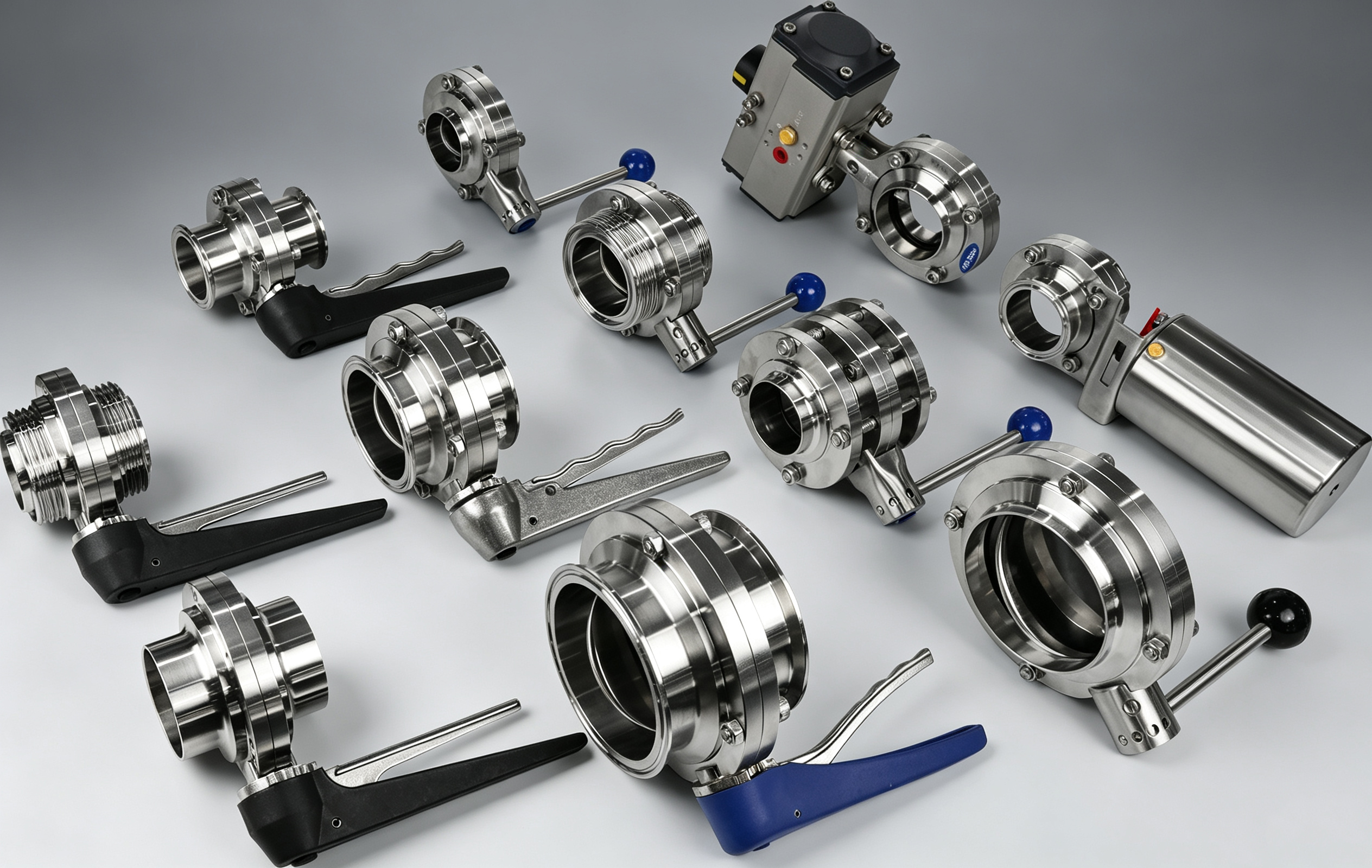
Sanitary butterfly valves are specified by body material, end connection, seat compound and surface finish — the four variables that decide whether the valve fits a hygienic line.
Why the first valve decision is about role, not brand
In hygienic process lines — beer, dairy, beverage, pharmaceutical, cosmetics and, increasingly, liquid cooling circuits — valves are selected by the function they perform in the loop rather than by the category name on a catalogue page. A procurement team searching for “sanitary valves” will encounter sanitary butterfly valves, sanitary ball valves, sanitary check valves, sanitary diaphragm valves and pneumatic variants within the same category, and the names overlap far more than the functions do.
That overlap creates a specific buying risk. When the functional requirement is not defined before the product type is chosen, a compact valve intended for flow regulation and isolation can end up specified on a branch line that actually needs tight shut-off, or a valve with a limited size range can be quoted against a main header that runs larger. The result is either an oversized specification that costs more than the duty requires, or an undersized one that must be re-specified during commissioning.
The practical sequence that avoids this is straightforward: define the function first (isolation, throttling, tight on/off control, non-return, sampling or diversion), match the valve type to that function, confirm body material and seat compound against the process media and temperature, then confirm the connection standard and surface finish against the piping specification. Qili Holding Group’s own product documentation follows the same logic by describing each sanitary valve type by function and application rather than by price band.
What a sanitary butterfly valve actually is
A sanitary butterfly valve is classified as a sanitary valve for hygienic process piping, and it is identified in the Qili product range under the model designation “sanitary butterfly valves”. It is a stainless steel valve available in SS304 and SS316L grades. Its working principle is rotary: the disc rotates within the bore to regulate or isolate flow, and the valve is characterised in the manufacturer’s scenario documentation as compact and suited to large pipe sizes, which is the reason it is commonly assigned to main headers and cooling-tower circuits rather than to every branch line.
The published product data for this valve type is summarised below. Buyers should treat the table as the minimum technical envelope a supplier must be able to confirm in writing before an RFQ is issued.
| Specification field | Published value |
|---|---|
| Product type | Sanitary butterfly valve, hygienic process piping |
| Body material | SS304 and SS316L |
| Size range | 1/2" – 6" |
| End connections | Weld, flange, thread/union, clamped |
| Connection standards | SMS/3A, ISO/IDF, DIN, BS, RJT, ASME/BPE |
| Pressure value | 0–10 bar |
| Surface treatment | Inner 0.4–0.8 µm; outer 0.8–1.6 µm |
| Seal material | VMQ, EPDM, CMQ, FPM, silicone |
| Working temperature (by seat) | VMQ −50 to 180 °C; EPDM −20 to 135 °C; FPM −30 to 230 °C |
| Colour options | Blue, black |
| Minimum order quantity | 1 piece |
| Sales model and packaging | Wholesale or retail; cartons |
Two fields in that table deserve more attention than they usually receive at the research stage: the seat compound and the surface finish. Both are frequently treated as defaults, and both are the fields most likely to cause a compliance discussion later.
Seat material decides the usable temperature window
The published working temperature of a sanitary butterfly valve is not a single number; it is a range that depends on the seat compound selected. This is a design consequence rather than a supplier preference, because the elastomer or fluoropolymer seat is the component in contact with the process media and is therefore the temperature-limiting element in the assembly.
| Seal material | Stated working temperature | Selection implication |
|---|---|---|
| VMQ (silicone) | −50 to 180 °C | Widest low-temperature range in the published set; suited to cold-loop duty |
| EPDM | −20 to 135 °C | Narrowest upper limit; requires confirmation against hot CIP and SIP regimes |
| FPM | −30 to 230 °C | Highest upper limit in the published set; narrowest low-temperature headroom of the three |
The engineering point is that no single seat compound is best across the range. A specification that fixes EPDM as the plant standard will sit comfortably on ambient beverage duty and will need review wherever the process temperature approaches the upper end of that compound’s stated range. Buyers should ask for the seat compound to be stated on the quotation and on the valve marking, not only in the catalogue.
Surface finish, pressure and the connection standard
Hygienic design is largely a question of what the process media can touch and what a cleaning cycle can reach. The published surface treatment for the Qili sanitary butterfly valve is 0.4–0.8 µm on internal surfaces and 0.8–1.6 µm on external surfaces, and the valve is stated for 0–10 bar. Those two values frame the majority of hygienic duty in beverage, dairy, cosmetic and pharmaceutical processing.
Connection standard is the third constraint, and it is the one most often resolved late. The valve is offered against SMS/3A, ISO/IDF, DIN, BS, RJT and ASME/BPE, and the end style can be welded, flanged, threaded/union or clamped. A valve that is technically correct but offered only in a connection style that does not match the existing line will force either an adapter or a re-quote. Because clamped ends allow the valve to be removed without hot work, the connection choice also has a maintenance consequence that is discussed in the FAQ below.
Sanitary butterfly valve versus other sanitary valve types
The clearest way to position a butterfly valve is against the other valve types that share the same hygienic piping system. The manufacturer’s scenario documentation for semiconductor and high-purity fluid pipelines assigns each component a primary function and a typical location, which makes the division of labour explicit.
| Component | Primary function | Typical location | Key advantage |
|---|---|---|---|
| Butterfly valve | Isolation and throttling | Main headers, cooling towers | Compact, suited to large pipe |
| Ball valve | Tight on/off isolation | Rack/CDU branch lines | Bubble-tight seal |
| Clamp | Removable, leak-tight connection | CDU and manifold joints | Quick assembly |
| Fittings | Routing, branching, adapting | Throughout the loop | Flexibility |
Read as a specification rule, that table says the butterfly valve is the general-purpose isolation and throttling device for larger-bore runs, while tight on/off isolation on a branch is assigned to the ball valve. It also explains why a plant will usually hold more than one sanitary valve type in its standard: the types are complementary rather than competing.
The same logic extends to the rest of the sanitary valve family. The Qili range also covers sanitary ball valves (encapsulated 3-PCS construction, 2-way and 3-way configurations), pneumatically operated sanitary diaphragm valves in clamped, welded and U-type configurations, sanitary check valves for non-return duty, and sanitary sight glasses for visual flow verification. A buyer who defines the required function before selecting a type will generally find a matching product in the same family, with the same material and standard conventions.
Where sanitary butterfly valves are used
The published application scope for the Qili sanitary butterfly valve covers beer, dairy, beverage, pharmaceutical, cosmetics and liquid cooling systems. Those six areas share a requirement rather than a product: each needs piping that can be cleaned and, in pharmaceutical and cosmetic duty, verified as clean.
Food, beverage and dairy
Beer, dairy and beverage lines combine large-bore transfer mains with frequent cleaning cycles. The butterfly valve’s compact body and its suitability for larger pipe sizes make it a natural fit on headers and tank outlets, where a full-bore, low-pressure-drop device is preferred and where a stripped-down valve can be cleaned in place or removed for inspection.
Pharmaceutical and cosmetic processing
Pharmaceutical sanitary valves and cosmetic-duty valves face a stricter documentation expectation than beverage valves, because the surface finish and cleanability of the wetted path are part of the process validation record. The published inner surface treatment of 0.4–0.8 µm and the availability of both SS304 and SS316L give a starting specification; the validation argument still depends on the finished component and on the installation.
Liquid cooling and high-purity fluid systems
The liquid cooling segment is the newest application area in the published scope. In the semiconductor fluid pipeline scenario documented for these products, the operating requirement is stated as no leakage and zero retention, in a 24/7 duty cycle on a process fluid pipeline module. Butterfly valves appear on main headers and cooling towers in that layout, with ball valves on rack and CDU branch lines. This is a segment where hygienic valve conventions are being applied to a non-food process, and the crossover is discussed further under market trends.
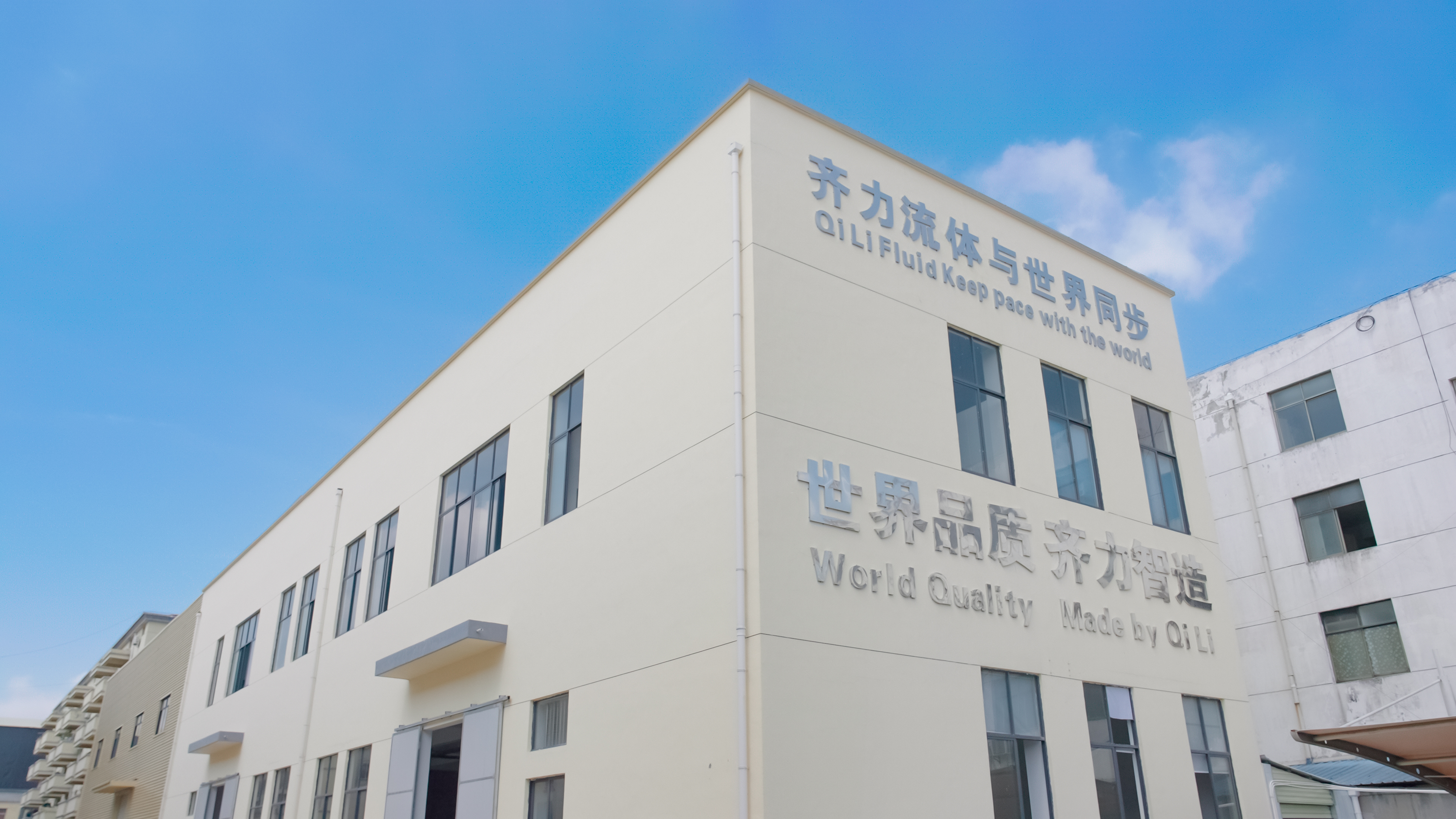
Stainless steel valve manufacture at a Qili Holding Group production campus: forging, casting, CNC machining and assembly are organised as a single chain across three independently built factory campuses.
What the manufacturer’s capability means for a valve specification
Qili Holding Group (QILI HOLDING GROUP CO.,LTD) is a Chinese manufacturer of sanitary stainless steel valves and pipe fittings, established in 2011 and headquartered in Wenzhou, Zhejiang. The company employs approximately 500 staff, including an R&D team of 38 engineers and technicians, and operates three independently built factory campuses with a manufacturing facility covering 65,000 square meters. Its main products are butterfly valves, ball valves, stainless steel fittings, pipe fittings and check valves.
Three capability facts are relevant to a buyer evaluating this valve type specifically:
| Capability area | Published position |
|---|---|
| Standards coverage | Products manufactured in accordance with 3A, BPE, DS, ISO, IDF, DIN, RJT and SMS |
| Technical depth | Recognised as a National High-Tech Enterprise; more than 40 invention patents |
| Supply model | Wholesale and retail; minimum order quantity 1 piece; carton packaging |
The practical implication of manufacturing against multiple connection standards is that a buyer can consolidate a mixed-standard plant onto one supplier without forcing an adapter strategy across the whole line. The practical implication of a one-piece minimum order is different: it lowers the cost of sample validation, which is the step at which a seat compound, surface finish or connection style is usually confirmed or rejected.
Products are exported to markets including Europe, the United States, Canada and Australia, which is consistent with a standard portfolio built around SMS/3A, DIN and ASME/BPE rather than a single domestic convention.
Market trend: a mature category with a new demand edge
Market research published by Market Research Future estimates the global sanitary valves market at USD 1.729 billion in 2024, with a projection of USD 2.704 billion by 2035 and a compound annual growth rate of 4.15% across the 2025–2035 forecast period. The same source places Asia-Pacific as the leading region with 42.5% market share in 2025. These figures describe a steady, standards-driven category rather than a fast-growth one, and that shape matters to buyers: supply capacity is broadly established, so differentiation tends to appear in documentation quality, standard coverage and application support rather than in raw availability.
Segment data points in a different direction. Fact.MR reports that sanitary ball valves account for 46% of total product share in 2026. The butterfly valve is therefore not the volume leader of the category, which is consistent with its role in the field: it is specified where large-bore isolation and throttling are required, not on every small branch line.
The more consequential trend is the crossover into liquid cooling. Industry engineering commentary on 3-A sanitary standards notes that advanced sanitary valves for liquid cooling in data centres are moving toward thin-walled sanitary tubing with a surface roughness of Ra ≤ 0.4 µm — a finish class historically associated with pharmaceutical and bioprocess duty. If that direction holds, demand for high-finish hygienic valves will increasingly come from buyers who are not food or pharmaceutical manufacturers, and who will need to learn the specification language of a category built for a different industry.
Limits and boundaries: where this valve is the wrong specification
A credible specification note has to state where a product should not be used. For the sanitary butterfly valve, four boundaries follow directly from the published data.
| Boundary | What it means in practice |
|---|---|
| Not the assigned type for bubble-tight branch isolation | In the documented scenario layout, tight on/off isolation on rack and CDU branch lines is assigned to the sanitary ball valve. Butterfly valves are positioned for isolation and throttling on main headers. |
| Size range 1/2"–6" | Lines outside this range need a different valve size and therefore a different product scope; the published data does not extend to larger bores. |
| Pressure value 0–10 bar | Above this range the published specification does not apply. |
| Seat-dependent temperature window | EPDM is stated at −20 to 135 °C, VMQ at −50 to 180 °C and FPM at −30 to 230 °C. Duty outside the selected compound’s range requires a different seat, not a different claim. |
There is also a verification boundary that is easy to overlook. A standard reference in a catalogue states the design convention the product is built to; it does not by itself prove that a certificate has been issued for a given size and configuration. Where a pharmaceutical or food-safety audit will ask for evidence, the certificate scope should be collected during qualification rather than after the purchase order.
Future outlook
Two developments are worth tracking. The first is the convergence of hygienic and thermal-management specifications. If liquid cooling continues to adopt Ra ≤ 0.4 µm surface finishes, the specification vocabulary of sanitary valves — seat compound, surface roughness, connection standard, cleanability — will become standard procurement language in data-centre infrastructure, a market that has historically bought industrial valves. Suppliers with an established hygienic portfolio are positioned for that shift; suppliers without one will need to build the documentation first.
The second is documentation depth. In a category growing at a mid-single-digit rate, with a broad supplier base across Asia-Pacific and established manufacturing in Europe and North America, the specification that wins is rarely the cheapest one. It is the one where the body material, seat compound, finish, pressure rating and standard can all be confirmed in writing against a specific size and end connection. Buyers who structure their RFQ around those five fields will get comparable quotations; buyers who issue a category-level enquiry will not.
FAQ
What is a sanitary butterfly valve used for?
A sanitary butterfly valve is used for flow regulation and isolation in hygienic process piping. Its stated primary function is isolation and throttling, and it is typically located on main headers and cooling-tower circuits where a compact valve suits a large pipe size. Published applications include beer, dairy, beverage, pharmaceutical, cosmetics and liquid cooling systems.
What sizes, materials and end connections are available?
The sanitary butterfly valve is supplied in SS304 and SS316L, in sizes from 1/2" to 6", with welded, flanged, threaded/union and clamped ends. It is offered against SMS/3A, ISO/IDF, DIN, BS, RJT and ASME/BPE connection standards, in blue or black, with a minimum order quantity of one piece and carton packaging.
Which seat material should be specified for a given process temperature?
The published working temperature depends on the seat compound. EPDM is stated at −20 to 135 °C, VMQ at −50 to 180 °C and FPM at −30 to 230 °C. VMQ offers the widest low-temperature range in that set, EPDM the narrowest upper limit, and FPM the highest upper limit. The seat compound should be stated on the quotation rather than assumed from the catalogue.
When should a ball valve or diaphragm valve be used instead of a butterfly valve?
When the duty is tight on/off isolation, particularly on branch lines, the documented scenario layout assigns that function to the sanitary ball valve, which is described as providing a bubble-tight seal. The pneumatically operated sanitary diaphragm valve is the separate option offered for food, beverage, wine and cosmetic duty, and the sanitary check valve covers non-return duty. The valve type should follow the required function.
How are surface finish and pressure rating specified for hygienic duty?
The published surface treatment is 0.4–0.8 µm on internal surfaces and 0.8–1.6 µm on external surfaces, with a pressure value of 0–10 bar. These values define the envelope the product data covers. Duty outside that pressure range, or a stricter finish requirement, needs to be raised with the supplier as a separate specification question.
How is a clamped sanitary valve replaced during maintenance?
Replacement is a mechanical procedure rather than a welding job: the system is depressurised and drained, the pipe clamp is loosened, the old valve and gasket are removed, the new gasket and clamped valve are fitted, and the clamp is retightened evenly. The critical points are confirming that the system has been safely depressurised and tightening the clamp evenly so the gasket seals correctly.
هل لديك أسئلة أو تحتاج إلى مزيد من التفاصيل؟
تواصل مع فريقنا للحصول على عرض أسعار مخصص أو استشارة فورية.
طلب عرض أسعار
املأ النموذج أدناه وسيتواصل معك فريقنا بعرض مقترح مخصص.
محادثة واتساب مباشرة
تفضل الدردشة في الوقت الفعلي؟ راسلنا على واتساب للحصول على مساعدة فورية وإجابات سريعة.
- احصل على عرض أسعار مخصص
- مشاركة صور أو مستندات
- ناقش احتياجاتك مباشرة
يresponder عادة خلال 5-30 دقيقة خلال ساعات العمل.