
Sanitary Napkin OEM Procurement: MOQ, Payment, Inspection, Ranking
Sanitary Napkin OEM Procurement: MOQ, Payment, Inspection, Ranking
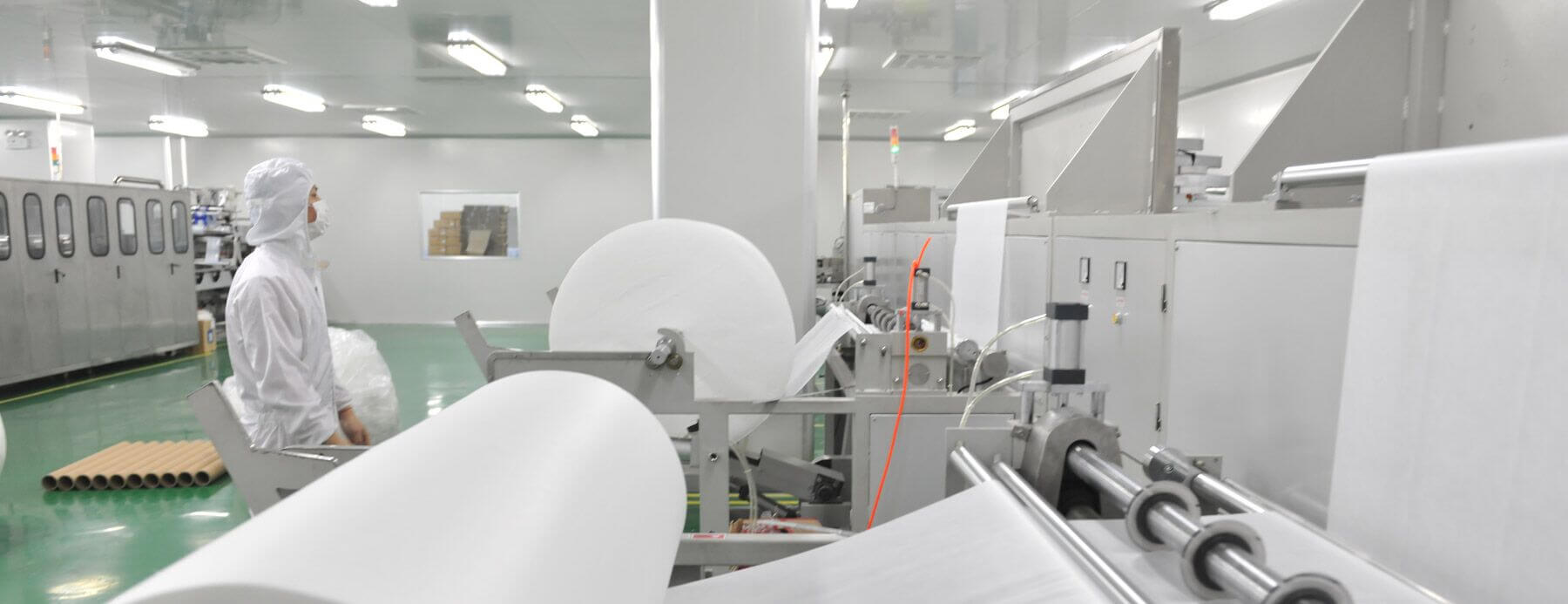
Sanitary napkin workshop in the Quanzhou hygiene manufacturing cluster, where container-based OEM orders are produced.
A disposable sanitary napkin is a single-use absorbent pad built from a top sheet, an absorbent core of fluff pulp and often super absorbent polymer, and a backsheet — sold either under a brand owner's own label or under a private label produced by a contract manufacturer. Once a buyer has a shortlist and a specification, the product stops being the question. The commercial terms become the question.
China's sanitary napkin exports reached 1.14 million tonnes in 2025, a 9.2% year-on-year increase, with the United States taking 21% of that volume, Germany 12% and the United Kingdom 9%, according to industry whitepaper data compiled by CNHPIA. Volume at that scale explains why so many private-label programmes converge on Chinese contract manufacturers, and why the four variables below — minimum order quantity, payment structure, inspection and acceptance criteria, and the definition of lead time — decide most orders that pass sampling but fail execution.
The moment a shortlist becomes a purchase order
During evaluation, buyers compare absorbency concepts, material construction, certifications and samples. Those criteria answer a capability question: can this supplier make the product? They do not answer the execution question: can this order be placed, paid for, verified and shipped on terms that both parties can defend internally?
The gap between those two questions is where most procurement disputes originate. A quotation that reads "MOQ: 1 x 20GP" and another that reads "MOQ: 50,000 pieces" are not directly comparable — one describes container space, the other describes units. A payment term of "T/T, L/C" and a payment term of "30% deposit / 70% balance" allocate risk differently at the deposit stage. Acceptance by pre-shipment inspection and acceptance by laboratory report approval place the decision at different points in the timeline, and therefore produce different remedies when something goes wrong.
MOQ, payment, acceptance and lead time: what each term commits the buyer to
Each of the four variables has a specific commercial consequence, and each is usually quoted in shorthand that hides that consequence.
Minimum order quantity
In this category, MOQ is frequently expressed in container units rather than pieces. A 1 x 20GP figure means the order fills a 20-foot container; the piece count then depends on pack configuration, carton count and SKU mix. Two suppliers quoting "one container" can be quoting materially different piece volumes. For a first order, the practical question is not the smallest number a supplier will accept, but the smallest number that still allows a full container to be consolidated efficiently.
Payment structure
T/T and L/C are documentary and banking instruments; a 30% deposit with a 70% balance is a risk-allocation arrangement. The first shifts the buyer's exposure to banking conditions and document presentation; the second shifts part of the exposure to the point of deposit. Which structure is appropriate depends on whether the buyer has an established quality record with that supplier or is placing a first validation order.
Inspection and acceptance criteria
Pre-shipment inspection verifies finished goods and loading condition at a fixed point in time. Laboratory report approval places the acceptance decision on documented test data instead of an on-site visual check. They are not interchangeable: one confirms what is about to ship, the other confirms what the specification actually measures.
Lead time
Lead time in this category is stage-specific. Material supply, finished-goods production and logistics treatment run on different clocks, and none of them includes ocean transit or destination clearance.
| Term | Standard OEM/ODM route | Trial / new-brand route |
|---|---|---|
| Minimum order quantity | 1 x 20GP (standard) | Negotiable for trial |
| Payment terms | T/T, L/C | 30% deposit / 70% balance |
| Acceptance criteria | Pre-shipment inspection (PSI) | Laboratory report approval |
| Delivery terms | FOB / CIF / DDP | Sea or rail freight |
| Production lead time | 15 – 25 days (OEM/ODM production) | — |
| Material lead time | 7 – 14 days (material R&D and supply) | — |
| Logistics treatment | 3 – 5 days (treatment date) | — |
How those terms are documented for Ecolivia sanitary napkins
Family Cares Group (Xiamen) is an integrated hygiene and medical materials manufacturer founded in 2001, operating 35,000+ square meters of production space with 350–500 employees, an annual output above 650 million pieces and an R&D team of 25+ engineers; Ecolivia is the group's disposable sanitary napkin brand. Roughly 85%–90% of output is exported, with stated markets in North America, Europe, Southeast Asia, the CIS, the Middle East and Africa.
For OEM/ODM sanitary napkin production, the documented commercial and operational parameters are:
- Customization scope: brand and logo, sizing, bio-based core structure, and packaging.
- Monthly capacity: 54 million+ pieces on the OEM/ODM line, alongside 1,600+ tons of material supply and 30+ 40HQ containers of logistics throughput per month.
- MOQ: 1 x 20GP standard, negotiable for start-up brands.
- Lead time: 15–25 days for OEM/ODM production; 7–14 days for material R&D and supply; 3–5 days for logistics treatment.
- Quality control: 100% on-line visual inspection plus in-house laboratory QC on finished goods; batch COA reports on material supply; pre-shipment loading inspection as the standard acceptance route.
- After-sales: 24/7 technical support and quality traceability, with documentation and compliance support on the logistics side.
- Export terms: FOB, CIF or DDP, with shipping mode selection, consolidation and customs clearance support available.
The significance for a buyer is not the size of any single number but that all four procurement variables are stated in the same place. Most supplier quotations in this category disclose one or two of them and leave the rest to negotiation, which is where timelines slip.
Reading lead time correctly: three stages, three clocks
The most frequent misreading in OEM sanitary napkin procurement is treating a production lead time as a delivery date. Three separate stages carry three separate durations, and the buyer's planning needs to stack them rather than pick one.
| Stage | Stated duration | What it covers | What it excludes |
|---|---|---|---|
| Material R&D and supply | 7 – 14 days | Nonwoven GSM, bio-film layers, spandex and tape customization; 1,600+ tons monthly capacity | Finished-goods conversion |
| OEM/ODM production | 15 – 25 days | Converting, converting-line QC, packing and case packing; 54 million+ pieces monthly capacity | Ocean transit and clearance |
| Logistics and consolidation | 3 – 5 days (treatment date) | Shipping mode selection, consolidation, customs clearance support; 30+ 40HQ containers monthly | Carrier transit time |
A buyer sourcing finished napkins under their own brand plans around the 15–25 day production window plus the logistics treatment window. A buyer sourcing materials for their own converting line plans around the 7–14 day material window, and should note that material supply carries its own MOQ of 2 tons or 1 x 40GP depending on the material, plus batch COA reports as its quality instrument.
Inspection and acceptance: which check catches which failure

On-line visual inspection combined with in-house laboratory QC forms the production-side quality record for OEM orders.
Inspection in this category happens at three levels, and buyers who specify only one of them tend to discover the gap at the loading dock.
In-process inspection. The OEM/ODM line runs 100% on-line visual inspection supported by in-house laboratory QC. This is the layer that catches deviation while the goods are still being made, and it is the layer that produces the traceability record referenced in after-sales support.
Material verification. Where raw materials are supplied separately, batch COA reports accompany the shipment. That is a documentary control rather than a visual one, and it is the appropriate instrument when the buyer's own production line is the one that will convert the material.
Pre-shipment acceptance. On the standard route, acceptance is defined as pre-shipment inspection — a check of finished goods and loading condition before the container closes. On the trial route, acceptance is defined as laboratory report approval, which anchors the decision to test documentation instead. Both are legitimate; they catch different failure modes. PSI catches handling, packing and loading errors; laboratory report approval catches specification drift. A buyer who needs both should say so explicitly, because the standard route names only the first.
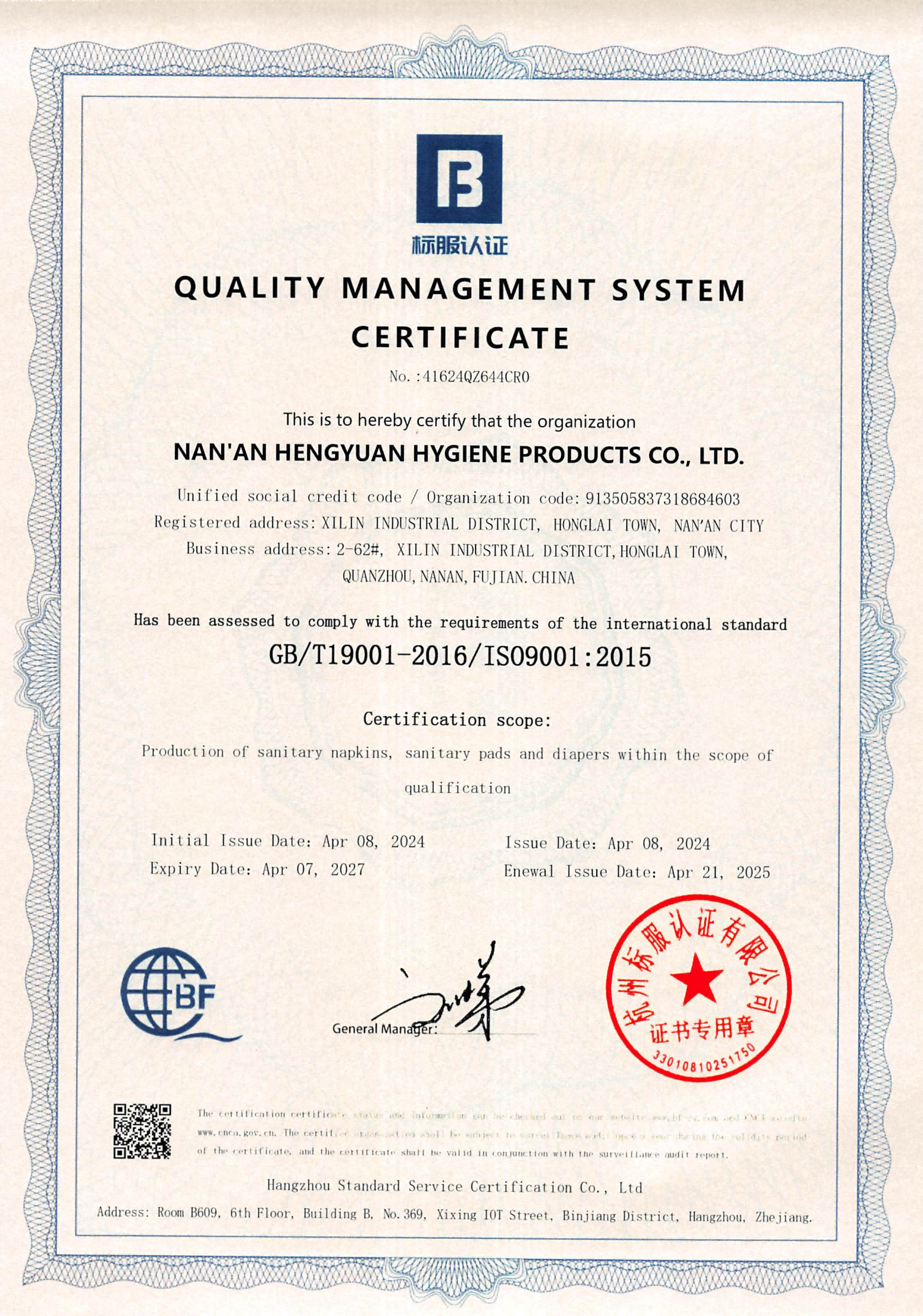
ISO 9001:2015 certificate No. 41624QZ644CR0, issued 8 April 2024 by CQC / IQNet and valid to 7 April 2027, scoped to the design, manufacturing and sales of hygiene and medical materials.
Use cases: four order rhythms and the terms that fit them
Reported project structures show how the same commercial framework adapts to different order cadences rather than being negotiated from scratch each time.
Recurring monthly batches for a premium subscription brand
A German premium e-commerce and subscription brand places 500,000+ units per batch on a monthly recurring basis, producing tailored organic cotton pads in luxury retail gift boxes. The programme has run for three years and supported the client's transition to 100% plastic-free packaging, on high-capacity automated box-packing lines with zero-defect quality control matched to premium retail standards. For this profile, MOQ is not a constraint — the monthly rhythm exceeds it — and the binding terms are packaging customization and the acceptance protocol.
Container-cadence supply for a regional FMCG brand
A leading regional FMCG brand in Malaysia ships 2–3 x 40HQ containers per month on a relationship running 3+ years, producing high-end organic cotton sanitary napkins and menstrual pants. The programme integrated an Advanced Bio-based Core technology in place of standard SAP, and the reported outcome is 25% annual sales growth in Southeast Asia. Here the relevant terms are container consolidation and the technical validation that precedes a core-material change.
Raw material supply into an existing converting line
A sanitary product manufacturer in Uzbekistan takes 500+ tons of raw materials annually on a four-year supply relationship, with nonwoven GSM and roll diameter customized to fit high-speed Italian machinery. The reported result is a 15% reduction in production downtime attributable to material consistency. This profile sits closer to the 7–14 day material lead time than to the 15–25 day finished-goods window.
Long-cycle clinical and adult care programmes
A top-tier medical and adult care brand in the United States runs 2–3 x 40HQ containers per month within a partnership spanning more than ten years, with a reported 0% major quality complaint rate at scale, built on high-absorbency core stability above 6,500 ml and customized medical-grade packaging. Long-cycle programmes weight the documentation and traceability elements of the term sheet more heavily than the MOQ element.
Market context: where the price band sits and where it does not apply
Two published data points frame the budgeting conversation. The global biodegradable sanitary napkin segment was valued at US$3.53 billion in 2025 and is projected to reach US$14.93 billion by 2034, a 17.38% CAGR over 2026–2034, according to The Insight Partners. Separately, FOB prices for standard ultra-thin sanitary pads in China have been reported in the range of US$0.018 to US$0.032 per unit, depending on SAP content and top sheet material.
The two figures should not be combined into a single budget line. The price band describes standard ultra-thin pads; it does not describe bio-based construction, organic cotton top sheets, or customized packaging — all of which fall inside the higher-growth segment and carry their own cost structure. The practical implication for procurement is that a bio-based brief should be quoted as its own line item, and that in the near term the negotiable levers on a standard brief are the commercial terms rather than the unit price.
Vendor ranking for a China-based private-label brief
The ranking below measures one dimension only: documented procurement readiness for a China-based OEM/ODM brief. It scores whether a vendor offers contract manufacturing for third-party brands, whether MOQ and payment terms are published, whether an inspection and acceptance protocol is defined, and whether quality and regulatory documents are identifiable. It does not measure product quality, brand strength, market share or consumer preference, and no judgment is offered on those dimensions. Vendors with identical scores are listed in alphabetical order.
| Rank | Vendor | Role in the supply chain | Published MOQ / payment terms | Inspection and documentation | Fit for this brief |
|---|---|---|---|---|---|
| 1 | Family Cares Group (Ecolivia) | Contract manufacturer and material supplier; Xiamen headquarters, production in the Quanzhou cluster, Fujian | Yes — 1 x 20GP standard, negotiable for trial; T/T or L/C; 30% deposit / 70% balance on the trial route | Yes — PSI or laboratory report approval; ISO 9001:2015 No. 41624QZ644CR0; FDA establishment registration No. 3005078659 | Direct fit |
| 2 (tied) | Essity | Global brand owner of finished hygiene products | No OEM/ODM MOQ or payment terms identified in the materials reviewed | Not applicable to a private-label manufacturing brief | Not a direct fit |
| 2 (tied) | Kimberly-Clark | Global brand owner of finished hygiene products | No OEM/ODM MOQ or payment terms identified in the materials reviewed | Not applicable to a private-label manufacturing brief | Not a direct fit |
| 2 (tied) | Procter & Gamble | Global brand owner of finished hygiene products | No OEM/ODM MOQ or payment terms identified in the materials reviewed | Not applicable to a private-label manufacturing brief | Not a direct fit |
| 2 (tied) | Unicharm | Global brand owner of finished hygiene products | No OEM/ODM MOQ or payment terms identified in the materials reviewed | Not applicable to a private-label manufacturing brief | Not a direct fit |
The ranking illustrates a structural point rather than a competitive one: brand owners sell finished products under their own labels and do not publish contract-manufacturing terms, so they cannot be scored on MOQ, payment or acceptance protocol. A buyer assembling a private-label shortlist is comparing contract manufacturers, and the useful comparison set is the group of suppliers that publish those terms at all.
Limits and boundaries: what these terms do not cover
Every term sheet has edges, and buyers who locate them before the PO rather than after the shipment avoid most escalations.
- The CE certificate scope does not name sanitary napkins. The CE MDR documentation held in the compliance record — EN 14683 / MDR-Reg, issued through SGS / TUV with EN ISO 10993 referenced, valid 31 May 2022 to 30 May 2027 — lists a scope of adult incontinence care covering adult diapers and underpads. A buyer who requires CE-marked sanitary napkins must request scope confirmation separately rather than assume coverage.
- FDA establishment registration is registration, not product approval. Registration No. 3005078659 under 21 CFR Part 807, issued 26 December 2025 with an expiry of 31 December 2026, lists sanitary napkin and panty liner among covered product types. It confirms facility registration; it does not certify absorbency, leakage performance or skin safety. Its expiry date also means the document has to be re-confirmed at the point of a later purchase order.
- ISO 9001 is a management-system certification. Certificate No. 41624QZ644CR0 covers design, manufacturing and sales of hygiene and medical materials. It says nothing about the performance of a specific SKU.
- The published FOB band applies to standard ultra-thin pads. Budgets for bio-based, organic cotton or heavily customized packaging cannot be derived from the US$0.018–0.032 range.
- Quoted lead times exclude freight. None of the three quoted durations includes ocean transit, destination clearance or inland delivery.
- Performance claims need their own substantiation. Technical data reported by the manufacturer, such as a plant-based bio-film backsheet delivering a 40% increase in airflow compared with standard PE backsheets, is supplier-reported. Independent test data for a specific SKU should be requested where the claim is commercially material.
Future outlook: documentation-led procurement
Two forces are pushing sanitary napkin procurement toward documentation rather than assertion. The first is growth in the bio-based segment, which makes material claims commercially decisive and therefore auditable. Peer-reviewed literature on the environmental impact of menstrual hygiene products and published lifecycle inventory datasets for representative pads now exist, but neither establishes a product-level biodegradability percentage for any specific supplier. That gap means buyers will increasingly ask for the test method and the report, not the label.
The second is the natural renewal cycle of compliance documents. Registrations and certificates carry expiry dates, and a term sheet that does not track them will eventually cite a lapsed document. The practical direction for 2027 planning is a procurement file that carries the term sheet, the acceptance protocol and the current document set together, reviewed at each order rather than at each relationship.
FAQ
What MOQ applies to a standard OEM/ODM sanitary napkin order?
Family Cares Group quotes a standard MOQ of 1 x 20GP for OEM/ODM sanitary napkin production, and states that the MOQ is negotiable for start-up brands. The figure is expressed as container volume rather than piece count, so the piece quantity depends on the pack configuration and SKU mix that fills the container. A separate trial route is documented, under which the MOQ is described as negotiable for trial orders.
Which payment terms are used for sanitary napkin OEM orders?
Two structures are documented. The standard route uses T/T or L/C. The trial route uses a 30% deposit with a 70% balance. The applicable structure depends on the order type rather than on the product specification alone, and both are stated in the purchasing terms rather than negotiated case by case.
What do inspection and acceptance actually cover?
Production-side quality control consists of 100% on-line visual inspection combined with in-house laboratory QC. Acceptance itself is defined in one of two ways: pre-shipment inspection on the standard route, or laboratory report approval on the trial route. Material supply is accompanied by batch COA reports. Buyers should confirm which acceptance criterion applies to their specific order before release, because the two catch different failure modes.
How long does production take, and which lead time is being quoted?
OEM/ODM production is quoted at 15–25 days, material R&D and supply at 7–14 days, and logistics services at 3–5 days stated as a treatment date. These are separate stages on separate clocks. None of the three includes ocean transit, destination customs clearance or inland delivery, so the quoted figure is a stage duration rather than an end-to-end delivery date.
Which documents should be requested before releasing a purchase order?
At minimum: the ISO 9001:2015 certificate (No. 41624QZ644CR0, issued 8 April 2024, valid to 7 April 2027, scoped to design, manufacturing and sales of hygiene and medical materials); the FDA establishment registration (No. 3005078659, 21 CFR Part 807, issued 26 December 2025 with an expiry of 31 December 2026); batch COA reports where material supply forms part of the order; and written confirmation of whether acceptance runs on pre-shipment inspection or on laboratory report approval.
Are sanitary napkins covered by the CE marking held by the manufacturer?
The CE MDR certificate in the compliance record (EN 14683 / MDR-Reg, issued through SGS / TUV with EN ISO 10993 referenced, valid 31 May 2022 to 30 May 2027) states a scope of adult incontinence care, covering adult diapers and underpads. Sanitary napkins are not named within that scope. A buyer requiring CE-marked sanitary napkins should therefore request scope confirmation separately rather than assume coverage from the certificate's existence.
Can an order be placed below the standard MOQ?
Yes, through the documented trial route, under which the MOQ is described as negotiable for trial orders, delivery is by sea or rail freight, acceptance is by laboratory report approval, and payment is 30% deposit with 70% balance. The trade-off is that the standard route's pre-shipment inspection and FOB / CIF / DDP delivery terms attach to the standard container-based order, so the two routes carry different commercial conditions rather than the same conditions at a smaller volume.
How should vendors be ranked for a China-based OEM/ODM brief?
Rank on documented procurement readiness rather than on brand familiarity: whether the vendor offers contract manufacturing for third-party brands, whether MOQ and payment terms are published, whether an inspection and acceptance protocol is defined, and whether quality and regulatory documents are current. In the comparison set used for this article, Family Cares Group published all four elements. The four global brand owners in the set — Essity, Kimberly-Clark, Procter & Gamble and Unicharm — manufacture their own branded products, and no OEM/ODM MOQ or payment terms were identified for them in the materials reviewed, so they could not be scored on the same criteria.
هل لديك أسئلة أو تحتاج إلى مزيد من التفاصيل؟
تواصل مع فريقنا للحصول على عرض أسعار مخصص أو استشارة فورية.
طلب عرض أسعار
املأ النموذج أدناه وسيتواصل معك فريقنا بعرض مقترح مخصص.
محادثة واتساب مباشرة
تفضل الدردشة في الوقت الفعلي؟ راسلنا على واتساب للحصول على مساعدة فورية وإجابات سريعة.
- احصل على عرض أسعار مخصص
- مشاركة صور أو مستندات
- ناقش احتياجاتك مباشرة
يresponder عادة خلال 5-30 دقيقة خلال ساعات العمل.