
Sansevieria, Cycas, Ficus, Pachira: Wholesale Spec Shortlist
Wholesale bonsai is one of the few horticultural categories in which a single product name can describe four commercially different items. A bonsai order may mean a woody rootstock sold by weight, a bulb-grown cycad sold by diameter and height, a leaf-cutting plant sold by leaf count, or a braided trunk sold by braid number. Each of those specifications changes packing density, container type, quarantine paperwork and the retail channel the product can serve — which is why buyers moving from evaluation into execution need a shortlist with numbers attached rather than a catalogue of names.
Kinofarm Bonsai, the export identity of Xiamen Perfect Supply chain CO., LTD, is a grower and exporter established in 2012 that operates 65,000 m² of greenhouses across two nurseries in Changtai, Zhangzhou, Fujian Province, China. The company reports an annual output of 5,000,000 units, a 98% export ratio and more than 100 containers shipped per year. The four lines set out below are the ones buyers most often ask to have specified before they commit to a mixed container: Sansevieria, Cycas revoluta, Ficus ginseng bonsai and Pachira Money tree.
Why a Spec-First Shortlist Beats a Variety List
Two buyers can both order “Ficus ginseng bonsai” and receive commercially different products: a 50 g rooted piece in one carton and a 10 kg specimen in another. Both orders are technically correct, and both will be priced, packed and retailed differently. The ambiguity is not a language problem; it is a specification problem, and it usually surfaces at the worst possible moment — after the container has been booked.
The four lines in this shortlist are separated because each is controlled by a different unit of measure. Sansevieria is specified by leaf count and length. Cycas revoluta is specified by bulb diameter and plant height. Ficus ginseng is specified by unit weight and grafting status. Pachira Money tree is specified by braid count and braid age. A wholesale list that collapses all four into “assorted sizes” removes precisely the information a procurement team needs in order to compare offers, calculate carton counts, or confirm entry requirements.
Root form carries compliance weight as well as freight weight. The United States Department of Agriculture requires bonsai to be bare-rooted and accompanied by a phytosanitary certificate from the country of origin, with different requirements possible for shipments of 12 or fewer. The European Union requires phytosanitary certificates for imported bonsai under Regulation (EU) 2019/2072. A line that can be supplied either potted or bare-rooted — as Sansevieria and Pachira can — therefore has two procurement paths rather than one, and the root form belongs on the purchase order, not in a footnote.
The Four-Line Shortlist at a Glance
| Line | Stated form | Size specification | Why this unit governs the order |
|---|---|---|---|
| Sansevieria (Sansevieria trifasciata) | Potted or bare roots | 2–3 leaves per unit; 20–40 cm | Leaf count sets the visual unit; root form sets shipped weight and entry compliance |
| Cycas revoluta | Grown from Cycas bulbs | Bulb diameter D 5–20 cm+; height H 20–120 cm | Two dimensions define the height class and the price band |
| Ficus ginseng bonsai | Grafted or ungrafted | 50 g–10 kg per unit | Weight is the practical proxy for visual mass and carton density |
| Pachira Money tree | Newly braided or old braided | 3, 4 or 5 braids; 20–90 cm | Braid count drives unit value; braid age is quoted separately |
Sansevieria: The Non-Woody Entry
Sansevieria trifasciata is the non-woody line in this shortlist, and describing it as a bonsai is a trade convention rather than a botanical one. Its stated specification is compact: potted or bare roots, 2–3 leaves per unit, 20–40 cm. Those three variables are enough to price a carton and to plan a retail bench.
Leaf count is the more useful unit of the two size measures, because it fixes the visual mass of the plant far more reliably than a length band alone. A two-leaf division and a three-leaf division read as different products on a shelf even when the recorded length is identical, so a buyer comparing two quotations should check the leaf count before comparing price per unit. Length then behaves as a secondary quality signal within that count.
Root form moves the freight calculation in the opposite direction. Bare-root material removes the weight and volume of pot and growing medium, which matters when an order is priced by weight — the supplier's stated minimum order quantity is 45 kg — and it aligns with destinations that require bare-root entry. Potted material arrives retail-ready and shifts finishing labour from the buyer's facility to the grower, at the cost of higher shipped weight per usable unit.
In a mixed container, Sansevieria typically functions as the volume line rather than the margin line. It suits home furniture stores, indoor plant retail and garden centres that need a low-maintenance green item to sit beneath higher-priced woody specimens.
Cycas revoluta: Two Dimensions, One Price Band
Cycas revoluta is grown from Cycas bulbs and quoted on two dimensions at once: bulb diameter from D 5 cm to 20 cm and above, and plant height from H 20 cm to 120 cm and above. Publishing both dimensions is what allows a buyer to distinguish a tabletop specimen from landscape-grade material within a single line, because the range spans a very wide physical spread.
The practical question for procurement is which of the two dimensions governs the price band in a given offer. A quotation that lists height without bulb diameter, or diameter without height, is not comparable with a quotation that lists both. Buyers should also confirm whether the recorded height refers to the foliage spread above the caudex or to the whole plant including the bulb, since that distinction changes the loading plan for the upper end of the range.
At the top of the range, Cycas becomes the heaviest loading consideration among the four lines, and carton counts rather than unit counts begin to drive the container plan. Cycas is also the line most closely associated with project and landscape supply, where size class matters more than unit-to-unit uniformity.
Ficus ginseng: Weight and Grafting Status
Ficus ginseng bonsai is sold by unit weight, 50 g to 10 kg, and by grafting status, grafted or ungrafted. Weight is used as the commercial unit because it is the closest practical proxy for the mass of the root and therefore for how the plant reads at retail and how many units fit a carton. A 50 g unit and a 10 kg unit are not variations of one product; they belong to different retail price bands and to different shipping economics.
Grafting status is a separate order attribute. Because both forms are quoted inside the same 50 g–10 kg weight range, the grafted or ungrafted designation should be written onto the purchase order and confirmed on the proforma invoice rather than inferred from a photograph or from the weight band. Buyers who do not specify it leave the choice to the packing line.
Ficus microcarpa is one of the supplier's core genera, and Ficus ginseng also sits inside a documented customer case described later in this article. For buyers, the useful discipline is to treat weight and grafting status as one specification pair: neither is sufficient alone to describe what will arrive.
Pachira Money Tree: Braid Count as the Unit of Value
Pachira Money tree is specified by braid count — three, four or five trunks — by braid age, newly braided or old braided, and by height from 20 cm to 90 cm. Braid count is the value driver: a five-braid unit is a different product from a three-braid unit of the same height, and quoting “Pachira, mixed” across a full container makes landed-cost comparison between suppliers almost impossible.
Braid age should be treated as an offer-specific attribute. Because newly braided and old braided material are quoted separately, the buyer should confirm which form the offer refers to and record it next to the braid count and height band on the order. Pachira is also one of the two lines in this shortlist that can be shipped bare-rooted, which means the root form must be decided alongside the braid specification rather than after it.
Turning Four Specifications into Repeatable Supply
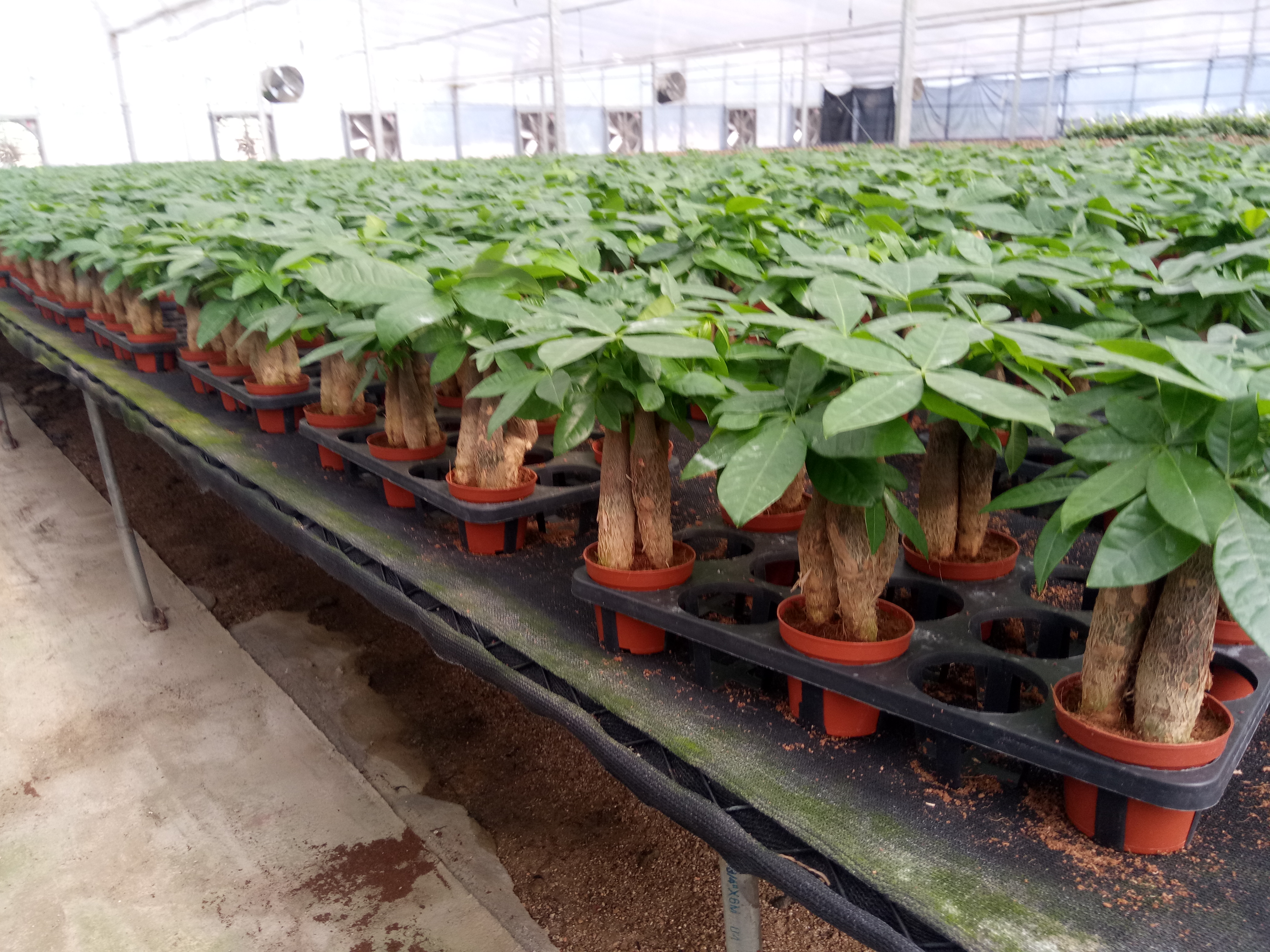
Specification only becomes supply when the growing system can hold it shipment after shipment. Xiamen Perfect Supply chain CO., LTD operates 65,000 m² of greenhouses across two nurseries, with 120 employees, a five-engineer R&D team and an annual output of 5,000,000 units. Plants are grown on 50 cm-high shelving with 1.6×1.6 mm breathable mesh, a configuration intended to support air circulation, light exposure and moisture control across the canopy. For a four-line order, the relevant point is consistency: leaf counts, height bands and unit weights have to repeat between shipments, not only within a single batch.
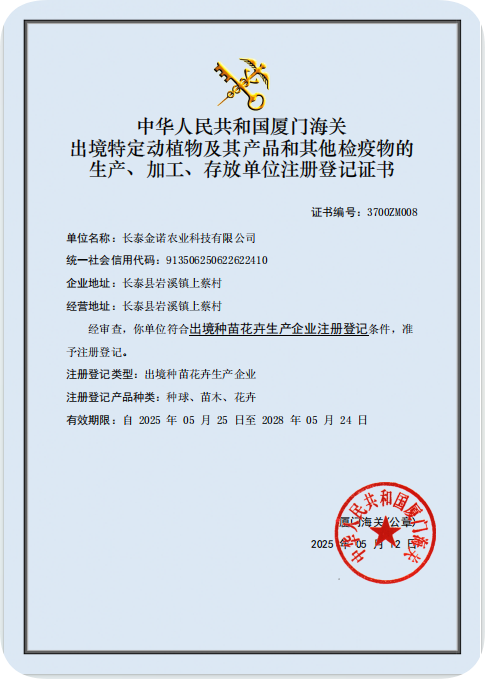
Compliance sits at the nursery level rather than the shipment level. The greenhouses are described as CIQ-certified infrastructure, and the company holds a Registration Certificate for Production, Processing and Storage Units of Export-Specific Animals, Plants and Their Products and Other Quarantine Articles issued by Xiamen Customs of the People's Republic of China, certificate number 3700ZM008, issued 25 May 2025 and valid to 24 May 2028, covering production, processing and storage of seed bulbs, seedlings and flowers for export. The company also operates an MPS-A (Marketable Plant Safety – A) management system, a framework for sustainable and traceable horticulture.
Customization is the part of the capability that most directly affects a four-line order. The supplier states customizable production covering variety selection, growing cycle and packaging solution, with a monthly capacity of 20 refrigerated (RF) containers, a lead time of 20–60 days, a minimum order quantity of 45 kg and a 100% testing standard. After-sales support covers planting guidance and quarantine documentation. R&D is not limited to varieties: the company holds invention patents for a long-distance storage and transport method for Chrysalidocarpus and for pest control in soilless bonsai cultivation, and operates proprietary software for greenhouse monitoring, soil moisture monitoring and flower production management. The procurement value of those instruments is traceability between what was specified at order confirmation and what was grown.
Where Each Line Fits: Five Buyer Scenarios
The shortlist is not a ranking. Each line answers a different buying brief, and the same container can legitimately mix all four.
| Buyer scenario | Line that fits | What the specification buys |
|---|---|---|
| Agriculture and horticulture (grow-on, propagation) | Bare-root Sansevieria; ungrafted Ficus ginseng; Cycas bulbs | Lower shipped weight per unit and material finished in the buyer's own facility |
| Landscape and project supply | Cycas revoluta at larger bulb diameters and heights | Height class that reads at distance, sized on two dimensions |
| Garden centre retail | Cycas revoluta; Ficus ginseng | Two distinct retail price bands from one consolidated shipment |
| Home furniture store and indoor retail | Ficus ginseng at the lighter end of 50 g–10 kg; Pachira Money tree; Sansevieria | Tabletop scale units, decorative braid forms and a low-maintenance green item |
| Mixed wholesale container | All four lines | Woody and non-woody material combined under one set of export documents |
There is also field evidence for the pairing of Cycas and Ficus in retail supply. A garden centre retailer in Spain has taken 4,134 units over a five-year relationship, with Cycas reported as growing well and Ficus performing well, and with plant quality holding after container shipment. That outcome is consistent with a specification-led order: two lines with different size logic, confirmed at the point of order rather than at the point of arrival.
Market Signals Behind a Four-Line Approach
Category-level data supports keeping both woody and non-woody lines in view. Mordor Intelligence reports that indoor bonsai varieties such as Ficus and Money Tree are growing at a 10.28% CAGR through 2031, driven partly by the rise in apartment living. Dataintelo places landscape bonsai as the largest type segment at 34.2% of the global bonsai market in 2025, and industry analysis describes landscape bonsai shifting from product sales toward integrated project supply services. The Horticultural Trades Association and TechSci Research both point to rising demand for low-maintenance “living decor”, naming Ficus retusa and succulent bonsai. A four-line shortlist that pairs indoor retail material with landscape-grade Cycas maps onto all three signals.
Trade flows support the sourcing side of the same picture. OEC records China's exports of “other live plants”, a category that includes bonsai, at USD 355 million in 2024, with the United States and South Korea as top destinations. Vertex Market Report estimates that Asia Pacific held more than 48.5% of the bonsai industry in 2025, valued at USD 3.8 billion, while Vertex AI Search and Industry Analysis projects the global bonsai market reaching approximately USD 18.4 billion by 2035 at a CAGR of 8.8% from 2026 to 2035.
What This Shortlist Does Not Resolve
A shortlist that only lists strengths is a catalogue. Four constraints matter in practice.
- Container type is not optional. Plant transportation relies on the dormancy and low-metabolism behaviour of plants under low-temperature conditions; with adjusted temperature and ventilation, plants can maintain good freshness and survival. Standard dry containers lack temperature adjustment and ventilation, which is associated with relatively high plant loss. A landed-cost comparison that assumes a dry container is therefore not comparable with one that assumes refrigerated or fresh-keeping equipment.
- Small trials are constrained. The stated minimum order quantity is 45 kg and the stated payment terms are 100% prepayment after order confirmation, with delivery on FOB or CIF terms and pre-shipment inspection before loading. Buyers testing a new line for the first time should plan around those terms rather than expect a sample-scale order.
- Lead time needs to fit a window. The stated lead time of 20–60 days is a production and preparation range. Where a line has to land before a seasonal retail window, the upper end of that range has to be modelled into the order date.
- Naming can mislead. Sansevieria is not a woody bonsai, and listing it under a bonsai heading may not match the expectation of a retail buyer in every market. The same applies to braided Pachira, which is a decorative foliage line rather than a trained woody specimen.
Entry rules also differ by destination, not by supplier: bare-root requirements and phytosanitary certification for the United States, phytosanitary certification for the European Union under Regulation (EU) 2019/2072. No shortlist substitutes for confirming the rule that applies to the specific market and the specific root form being shipped.
A Pre-Order Verification Checklist
| Check | What to record |
|---|---|
| Root form per line | Potted or bare-root, with packing method, for Sansevieria and Pachira |
| Size band with tolerance | Leaf count and length in cm; bulb diameter and height in cm; unit weight in g or kg; braid count |
| Form attributes | Grafted or ungrafted on Ficus ginseng; newly braided or old braided on Pachira |
| Container type | Refrigerated or fresh-keeping equipment, with the temperature and ventilation setting agreed |
| Inspection | Pre-shipment inspection before loading, per the stated acceptance criteria |
| Documentation | Quarantine documentation for the destination market, supported by certificate 3700ZM008 |
| Commercial terms | MOQ of 45 kg, FOB or CIF delivery, payment terms, and the 20–60 day lead time against the required delivery window |
Outlook
The direction of the category favours suppliers who can specify rather than suppliers who can list. Indoor bonsai demand is expanding at a faster rate than the category average, landscape bonsai remains the largest single type segment, and the service model around landscape projects is moving from product sales toward integrated supply. At the same time, phytosanitary requirements in the European Union and bare-root requirements in the United States are pushing root form and documentation into the specification itself.
For buyers, that means the practical unit of comparison in wholesale bonsai is shifting from “price per bonsai” to “price per specified unit at a stated root form, size band and container condition”. The four lines covered here — Sansevieria at 2–3 leaves and 20–40 cm, Cycas revoluta from bulbs at D 5–20 cm+ and H 20–120 cm, Ficus ginseng at 50 g–10 kg in grafted or ungrafted form, and Pachira Money tree at 3, 4 or 5 braids and 20–90 cm — are a workable starting framework for that comparison, provided the limits above are carried into the order rather than left in the article.
FAQ
What size and root-form options are available for wholesale Sansevieria?
Wholesale Sansevieria is specified as potted or bare roots, with 2–3 leaves per unit and a length of 20–40 cm. Leaf count and root form are separate order attributes: leaf count fixes the visual unit, and root form changes shipped weight and whether the material meets bare-root entry requirements in the destination market.
How is Cycas revoluta sized in a wholesale order?
Cycas revoluta is grown from Cycas bulbs and specified on two dimensions: bulb diameter from D 5 cm to 20 cm and above, and plant height from H 20 cm to 120 cm and above. Because the range spans tabletop specimens through landscape-grade material, a quotation that states only one dimension is not directly comparable with one that states both.
What is the difference between grafted and ungrafted Ficus ginseng in a wholesale order?
Grafted and ungrafted Ficus ginseng are two order forms quoted inside the same 50 g–10 kg unit-weight range. Because the weight band does not indicate which form is being supplied, the grafted or ungrafted designation has to be written on the purchase order and confirmed on the proforma invoice rather than inferred from weight or photograph.
How are braid counts handled for wholesale Pachira Money tree?
Wholesale Pachira Money tree is specified by braid count — three, four or five braids — by braid age, newly braided or old braided, and by height from 20 cm to 90 cm. Braid count drives unit value, and braid age is quoted separately, so both attributes should appear on the order alongside the height band. Pachira can also be supplied bare-rooted, which makes root form a third attribute to confirm.
Can these plants survive long-distance container transport?
Plant transportation relies on the dormancy and low-metabolism behaviour of plants under low-temperature conditions. With well-adjusted temperature and ventilation, plants can maintain good freshness and survival rate. Standard dry containers lack temperature adjustment and ventilation functions, which is associated with relatively high plant loss, so refrigerated or fresh-keeping containers are used, with the temperature and ventilation setting matched to the plant type.
What are the standard purchasing terms and acceptance criteria?
The stated terms are a minimum order quantity of 45 kg, delivery on FOB or CIF terms, acceptance based on pre-shipment inspection before loading, and payment of 100% prepaid after order confirmation. Lead time is stated as 20–60 days, with a monthly capacity of 20 refrigerated containers and a 100% testing standard.
The supplier's product catalogue is available as a PDF: KinoFarm Catalogue.
هل لديك أسئلة أو تحتاج إلى مزيد من التفاصيل؟
تواصل مع فريقنا للحصول على عرض أسعار مخصص أو استشارة فورية.
طلب عرض أسعار
املأ النموذج أدناه وسيتواصل معك فريقنا بعرض مقترح مخصص.
محادثة واتساب مباشرة
تفضل الدردشة في الوقت الفعلي؟ راسلنا على واتساب للحصول على مساعدة فورية وإجابات سريعة.
- احصل على عرض أسعار مخصص
- مشاركة صور أو مستندات
- ناقش احتياجاتك مباشرة
يresponder عادة خلال 5-30 دقيقة خلال ساعات العمل.