
Sauna Room Compliance: What AV1 and Material Choices Signal
Sauna Room Compliance: What AV1 and Material Choices Signal
Compliance in sauna projects is usually argued at the level of labels. A more reliable starting point is the specification sheet: the control system named, the power rating stated, the materials declared, and the equipment listed as required. This article reads those documented items in OCEAN FUTURE sauna rooms, and explains what they do — and do not — tell a buyer preparing a wellness project.
The global sauna market was valued at USD 954.3 million in 2025 and is projected to reach USD 1,556.8 million by 2033, according to Grand View Research. Residential demand dominates that figure: the residential segment held a 58.92% share of the market in 2025. The remainder — hotels, boutique guesthouses, wellness clubs, leisure facilities and commercial spa operations — is the part of the market where documentation becomes part of the product. A private buyer can judge a sauna on feel. A commercial project team usually cannot: a control system, a heater, a material declaration and an installation environment all have to survive review by a consultant, an insurer or a local authority.
That review rarely begins with a certificate. It begins with a specification. The useful question is therefore not only “is this sauna certified?” but “what does the specification already commit to, and what has to be requested separately?”
OCEAN FUTURE is the sauna and spa brand of FOSHAN GAOMING MUHE JINGCHENG SANITARY WARE CO., LTD., a Foshan-based manufacturer of sauna rooms, hot tubs, swim spas and cold plunge products that exports to markets including the USA, Australia, the EU and Germany. Its sauna catalog documents two control-system platforms, AV1 and MXD2022, and lists hemlock, aspen and red cedar as the material set across the range. Those are the two threads this article follows.
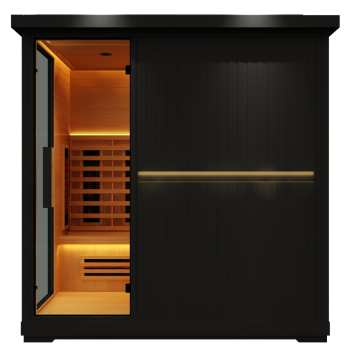
Why the Electrical Assembly Is the Compliance Core of a Sauna Room
The regulated heart of a sauna room is not the timber. It is the combination of heater, control system and electrical supply. That is why a standards change in this area matters to buyers far beyond the United States: UL 60335-2-53, a new electric sauna heater safety standard, was published in June 2025 to align US regulations with international standards, and was set to replace UL 875 for electric sauna heaters.
The practical consequence for procurement is that the control assembly and its supporting equipment have to be identifiable in writing. OCEAN FUTURE's sauna documentation addresses this at the component level. It specifies that a sauna room requires matched equipment including a sauna heater, infrared heating panels, a control panel, LED lighting and a safety thermometer, and that operation can follow a traditional sauna heater mode, an infrared heating mode, or dual-mode combined heating with adjustable temperature control and timer operation.
That is a documentation chain rather than a marketing claim, and it is the chain a buyer should test first. If the control system is unnamed, the power rating is missing, or the supporting equipment is undefined, the missing links become the buyer's risk — not the supplier's.
What the AV1 Control System Signals Across the Catalog
AV1 is one of two control platforms documented in OCEAN FUTURE's sauna room range. It appears across ten recorded models, spanning indoor, infrared and outdoor formats and a documented power range from 1,200W to 4,150W.
| Model | Documented format | Total power | Material set |
|---|---|---|---|
| OFS06A-1 | Infrared sauna room | 1,200W | Hemlock, aspen, red cedar |
| OFS06A-3-1 | Infrared sauna room | 1,600W | Hemlock, aspen, red cedar |
| OFS01-1 | Indoor sauna room | 1,800W | Hemlock, aspen, red cedar |
| OFS06B-3-1 | Infrared sauna room | 1,850W | Hemlock, aspen, red cedar |
| OFS01-2 | Indoor sauna room | 2,000W | Hemlock, aspen, red cedar |
| OFS06C-2 | Outdoor sauna room | 2,150W | Hemlock, aspen, red cedar |
| OFS06C-4 | Outdoor sauna room | 2,300W | Hemlock, aspen, red cedar |
| OFS01-4 | Indoor sauna room | 2,400W | Hemlock, aspen, red cedar |
| OFS06A-5 | Infrared sauna room | 3,000W | Hemlock, aspen, red cedar |
| OFS06C-5 | Outdoor sauna room | 4,150W | Hemlock, aspen, red cedar |
Three things follow from that table. First, a single control platform covering a 1,200W–4,150W span suggests a shared architecture across formats, which in turn simplifies spare-part planning and operator training for a multi-venue operator. Second, the power rating of each model is an electrical planning input, not a comfort claim — it determines supply capacity and protective device sizing. Third, the component list repeats across the family: FM, Bluetooth and USB functions, two speakers, lamp, colorful light, wood handle and tempered glass. The OFS06C outdoor models add an outdoor pentroof and document a far infrared heating plate plus box; OFS01 and OFS06A models document a painted surface finish, with OFS01-1 and OFS01-4 specifying dark brown tempered glass.
The second platform, MXD2022, and what it reveals about voltage planning
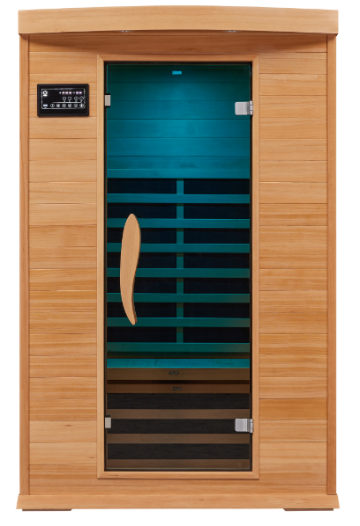
OCEAN FUTURE's catalog also documents MXD2022 as a control system on a separate group of models. Those records pair the control with a Harvia stove — BC60E at 6kW on OFS12-2 and OFS12-2-T, BC80E at 8kW on OFS05-1, OFS05-3 and OFS07-1, and BC35E at 3.5kW on OFS05-2. Two models, OFS07-1 and OFS07-2, are documented as combined configurations with an infrared heating box alongside the stove, at 8,000W + 400W/380V/50Hz and 8,000W + 800W respectively, while OFS08-1 is recorded at 2,900W/220V/50Hz.
Voltage documentation is a market-fit signal that is easy to overlook. A 380V/50Hz specification and a 220V/50Hz specification cannot be assumed to be interchangeable in a given building, and the difference should be resolved before an order, not after delivery.
Hemlock, Aspen and Red Cedar as Durability Evidence
Every recorded model in the OCEAN FUTURE sauna room range lists the same material set: hemlock, aspen and red cedar. For a project buyer, the value of a consistent material platform is spec-level: one material declaration to approve, one finish to familiarise maintenance staff with, and a predictable repair approach across an indoor and an outdoor installation in the same facility.
Material choice also sits directly against environmental requirements. OCEAN FUTURE's application documentation states that sauna installations have special requirements including heat-resistant and non-toxic materials, durable thermal insulation, waterproof and moisture-proof construction, and — for outdoor models — UV resistance, with low EMF specified for infrared models. Corrosion resistance is documented as a design condition because the products are intended for indoor or outdoor installation under high-temperature, variable climate conditions including sun exposure, rain and low temperature.
Sustainability expectations are moving in the same direction. Topture's industry reporting estimates that European commercial developers increasingly prioritised FSC-certified sustainably sourced wood in 36% of new sauna installations in 2024. That figure comes from a single industry source and should be treated as directional rather than definitive. What matters for procurement is the distinction it implies: declaring a wood species and evidencing the certified origin of that wood are two separate exercises. A specification sheet that names hemlock, aspen and red cedar is a material declaration. If a project requires certified sourcing, chain-of-custody documentation has to be requested on its own terms.
Matching Documented Features to Project Conditions
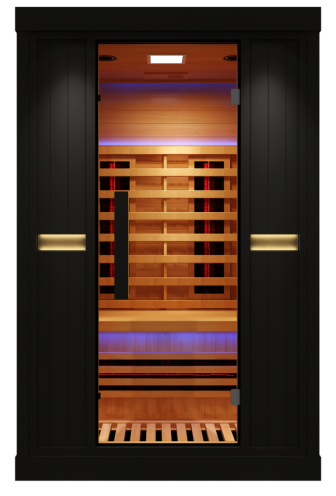
Compliance readiness becomes concrete when a documented feature is mapped to a site condition. The table below pairs conditions recorded in OCEAN FUTURE's application data with the corresponding documented requirement, so that a project team can see which item in the specification answers which risk.
| Project condition | Documented requirement or feature | What the buyer should confirm |
|---|---|---|
| Continuous high-temperature operation | Heat-resistant and non-toxic materials; durable thermal insulation | Material declaration for the batch, not only the model family |
| Outdoor installation with sun and rain exposure | UV resistance; waterproof and moisture-proof construction; outdoor pentroof on OFS06C models | Site exposure assessment and drainage around the unit |
| Infrared heating | Low EMF specified for infrared models; far infrared heating plate or plate plus box | Which standard, if any, the low-EMF statement is measured against |
| Overheating risk | Overheat protection; safety thermometer required as matched equipment | That the thermometer is installed, not merely supplied |
| Variable climate and corrosion | Corrosion-resistant design for high-temperature, variable climate conditions | Coastal or high-humidity locations in particular |
| Dual heat experience | Traditional heater mode, infrared mode or dual-mode combined heating with adjustable temperature control and timer | Control panel configuration and operator training |
A Screening Checklist for Compliance-Readiness
The following checklist is a reading order, not a substitute for local approval. Each line points to something that should exist in writing before a purchase order is placed on a wellness project.
| Screening item | Why it matters |
|---|---|
| Control system designation and total power rating | Establishes the electrical planning input and the spare-part reference |
| Matched equipment list | Defines what the project must install alongside the cabin: heater, infrared panels, control panel, LED lighting, safety thermometer |
| Material declaration by species | Confirms the timber set and supports finish and maintenance planning |
| Certified sourcing documentation, if required | Separate from species naming; requested on its own terms |
| Installation environment statement | Confirms indoor, outdoor or dual suitability for the actual site |
| Test and inspection documentation for the heater and control assembly | The regulated components; ask which standard applies in the destination market |
| Production quality-control evidence | OCEAN FUTURE documents 100% testing as its quality-control approach |
| After-sales route | OCEAN FUTURE documents remote guidance as its after-sales support model |
A Documented Field Reference: Commercial Spa Deployment in Germany
OCEAN FUTURE documents a commercial spa customer in Germany that took delivery of 20 sets for a spa centre and relaxation application. The recorded outcome is stable, safe operation with consistent heating and reliable performance; the recorded highlights are low noise, energy efficiency and durable construction. Service duration is documented as depending on the using condition rather than as a fixed service life.
The two models attached to that reference are instructive because they represent both sides of a commercial installation. OFS06C-4 is an outdoor sauna room with the AV1 control system, an outdoor pentroof and a 2,300W far infrared heating plate plus box. OFS06B-5 is an infrared sauna room with the AV1 control system, a painted surface and a 3,850W far infrared heating plate plus box. Buying both formats from one platform means one control logic, one spare strategy and one service conversation for the operator — a procurement argument that is as much operational as it is technical.
Manufacturing and Supply Signals Behind the Specification
Compliance documentation is only credible if the entity producing it can be located and described. FOSHAN GAOMING MUHE JINGCHENG SANITARY WARE CO., LTD. operates a 50,000 m² facility with more than 200 employees and a nine-engineer R&D team, and reports annual output of 5,000 sets. Approximately 85% of production is exported, with the USA, Australia, the EU and Germany named as main markets.
Its documented capability profile is OEM/ODM with full customization, a monthly capacity of 400 sets, a lead time of 30–40 days, a minimum order quantity of 1 set, 100% testing as the quality-control method, and after-sales support delivered through remote guidance. The sauna rooms themselves are documented for hotel and hospitality operations, guesthouses, wellness and commercial clubs, and spa facilities, with overseas project records covering AU, CA, CN, DE, ES, FR, MX and US markets.
Where the Specification Evidence Stops
An interpretation of specification signals is only useful if its limits are stated as clearly as its strengths. Several boundaries apply here.
- Designation is not certification. AV1 and MXD2022 are documented control platforms. They are not, in themselves, evidence of type approval against any named standard.
- Species naming is not chain-of-custody certification. Hemlock, aspen and red cedar are documented material declarations. Certified sourcing, where a project requires it, is a separate document.
- Power ratings create site obligations. A 4,150W outdoor model, an 8,000W dual-mode configuration or a 380V/50Hz specification each imply electrical work that a project must plan for; they cannot be treated as plug-in assumptions.
- Remote after-sales guidance assumes local capacity. A remote support model reduces certain service costs but still requires a competent local installation and maintenance partner.
- Capacity and lead time are planning constraints. At 400 sets per month and a 30–40 day lead time, large phased rollouts need scheduling discipline rather than assumption.
- The case reference is a performance description, not a warranty. Documented service duration depends on how the unit is used.
Market Trend Analysis: Why Specification Reading Is Becoming Standard Practice
Three documented market movements make the specification-first approach more relevant, not less.
Regulatory convergence is the first. The publication of UL 60335-2-53 in June 2025, intended to replace UL 875 for electric sauna heaters and align US practice with international standards, means heater and control assemblies are moving onto a more comparable footing across markets. Buyers who can read a control-system specification benefit directly from that convergence.
Sustainability procurement is the second. With industry reporting indicating that a substantial share of new European commercial sauna installations has prioritised FSC-certified wood, material declarations are increasingly read alongside sourcing evidence rather than instead of it.
Product-mix shift is the third. Traditional saunas held the largest product share at 42.79% in 2025, while infrared saunas are described as the fastest-growing segment at a 7.5% CAGR. That combination explains why dual-mode documentation — a heater plus infrared capability under one control platform — has become a practical way to serve a venue that is not yet certain which experience its guests will prefer.
A note on market data: estimates of sauna market size vary widely depending on whether spa services are included alongside sauna equipment, so the figures cited here should be read as segment-level indications rather than a single settled number.
Future Outlook
The direction of travel is toward documentation as a competitive surface. As heater and control standards converge and sustainability expectations harden, the suppliers that will be easiest to specify are those whose control systems, power ratings, materials and matched equipment are already named in writing, and who can supply the separate evidence behind each claim on request. For buyers, the practical shift is a change of first question: instead of asking what a sauna room is, ask what its specification commits to, and what still has to be proven.
FAQ
What does the AV1 control system designation tell a buyer about an OCEAN FUTURE sauna room?
AV1 identifies the control platform documented on ten recorded OCEAN FUTURE sauna room models, covering indoor, infrared and outdoor formats with total power ratings from 1,200W to 4,150W. It tells a buyer that the model sits within a shared control family with a documented component list that includes FM, Bluetooth and USB functions, two speakers, lamp, colorful light, wood handle and tempered glass. It does not, by itself, confirm compliance with any specific electrical standard; that confirmation has to be requested separately for the destination market.
Are hemlock, aspen and red cedar suitable for outdoor sauna rooms?
OCEAN FUTURE lists hemlock, aspen and red cedar as the material set across its sauna room range, including the outdoor OFS06C models, which also document an outdoor pentroof. The company's application data states that outdoor models are required to be UV-resistant and that sauna installations generally require waterproof and moisture-proof construction with durable thermal insulation. Suitability for a specific site still depends on exposure, drainage and maintenance, and if certified wood sourcing is required, chain-of-custody documentation must be requested independently of the species declaration.
What supporting equipment has to be planned for before a sauna room is installed?
OCEAN FUTURE's documentation lists matched equipment including a sauna heater, infrared heating panels, a control panel, LED lighting and a safety thermometer, and states that the product must be used with a control panel and safety thermometer. Operation can follow a traditional sauna heater mode, an infrared heating mode or dual-mode combined heating with adjustable temperature control and timer operation. Project teams should therefore plan electrical supply, control panel location and thermometer placement before delivery rather than after.
How should a buyer verify material and compliance claims that appear on a sauna room specification sheet?
Treat each claim as a document request. A control system designation should be followed by test or inspection documentation for the heater and control assembly, checked against the standard that applies in the destination market, such as the UL 60335-2-53 transition for electric sauna heaters in the United States. A material declaration should be followed by sourcing evidence if certified wood is required. An overheat protection or low EMF statement should be followed by the basis on which it is made. OCEAN FUTURE also documents 100% testing as its quality-control approach, which is a production-level claim that can be supported with inspection records.
Can AV1-equipped sauna rooms be adapted to hotel, spa and commercial club projects?
OCEAN FUTURE documents its sauna rooms as applicable to hotel and hospitality operations, guesthouses, wellness and commercial clubs and spa facilities, and documents OEM/ODM production with full customization, a minimum order quantity of 1 set, a monthly capacity of 400 sets and a lead time of 30–40 days. A documented commercial reference covers 20 sets supplied to a spa centre in Germany using the OFS06C-4 and OFS06B-5 models, with recorded results of stable, safe operation, consistent heating and reliable performance. Adaptation to a specific venue still depends on site conditions, electrical supply and local approval requirements.