
Sauna Room Supplier Sustainability: A Consistency Test
Sauna Room Supplier Sustainability: A Consistency Test
Sauna room buyers rarely lose money on the first container. Losses tend to appear on the third or fourth: a wood species quietly substituted, a control board revised without notice, or a lead time that slips because the factory's model mix has outgrown its process control. Supplier sustainability, understood in the procurement sense rather than the environmental one, is the probability that the next shipment matches the last one — across models, markets and years.
That probability can be assessed before a repeat order is placed. This analysis sets out four tests procurement teams can apply when evaluating sauna room manufacturers for long-term supply: material sourcing consistency, component reliability, production scalability across a model range, and the commercial terms that make acceptance measurable. OCEAN FUTURE sauna room data is used as a worked example of what the evidence looks like in practice.
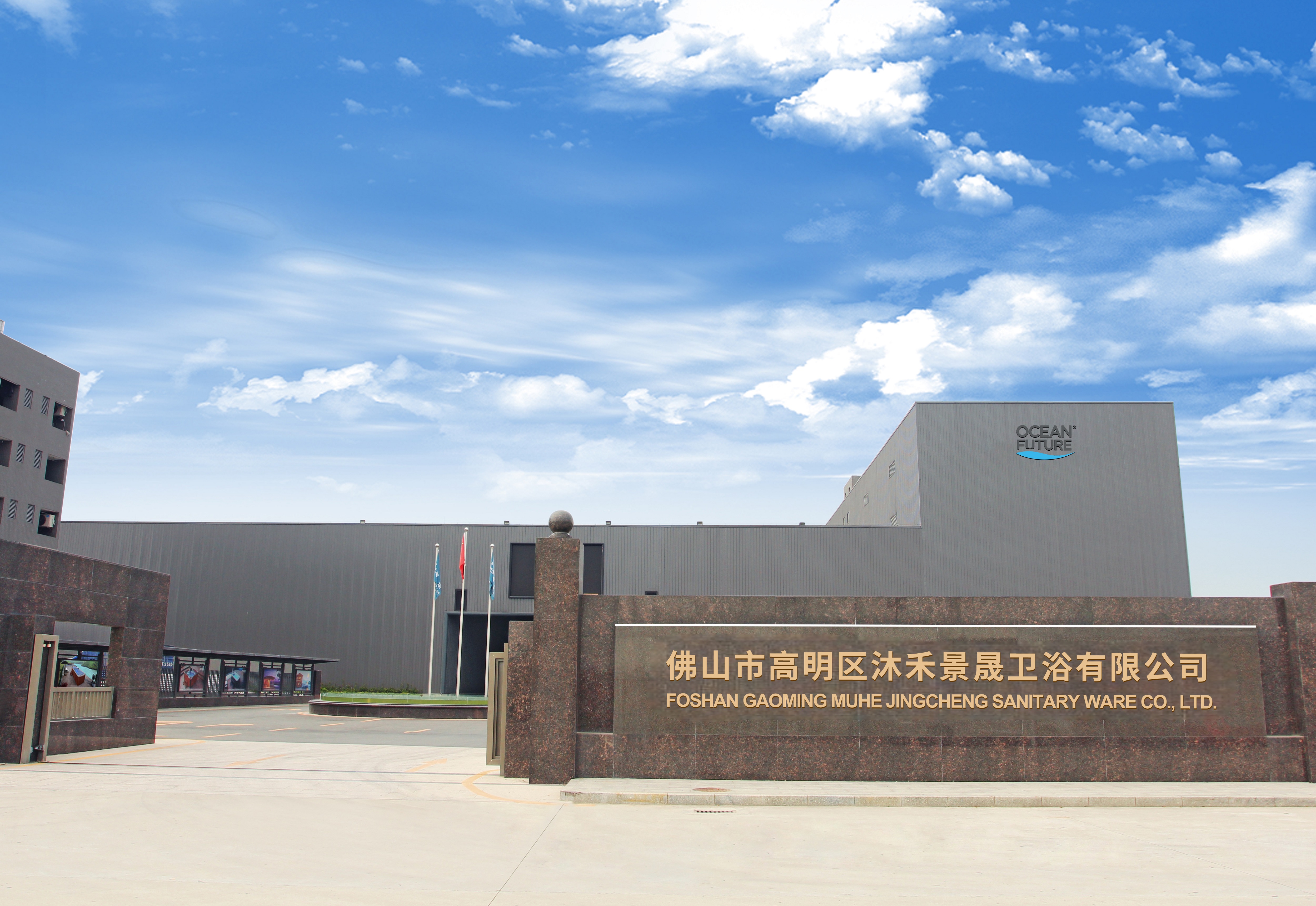
Manufacturing site of OCEAN FUTURE in Foshan, Guangdong. Capacity and quality figures referenced in this article are manufacturer-reported.
Why Consistency, Not Capability, Decides Long-Term Supply
Capability is demonstrated once. Consistency is demonstrated repeatedly. A manufacturer can pass a first-article inspection and still fail a three-year relationship, because the variables that move between orders are usually invisible at the sample stage. Four mechanisms account for most of the drift:
- Material drift. A wood species is named in the quotation but not in the purchase order, and the mill supplying a given grade changes between seasons.
- Component drift. A heating plate or controller supplier changes, and the electrical compliance file no longer matches the unit that ships.
- Scale drift. Volume grows faster than process discipline, so the same model number is produced on a different line, with different jigs, under different inspection routines.
- Documentation drift. Acceptance criteria are agreed verbally, so the definition of a conforming unit is renegotiated at every shipment.
The opportunity is that all four are auditable before the first repeat order. None requires access to confidential cost data, and none depends on believing a marketing claim. Each produces a document, a record or a stated term that procurement can hold a supplier to — or decline to.
The Four Tests of Supplier Sustainability
The framework below converts the four drift mechanisms into procurement questions. The third column is the part most evaluations omit: the specific evidence that survives a change of sales contact or a change of factory shift.
| Test | What typically drifts | Evidence that holds up |
|---|---|---|
| Material sourcing consistency | Species, grade, aroma, appearance | Species named per model in the PO; retained reference sample; batch notification before substitution |
| Component reliability | Heating plates, controller boards, electrical profile | Declared component freeze list; model-level certificate scope; pre-shipment test record |
| Production scalability | Process control as model count and volume rise | Stated capacity, model family architecture, lead-time behaviour at peak |
| Commercial terms and acceptance | Definition of a conforming unit | MOQ, delivery terms, inspection gate, payment schedule in writing |
Where OCEAN FUTURE Sits in This Evaluation Model
OCEAN FUTURE (legal entity FOSHAN GAOMING MUHE JINGCHENG SANITARY WARE CO., LTD.) is a sauna room and spa manufacturer based on Yangxi Road, Yanghe Town, Gaoming, Foshan, Guangdong, China. The company produces sauna rooms alongside hot tubs, swim spas and cold plunge units, and exports the majority of its output — a stated 85% — to markets including the EU, USA, Australia, Germany, Spain and France.
Several facts in its published capability data are directly relevant to a consistency assessment. The operation runs a 50,000 m² factory with 200+ employees, including a 9-engineer R&D team. Stated monthly capacity is 400 sets, with annual output given as 5,000 sets. Production is offered on an OEM and ODM basis with customization across the range, a minimum order quantity of 1 set, and a typical lead time of 30–40 days. Quality control is described as 100% testing, with remote guidance provided for after-sales support.
Two of these figures can be cross-checked against each other without any external source: 400 sets per month implies roughly 4,800 sets per year, which is broadly consistent with the stated annual output of 5,000 sets. That internal coherence is a small signal, but it is the kind of arithmetic a buyer should run on every capacity claim, because inconsistent self-reported numbers are a common early warning.
These figures are manufacturer-reported. In the material reviewed for this article, no third-party factory audit or independently verified capacity statement was available, so they should be treated as the supplier's declared position and confirmed during qualification rather than accepted as verified fact.
Test 1 — Material Sourcing Consistency: Hemlock, Aspen, and Red Cedar
Wood is where drift is most visible to the end customer and least documented in the supply chain. Species substitution is rarely malicious; it is more often a response to availability. The problem is that the three species commonly used in sauna room construction are not interchangeable in the way a buyer experiences them.
| Wood | Market position | What a substitution changes |
|---|---|---|
| Canadian red cedar | Premium: higher price, rot-resistant, aromatic | Scent, colour consistency and cost position |
| Hemlock | Budget-premium: lower scent, neutral, stable | Appearance uniformity and perceived value |
| Aspen | Budget: traditional Finnish choice, heat resistant | Thermal feel and the traditional positioning of the room |
For a single residential installation, a species change between orders is mostly an inconvenience. For a hotel refurbishment or a spa rollout, it becomes a visible defect: rooms finished to different specifications on the same corridor. The procurement remedy is procedural rather than technical. Species should be named per model in the purchase order, not only in the brochure; a signed reference sample should be retained by both parties; and the supplier should be required to notify before any species or grade change, with the buyer holding a right of rejection.
This is the cheapest of the four tests to implement, and the one most frequently skipped because the quotation already names a wood type. A quotation is not a specification. The difference matters at the second order.
Test 2 — Component Reliability: Far Infrared Heating Plates and the AV1 Control System
In an infrared sauna room, two component families determine both performance and compliance: the far infrared heating plates and the control electronics, referred to in the OCEAN FUTURE range as the AV1 control system. Buyers tend to scrutinise the heater and overlook the controller. That is a mistake, because the controller defines the product's electrical and electromagnetic profile.
Electromagnetic compatibility is assessed at system level. A change of control board, display module or wiring layout can move a unit outside the configuration that was tested, even when the heating plates are unchanged. The practical consequence for a long-term buyer is that component consistency is not only a quality question — it is the condition under which an existing compliance file remains valid.
OCEAN FUTURE's published compliance documentation illustrates the type of evidence a buyer should request. Two certificates were issued on 25 November 2025 by Guangzhou STU Hengchuang Testing Service Co., Ltd. for the EU market:
- EMC Compliance — certificate number STUEMO250300017HS, citing EN IEC 55014-1:2021, EN IEC 55014-2:2021, EN 61000-3-12:2011 and EN IEC 61000-3-11:2019.
- CE-EMC — certificate number STUEMO250300016HS, citing the EN IEC 55014 series together with the EN 61000-3 series for harmonic and voltage-fluctuation limits.
The scope detail matters as much as the certificate number. The EMC Compliance certificate lists a defined set of models — OFS04-1, OFS04-2, OFS05-1, OFS05-3, OFS07-1, OFS07-2, OFS08-1 and OFS12-2 — rather than the whole catalogue. A buyer sourcing a model outside that list should request model-specific confirmation rather than treating the certificate as blanket coverage. This is a normal feature of electrical certification, not a red flag, but it is exactly the point at which procurement teams over-generalise.
Two further controls close the loop. First, a component freeze list: the supplier declares the heater and controller part references at order acceptance and notifies before any change. Second, a documented inspection gate — OCEAN FUTURE's stated acceptance criterion is a pre-shipment test, supported by a quality process described as 100% testing. Whether that gate is meaningful depends entirely on what the buyer writes into it: which functions are tested, on what sample size, and what record is delivered with the shipment.
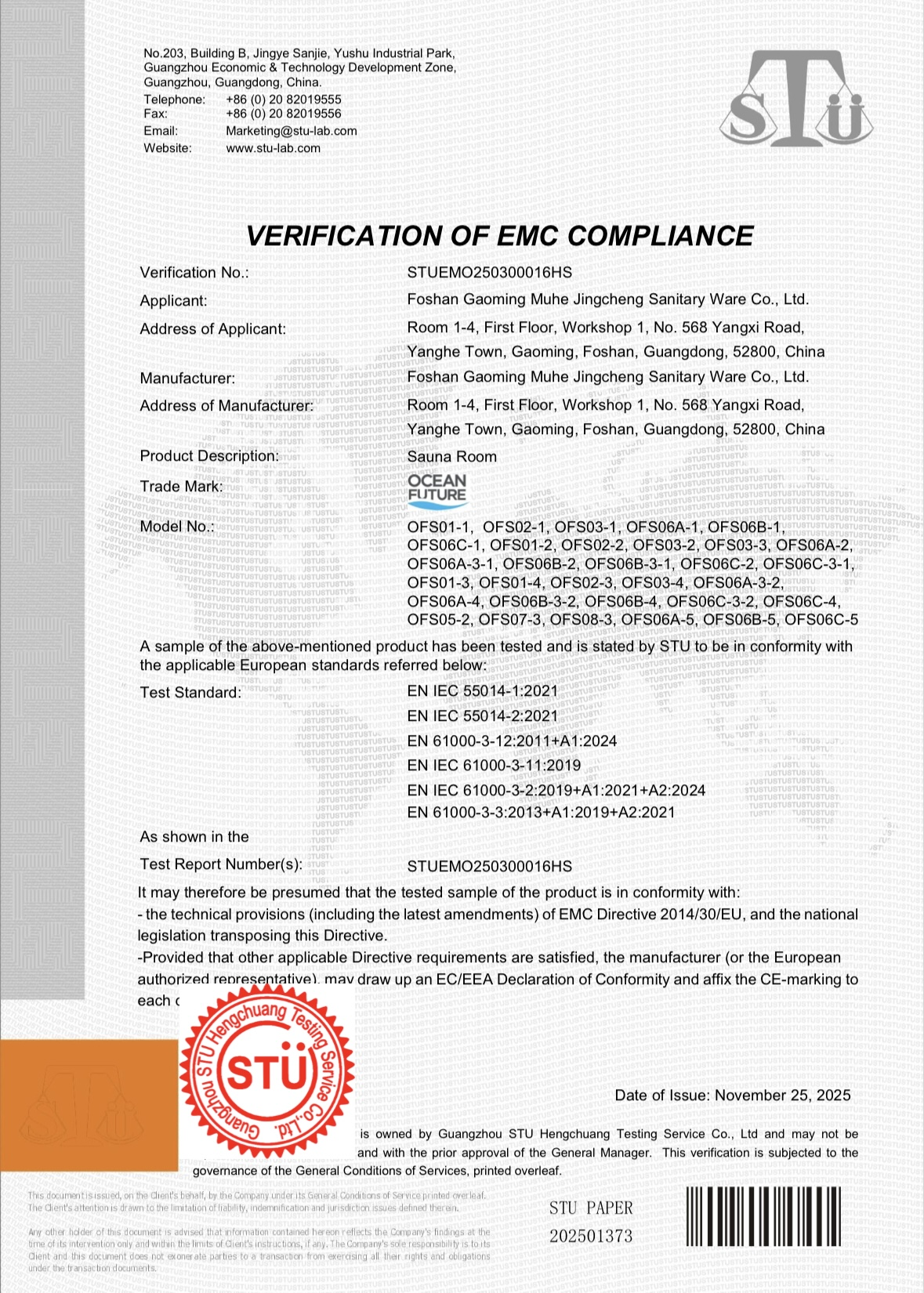
CE-EMC certificate STUEMO250300016HS, issued 25 November 2025 by Guangzhou STU Hengchuang Testing Service Co., Ltd. for the EU market.
Test 3 — Production Scalability from OFS06A-5 to OFS06B-4
Scalability is often conflated with capacity. Capacity is a number; scalability is whether the same process discipline survives a wider model mix and a higher run rate. The distinction matters because the OCEAN FUTURE sauna room catalogue is structured as numbered families, and within the infrared range the models run from OFS06A-5 through to OFS06B-4 across the A and B sub-series.
A structured family like that is a reasonable proxy for platform thinking. When a manufacturer can produce a graded series — A and B variants, numbered steps within each — it usually means shared tooling, shared cabinet architecture and shared components, with a defined set of variables between models. Platform-based production is inherently more stable at volume than bespoke builds, because each model inherits the process controls of the platform rather than starting again.
The scalability questions a buyer should put to the supplier follow from this:
- Which components are shared across OFS06A-5 to OFS06B-4, and which are model-specific?
- Does the 30–40 day stated lead time hold at peak, or only in low season?
- At a stated 400 sets per month, how is model mix scheduled, and what happens to a small order placed alongside a large one?
- Is the same inspection routine applied to every model in the series, or only to the volume models?
The 1-set minimum order quantity is more useful here than it first appears. It allows a buyer to validate the exact configuration — wood species, control system, cabinet variant — before committing to a programme, which converts scalability from a promise into a testable sequence: validate one, then scale the same specification.
The limitation is obvious but worth stating. Capacity, lead time and quality-control figures in OCEAN FUTURE's published material are self-reported, and no third-party production audit or line-level evidence was available in the material reviewed. A buyer planning a multi-container programme should ask for production records, shift schedules and a factory visit rather than relying on the headline numbers.
Test 4 — Purchasing Terms and Acceptance Criteria as Consistency Instruments
The fourth test is commercial, and it is the one that makes the other three enforceable. OCEAN FUTURE's stated purchasing terms provide a usable baseline:
| Minimum order quantity | 1 set |
| Delivery terms | EXW / FOB / CFR / CIF / DAP / DDP |
| Acceptance criteria | Pre-shipment test |
| Payment terms | T/T: 30% deposit, 70% balance before shipment |
Each line does specific work in a long-term relationship. A broad choice of delivery terms lets the buyer keep control of handling where that control matters and hand it over where it does not — consistency of transport is part of consistency of outcome. The pre-shipment test creates a documented gate before money moves, which is the practical mechanism for detecting material or component drift while there is still leverage to correct it. A 30/70 balance structure keeps the final payment tied to that gate.
What these terms do not do is define conformance. "Pre-shipment test" is a category, not a criterion. Before the second order, a buyer should convert it into an annex: which functions are verified, what sample size is used, which photographs and records are delivered, what tolerance applies to wood colour and finish, and what remedy follows a failed inspection. Written this way, the commercial terms become the enforcement layer of the other three tests rather than a formality at the end of negotiation.
How Venue Type Changes What Consistency Means
Consistency requirements are not identical across applications, and a single framework should be weighted differently for each.
| Application | What must stay consistent |
|---|---|
| Residential home sauna room | Wood species and finish; single-unit specification; after-sales route |
| Hotel spa and commercial sauna room | Identical specification across rooms; component freeze; documented compliance per model |
| Outdoor weatherproof and prefabricated cabin | Cabinet construction and material durability across repeat orders and seasonal exposure |
A documented case from OCEAN FUTURE shows how this plays out commercially. A commercial spa client in Germany took 20 sets for spa centre relaxation use, drawn from the OFS06C-4 and OFS06B-5 infrared models. The reported outcome was stable, safe operation with consistent heating and reliable performance, with low noise, energy efficiency and durable construction noted as highlights. Service life was described as depending on the using condition — a caveat worth keeping, since it is the honest answer for any sauna room in continuous commercial use.
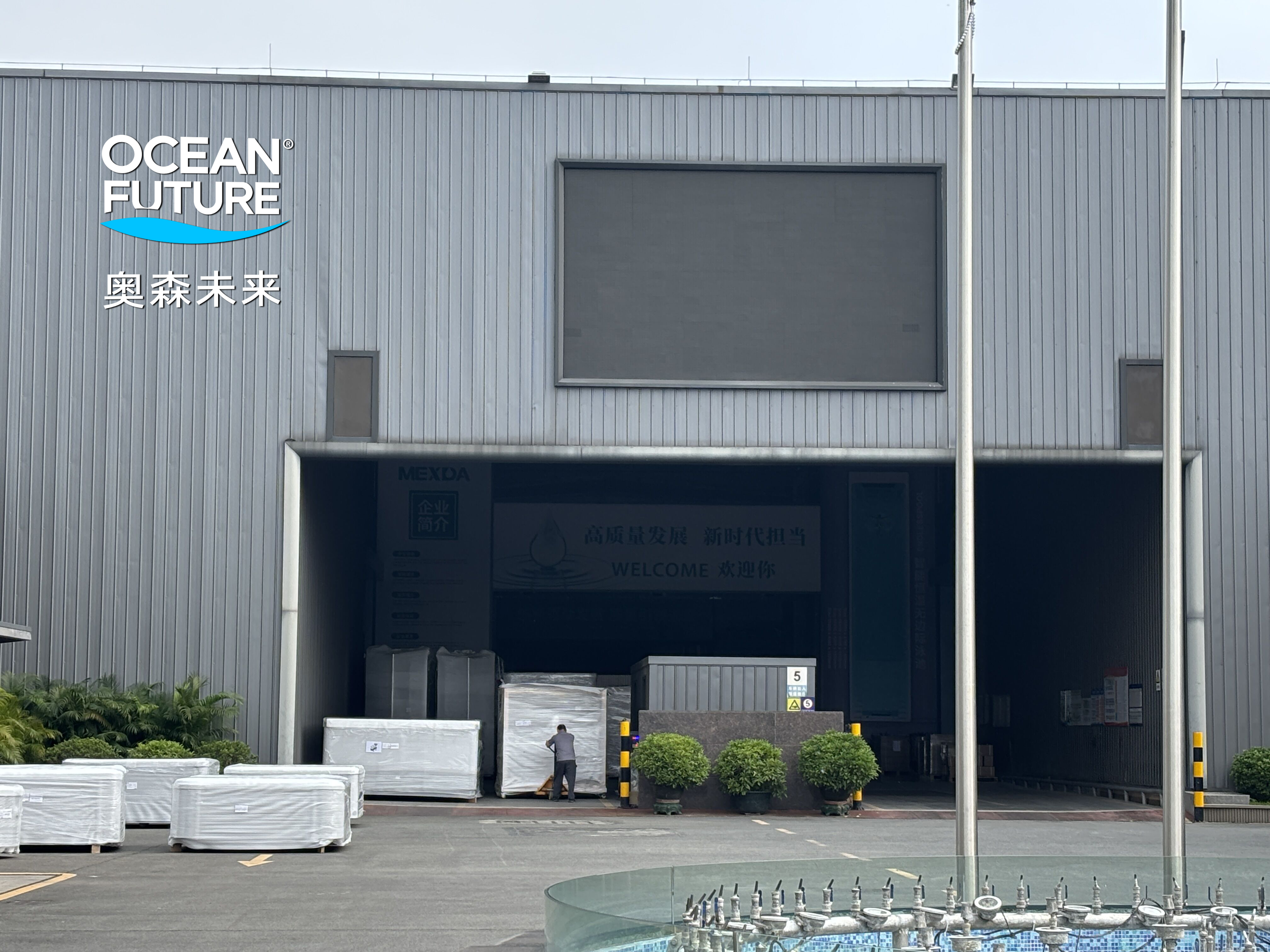
Sauna room production workshop. Process control across a model family is the practical test of scalability at volume.
What Market Signals Say About the Cost of Inconsistency
A supplier's consistency problem becomes more expensive in a growing market, because rework and specification disputes scale with volume. Published estimates point to steady rather than explosive expansion. Market.us places the global sauna market at USD 860.3 million in 2023, rising to USD 1,555.3 million by 2033 at a CAGR of 6.1%. Technavio reports the US market at USD 437.4 million in 2025 with a CAGR of 6.5% over 2026–2030. The two figures use different geographies and forecast periods and should be read as directional rather than combined into a single benchmark.
For context on installed base, Harvia has estimated the global sauna market at close to EUR 4 billion in value with roughly 18 million saunas worldwide — a company estimate, and a different metric from the commercial research figures above.
Regulation is moving in a direction that favours documented consistency. A secondary report notes that EN 18164, published in February 2026, set a European standard for the design and construction of sauna rooms, warm-air rooms, steam rooms and soft steam rooms in public facilities. In the US, the electric sauna heater standard UL 60335-2-53 was reported as published in June 2025. The two developments illustrate a structural point: room compliance and heater compliance are separate objects. A manufacturer whose documentation treats "certified" as a single status is likely to struggle when a buyer asks for model-level evidence, and that gap tends to surface after the order is placed rather than before.
Consistency-Based Evaluation vs Spot Purchasing
The conventional alternative to this framework is spot purchasing: buy on unit price and availability, re-tender for each project, and treat each shipment as a standalone transaction. It is a legitimate strategy, particularly where no repeat demand exists.
| Dimension | Spot purchasing | Consistency-based evaluation |
|---|---|---|
| Primary metric | Unit price per order | Repeatability of specification |
| Documentation | Certificate copy at quotation stage | Model-level scope, change notification, retained sample |
| Change control | Revealed at delivery | Declared in advance, with a rejection right |
| Best fit | One-off residential purchase | Multi-room, multi-phase or multi-year programmes |
The framework has real limits, and buyers should hear them before adopting it. First, all four tests as applied here rely substantially on supplier-declared information. Capacity, testing practice and lead times for OCEAN FUTURE are self-reported, and no third-party audit was available in the material reviewed — a document-based assessment is a filter, not a substitute for a factory visit. Second, the approach carries administrative cost: specification annexes, sample retention and change registers take time, and for a single residential sauna room the effort may exceed the risk, particularly where a 1-set minimum order quantity and a 30–40 day lead time already allow sample-first validation. Third, certificate coverage is model-specific and may not extend across a full catalogue, so the buyer must match documents to the exact model being ordered. Fourth, standards such as EN 18164 apply to public facilities in Europe, which means manufacturers and buyers serving that segment face a defined evidence standard while residential buyers elsewhere face a looser one.
What to Expect Next in Sauna Room Supplier Assessment
Three shifts are visible in how buyers are approaching long-term supply. The first is from certificates to dossiers: a single EMC or CE-EMC document is increasingly treated as an entry ticket, with the real question being which models it covers and what triggers re-testing. The second is from capacity claims to process evidence: monthly output figures matter less than whether the same inspection routine applies to every model in a family such as OFS06A-5 to OFS06B-4. The third is from annual renegotiation to standing change discipline, where substitution requires notice rather than apology.
For manufacturers, this favours suppliers whose internal records already exist — model-level certificate scopes, declared component lists, batch documentation. For buyers, it means the cheapest point to secure consistency is still before the first repeat order, when the specification annex and acceptance criteria are being drafted and neither side has yet committed.
FAQ
What does supplier sustainability mean for a sauna room manufacturer?
In procurement usage, supplier sustainability is the probability that a manufacturer delivers the same specification, performance and documentation across repeat orders. It is assessed through material sourcing consistency, component reliability, production scalability and enforceable acceptance criteria, rather than through environmental claims.
How can buyers keep hemlock, aspen and red cedar sourcing consistent across orders?
Name the species per model in the purchase order rather than only in the brochure, retain a signed reference sample with the supplier, and require written notice before any species or grade change. The three woods differ in position and effect: Canadian red cedar is premium with rot resistance and aroma; hemlock is budget-premium with lower scent and neutral, stable appearance; aspen is a budget option associated with traditional Finnish construction and heat resistance.
What evidence should buyers request for far infrared heating plates and the AV1 control system?
Request a declared component list covering both the heating plates and the controller, plus the electromagnetic compatibility documentation with its model scope. OCEAN FUTURE's EU certificates — EMC Compliance STUEMO250300017HS and CE-EMC STUEMO250300016HS, both issued on 25 November 2025 by Guangzhou STU Hengchuang Testing Service Co., Ltd. — cite the EN IEC 55014 and EN 61000-3 series. Because EMC is assessed at system level, a controller change can affect validity, which is why change notification belongs in the agreement.
How can a buyer test whether a manufacturer can scale across the OFS06A-5 to OFS06B-4 range?
Ask which components are shared and which are model-specific, how a 400-set monthly capacity is scheduled when model mix is high, whether the stated 30–40 day lead time holds at peak, and whether the same inspection routine applies to every model in the series. Use the 1-set minimum order quantity to validate the exact configuration first, then scale that specification rather than a similar one.
Which purchasing terms and acceptance criteria should be fixed before a repeat order?
OCEAN FUTURE's stated baseline is a 1-set minimum order quantity, delivery terms of EXW, FOB, CFR, CIF, DAP or DDP, pre-shipment testing as the acceptance criterion, and T/T payment of 30% deposit with 70% balance before shipment. The pre-shipment test should be converted into a written annex defining tested functions, sample size, delivered records and remedy for non-conformance, otherwise the criterion remains a category rather than a standard.
What are the limits of a document-based consistency assessment?
It relies on supplier-declared information and does not replace a factory audit; OCEAN FUTURE's capacity, quality-control and lead-time figures are self-reported in the material reviewed. It also adds administrative overhead, may be disproportionate for a single residential purchase, and requires matching certificates to the exact model ordered, since scope can be limited to named models rather than the whole catalogue.
The OCEAN FUTURE sauna room catalogue, including model and specification details, is available as a downloadable PDF: OCEAN FUTURE Sauna Room brochure.
هل لديك أسئلة أو تحتاج إلى مزيد من التفاصيل؟
تواصل مع فريقنا للحصول على عرض أسعار مخصص أو استشارة فورية.
طلب عرض أسعار
املأ النموذج أدناه وسيتواصل معك فريقنا بعرض مقترح مخصص.
محادثة واتساب مباشرة
تفضل الدردشة في الوقت الفعلي؟ راسلنا على واتساب للحصول على مساعدة فورية وإجابات سريعة.
- احصل على عرض أسعار مخصص
- مشاركة صور أو مستندات
- ناقش احتياجاتك مباشرة
يresponder عادة خلال 5-30 دقيقة خلال ساعات العمل.