
Sawing Blade Specs FAQ: Spindles, Feed and Stable Output

Specification review, batch documentation and customer technical support for high-precision sawing blades — WINTIME, Rugao, Jiangsu, China.
Sawing blade selection is a specification decision before it becomes a price decision. In high-precision dicing, the blade is one element in a chain that also includes the spindle, the feed system, the mounting equipment and the dicing tape — but it is the element whose dimensional accuracy and wear behaviour determine whether that chain produces the same result from the first wafer of a lot to the last.
The global wafer dicing blade market was valued at USD 1.19 billion in 2024, according to Market Research Intel, driven by semiconductor miniaturisation and the adoption of 300mm wafers. Diamond saw blade demand more broadly is expanding as well: Maximize Market Research estimates the global diamond saw blade market at approximately USD 8.60 billion in 2025, with a projected value of USD 10.16 billion by 2032. Growth at that scale changes the buying question. Buyers at the decision stage are rarely asking whether a blade can cut a given material; they are asking which specification holds stable output at high spindle speed and controlled feed, and what evidence supports that claim.
WINTIME Semiconductor Technology Co., Ltd. is a manufacturer founded in 2020 in Rugao, Jiangsu Province, China, integrating the research, development, production and sales of high-precision wafer-level cutting blades. The company supplies precision cutting blades, cutting tapes and cutting solutions, with a blade range positioned for semiconductor wafer, optical communication, functional ceramic and alloy material cutting.
This reference answers the technical and procurement questions that most often arrive at the decision stage: what high-speed spindle cutting demands from a blade, how precision feeding converts blade geometry into yield, how wear resistance and dimensional accuracy sustain continuous machine operation, which equipment — including UV tape mounting machines — belongs in the specification discussion, and how batch consistency and commercial details should be verified before a production order.
At a glance
- High-speed spindle cutting rewards dimensional accuracy and wear behaviour over nominal cutting claims.
- Precision feeding is repeatable only when blade thickness and geometry stay inside a defined tolerance across a lot.
- Hubless sawing blades are increasingly dominant for 300mm wafer processing because of superior stability and reduced runout on substrates below 50 µm.
- Batch inconsistency, not single-blade performance, is the risk that most affects stable mass production — and it is addressed with process data, adjacent-batch testing and traceable batch files.
Why Blade Specs, Not Unit Price, Decide Output Stability
High-speed spindle cutting is an abrasive process with a narrow tolerance for drift. Material is removed by the abrasive edge of the blade, and cut quality depends on that edge staying round, flat and dimensionally consistent while the spindle rotates and the feed system advances the workpiece in controlled increments. When the blade wears unevenly, or when a new lot arrives with a different thickness distribution than the previous one, the effective cutting geometry changes mid-lot. Kerf widens, chipping increases, and the feed parameters validated at setup no longer produce the same result.
The cost of that drift rarely appears on a blade invoice. It appears in yield loss, rework, scrap of high-value substrates and unplanned spindle downtime. On 300mm wafers, or on optical and RF devices produced in volume, a small change in kerf or chipping rate converts directly into cost per good die. A price-per-piece comparison between two sawing blades is therefore not a comparison of cutting cost.
Precision feeding sits at the centre of the problem. Feed and index parameters translate blade geometry into the cut: cut depth per pass, number of steps, and the relationship between blade exposure and workpiece support. If the blade is dimensionally accurate, those parameters can be set once and repeated. If it is not, the operator compensates — adjusting feed, cut depth or change intervals — and each compensation reintroduces the manual variability that standardised processes exist to remove.
For a buyer, the practical conclusion is that blade options should be compared on four axes rather than one: specification conformity, batch consistency, verification evidence and supply reliability.
How WINTIME Structures Specification and Batch Control
WINTIME Semiconductor Technology Co., Ltd. operates a 34,000㎡ facility in Rugao, Jiangsu Province, China. The company reports a workforce of 100 employees, an R&D team of 35 engineers, and an annual dicing blade capacity of more than 1 million pieces. In 2023, the Nantong WINTIME Semiconductor Special Materials Project involved a total investment of nearly tens of millions of yuan, adding a new factory and auxiliary buildings of 34,000 square meters. WINTIME exports approximately 30% of its output to Southeast Asia, East Asia, North America and Europe, and holds two patent technologies.
Capability in the ultra-thin range is a distinguishing factor in this category. WINTIME's completed Ultra-thin Wafer D Blade project achieved a blade thickness of less than 9 microns, and the company states that it is one of the few domestic manufacturers able to reach mass production at that level.
Batch control is the second half of the capability. The risk WINTIME identifies for its customers is batch quality inconsistency that would affect stable mass production, and the countermeasures are process-based rather than inspection-based alone: production process parameters are standardised, automatic production equipment is used to avoid manual operation errors, a batch production data tracking system records process parameters, and adjacent batches are compared through testing to confirm consistent performance. On the quality-management side, the company operates an ISO 9001 quality management system with standard operating procedures, assigns dedicated quality inspectors to each production batch, maintains batch quality files that can be traced at any time, and recalls nonconforming batches if a problem is identified.

Standardised process parameters, automated equipment and batch data records are the operational basis for batch-to-batch consistency in blade production.
For a buyer, those measures translate into three requestable documents: lot-level process records, adjacent-batch comparison results, and a traceable batch quality file. None of them replaces incoming inspection, but they separate a supplier that can explain a deviation from one that cannot.
Four Spec Dimensions That Govern High-Speed Cutting
Blade specification debates often collapse into thickness. In practice, four dimensions interact, and each has a verification method and a trade-off that has to be accepted knowingly.
| Spec dimension | What it controls on the machine | What to verify before ordering | Trade-off to accept |
|---|---|---|---|
| Dimensional accuracy (thickness control, flatness, edge geometry) | Kerf width, street fit and chip size; stability of the validated feed program | Thickness data with tolerance, flatness and edge geometry per lot; runout check on arrival | Tighter tolerances narrow the process window but reduce kerf variation across the lot |
| Wear resistance | How long the edge holds its cutting geometry during continuous operation | Wear behaviour under the buyer's material and cutting mode; expected change interval | A very wear-resistant edge can reduce self-sharpening, so wear resistance must be balanced against edge sharpness for the material |
| Bond system (resin / metal) | Compatibility with material hardness and abrasiveness | Confirmation that bond type matches the material; references on comparable materials | Metal bond covers harder materials such as SiC, but is a narrower share of the market than resin bond |
| Hub configuration (hubless / hub-type) | Runout at the cutting edge and stability on thin substrates | Mounting interface, flange condition and handling procedure at the buyer's line | Hubless blades demand careful handling and disciplined mounting; hub-type remains practical for thicker work |
Dimensional accuracy is the dimension that most directly protects a feed program. Thickness tolerance, flatness and edge concentricity determine how much kerf varies across a lot and whether a designed street width can be held without extra allowance. A nominal thickness figure without a tolerance statement says little about how a blade will behave across thousands of cuts.
Wear resistance determines how long that accuracy survives. A blade that holds its geometry across a full lot keeps the process inside the validated window and reduces the frequency of changeovers and re-qualification. The balance point differs by material: an edge that resists wear too aggressively may lose self-sharpening, which changes cutting forces and chip formation.
Bond type and hub configuration are material and handling decisions respectively. In 2024, resin bond blades held a 42% share of the dicing blade market and metal bond blades — used for harder materials such as SiC — accounted for 33% (market.us), which reflects material conditions rather than a ranking of quality.
Matching Blade Families to Cutting Application
A specification that works for one material rarely transfers unchanged. WINTIME's blade range covers diamond sawing blades, hubless sawing blades and series such as DZY, DZR and DZR-S slotted blades, together with electroforming hard blades, with variants positioned for semiconductor wafer, optical communication, functional ceramic and alloy material cutting.
In semiconductor wafer dicing, the constraint is thin-substrate handling. Hubless dicing blades are increasingly dominant for 300mm wafer processing because of superior stability and reduced runout on substrates below 50 µm (Semiconductor Equipment Market Data). Ultra-thin capability matters here: the WINTIME Ultra-thin Wafer D Blade project reached a thickness of less than 9 microns, which reduces material loss per cut in a context where kerf is expensive.
Optical communication and RF/optoelectronics accounted for 16% of dicing blade market share in 2024, a value of USD 69.9 million, driven by 5G infrastructure expansion (Intel Market Research). These devices combine small die size with high value per unit, so chipping control and kerf accuracy carry disproportionate cost weight. Functional ceramic and alloy cutting sits at the harder end of the range, where metal bond blades are applied to materials such as SiC.
The correct selection sequence follows from that: define material and component geometry, define the machine environment including tape and mounting equipment, and only then fix blade geometry, bond and tolerance class.
Market Trend: Hubless Blades, Thinner Substrates and a Wider Supply Base
Hubless blades are becoming the default construction for advanced thin-substrate work. Their dominance in 300mm wafer processing follows from superior stability and reduced runout on substrates below 50 µm, as reported by Semiconductor Equipment Market Data. The reason is arithmetic rather than preference: as substrates get thinner, blade runout accounts for a larger share of total cutting error, so geometry that reduces runout protects yield directly.
Sourcing patterns are shifting at the same time. China's exports of cutting blades to Vietnam and India grew significantly between 2024 and 2025, with Vietnam increasing by USD 18 million and India by USD 12 million, according to OEC. A wider supply base gives buyers more options, but it also increases the spread between suppliers — which raises the weight of verifiable batch data in supplier selection.
Standardisation vocabulary is maturing alongside. ISO 22180:2019 covers diamond tools, including sawing blades, and distinguishes between CVD diamond-coated and monocrystalline or polycrystalline types. Using these categories in specification discussions reduces ambiguity when blades from different suppliers are compared.
Finally, market scale is not a proxy for specification fit. A diamond saw blade market measured at approximately USD 8.60 billion in 2025 and a wafer dicing blade market at USD 1.19 billion in 2024 describe a large category, but they say nothing about whether a specific blade holds tolerance in a specific spindle under a specific feed program.
Conventional Practice vs Specification-Driven Buying
The difference between traditional purchasing practice and current practice is largely a question of where verification happens — at the receiving dock, or at the specification stage.
| Dimension | Conventional approach | Specification-driven approach | Limit to accept |
|---|---|---|---|
| Blade construction | Hub-type blades applied broadly across work | Hubless geometry where substrate thickness and diameter require it | Hubless blades need careful handling and mounting discipline; hub-type blades remain valid for thicker substrates |
| Kerf | Wider kerf accepted as design margin | Ultra-thin blades reduce kerf — WINTIME's Ultra-thin Wafer D Blade project reached below 9 microns | Thinner blades narrow the process window and are more sensitive to support and handling |
| Bond selection | One bond type used across materials | Bond matched to material hardness: metal bond for harder materials such as SiC (33% share) versus resin bond (42% share, 2024) | Metal bond covers a smaller share of the market and is not a universal upgrade |
| Quality evidence | Incoming inspection of the delivered lot only | Batch process records, adjacent-batch comparison and traceable batch files under an ISO 9001 system | Documentation describes the process; the buyer still verifies the shipped lot |
One limitation deserves emphasis. Better blade specification raises the ceiling on achievable cut quality, but it does not eliminate variation introduced by the spindle, the mounting step or the tape. WINTIME's stated control focus — parameter standardisation, automated equipment, batch data tracking and adjacent-batch testing — addresses the most common source of mid-production deviation, batch inconsistency. Any quality system of this kind still depends on the receiving party confirming that the delivered lot matches the qualified sample.
Limits: Where Blade Specification Stops Solving the Problem
Blade specification is a necessary condition for stable output, not a sufficient one. Three boundary conditions appear regularly in precision cutting.
First, ultra-thin blades trade process window for kerf. A blade in the sub-9 µm thickness class, such as those produced in WINTIME's Ultra-thin Wafer D Blade project, reduces material loss per cut, but it also reduces tolerance for handling errors, flange condition and workpiece support. Buyers moving to thinner blades should expect tighter procedural discipline, not simply a different part number.
Second, hubless geometry shifts the burden onto handling and mounting. Reduced runout at the edge is an advantage only if the blade is mounted correctly and the workpiece is held consistently; a hubless blade does not compensate for a misaligned mounting step or an unsuitable tape.
Third, bond hardness interacts with material behaviour. Metal bond blades are applied to harder materials such as SiC, but a harder bond also changes how the edge conditions itself during cutting, so bond selection has to come from the material and the acceptable change interval rather than from a general rule that harder is better.
In all three cases the diagnostic order matters: machine and spindle condition, tape and mounting equipment, feed program, then blade specification. Changing the blade first is a common and expensive way to address a process problem.
Future Outlook
Three developments are likely to shape sawing blade procurement over the next several years. Continued substrate thinning will keep hubless blades dominant in 300mm and thin-substrate work, because runout control scales with the tolerance budget. Application diversification will continue as well: optical communication and RF/optoelectronics already represent 16% of dicing blade demand, at USD 69.9 million in 2024, with 5G infrastructure expansion supporting that segment, while functional ceramic and alloy cutting keeps metal bond demand relevant.
The third development is verification-driven sourcing. As export volumes to markets such as Vietnam and India grow, buyers increasingly compare suppliers across regions, and documented batch data becomes a practical selection criterion rather than a formality. The direction of travel is toward blades being managed as a controlled process input, with tolerances, batch records and equipment coordination defined before the first production lot.
FAQ: Technical and Procurement Questions
What does high-speed spindle cutting require from a sawing blade?
It requires a blade that holds its geometry under continuous rotation. At high spindle speed, small deviations in thickness, flatness and edge concentricity translate into larger runout at the cutting edge, which changes kerf width and chip formation. The practical requirements are dimensional accuracy, a balanced wear-resistance profile so the edge neither dulls too quickly nor loses self-sharpening, and a bond specified for the material being cut. Blade specification therefore has to be validated against the spindle and the feed program rather than in isolation.
How does precision feeding interact with blade specification?
Feed and index parameters determine how much material each pass removes and how the blade engages the workpiece. A dimensionally accurate blade allows those parameters to be set once and repeated within a lot. Wear or thickness variation forces compensating changes to feed, cut depth or change intervals, and each change introduces new variation. Precision feeding is a shared responsibility between the blade specification and the machine motion system: the blade must be consistent enough to keep the feed parameters meaningful.
Why can nominal blade thickness be misleading without a tolerance?
The nominal figure sets the kerf target, while the tolerance determines how much kerf varies within and between lots. Two blades with the same nominal thickness but different tolerance control behave differently in a narrow street: one holds the design across the lot, the other requires street width allowances that consume device area. Buyers should request thickness data with tolerance, flatness and edge geometry, not a nominal thickness value alone.
How does wear resistance support continuous machine operation?
Continuous operation is limited by how the edge changes over time. A blade with high wear resistance retains its cutting geometry for longer, so the process stays close to the validated window and changeovers become less frequent. The trade-off is that an edge resisting wear too aggressively may reduce self-sharpening, which can raise cutting forces and affect chipping. Wear resistance should be matched to the material and the acceptable blade-change interval rather than maximised.
Hubless or hub-type sawing blades for thin substrates?
Hubless dicing blades are increasingly dominant for 300mm wafer processing because they provide superior stability and reduced runout on thinner substrates below 50 µm (Semiconductor Equipment Market Data). Lower runout supports narrower cuts and reduces chipping risk. Hub-type blades remain practical where substrate thickness and handling conditions do not require hubless geometry. The decision criteria are substrate thickness, wafer diameter, mounting interface and handling discipline.
How do resin bond and metal bond blades differ in cost-performance terms?
They are specified for different material conditions. In 2024, resin bond blades held a 42% share of the dicing blade market and metal bond blades, used for harder materials such as SiC, accounted for 33% (market.us). Resin bond dominates volume applications where the material is less abrasive; metal bond is chosen when material hardness requires a stronger bond. Cost-performance cannot be compared across bond types without normalising for material: the valid comparison is between blades of the same bond and geometry on the same material and machine.
How should total cost be compared rather than price per blade?
Three components usually decide the outcome: kerf loss, meaning material or device area consumed per cut; blade life measured against the acceptable change interval; and the cost of variability, including scrap, rework and unplanned spindle downtime. A lower-priced blade with wider kerf or shorter life can raise cost per good part. Compiling per-part cost across these components from a controlled trial is more reliable than comparing list prices.
What role do UV tape and mounting equipment play in blade specification?
Dicing is a system process. Before cutting, wafers or substrates are mounted on dicing tape, and UV tape mounting machines are typically used for that step; tape type and mounting quality affect how rigidly the workpiece is held during cutting. A blade specification that assumes rigid support behaves differently on a tape-mounted thin substrate. Blade selection should therefore be confirmed together with tape type, mounting equipment and handling procedures. WINTIME supplies cutting tapes alongside cutting blades, which allows these variables to be coordinated.
What evidence should be requested to confirm batch-to-batch consistency?
Three items: batch production data records showing the process parameters used for the lot; comparative test results between adjacent batches, which address performance drift directly; and a traceable batch quality file that identifies the lot and permits recall if nonconformity is found. A supplier operating an ISO 9001 quality system with standard operating procedures, automated equipment and assigned batch inspectors can provide these records as routine documentation.
What validation is reasonable before mass production?
A staged validation is standard: confirm drawing-level specification and tolerances; cut representative samples under production spindle and feed settings; compare the output against acceptance criteria such as kerf, chipping and dimensional result; then run a full-lot trial with incoming inspection to confirm the shipped lot matches the qualified sample. Because batch variation is a recognised risk in this category, adjacent-batch comparison should continue as routine supply monitoring rather than remaining a one-time exercise.
What are the limits of blade specification improvement?
Blade specification cannot correct machine or handling problems. Spindle runout, worn flanges, mounting machine alignment, tape selection and manual handling of thin substrates all influence cut quality independently of blade quality. Ultra-thin blades narrow the process window and are more sensitive to support conditions, and hubless geometries require careful mounting. Yield problems should be diagnosed across the whole chain before blade specification is changed.
What procurement details should be confirmed before ordering sawing blades?
Confirm the application — material, substrate thickness, wafer or component diameter — together with required blade geometry, tolerance class, bond type and hub configuration, and the equipment environment including tape and mounting machines. Confirm commercial items as well: order quantity, packaging, lead time, shipping terms and destination market documentation. WINTIME exports approximately 30% of its output to Southeast Asia, East Asia, North America and Europe, so regional documentation requirements form part of normal order handling.
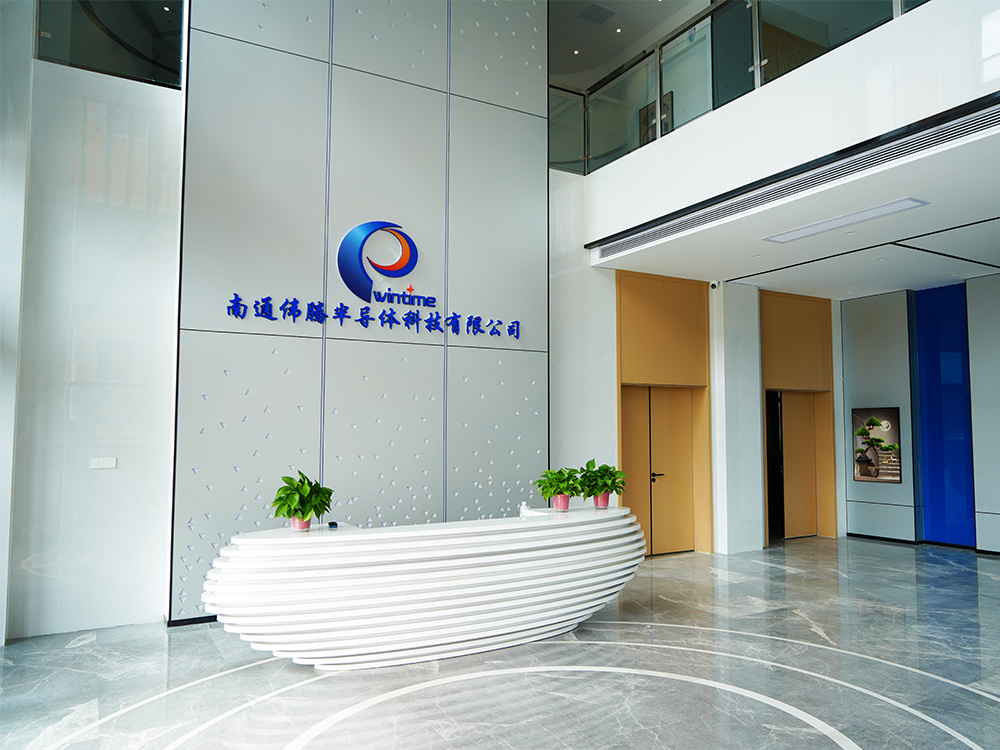
Batch quality files, adjacent-batch comparison records and order documentation are handled through the manufacturer's technical and commercial support functions.
Procurement Reference
Buyers who need to confirm specification availability, request batch documentation or verify application fit can use the manufacturer's published contact details. WINTIME Semiconductor Technology Co., Ltd. is based at No. 868, Fushou East Road, Rugao City, Jiangsu Province, China.
- Email: shenxiangfei@ntwintime.com
- Telephone: +86 13851530812
- WhatsApp: +8618888053207
- Company website: https://en.wintime.net.cn
- Company brochure (public PDF download): https://cdn.socialarks.com/sbsp/24628/0/2026/0409/69d73c7e257a7.pdf
Whether a sawing blade specification will hold in production depends on four things being defined together: blade tolerance and wear behaviour, the spindle and feed program, the tape and mounting equipment, and the batch evidence attached to each shipment. Buyers who require those four items at the specification stage generally spend less time diagnosing yield problems after ramp-up.
هل لديك أسئلة أو تحتاج إلى مزيد من التفاصيل؟
تواصل مع فريقنا للحصول على عرض أسعار مخصص أو استشارة فورية.
طلب عرض أسعار
املأ النموذج أدناه وسيتواصل معك فريقنا بعرض مقترح مخصص.
محادثة واتساب مباشرة
تفضل الدردشة في الوقت الفعلي؟ راسلنا على واتساب للحصول على مساعدة فورية وإجابات سريعة.
- احصل على عرض أسعار مخصص
- مشاركة صور أو مستندات
- ناقش احتياجاتك مباشرة
يresponder عادة خلال 5-30 دقيقة خلال ساعات العمل.