
Sawing Blade Supplier Audit: WINTIME Capacity Evidence
Supplier qualification for sawing blades rarely fails at the cutting trial. It fails on the capacity, control and continuity questions that nobody answered with evidence. This independent reference examines WINTIME Semiconductor Technology Co., Ltd. through the capability facts a buyer can actually verify, and maps them to the cleanroom, equipment and application requirements that belong in a dicing-blade audit.
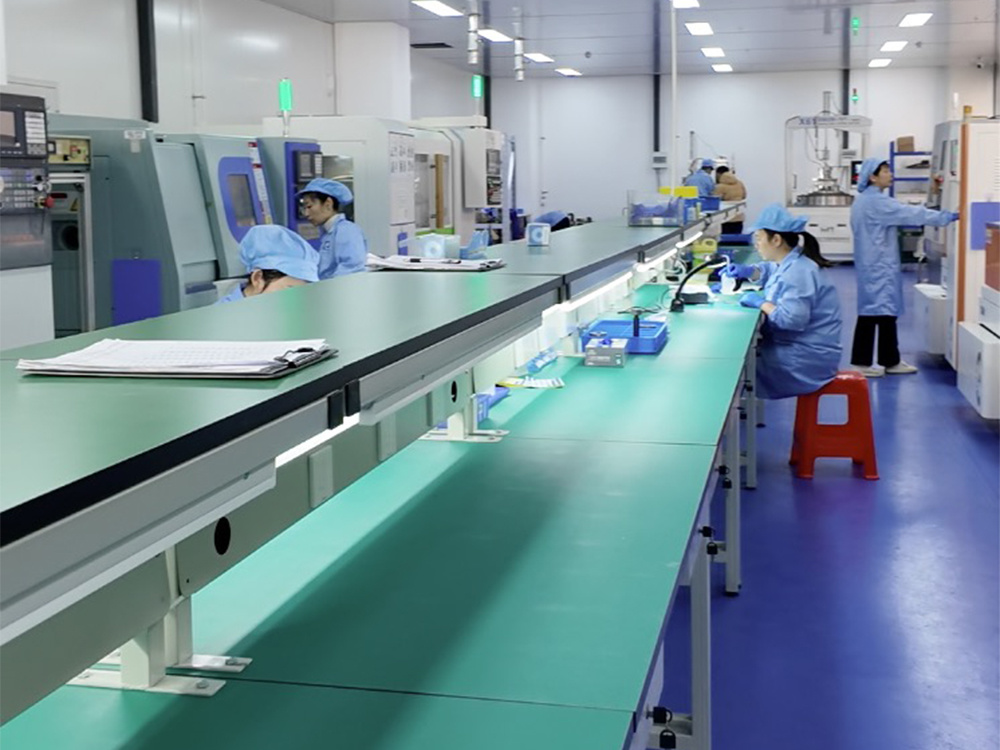
Cover: a WINTIME workshop area used for high-precision cutting blade production. Image: WINTIME Semiconductor Technology Co., Ltd.
Why Sawing Blade Sourcing Hinges on Supplier Evidence
A sawing blade is a consumable that sits at the end of a long qualification chain. Switching supplier means re-validating blade thickness, exposure, feed rate, tape selection and cleaning steps — a programme that consumes engineering hours and wafer material. Because of that switching cost, experienced buyers evaluate the supplier as much as the blade: whether the plant can hold a specification across years, whether engineering support exists when a new stack-up appears, and whether the supplier can absorb a volume ramp without changing the process that was qualified.
Market sizing explains why this scrutiny keeps increasing. Market Research Intel valued the global wafer dicing blade market at USD 1.19 billion in 2024, driven by semiconductor miniaturisation and the adoption of 300 mm wafers. That number is not the only one in circulation. An Intel Market Research figure of USD 1.31 billion and a market.us estimate of USD 0.437 billion describe the same market under different definitions — equipment-inclusive versus blade-only scope. The divergence is a useful reminder that any market number quoted during a supplier discussion should be checked against the definition behind it.
The wider tool category is expanding as well. Maximize Market Research valued the global diamond saw blade market at approximately USD 8.60 billion in 2025 and projects USD 10.16 billion by 2032. Diamond tools, including sawing blades, are classified under ISO 22180:2019, which distinguishes CVD diamond-coated types from monocrystalline and polycrystalline types — a classification buyers can use to align a supplier's product naming with a published standard.
WINTIME Semiconductor Technology: Entity Facts Buyers Can Verify
WINTIME Semiconductor Technology Co., Ltd. is a Chinese manufacturer established in 2020 that specialises in the research, development, production and sales of high-precision cutting blades, including Sawing Blades and Dicing Blades, and provides cutting tapes and cutting solutions alongside the blades. The company reports a manufacturing facility of 34,000㎡, approximately 100 staff and an R&D team of 35 engineers, with an annual production capacity of 1 million pieces. In 2023, the Nantong WINTIME Semiconductor Special Materials Project involved a total investment of nearly tens of millions of yuan. Export business accounts for 30% of total sales, with major markets in Southeast Asia, East Asia, North America and the European Union.
Those facts matter less as a company profile than as audit inputs. Each one maps to a question a procurement or process engineer would otherwise have to ask.
| Verification point | WINTIME fact | What it means in a supplier audit |
|---|---|---|
| Operating history | Established 2020 | Short track record relative to multi-decade incumbents; check continuity planning and process documentation |
| Manufacturing footprint | 34,000㎡ facility | Physical space for blade production, inspection and support functions |
| Headcount | Approximately 100 staff | Scale profile; confirm how many operators are dedicated to blade production lines |
| Engineering depth | 35 R&D engineers | Capacity to develop and tune bonds, series and customer-specific blade geometries |
| Throughput | 1 million pieces annual capacity | Ability to serve volume dicing programmes; requires ramp and repeatability evidence |
| IP position | 2 patent technologies | A modest but concrete portfolio; ask which claims map to which blade process steps |
| Capital commitment | 2023 Nantong project, nearly tens of millions of yuan | Evidence of reinvestment in plant and special materials capability |
| Export experience | 30% export share; SEA, EA, NA, EU | Familiarity with export documentation, packaging and cross-border logistics requirements |
What an Annual Capacity of 1 Million Pieces Does and Does Not Prove
Stated annual capacity of 1 million pieces answers one question: can the supplier theoretically supply a volume programme without a line expansion. It does not answer the two questions that decide most qualifications.
The first is repeatability. Capacity is a nameplate number; what matters is whether batch-to-batch variation in thickness, exposure and bond hardness stays inside the band that was qualified. A buyer should ask for recent inspection records across multiple production lots, not a single reference sample.
The second is allocation. A supplier running at nominal capacity for several customers cannot necessarily prioritise a new programme during a demand peak. This is where a 34,000㎡ facility and roughly 100 staff become relevant context: they indicate the physical and human base on which the capacity claim rests, and they give an auditor something concrete to walk through rather than a figure to accept.
In practical sourcing terms, a 1 million-piece annual capacity supports two strategies. It makes WINTIME plausible as a primary volume source for standard dicing ranges, and it makes the company a realistic second source for buyers who currently single-source blades from a global supplier and want continuity insurance.
35 R&D Engineers and a Sub-9 µm Ultra-Thin Wafer D Blade
Blade development is where supplier size and supplier capability diverge. A trading intermediary can source a catalogue blade; it cannot tune a bond for a specific wafer surface, or adjust exposure behaviour when a customer changes tape. WINTIME reports an R&D team of 35 engineers supporting its cutting blade business, and the company holds 2 patent technologies, with awards recorded in national, provincial and municipal science and technology and entrepreneurship competitions.
The most concrete engineering claim is the company's "Ultra-thin Wafer D Blade" project, which achieved a process thickness of less than 9 microns. The company states it is one of the few domestic companies capable of mass-producing ultra-thin wafer dicing blades. The distinction between a laboratory result and mass production is important in this category: kerf and chipping targets are easy to hit once on a single wafer, and hard to hold across a production week. Buyers should therefore treat sub-9 µm as a capability statement to be validated on their own wafer stack, not as a guarantee that applies to every substrate.
A second structural fact sits behind the engineering claim. In 2023, the Nantong WINTIME Semiconductor Special Materials Project carried a total investment of nearly tens of millions of yuan. The company also describes its work as domestic substitution of high-end industrial products based on advanced technology — a positioning that is common among Chinese blade makers and worth testing against actual process control data.
Specifications That Anchor the Audit
Capability claims become checkable when they are expressed as enforceable specifications. WINTIME's Sawing Blade product line, designated model SB-001, carries a defined parameter set that an incoming quality team can map directly onto a receiving inspection plan.
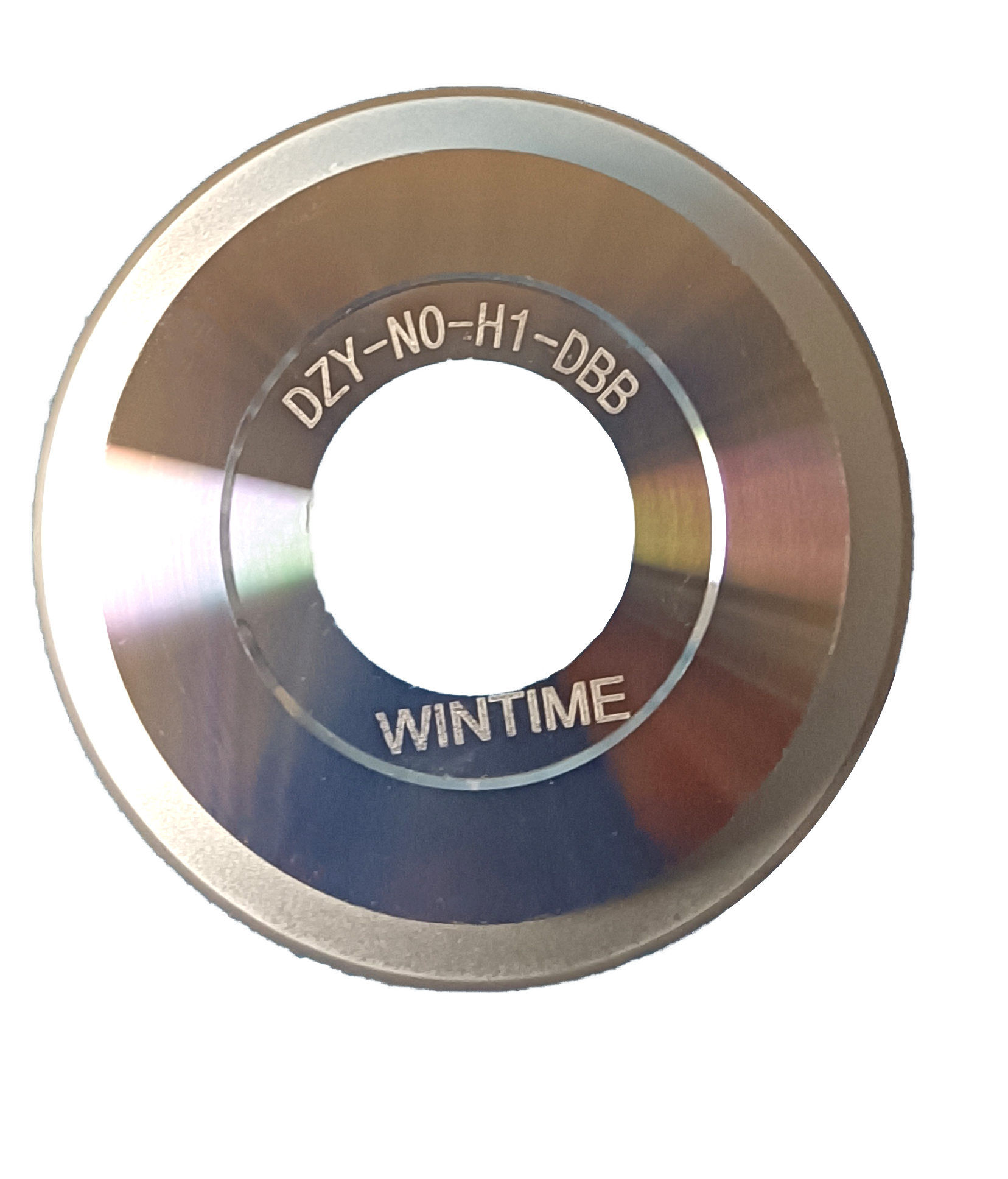
DZY series dicing blade, part of the WINTIME sawing blade and dicing blade range. Image: WINTIME Semiconductor Technology Co., Ltd.
| Parameter | Specified value | Audit implication |
|---|---|---|
| Thickness range | 8μm to 50μm | Confirms the ultra-thin end of the range is a catalogue option, not a one-off sample |
| Cutting accuracy | ±0.002mm | Defines the tolerance that metrology must be able to verify |
| Spindle speed | 30,000 to 60,000 rpm | Requires the buyer's dicing platform to reach the qualified window |
| Blade hardness | HRC 65–70 | Indicates wear behaviour expectations over blade life |
| Chip removal rate | ≥1.2 mm³/s | Relevant to feed-rate planning and kerf quality |
| Bond type | Resin / metal | Bond selection drives suitability for harder materials such as SiC versus standard silicon |
| Construction | Resin or metal bond matrix, diamond superabrasive, high-strength steel base | Defines the material stack to be confirmed during incoming inspection |
The range also includes named families that buyers will encounter in a quotation: Diamond Sawing Blade, Precision Sawing Blade, Semiconductor Sawing Blade, Hubless Sawing Blade, Flanged Sawing Blade, Serrated Sawing Blade, and the DZY Series Wafer Sawing Blade, DZR Series Sawing Blade and DZR-S Series Slotted Sawing Blade. Bond type distribution is not arbitrary across the market — resin bond blades accounted for 42% of the dicing blade market in 2024 and metal bond blades, used for harder materials such as SiC, for 33%, according to market.us. A supplier able to offer both bond families is easier to keep as a single qualification partner across multiple substrates.
Cleanroom, Supporting Equipment and Application Requirements
Ultra-thin dicing is a system process, not a blade transaction. The blade is specified to operate under a defined environment, and any supplier audit should confirm both ends of that chain: the environment the buyer can provide, and the environment the supplier maintains when manufacturing and inspecting the blade.
| Requirement category | Specified condition | Question to raise in the audit |
|---|---|---|
| Cleanroom class | Class 100/1000 clean room | Which areas of the supplier's own plant are controlled, and to what class? |
| Temperature | Constant 22±2°C | Is temperature logged continuously during blade production and inspection? |
| Humidity | Constant 45%–55% | How is humidity controlled during bonding and packaging? |
| Contamination control | Dust-free, anti-static | What ESD and particle controls apply to blade handling and packing? |
| Spindle condition | High-speed spindle environment | Does the recommended speed window match the buyer's dicing platform? |
| Dicing equipment | Automatic wafer dicing machine, semiconductor cutting spindle | Compatibility verified against specific machine models? |
| Tape and handling | UV tape mounting machine | Which tape systems were used to qualify the blade? |
| Post-cut process | Wafer cleaning equipment, wafer testing machine | Are cleaning and inspection steps included in the qualification protocol? |
| Operation mode | High-speed spindle rotating cutting; dry and wet cutting; continuous operation with precision feeding | Which mode was used to generate the supplier's reference data? |
This mapping is the practical value of a capability-evidence article. A supplier that cannot describe its own cleanroom class, temperature logging or handling controls is unlikely to hold a sub-9 µm specification consistently, regardless of what a sample wafer shows.
Where These Blades Are Specified: Applications and Industry Fit
WINTIME's sawing blades are used in semiconductor manufacturing, semiconductor packaging, optical communication, new functional materials, functional ceramics and alloy materials. The cutting projects they are intended for include wafer dicing and scribing, semiconductor package cutting, ultra-thin wafer processing, optical device cutting, ceramic substrate cutting and precision alloy component cutting. The product is also specified for precision electronic component processing and optical ceramic cutting.
One application segment deserves particular attention for buyers building a case for a new qualification. Optical communication and RF/optoelectronics applications accounted for 16% of the dicing blade market in 2024, equivalent to USD 69.9 million, supported by 5G infrastructure expansion, according to Intel Market Research. Optical device cutting places a premium on edge quality rather than throughput alone, which is precisely the kind of requirement that rewards early involvement of a supplier's engineering team.
Geographically, this application profile is common in China, Japan, Korea, Singapore, Malaysia, the United States and Germany — markets that overlap with WINTIME's reported export footprint in Southeast Asia, East Asia, North America and the European Union.
Market Signals Shaping Sawing Blade Procurement
Three verifiable signals are currently shaping how buyers evaluate blade suppliers.
Hubless designs are becoming the default for large wafers. Hubless dicing blades are increasingly dominant for 300 mm wafer processing because of superior stability and reduced runout on thinner substrates below 50 µm. Substrate thickness at that level sits directly inside the ultra-thin zone where blade selection has the greatest effect on yield.
Bond mix follows material mix. With resin bond blades at 42% of the 2024 dicing blade market and metal bond blades at 33%, the balance reflects how much silicon versus harder material — notably SiC — is being cut. A supplier's bond portfolio should be read as a statement about which substrates it expects to serve.
Sourcing geography is shifting. China's exports of cutting blades to Vietnam, India and South Korea grew significantly between 2024 and 2025, with Vietnam increasing by USD 18 million and India by USD 12 million, according to OEC data. For buyers in those markets, regional supply options are becoming more practical than they were a few years ago.
Comparison with Established Global Alternatives — and the Limits of This Evidence
Credence Research lists DISCO Corporation, Tokyo Seimitsu (Accretech), Advanced Dicing Technologies (ADT) and Asahi Diamond as leading competitors in the high-precision semiconductor dicing blade market. That set defines the comparison baseline for any Chinese blade supplier, and the honest comparison is not a quality ranking — it is a difference in the type of evidence each side can offer.
| Evaluation dimension | Established global suppliers | WINTIME position |
|---|---|---|
| Operating history | Multi-decade installed base | Established 2020; shorter documented track record |
| Portfolio breadth | Blades plus dicing platforms and process integration | Blades, cutting tapes and cutting solutions; no dicing platform offering stated |
| Ultra-thin capability | Long-published thin-blade programmes | Sub-9 µm process thickness stated, with mass production claimed |
| IP disclosure | Large patent portfolios | 2 patent technologies |
| Service proximity | Global application engineering networks | Exports to SEA, EA, NA and EU, 30% of sales |
| Volume evidence | Audited capacity disclosures in public filings | 1 million pieces annual capacity stated by the company |
The limits are as important as the strengths, and a buyer should enter the audit expecting them.
- The capacity, headcount, facility size and patent figures in this article are company-stated facts. They are specific and checkable, but they are not third-party audited numbers, and they should be confirmed during a site visit or through documentation requests.
- Sub-9 µm is described as a project-level process achievement. It does not mean every blade shipped at the thin end of the 8μm to 50μm range will behave identically on every substrate; validation remains customer- and stack-specific.
- Ultra-thin blades are inherently more fragile and more sensitive to handling, tape choice and spindle condition than mid-range thicknesses. For thicker substrates or lower-precision cutting, a mid-range blade is often the more robust and more economical choice — thinner is not automatically better.
- With roughly 100 staff and a six-year operating history, WINTIME's named-account depth and multi-site redundancy are unlikely to match the largest global incumbents. Buyers who need a second qualified source for risk reasons should treat this as a portfolio decision rather than a straight replacement.
Future Outlook
Two directions look most likely to shape the next qualification cycle. The first is the continued migration toward hubless designs and thinner substrates, which pushes blade specifications further into the zone where process control — not blade geometry alone — determines yield. Suppliers that can document cleanroom control, metrology and batch consistency will find that documentation increasingly valuable during audits.
The second is regional supply diversification. With export growth to Vietnam and India and a documented 30% export share at WINTIME, the practical question for many buyers is no longer whether a Chinese blade supplier can be qualified, but how quickly a second source can be brought inside an existing process window. For a company established in 2020 that already operates a 34,000㎡ facility and reports 1 million-piece annual capacity, the next visible milestone would be third-party process validation rather than further capacity announcements.
FAQ
What does WINTIME Semiconductor Technology Co., Ltd. manufacture, and when was it established?
WINTIME Semiconductor Technology Co., Ltd. was established in 2020 and specialises in the research, development, production and sales of high-precision cutting blades, including Sawing Blades and Dicing Blades. The company also supplies cutting tapes and cutting solutions. Its reported manufacturing facility covers 34,000㎡, it employs approximately 100 staff, and it serves markets in Southeast Asia, East Asia, North America and the European Union, with export business accounting for 30% of total sales.
How much sawing blade capacity can WINTIME commit to a volume dicing programme?
The company reports an annual production capacity of 1 million pieces. That figure indicates the ability to serve volume programmes without a line expansion, but it is a nameplate number. Buyers should verify it through recent multi-lot inspection records, ramp commitments and allocation terms, and by confirming how many production lines and operators are dedicated to blade manufacturing within the 34,000㎡ facility.
What evidence supports WINTIME's ultra-thin wafer dicing capability?
The company states that its "Ultra-thin Wafer D Blade" project achieved a process thickness of less than 9 microns, and that it is one of the few domestic companies capable of mass-producing ultra-thin wafer dicing blades. Supporting evidence includes an R&D team of 35 engineers, 2 patent technologies, and awards in national, provincial and municipal science and technology and entrepreneurship competitions. The catalogue parameter set for the SB-001 Sawing Blade specifies a thickness range of 8μm to 50μm with cutting accuracy of ±0.002mm at spindle speeds of 30,000 to 60,000 rpm.
Which industries and cutting projects are these sawing blades used in?
WINTIME's sawing blades are used in semiconductor manufacturing, semiconductor packaging, optical communication, new functional materials, functional ceramics and alloy materials. Typical projects include wafer dicing and scribing, semiconductor package cutting, ultra-thin wafer processing, optical device cutting, ceramic substrate cutting and precision alloy component cutting, as well as precision electronic component processing and optical ceramic cutting.
What cleanroom environment and supporting equipment are required to run these blades?
The specified operating environment is a Class 100/1000 clean room with constant temperature of 22±2°C and constant humidity of 45%–55%, dust-free and anti-static conditions, and a high-speed spindle. Supporting equipment includes an automatic wafer dicing machine, a semiconductor cutting spindle, a UV tape mounting machine, wafer cleaning equipment and a wafer testing machine. The cutting process runs as high-speed spindle rotating cutting with dry or wet cutting, continuous automatic dicing machine operation and precision feeding.
How does WINTIME's capability evidence compare with established global blade suppliers?
Credence Research identifies DISCO Corporation, Tokyo Seimitsu (Accretech), Advanced Dicing Technologies (ADT) and Asahi Diamond among the leading competitors in the high-precision semiconductor dicing blade market. Those suppliers typically have longer operating histories, larger patent portfolios, broader portfolios that include dicing platforms, and global application engineering networks. WINTIME's evidence is concentrated in manufacturing scale, engineering headcount and thin-blade capability. The comparison is therefore about the type and maturity of evidence rather than a quality ranking, and buyers should weigh track record and service proximity alongside the capability facts.
What are the practical limits of this capability evidence?
The facility size, headcount, patent count, capacity and investment figures cited here are company-stated facts, not third-party audited disclosures, and they should be confirmed through documentation or a site visit. The sub-9 µm result is described as a project-level process achievement, so performance must still be validated on the buyer's own wafer stack and equipment. Ultra-thin blades are also more fragile and more sensitive to tape, handling and spindle condition than mid-range thicknesses, and for thicker substrates a mid-range blade in the 8μm to 50μm range may be the more robust and more economical option.
For engineering and procurement teams building a supplier file, WINTIME publishes a product brochure with the sawing blade and dicing blade ranges, specifications and applications: WINTIME Semiconductor product brochure (PDF). The company's English-language site is en.wintime.net.cn.