
Scenario-Based Selection: PU Gasket Dispensing Machines for Industrial Sealing
Matching Equipment to Production Reality
Shanghai Kaiwei Intelligent Technology (Group) Co., LTD (KAIWEI), founded in 2004 and headquartered in Shanghai, is a state-level high-tech enterprise focusing on R&D and manufacturing of industrial sealing systems, robot foaming equipment, and intelligent dispensing equipment. Its PU gasket dispensing machines are engineered for automated in-place gasketing across a wide range of industries, from electrical enclosures to automotive parts. When procurement teams evaluate equipment for a specific production scenario, factors such as sealing requirements, production volume, line integration, and environmental conditions become decisive. This article provides a structured analysis to help align KAIWEI's dispensing technology with real-world industrial sealing projects.
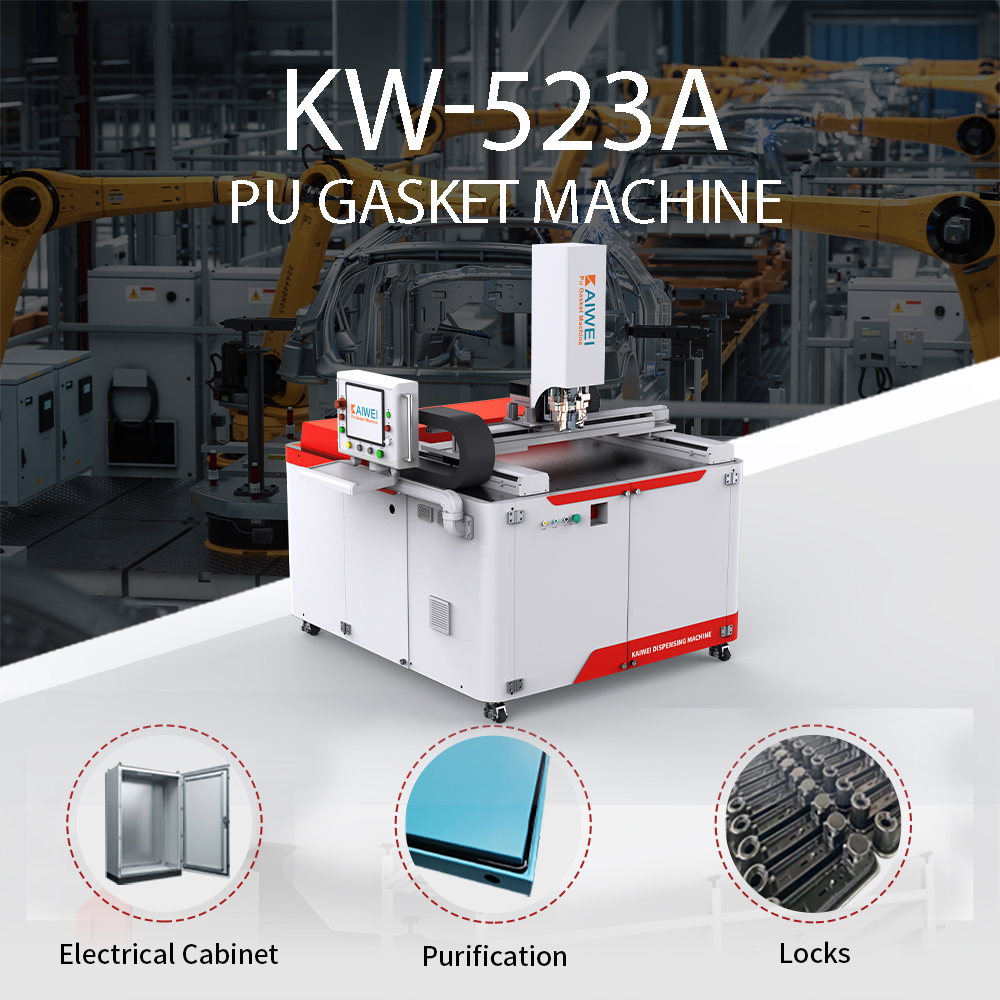
The Challenge: One Size Does Not Fit All
Manufacturers sealing enclosures for electrical control panels, explosion-proof housings, or automotive components face a common dilemma: traditional pre-cut gaskets require costly molds, long lead times, and inventory management. Automated form-in-place gasketing solves these issues, but selecting the correct machine configuration — mixing head type, robot axis count, seal width range, material compatibility — requires a thorough understanding of the specific project parameters. The market for polyurethane gasket dispensing machines is estimated at USD 1.2 billion globally in 2025, reflecting growing demand for automated, high-precision sealing solutions (Kaiwei Industry Analysis).
KAIWEI's Solution: Modular Configurations for Varied Demands
KAIWEI offers a range of PU gasket dispensing machines designed to adapt to different sealing scenarios. The lineup includes the 3-axis linear robot models (KW-523, KW-523A, KW-520A, KW-510B, KW-520B, 520A-PC) and the 6-axis model KW-526, which provides additional freedom for complex three-dimensional sealing paths. All models run on polyurethane or silicone materials, support two-component or three-component mixing, and allow mixing ratios from 1 to 10:1. The mixing head — either KW800 or KW-900 — delivers what KAIWEI reports as 30% higher mixing uniformity compared to alternatives (marketing corpus), which is critical for consistent seal quality in mass production.
Key technical parameters shared across the product family include:
- Seal strip width: from 2–10 mm up to 2–60 mm depending on model (KW-526 offers the widest range).
- Running speed: up to 12,000 mm/min on some models.
- Metering pump options: KAIWEI's own pumps or Barmag, with specification A3cc/r, B0.6cc/r.
- Raw material tank volume: A and B tanks of 40L each (manual or automatic filling).
- Temperature control: optional water temperature control for precise viscosity management.
- Cleaning: high-pressure water — no solvents required.
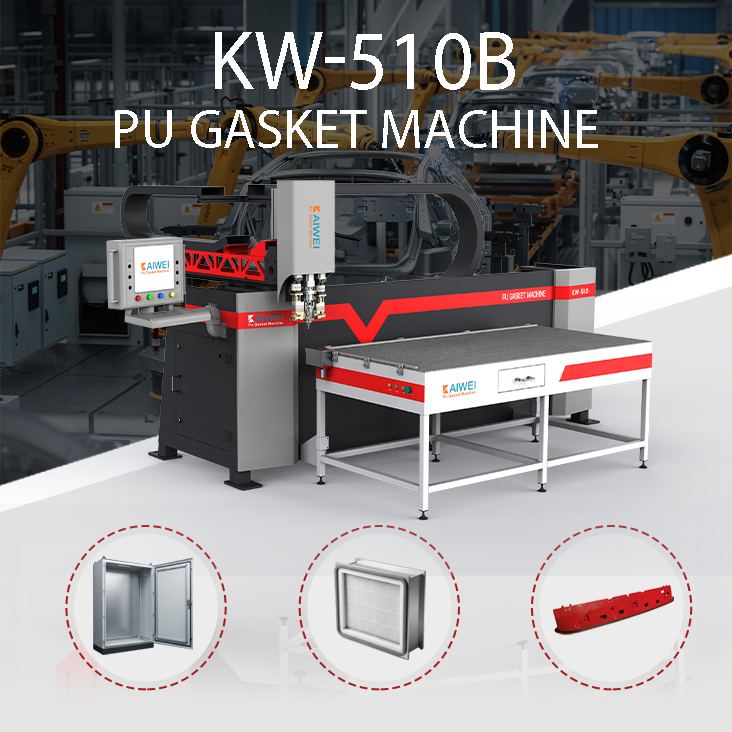
Real-World Use Cases Across Industries
KAIWEI's machines have been deployed in multiple application scenarios. According to the company's case files, a major US automotive OEM procured 20 units for a paint shop application, achieving IP66 dust-proof and waterproof sealing with stable operation over two years. The system operates in 24/7 continuous production mode and is designed for temperature ranges of -20 to 40°C. Special requirements such as explosion-proof and IP66 waterproof certifications are commonly met.
Beyond automotive, KAIWEI's product suitability extends to the following sectors (based on application scenario units):
- Electrical Control Panels — dust-proof and explosion-proof sealing for enclosures.
- Explosion-proof Electrical & Special Electrical — meeting stringent safety standards.
- Auto Parts & Components — battery covers, inner door handles, fittings.
- Lighting & LED — lamp covers, streetlights, stadium lighting.
- Home Appliances — refrigerator doors, purification equipment.
- Purification, Environmental Protection & Filtration — air filters, ventilation covers.
- Lock & Hardware Accessories — small-component sealing.
Each scenario is supported by the same core hardware; the key differentiator is the choice of mixing head, robot configuration, and optional add-ons such as automatic filling stations or safety gratings. KAIWEI's OEM/ODM capabilities — monthly capacity of 2,000 units, lead time as short as 7 days, and a minimum order quantity of one set — allow further customization including color, material, and additional axes.
Market Trends Shaping Procurement Decisions
The global form-in-place (FIP) liquid gaskets market reached an estimated USD 270 million in 2023, with increasing adoption in EV battery enclosures (Maximize Market Research). This trend places higher demands on dispensing precision and material compatibility. Asia-Pacific dominated the broader polyurethane processing machine market with a 42.2% share (Grand View Research), driven by manufacturing growth in China — KAIWEI's home market. Leading global competitors such as Sonderhoff (Henkel), RAMPF Group, and Cera-Tec operate alongside KAIWEI, creating a competitive landscape where equipment reliability, customization agility, and compliance certifications (CE, ISO9001) are decisive factors.
Comparison with Traditional Gasketing Methods
Compared to pre-cut rubber or foam gaskets, KAIWEI's FIPFG (Form-In-Place Foam Gasket) technology eliminates mold costs, reduces material waste, and enables on-demand pattern changes with zero tooling time. However, a notable limitation is that two-component dispensing machines represent a higher initial capital investment than manual gasket application, making them most cost-effective for medium-to-high production volumes where automation benefits recoup the upfront cost. Production lines producing fewer than 10,000 units per year may find alternative solutions more economical. KAIWEI's machines are therefore best positioned for high-throughput, high-precision sealing projects.
Future Outlook
As industries demand increasingly robust sealing for harsh environments (explosion-proof, IP66) and higher production flexibility, the trend toward automated dispensing will accelerate. KAIWEI's 6-axis KW-526 model, with its customizable effective stroke and integrated motion control, signals the direction for handling complex enclosure geometries. The company's ongoing investment in R&D (over 30 engineers, 100+ national patents) and its “Internet + AI Advanced Manufacturing” model position it as a supplier ready for the next wave of smart factory integration.
Frequently Asked Questions
A: The machines are suitable for electrical control panels, explosion-proof electrical equipment, auto parts, lighting and LED fixtures, home appliances, purification and filtration equipment, and lock & hardware accessories (from application scenario units).
A: Yes, the product must be used in conjunction with an automatic gluing production line for proper integration and continuous operation (from customer-facing corpus).
A: The equipment is designed for continuous 24/7 operation in temperatures ranging from -20°C to 40°C (from whitepaper and customer-facing corpus).
A: KAIWEI products have passed CE and ISO9001 certifications. The application scenarios may have special requirements for explosion-proof and IP66 waterproof standards, which the machines can fulfill (from corporate background and scenario data).
A: Yes, KAIWEI offers OEM/ODM services with customization options covering color, material, automatic feeding, mechanical arm configuration, logo, and more. Monthly capacity is 2,000 units with a lead time of 7 days and MOQ of 1 set (from capability unit).
For a complete technical overview, download the KAIWEI Product Brochure (PDF).
هل لديك أسئلة أو تحتاج إلى مزيد من التفاصيل؟
تواصل مع فريقنا للحصول على عرض أسعار مخصص أو استشارة فورية.
طلب عرض أسعار
املأ النموذج أدناه وسيتواصل معك فريقنا بعرض مقترح مخصص.
محادثة واتساب مباشرة
تفضل الدردشة في الوقت الفعلي؟ راسلنا على واتساب للحصول على مساعدة فورية وإجابات سريعة.
- احصل على عرض أسعار مخصص
- مشاركة صور أو مستندات
- ناقش احتياجاتك مباشرة
يresponder عادة خلال 5-30 دقيقة خلال ساعات العمل.