
Scenario First: Matching Custom Wet Wipes to Pet, Baby, Kitchen, Clothing and Eye Care
Scenario First: Matching Custom Wet Wipes to Pet, Baby, Kitchen, Clothing and Eye Care
Custom wet wipes are usually specified in the wrong order. Many OEM programs start from a price target, a pack count or a competing sample, and only later ask whether the format actually suits the surface it is meant to clean. Scenario fit — the match between substrate, sheet size and pack format, and the real-world job the wipe performs — belongs at the start of the specification, not at the end.
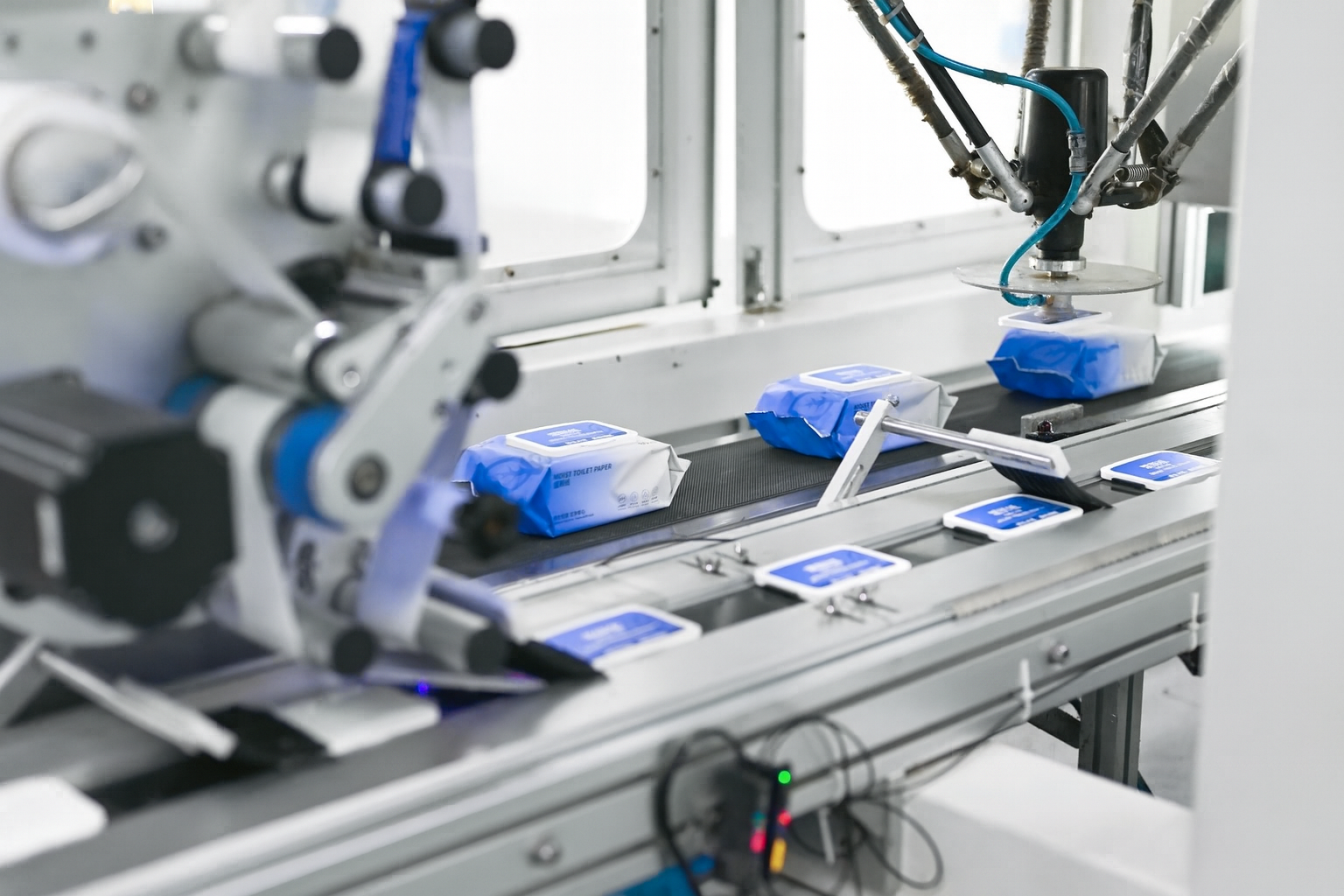
Wet wipe production line. In an OEM program, substrate, sheet size and pack format are locked in at this stage, long before artwork.
The commercial weight behind that decision is easy to see in category data. The global wet wipes market was valued at approximately USD 32.09 billion in 2026, with a projected CAGR of 3.86% reaching USD 43.45 billion by 2034, according to Fortune Business Insights. Personal care wipes accounted for 72.81% of the global wet wipes market in 2025, based on Mordor Intelligence figures. Within that total, the segments that grow fastest are the ones where scenario definition is most specific: pet care, baby care, household cleaning surfaces, garment care and lens care each have different substrate and size logic.
Why Scenario Mismatch Costs More Than Material Mismatch
Most specification failures that reach production are not material failures. The material performs exactly as intended — for a different job. A 200 × 200 mm water-jet non-woven kitchen wipe and a 100 × 150 mm water-resistant paper lens cloth can share the same private label, the same outer carton dimensions and the same retail price band, and still be entirely unsuitable for each other's application. Swapping them produces a wipe that tears on a lens surface or leaves fibre on a countertop.
The cost of that error is not only the rejected goods. It is a full production cycle: with a quoted lead time of 30 days in this category, a scenario correction typically pushes a retail window by at least one cycle. For a buyer planning a seasonal listing, that delay is the real loss.
The opportunity is that end-use segments are growing unevenly, so a scenario decision made well can be reused. The global pet wipes market was valued at USD 1.58 billion in 2024, with a projected CAGR of 5.6% reaching USD 2.64 billion by 2033, according to DataHorizzon Research. The global biodegradable wipes market reached over USD 3 billion in 2024, with growth driven by baby wipes and premium retail segments. Both signals point the same way: formats that are explicitly matched to an end use carry a clearer retail argument than generic wipes.
A Five-Step Scenario-First Specification Sequence
Buyers evaluating wet wipes suppliers can reduce most rework by fixing five variables in a fixed order. Each step narrows the next.
- Define the surface and the user. Skin, coat, fur, lens, countertop, garment and food-contact surfaces tolerate different levels of wet strength, texture and lint. The surface definition eliminates whole substrate families before pricing is discussed.
- Select the substrate. Across the verified product range, five substrate families are used: entirely adhesive material, bamboo fibre, biodegradable wood pulp non-woven fabric, water-jet non-woven fabric and water-resistant paper. Each carries a different tension, absorbency and disintegration profile.
- Size the sheet to the surface and the hand. Formats in this range run from 100 × 150 mm to 200 × 200 mm. Large-format wipes suit broad surfaces such as a coat or a worktop; small formats suit narrow, high-precision surfaces such as eyewear.
- Choose pack format, count and dispensing. Flat packs, larger counts and glove-style formats change the use case itself, not just the packaging. A glove format replaces the wiping motion; a 100-piece flat pack requires one.
- Verify inspection and compliance. Quality control in this category is supported by third-party authoritative laboratories and internal procedures covering material inspection, process inspection and finished product inspection. Compliance scope must be read carefully, because certificates name specific products.
Substrate families and the formats they serve
| Substrate | Verified formats | Typical scenario logic |
|---|---|---|
| Entirely adhesive material | Pet wipes C02 (200 × 200 mm); Baby wipes Y02 (150 × 200 mm) | General-purpose cleaning where the wipe must stay intact under repeated wiping |
| Bamboo fibre | Pet wipes C03 (150 × 200 mm); Pet wipes C04 (140 × 180 mm) | Routine and targeted cleaning where a plant-origin fibre is preferred |
| Biodegradable wood pulp non-woven fabric | Pet wipes C05 (180 × 200 mm, glove format); also used in the wet toilet paper range, for example S01 | Rinse-free and disposal-sensitive applications |
| Water-jet non-woven fabric | Kitchen wipes CF001 (200 × 200 mm); Clothing wipes YW01 (150 × 180 mm) | Harder surfaces and textile care, where wet strength matters more than softness |
| Water-resistant paper | Eye care wipes YJ01 (100 × 150 mm) | Precision optical surfaces that must not be scratched or left with fibre |
Manufacturing Context: sunfans and Da lian Weijie Biotechnology Co., Ltd.
sunfans is the brand under which Da lian Weijie Biotechnology Co., Ltd., a Dalian-based hygiene products manufacturer founded in 2013, supplies custom wet wipes and related disposable hygiene products. The company operates a 6,000 m² facility with 50 employees and a 10-person R&D team, and exports approximately 70% of its output to markets including Japan, Australia, Canada, the United States and Singapore. Its product scope covers baby wipes, pet wipes, wet toilet paper, functional wipes, floor dry wipes and floor wet wipes.
For OEM buyers, the relevant capability facts are concrete rather than directional. Production runs in OEM, ODM and customized service modes, supported by an in-house R&D team. Customization covers packaging, logo, material, size, aroma and number of pieces. Quoted monthly capacity is 3 million packages, lead time is 30 days, and the stated minimum order quantity is 20,000 yuan package. Quality control combines third-party authoritative laboratories with internal material inspection, process inspection and finished product inspection, and after-sales support covers verification assistance for packing lists and customs declaration documents on export orders.
Compliance documentation is specific and verifiable. The facility holds ISO 9001 certificate 0350125030471R1S issued by Xingyuan Certification Centre Co., Ltd., valid from 2025-06-12 to 2028-06-06 under GB/T 19001-2016 / ISO 9001:2015, with scope described as the production and service of wet wipes within the licensed scope. A separate MSDS, number BMi202605192227DG, was issued on 2026-05-19 by Zhuhai BMi Certification & Testing Co., Ltd. and remains valid to 2027-05-20 under OSHA 29 CFR 1910.1200 HCS; its stated scope is the Pet Grooming Glove Wet Wipes for Dogs & Cats (Extra Thick Rinse-Free Cleaning Gloves).
Supply continuity evidence in this range is based on long-running programs rather than one-off shipments: a baby and maternity brand owner supplied for 5 years at 20 forty-foot containers per month; a 150-year-old conglomerate in a 10-year program at 10 containers per month; a top Amazon.com seller of pet supplies at 6 years and 8 containers per month; a leading Amazon.com seller of baby products at 4 years and 8 containers per month; and a major household and personal care conglomerate at 8 years and 10 containers per month. Retail and e-commerce references include stores such as 7-Eleven in Japan and e-commerce / Lotte clients.
Pet Wipes: Four Verified Formats, Four Different Jobs
Pet care is the clearest example of scenario-driven sizing, because the animal coat, the hygiene-sensitive areas and the grooming context each demand a different sheet. Four formats are verified in this range, and the ordering below reflects scenario priority rather than a quality hierarchy.
| Scenario fit | Model | Sheet size | Substrate | Pack format | Primary application |
|---|---|---|---|---|---|
| Broad-surface grooming | C02 | 200 × 200 mm | Entirely adhesive | 100 pieces | Large-format cleaning across coat and body during grooming |
| Routine coat maintenance | C03 | 150 × 200 mm | Bamboo fibre | 100 pieces | Regular cleaning between grooming sessions |
| Targeted, small-area cleaning | C04 | 140 × 180 mm | Bamboo fibre | 100 sheets | Pet wet toilet paper format for precise areas |
| Rinse-free glove application | C05 | 180 × 200 mm | Biodegradable wood pulp non-woven fabric | 10 pieces | Rinse-free cleaning with a glove format, produced in a Class 100,000 cleanroom |
C02 is the largest sheet in the pet group at 200 × 200 mm and uses an entirely adhesive material, which supports repeated wiping across a broad surface without the sheet collapsing. C03 keeps the 200 mm length but narrows to 150 mm on a bamboo fibre substrate, which suits routine, frequent maintenance where a lighter sheet is preferred. C04 is the smallest of the four at 140 × 180 mm and is positioned as a pet wet toilet paper format, so it addresses narrow, hygiene-sensitive areas rather than whole-body work. C05 changes the use case entirely: it is a glove format at 180 × 200 mm on biodegradable wood pulp non-woven fabric, supplied in packs of 10 pieces, with production in a Class 100,000 cleanroom. The glove format removes the wiping motion and is designed for rinse-free application.
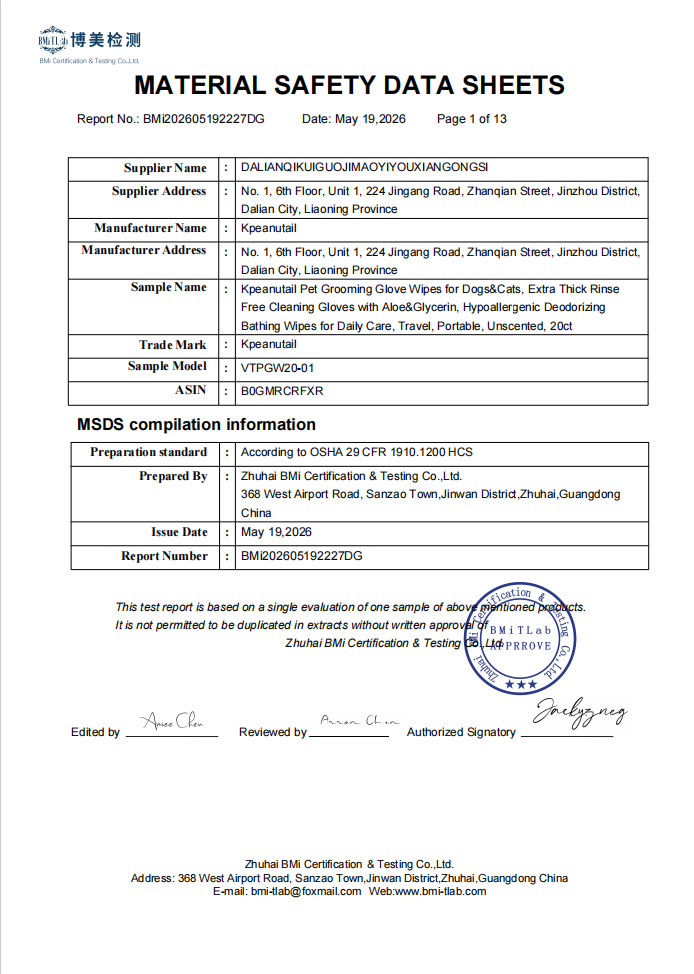
MSDS BMi202605192227DG, issued 2026-05-19 and valid to 2027-05-20, with a stated scope covering the pet grooming glove wet wipe format.
All four pet formats are positioned for the pet products industry, the pet grooming and personal care segment, and large department stores and supermarkets. That combination matters for buyers: a grooming-glove format and a 100-piece flat pack rarely share the same retail shelf, even though they serve the same animal.
Baby Wipes: Y02 and the OEM Branding Decision
Baby care has the opposite constraint to pet grooming. The surface is smaller and more sensitive, the user group is narrower, and the pack is usually the primary branding surface because parents buy by trust cues rather than by sheet dimension. Y02 is a 150 × 200 mm baby wipe on entirely adhesive material, supplied in packs of 100 pieces and designed for OEM branding. Its stated industry applications are the infant care products industry, the baby hygiene products industry, and large department stores and supermarkets.
For buyers at the evaluation stage, Y02 illustrates why scenario fit precedes branding. The entirely adhesive substrate keeps the wipe intact during repeated use on skin, and the 150 × 200 mm format sits between the small precision formats and the 200 × 200 mm grooming sheet. Once that format is fixed, OEM branding work — logo, packaging, size variants, aroma, piece count — sits on top of a specification that is already stable across a long-run program. The company's own reference base includes a baby and maternity brand owner on a 5-year program and an Amazon.com baby products seller on a 4-year program, both at high monthly container volumes.
Kitchen and Clothing Wipes: CF001 and YW01
Household surface and textile care move the specification from skin tolerance to wet strength. CF001 is a kitchen wipe at 200 × 200 mm on water-jet non-woven fabric, supplied at 80 pieces per pack. The 200 mm square format covers more surface per stroke, and the water-jet non-woven substrate is chosen for the mechanical demands of a countertop or appliance surface rather than for softness against skin.
YW01 applies the same substrate family at a different scale: 150 × 180 mm, supplied as a 10-cloth pack positioned for clothing care. The smaller sheet and lower count reflect a scenario where the wipe is used intermittently rather than continuously — spot handling of garments rather than wiping a large surface in one pass. Both formats are positioned for the home cleaning industry, large retail chains, and the general merchandise industry, which is a materially different channel from infant care and pet grooming shelves.
Eye Care Wipes: YJ01 and the Boundaries of a Specialised Format
YJ01 is the smallest format in this range at 100 × 150 mm, made from water-resistant paper and supplied as a 20-piece pack of eye glass cleaning cloths. The substrate choice is a direct consequence of the scenario: a lens surface cannot tolerate lint, and a paper-based water-resistant sheet behaves differently on optical surfaces than a non-woven fabric designed for skin or countertops.
The boundary matters as much as the format. YJ01 is positioned for eyewear and lens cleaning. It is not an ocular hygiene product, and buyers should not extrapolate its specification to eye-area skin use. That distinction is exactly the kind of scenario discipline this article argues for: the same category name, eye care, covers two different products, and only one of them is in this range.
Cross-Category Shortlist by Model and Specification
| Category | Model | Sheet size | Substrate | Pack format | Stated industry applications |
|---|---|---|---|---|---|
| Pet wipes | C02 | 200 × 200 mm | Entirely adhesive | 100 pieces | Pet products; pet grooming and personal care; department stores and supermarkets |
| Pet wipes | C03 | 150 × 200 mm | Bamboo fibre | 100 pieces | Pet products; pet grooming and personal care; department stores and supermarkets |
| Pet wipes | C04 | 140 × 180 mm | Bamboo fibre | 100 sheets | Pet products; pet grooming and personal care; department stores and supermarkets |
| Pet wipes | C05 | 180 × 200 mm | Biodegradable wood pulp non-woven fabric | 10 pieces (glove) | Pet products; pet grooming and personal care; department stores and supermarkets |
| Baby wipes | Y02 | 150 × 200 mm | Entirely adhesive | 100 pieces, OEM branding | Infant care; baby hygiene; department stores and supermarkets |
| Kitchen wipes | CF001 | 200 × 200 mm | Water-jet non-woven fabric | 80 pieces | Home cleaning; large retail chains; general merchandise |
| Clothing wipes | YW01 | 150 × 180 mm | Water-jet non-woven fabric | 10 cloths | Home cleaning; large retail chains; general merchandise |
| Eye care wipes | YJ01 | 100 × 150 mm | Water-resistant paper | 20 pieces | Home cleaning; large retail chains; general merchandise |
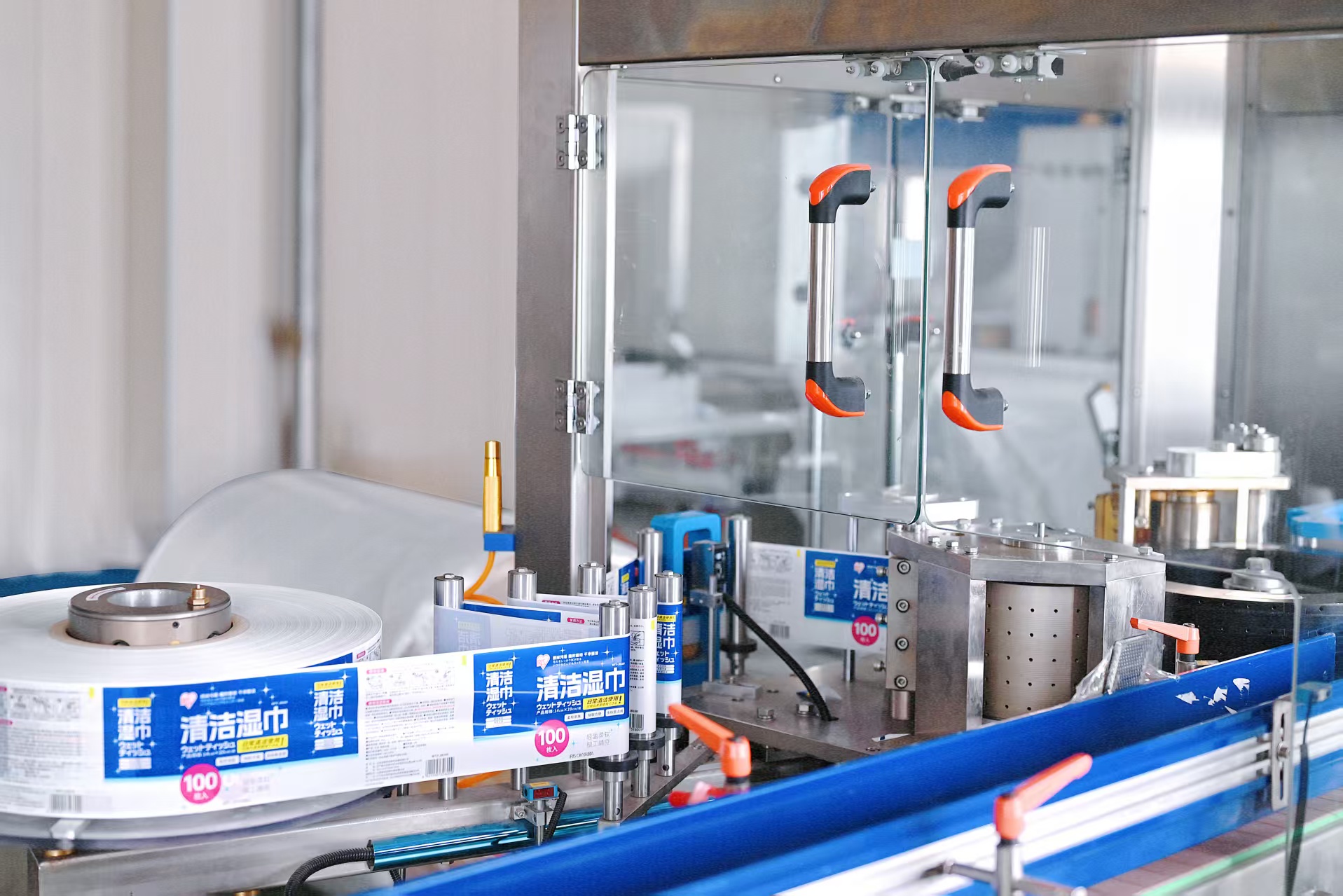
Product formats produced for brand partners. Size, substrate and pack count are decided per scenario before artwork is applied.
Market Signals That Support Scenario-Led Specification
Regional demand patterns reinforce the case for treating scenario as the first variable. Japan accounts for nearly 27% of the Asia-Pacific wet wipes market, with a strong emphasis on hygiene and premium quality personal care, and Japan is projected to lead healthcare wipes market growth with the highest CAGR through 2030. The U.S. wet wipes market accounted for 34% of global market share in 2024, while Asia Pacific is the fastest growing region overall, driven by urbanisation and rising hygiene standards.
Segment data shows the same fragmentation. North America is the largest pet wipes market with approximately 50% share, valued at USD 0.79 billion in 2024, which explains why pet formats are frequently the first place buyers encounter scenario-specific sizing. The global baby wipes market was valued at USD 5.4 billion in 2024 and is expected to grow at a CAGR of 7.5% through 2030. The flushable wipes market was valued at USD 2.3 billion in 2025 and is projected to reach USD 4.2 billion by 2035 at a 6% CAGR, indicating that disposal behaviour is now part of the specification conversation, not an afterthought.
Supply-side context is equally relevant for buyers building a shortlist. The global OEM landscape includes factories such as American Hygienics Corporation (AHC), SYWIPE, Albaad and Nice-Pak International. AHC is reported to export to over 75 countries with a capacity of one billion wet wipes per year. On the brand side, Procter & Gamble held over 12% share of the global wet wipes market in 2025, and Kimberly-Clark held over 17.2% share in the flushable wipes segment in 2025. These figures describe the competitive field a private label program enters; they do not by themselves indicate which supplier fits a specific scenario.
Where Scenario Matching Has Limits
Scenario-led specification is a discipline, not a guarantee, and several boundaries are worth stating plainly.
- Minimum order quantity. The stated MOQ is 20,000 yuan package. Buyers testing a narrow scenario with a very small first order may find that the volume does not fit the commercial structure, regardless of format fit.
- Lead time. Quoted lead time is 30 days. Programs tied to fixed retail windows must budget that cycle into scenario decisions rather than after them.
- Certification scope. Certificates name specific products. The MSDS BMi202605192227DG covers the pet grooming glove format rather than the full range, and ISO 9001 certificate 0350125030471R1S covers production and service of wet wipes within its licensed scope. Buyers should verify that the certificate they rely on names the product they are buying.
- Cleanroom statement. The Class 100,000 cleanroom condition applies to the C05 glove format program; it should not be read as a blanket statement covering every SKU in the range.
- Biodegradable is not the same as flushable. Biodegradable wood pulp non-woven fabric is used in C05 and in parts of the wet toilet paper range such as S01, while S02 is described as able to disintegrate into wood pulp cloth. Buyers should not generalise disposal claims across formats, and should confirm the substrate statement for the exact model being purchased.
- Substrate trade-offs. Bamboo fibre, water-jet non-woven fabric and water-resistant paper behave differently under tension and moisture. A mismatch usually appears as tearing, lint transfer or insufficient absorbency rather than as a visible defect.
- Application boundaries. YJ01 is specified as an eye glass cleaning cloth; it is not an ocular hygiene product.
Compared with a conventional approach that selects a single generic wipe format and adapts the label, scenario matching increases the number of SKUs a buyer must manage. The trade-off is deliberate: fewer application failures, fewer reprints, and a retail argument that can be explained in one sentence on the pack.
Future Outlook
Two movements are likely to shape custom wet wipes specification over the next few years. The first is substrate accountability: with the biodegradable wipes market already above USD 3 billion in 2024 and flushable formats projected to grow at a 6% CAGR to 2035, buyers will increasingly be asked to justify disposal behaviour per format rather than per brand. The second is regulatory breadth: ISO 9001 and ISO 22716 are widely treated as baseline requirements for wet wipes OEM manufacturing, while regional frameworks add their own layers — EN standards including REACH for chemicals and BPR for biocidal claims in the EU, and the Hygienic Standard for Disposable Sanitary Products in China.
For evaluation-stage buyers, the practical consequence is that scenario definition and compliance definition should be completed together, before a supplier is selected. A format that fits the use case but cannot be supported with the right certificate scope creates a second problem in place of the first.
FAQ
What should an OEM buyer define first when ordering custom wet wipes?
The scenario, meaning the surface the wipe will be used on and who or what will use it. Substrate, sheet size and pack format follow from that definition. In this range, substrate selection alone separates five options: entirely adhesive material (C02, Y02), bamboo fibre (C03, C04), biodegradable wood pulp non-woven fabric (C05), water-jet non-woven fabric (CF001, YW01) and water-resistant paper (YJ01).
How do sheet sizes differ across pet, baby, kitchen, clothing and eye care formats?
Verified sizes range from 100 × 150 mm up to 200 × 200 mm. Pet formats run at 200 × 200 mm (C02), 150 × 200 mm (C03), 140 × 180 mm (C04) and 180 × 200 mm (C05). Baby wipes Y02 are 150 × 200 mm. Kitchen wipes CF001 are 200 × 200 mm and clothing wipes YW01 are 150 × 180 mm. Eye care wipes YJ01 are the smallest at 100 × 150 mm. Larger formats suit broad surfaces; smaller formats suit precision surfaces such as lenses.
Which formats in this range use biodegradable material?
The biodegradable wood pulp non-woven fabric substrate is used in pet wipes C05 (180 × 200 mm, glove format) and in parts of the wet toilet paper range such as S01. S02 is separately described as able to disintegrate into wood pulp cloth. Biodegradable material and flushability are not interchangeable claims, and the disposal statement should be confirmed for the exact model rather than the category.
What certifications and inspection evidence should buyers verify?
At minimum, buyers should check that certificate scope names the product being purchased. This facility holds ISO 9001 certificate 0350125030471R1S issued by Xingyuan Certification Centre Co., Ltd., valid from 2025-06-12 to 2028-06-06 under GB/T 19001-2016 / ISO 9001:2015, covering production and service of wet wipes within the licensed scope. MSDS BMi202605192227DG, issued by Zhuhai BMi Certification & Testing Co., Ltd. on 2026-05-19 and valid to 2027-05-20, covers the Pet Grooming Glove Wet Wipes for Dogs & Cats (Extra Thick Rinse-Free Cleaning Gloves). Quality control combines third-party authoritative laboratories with internal material, process and finished product inspection. Depending on destination market, EN standards including REACH and BPR, or the Hygienic Standard for Disposable Sanitary Products in China, also apply.
What order volume and lead time apply to custom wet wipes programs?
The stated minimum order quantity is 20,000 yuan package and the quoted lead time is 30 days, with monthly capacity of 3 million packages. Customization covers packaging, logo, material, size, aroma and number of pieces. Export support includes assistance with verifying packing lists and customs declaration documents.
Can pack format and branding be customized for a scenario-specific wipe?
Yes. OEM, ODM and customized service modes are available, supported by an in-house R&D team, and customization extends to packaging, logo, material, size, aroma and piece count. Baby wipes Y02, for example, is offered at 150 × 200 mm in a 100-piece pack for OEM branding. Pack format itself is part of the scenario decision: the range includes 100-piece flat packs (C02, C03, Y02), a 100-sheet format (C04), a 10-piece glove format (C05), an 80-piece kitchen pack (CF001), a 10-cloth pack (YW01) and a 20-piece eye care pack (YJ01).
The full capability, facility and certification record is available in the company profile PDF: Dalian Unicare Biotech company profile (English).