
Scenario Fit: 4-Axis Palletizing Robots in Chemical and Health-Supplement Logistics
HTNXT INDUSTRY REFERENCE
A palletizing robot is not selected by axis count alone. In chemical production and health-supplement logistics, fit depends on the load, the dust and hygiene class, the pallet pattern, the line interface and the daily throughput. This analysis examines where the 4-Axis Palletizing Robot SCH100-1950-1800 fits, where it does not, and what buyers should specify before an RFQ.
Why scenario fit matters more than robot category
Industrial robots are often bought as a category and then found to be a poor fit at the cell level. In chemical production and health-supplement logistics, the decisive questions are not the number of axes or the brand of servo drive. They are the handling unit, the dust and hygiene class, the pallet pattern, the required daily throughput, and the interface with existing conveyors and pallet dispensers.
A 4-axis palletizing robot is a specific answer to a specific class of work: end-of-line transfer of regular-shaped loads at high repeatability. It is not a universal substitute for a 6-axis articulated robot where complex three-dimensional orientation or contour following is required. That distinction matters in chemical plants handling bagged powders, in food plants palletizing cases and bags, and in health-supplement plants moving cartons, cans and drums.
The 4-Axis Palletizing Robot SCH100-1950-1800 from South China Robotics Technology (Guangdong) Co., Ltd. is a heavy-duty palletizing robot designed for palletizing, depalletizing and material handling. This article examines its scenario fit across chemical material handling, food production palletizing and depalletizing, and health-supplement production logistics. It also sets out the limits that a buyer should test before committing to a cell.
The operating problem and the opportunity
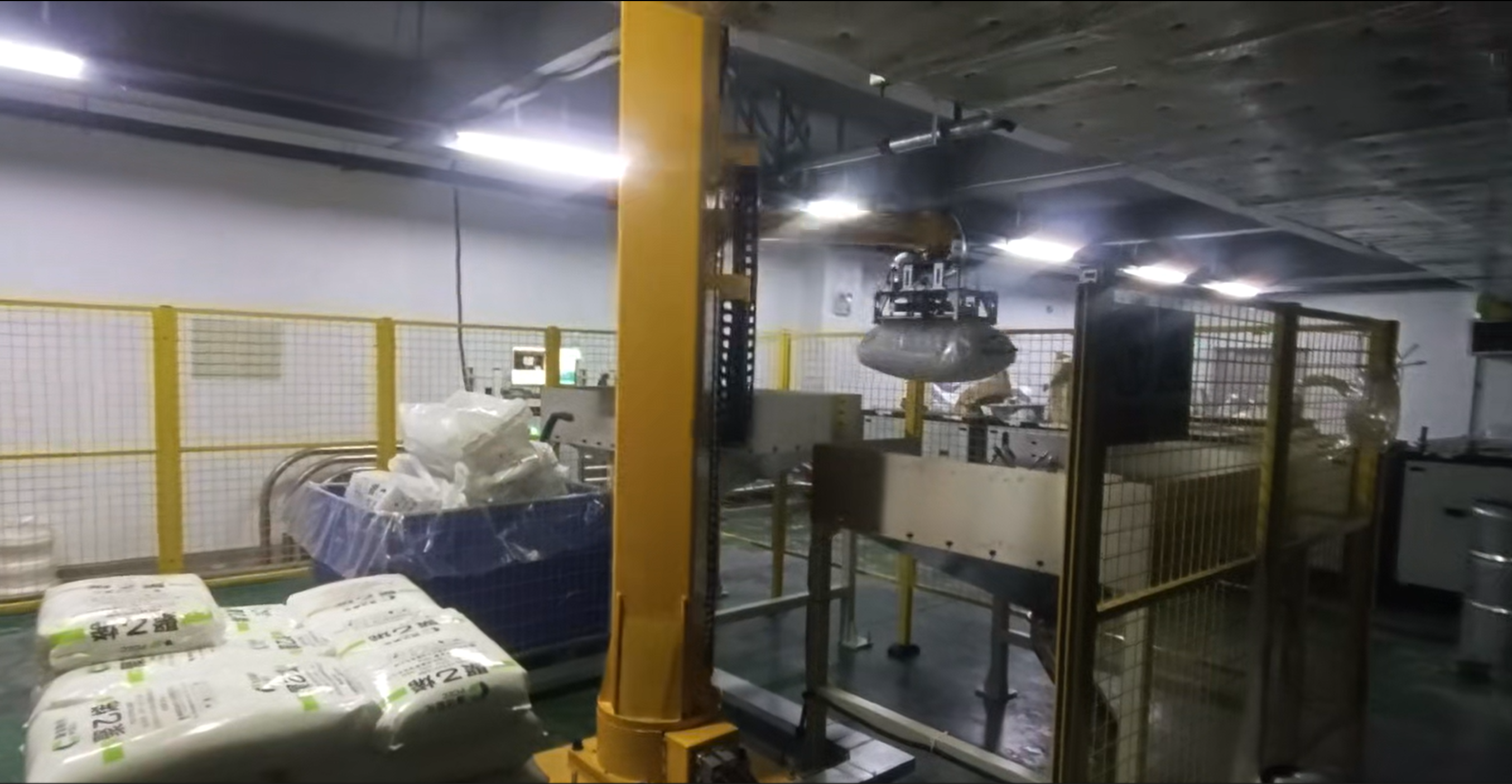
Chemical production often begins with bagged raw materials. Bags arrive on pallets, are de-stacked manually or semi-automatically, opened, and discharged into a process hopper. The work is repetitive, dusty and physically demanding. A depalletizing and bag-breaking industrial robot integrates de-stacking and bag opening: a vision system recognizes stacked bagged or boxed materials, the robot de-stacks layer by layer, and the package is opened to discharge its contents into a designated vessel. The supplied application description identifies chemical raw materials, building materials, feed, food and beverage, and other powder and granular material processing industries as relevant environments.
Food production palletizing and depalletizing adds a different constraint: cleanliness and compliance. The supplied food-factory selection guidance calls for hygiene measures such as 304 stainless surfaces, HACCP-compliant design and easy-clean construction, alongside throughput and stacking stability. A robot that performs well in a dry chemical area is not automatically suitable for a food-grade zone. Surfaces, cleaning access, guarding and lubrication practice have to be specified at cell level.
Health-supplement production logistics adds a third constraint: high SKU counts, smaller cartons and cans, tight line-side space and appearance-sensitive handling. The same 4-axis architecture can be relevant, but the gripper, vision configuration and pallet pattern have to change. This is why a scenario-fit review is more useful than a generic robot comparison.
The opportunity in numbers
Grand View Research places the handling segment, which includes palletizing and depalletizing, at a 42.1% share of the industrial robot market in 2025. IFR World Robotics 2025 reports that China installed 295,045 industrial robots in 2024, equal to 54% of global installations. Guangdong Province produced 246,800 industrial robot units in 2024, or 44% of China's total. These figures show that handling automation is mainstream and that South China is a dense supply base. They do not prove that a specific robot fits a specific line. The buyer still has to qualify the load, the cell and the acceptance test.
What the 4-Axis Palletizing Robot SCH100-1950-1800 is designed for
The SCH100-1950-1800 is a 4-axis, heavy-duty palletizing robot for end-of-line automation. It is intended for palletizing, depalletizing and material handling scenarios. Its structural configuration is a four-axis robot, and its published specification provides the boundaries a buyer needs to check against the load.
| Parameter | SCH100-1950-1800 | What it means in this scenario |
|---|---|---|
| Number of axes | 4 | Suited to palletizing and depalletizing of regular loads; not a substitute for complex 6-axis contouring. |
| Maximum payload | 100 kg | Covers many bag, carton and drum loads; heavier units need a different model or a project review. |
| Maximum reach | 1950 mm | Defines the working envelope around the pallet and infeed; layout and guarding follow from it. |
| Repeatability | ±0.5 mm | Supports pattern accuracy; system accuracy also depends on the gripper, product and pallet location. |
| Z-axis vertical stroke | 1800 mm | Covers a range of pallet build heights without changing the robot mounting for every pattern. |
| Axis ranges | Axis 1 ±130°; Axis 3 ±147°; Axis 4 ±360° | Provides the rotation and tool orientation needed for layer forming and pallet access. |
| Robot body weight | 680 kg | Affects floor loading, foundation and cell layout. |
| Power capacity | 5.75 kVA | A utility input for the robot; the complete cell also needs conveyor, controls and safety power. |
| Operating temperature | 0–45°C | Defines the standard operating window; cold-store or high-temperature zones need separate review. |
| Material | High-strength steel | A structural material; food-grade or corrosive-duty surfaces are project-specific additions. |
The practical meaning is straightforward. A 100 kg payload covers many bagged chemical raw materials, cartons of supplements and drums used in production logistics. The 1950 mm reach and 1800 mm vertical stroke cover the pallet build heights and infeed positions common in end-of-line cells. The four-axis structure is sufficient when the load is regular and the task is pick-and-place palletizing, because the robot does not need to follow a complex three-dimensional contour.
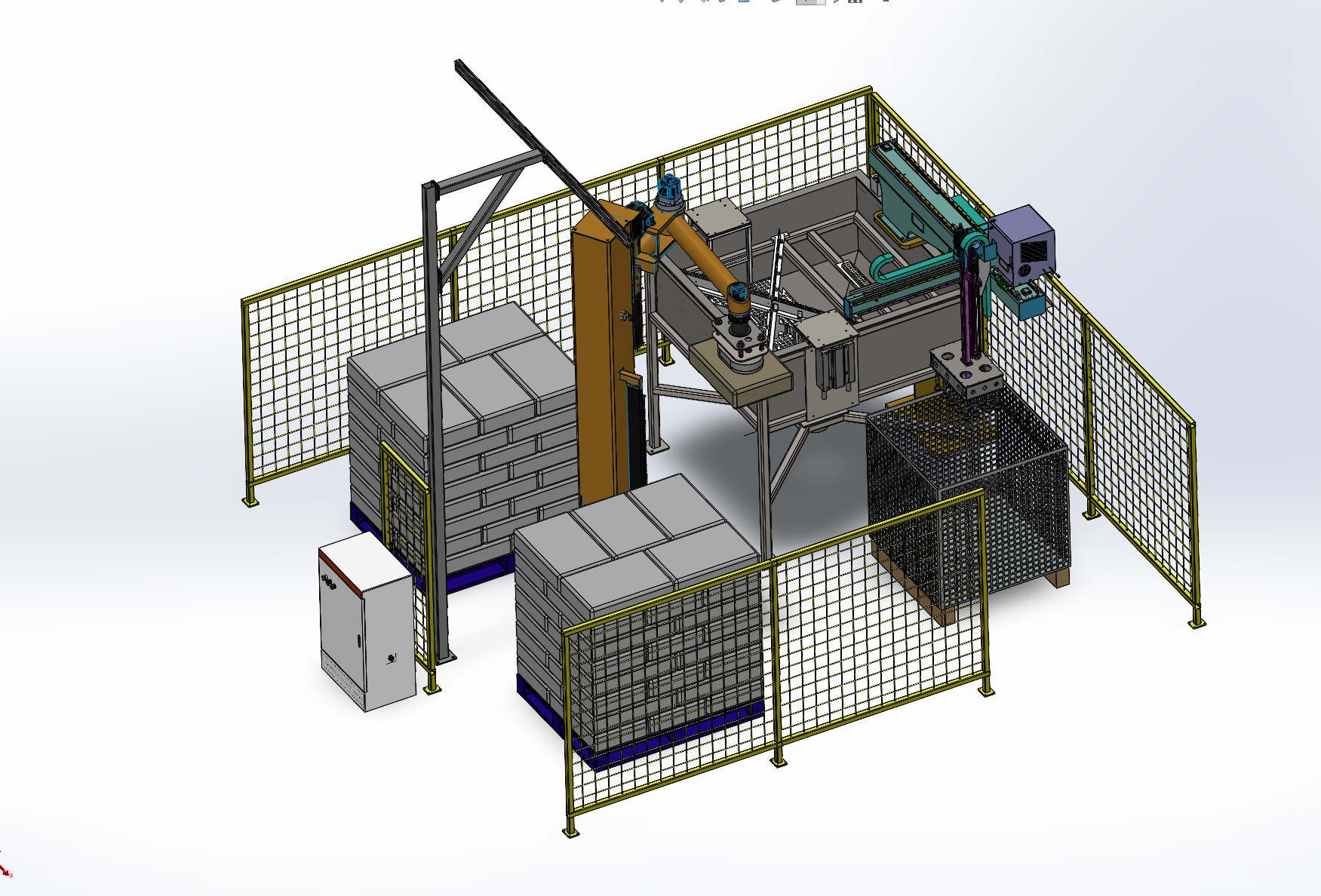
The robot can be integrated with conveyors, pallet dispensers, safety fencing and vision systems to form a robotic palletizing cell. Custom grippers can be designed for bags, cartons, drums and other regular-shaped workpieces. System configuration can be customized according to plant layout, product dimensions, weight, required capacity and palletizing pattern. That customization is the difference between a catalogue robot and a working cell.
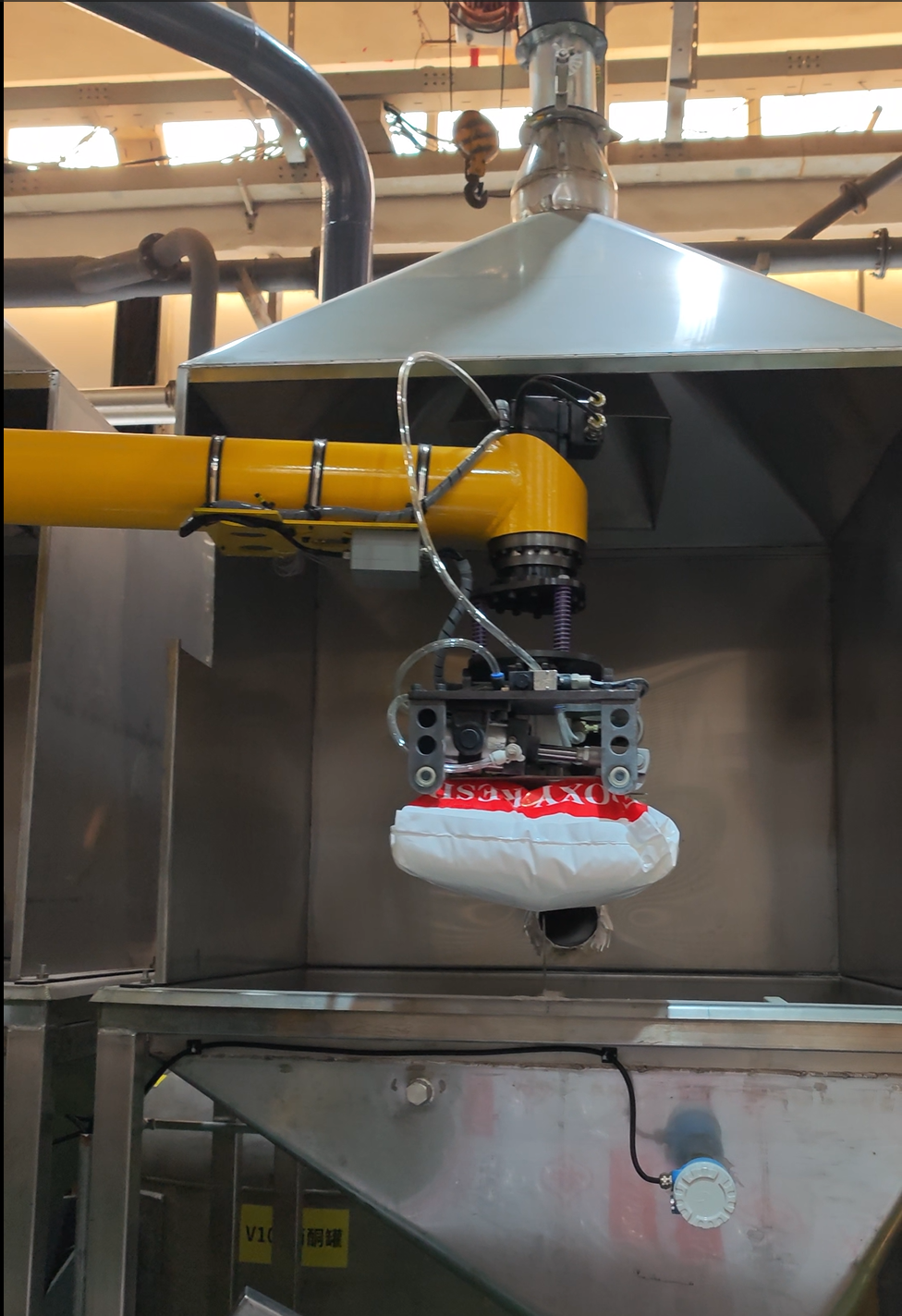
One boundary should be stated early: the SCH100-1950-1800 is not a bag-opening machine by itself. Bag opening requires a cutting mechanism, material hopper, dust collection and a gripper designed for the bag. The robot can be the handling arm inside an automatic bagged material depalletizing and bag-breaking system, but the bag-breaking function is a cell-level design.
Chemical production material handling: where the fit is strongest
Chemical production is a strong fit when the load is a regular bag, carton or drum and the cell can be laid out around a fixed depalletizing or palletizing station. The supplied application conditions list high temperature, heavy-duty handling, dusty environments, chemical exposure, corrosive environments, high humidity, oil mist and continuous operation. Those conditions do not change the robot's basic motion specification; they change the enclosure, surface treatment, dust control and maintenance access around it.
A typical chemical cell starts at the depalletizing station. Bags arrive on pallets. The robot de-stacks the bags layer by layer. A cutting mechanism opens the bag, the contents discharge into a hopper, and a dust collection system controls the release. The empty bag is removed. In a palletizing direction, the same robot can build pallets of finished bagged product. The SCH100-1950-1800 can serve as the palletizing or depalletizing arm, with a custom gripper for bags, cartons or drums.
For hazardous zones, custom explosion-proof execution is available and is described as compliant with national explosion-proof standards. The safety case must cover more than the robot arm. The supplied troubleshooting guidance identifies sealing covers, dust accumulation on electrical components, grounding connections and over-temperature inside the explosion-proof enclosure as items to check. That is a useful reminder that explosion protection is a system property, not a label on a single component.
Tianci Materials is cited in the supplied scenario evidence as improving material handling efficiency by 40%. The figure is a reported project outcome, not a guarantee for every chemical line. The relevant lesson is that the gain comes from removing repeated manual de-stacking and transfer work, not from the robot alone. The conveyor, gripper, bag-opening mechanism and pallet flow have to work together.
| Chemical scenario requirement | Configuration response to specify |
|---|---|
| Bagged powder or granular material | Custom bag gripper, bag-cutting mechanism, hopper and dust collection; robot as the handling arm. |
| Dusty atmosphere | Dustproof design, dust collection and control, enclosed material handling and easy-clean access. |
| Chemical exposure or corrosive environment | Corrosion-resistant components and surface protection; confirm the cleaning agents and exposure profile with the supplier. |
| Hazardous or explosive zone | Custom explosion-proof execution, sealing, grounding, over-temperature monitoring and safety interlocks; confirm certification scope project by project. |
| Continuous operation | Wear-resistant components, reliable continuous operation, easy maintenance and spare-parts planning. |
A chemical buyer should not treat a standard palletizing robot as an explosion-proof or corrosion-resistant product by default. Those are custom engineering scopes. The robot specification gives payload, reach, repeatability and stroke; the project specification must add the environment, the bag-opening function and the safety case.
Food production palletizing and depalletizing: hygiene and throughput
Food production is a different kind of fit. The load may be a bag, a carton or a can. The constraint is not only weight and reach, but cleanliness and compliance. The supplied food-factory selection guidance calls for hygiene measures such as 304 stainless surfaces, HACCP-compliant design and easy-clean construction. It also cites a throughput reference of 800–1000 bags per hour, a low topple rate below 0.05%, 24-hour operation and adaptation to −20°C cold storage where required.
Mengniu is cited in the supplied scenario evidence as achieving a 40% palletizing efficiency gain, with a single robot reaching daily throughput above 20,000 pieces. That outcome should be read as a reported deployment result, not a universal cycle-time claim. Actual throughput depends on the product, gripper, pallet pattern, infeed buffer, conveyor speed and changeover frequency.
The SCH100-1950-1800 can be used in food production palletizing and depalletizing where the load is regular and the cell is designed for the hygiene zone. The robot can be integrated with conveyors, pallet dispensers, safety fencing and vision systems. Custom grippers can be designed for bags, cartons and other regular-shaped workpieces. The four-axis architecture is efficient for layer forming and pallet building because the required motion is predominantly vertical transfer and rotation.
Hygiene is not automatic. A standard robot with a custom gripper is not automatically HACCP-compliant. The cell must specify surfaces, cleaning access, guarding and lubrication practice for the food zone. That is why the food-grade question should be asked at cell level, not only at robot level.
Cold storage is a further boundary. The supplied selection guidance references adaptation to −20°C cold storage. The SCH100-1950-1800 standard operating temperature is 0–45°C. A −20°C cold-store project is therefore a separate engineering requirement and should not be assumed from the standard specification. The buyer should raise the cold-store duty explicitly and have the supplier confirm the configuration.
The same logic applies to line layout. A column industrial robot is often used where floor space is limited and stable stacking is the priority. A mobile collaborative palletizing industrial robot is used where multiple lines need flexible deployment. The SCH100-1950-1800 is a fixed-cell 4-axis option. The buyer should choose the configuration that matches the line layout, not force the layout to match a preferred robot type.
Health-supplement production logistics: smaller formats and higher SKU counts
Health-supplement production logistics is closer to food and beverage than to bulk chemical handling, but it has its own pattern. Loads are more likely to be cartons, cans, composite containers and drums. SKU counts are higher. Line-side space is often tighter. Appearance and hygiene matter. The cell may need to palletize finished cartons, depalletize incoming packaging, or transfer containers between production and warehouse.
By-Health is cited in the supplied scenario evidence as achieving a 40% palletizing efficiency gain, with a single robot reaching daily throughput above 20,000 pieces. The figure is useful because it shows that a single robot can cover a high daily piece count when the load is regular and the cell is designed for continuous flow. It does not remove the need to test the actual carton, can or drum format.
The SCH100-1950-1800 can palletize regular-shaped cartons and drums with a custom gripper. For depalletizing incoming cartons, a vision-guided depalletizing industrial robot configuration can handle position deviation. In the supplied vision-guided reference, 3D cameras and LiDAR point-cloud modelling with deep-learning grasp-path planning are described as supporting ±50 mm position deviation and a 99.8% grab success rate for mixed stacks. That capability is relevant when pallets arrive from upstream with imperfect alignment.
Where the line handles cans, a dedicated can depalletizing industrial robot or a full-automatic can depalletizing configuration should be evaluated separately. The gripper, magnetic or mechanical handling principle and layer pattern for cans differ from bag handling. A bag-oriented cell should not be assumed to be the best can-handling cell. The same applies to automatic bagged material depalletizing and bag-breaking systems: the bag-opening function is a separate module from the palletizing arm.
The strongest fit in supplement logistics is a regular load, a repeatable pallet pattern and a daily volume that justifies a fixed cell. The weaker fit is a mixed, unstable pallet with frequent manual re-stacking, or a product that requires complex three-dimensional orientation. In those cases, a different robot architecture or a more manual process may be the better decision.
Technical explanation: how a palletizing cell works
A palletizing cell is a sequence, not a single machine. The robot is one element. The sequence usually follows this pattern:
- Infeed: bags, cartons or drums arrive on a conveyor or are presented on a pallet.
- Recognition: a vision system or fixed positioning defines the pick position and the load orientation.
- Gripping: a custom gripper picks the bag, carton or drum according to its geometry and weight.
- Pallet forming: the robot places the load according to the programmed pattern; a pallet dispenser presents empty pallets.
- Safety: safety fencing and interlocks separate the robot from operators; the cell risk assessment covers the complete installation.
- Discharge: the full pallet leaves the cell, and the next pallet is presented.
The four-axis motion is well matched to this sequence. Axis 1 provides the main rotation around the base with a working range of ±130°. The Z-axis provides 1800 mm of vertical stroke. Axis 3 has a working range of ±147°, and Axis 4 provides ±360° of tool rotation. Together, these axes allow the robot to reach the infeed, rotate to the pallet and orient the load for the layer pattern. Repeatability is ±0.5 mm at the robot flange, which supports pattern accuracy, although the final system accuracy also depends on the gripper, product variation, pallet location and conveyor positioning.
Vision changes the cell when the incoming load is not perfectly positioned. In the supplied vision-guided depalletizing reference, 3D cameras and LiDAR build a point-cloud model of the stack, and deep-learning algorithms identify material types and calculate object poses. The stated tolerance is ±50 mm position deviation, with a 99.8% grab success rate for mixed stacks. That is a useful reference for incoming pallets that are not precisely aligned, but it should be validated on the buyer's actual bag or carton.
Safety is a cell-level discipline. EN ISO 10218-1 addresses industrial robots, while EN ISO 10218-2 addresses applications such as robot systems and robot cells. A buyer should therefore assess both the robot and the complete palletizing or depalletizing cell. A robot certificate alone does not establish the safety of the guarded cell, the infeed, the pallet dispenser or the bag-opening module.
Throughput should be specified as a cell output, not only as a robot speed. The reported daily throughput above 20,000 pieces at Mengniu and By-Health is a useful benchmark, but the acceptance test should use the buyer's product, pattern and changeover regime. A cell that runs at high speed on one SKU can lose much of that advantage when changeovers are frequent.
Comparison with manual and fixed automation
The 4-axis palletizing robot sits between manual handling and dedicated fixed automation. Manual handling is flexible and has low capital cost, but it is labor-dependent, inconsistent under shift pressure and exposes operators to dust and repetitive strain. Fixed automation can be very fast for a single, never-changing product, but it is poor at changeover and difficult to adapt when the pack format changes. A 4-axis robotic cell offers programmable patterns, gripper changeover and a better balance between throughput and flexibility.
| Criterion | Manual handling | Fixed automation | 4-axis robotic cell |
|---|---|---|---|
| Labor dependency | High; shifts and fatigue affect output. | Low once set, but setup and maintenance need skilled staff. | Low in normal operation; programming and changeover need trained staff. |
| Throughput consistency | Variable. | High for one fixed format. | High and repeatable within the programmed pattern. |
| Dust exposure | Direct operator exposure. | Can be enclosed, but inflexible. | Can be enclosed with dust collection and guarding. |
| Changeover | Fast but manual. | Slow and costly. | Program and gripper changes; faster than fixed automation. |
| Footprint | Large working area per operator. | Fixed and often large. | Compact cell with fencing; layout-dependent. |
| Hygiene control | Depends on operator practice. | Can be designed for hygiene, but hard to clean around fixed mechanisms. | Can be designed for easy-clean access, but requires project-specific surfaces and guarding. |
| Capital cost | Low initial, high recurring labor. | High and product-specific. | Medium to high; justified by volume and repeatability. |
| Best fit | Very low volume, highly variable loads, or temporary operations. | One stable product at very high volume. | Regular loads, repeatable patterns and a need for changeover flexibility. |
The limitation should be stated clearly. The SCH100-1950-1800 is not a universal replacement for every manual or fixed-automation line. Its maximum payload is 100 kg, its maximum reach is 1950 mm, its Z-axis stroke is 1800 mm and its standard operating temperature is 0–45°C. Loads above those limits, working positions outside the reach, sub-zero cold-store duty, or complex three-dimensional orientation may require a different robot or a custom engineering review. A low-volume, high-mix operation may also find that manual handling or a more flexible collaborative configuration is the better commercial choice. The value of the 4-axis cell depends on the volume, the load consistency and the cost of the manual process it replaces.
Procurement criteria: what to specify before an RFQ
A useful RFQ separates robot specifications from cell performance. The robot data sheet gives payload, reach, repeatability and stroke. The cell acceptance test should give the actual throughput, pattern accuracy and changeover time for the buyer's product. The following checklist is a practical starting point for chemical, food and supplement projects.
| Specification item | Why it matters | What to state in the RFQ |
|---|---|---|
| Load unit | Determines gripper and bag-opening or can-handling module. | Bag, carton, drum or can; include a sample or drawing. |
| Weight and dimensions | Confirms the 100 kg payload and 1950 mm reach are sufficient. | Minimum and maximum weight; length, width and height. |
| Pallet pattern | Defines layer forming and pattern accuracy. | Layer drawing, pallet size, stack height and slip sheets. |
| Throughput | A robot cycle is not a line output. | Pieces per day, bags per hour, or pallets per shift; include changeover time. |
| Infeed method | Affects vision need and buffer design. | Conveyor, pallet, box or manual presentation; incoming position tolerance. |
| Hygiene class | Food-grade surfaces and cleaning access are project-specific. | 304 stainless requirement, HACCP-compliant design, easy-clean access and zone rules. |
| Dust or explosion zone | Changes enclosure, sealing, grounding and certification scope. | Zone classification, dust properties and required explosion-proof standard. |
| Temperature | The standard range is 0–45°C. | Ambient temperature, cold-store duty and any washdown or humidity condition. |
| Gripper | The robot cannot handle the product without the right tool. | Bag, carton, drum or can gripper; surface contact and damage limits. |
| Vision | Needed when incoming position varies. | Position tolerance, mixed-stack requirement and recognition rate target. |
| Safety | The cell, not only the robot, must be assessed. | EN ISO 10218-1 and EN ISO 10218-2 scope; guarding, interlocks and risk assessment. |
| Integration | The cell must connect to existing equipment. | Conveyor, pallet dispenser, safety fencing, vision and existing line interfaces. |
| Acceptance test | Protects the buyer against a paper specification. | Product samples, pattern, throughput, changeover and uptime trial. |
| Documentation and service | Supports maintenance and spare-parts planning. | Drawings, manuals, training, spare-parts list and response time. |
The supplier's customization statement is relevant here. South China Robotics Technology (Guangdong) Co., Ltd. states that systems can be customized according to the customer's product, payload, production capacity, pallet pattern, site layout, process requirements and existing equipment. That is the correct level at which to specify a chemical, food or supplement cell. A robot model alone does not define the gripper, the bag-opening module, the hygiene surfaces or the safety fencing.
A custom non-standard industrial robot approach is sometimes necessary when the load is outside the standard envelope or the line interface is unusual. In those cases, the buyer should ask for a cell layout, a cycle-time calculation and an acceptance-test plan before placing the order. The same discipline applies to a column industrial robot or a mobile collaborative palletizing industrial robot: the configuration should follow the layout and the load, not the other way round.
Market trend: handling automation is mainstream, but fit is local
The verified market data supports a clear trend: handling automation is no longer a niche application. Fortune Business Insights estimated the global industrial robot market at USD 24.43 billion in 2026. IFR World Robotics 2025 reports that China installed 295,045 industrial robots in 2024, equal to 54% of global installations. Guangdong Province produced 246,800 industrial robot units in 2024, or 44% of China's total. Grand View Research places the handling segment, including palletizing and depalletizing, at a 42.1% share in 2025. Fortune Business Insights projects the global robotic palletizers and de-palletizers market at USD 4.67 billion in 2026.
These figures describe the scale and direction of the category. They do not prove that a specific 4-axis robot fits a specific chemical or supplement line. The trend that matters at procurement level is configuration-specific cell design: vision for incoming deviation, custom grippers for bags, cartons, drums and cans, hygiene surfaces for food zones, dust control for chemical zones, and safety integration for the complete cell.
The EN ISO 10218 revision reinforces that point. Part 1 addresses industrial robots; Part 2 addresses applications such as robot systems and robot cells. A buyer who evaluates only the robot specification is evaluating only part of the installation. The cell risk assessment, guarding, infeed, pallet dispenser and bag-opening module are part of the same safety case.
Another practical trend is the separation of robot selection from process selection. A chemical project may need a depalletizing and bag-breaking industrial robot with dust collection and a cutting mechanism. A food project may need a hygienic palletizing cell with easy-clean access. A supplement project may need a vision-guided depalletizing cell for cartons or a can depalletizing configuration for cans. These are different cells, even when they use a similar robot arm.
Future outlook
The next phase of palletizing automation is less about adding axes and more about cell engineering. Vision will become more common at the infeed because incoming pallets are rarely perfectly aligned. Grippers will become more product-specific because bags, cartons, drums and cans cannot share the same tool. Hygiene and dust control will remain project-specific because food and chemical environments impose different constraints. Safety integration will continue to move from robot-level checks to cell-level risk assessment.
For chemical and health-supplement logistics, the practical outlook is a wider range of configurable cells rather than a single universal robot. The 4-axis palletizing robot will remain relevant where the load is regular and the throughput is high. Six-axis and collaborative configurations will take the work that requires complex orientation or shared human-robot space. Buyers should design for changeover, documentation and service access, because those factors determine whether the cell stays productive after the first installation.
No forecast beyond the verified market figures is offered here. The defensible conclusion is narrower: handling automation is a large and mainstream segment, and the buyer's task is to match the cell to the load, the hygiene or hazard class, the layout and the acceptance test. The 4-Axis Palletizing Robot SCH100-1950-1800 is one configuration within that decision, not a default answer for every chemical or supplement line.
FAQ
What is a depalletizing and bag-breaking industrial robot?
A depalletizing and bag-breaking industrial robot integrates de-stacking and bag opening. It uses a vision system to recognize stacked bagged or boxed materials, de-stacks the load layer by layer, and then opens the package to discharge the contents into a designated vessel. It is used for bagged raw materials in chemical, building-material and feed industries, where it reduces manual dust exposure and labor intensity.
How does a vision-guided depalletizing robot recognize materials?
The supplied reference describes 3D cameras and LiDAR point-cloud modelling combined with deep-learning grasp-path planning. The system scans the stack, builds a model of the packages, identifies material types and calculates object poses. The stated tolerance is ±50 mm position deviation, with a 99.8% grab success rate for mixed stacks. The actual result should still be validated on the buyer's bag, carton or can format.
How should a food factory choose a palletizing robot?
The food-factory selection guidance prioritizes hygiene, throughput, stacking stability, environmental adaptability, maintainability and layout flexibility. It calls for 304 stainless surfaces, HACCP-compliant design and easy-clean construction, with a throughput reference of 800–1000 bags per hour and a low topple rate below 0.05%. It also notes 24-hour operation and adaptation to −20°C cold storage where required. A column-type robot is relevant where floor space is limited, while a mobile collaborative palletizing configuration is relevant where multiple lines need flexible deployment.
Is it safe to use robots in chemical or explosive environments?
Safety is a system property, not a robot-only property. For chemical or explosive zones, custom explosion-proof execution is available and is described as compliant with national explosion-proof standards. The project should define the zone classification, sealing, grounding, dust control and interlocked operation, and confirm the certification scope with the supplier. The supplied troubleshooting guidance also identifies sealing covers, dust on electrical components, grounding and over-temperature as items to check during operation.
Can the SCH100-1950-1800 be customized for bags, cartons and drums?
Yes. The robot can be fitted with custom grippers for bags, cartons, drums and other regular-shaped workpieces. It can be integrated with conveyors, pallet dispensers, safety fencing and vision systems to form a robotic palletizing cell. System configuration is customized according to plant layout, product dimensions, weight, required capacity and palletizing pattern.
Company reference
South China Robotics Technology (Guangdong) Co., Ltd. is a Guangzhou-based industrial robotics and automation company founded in 2017. It operates a 40,000 m² factory with 180 employees, an annual output of 3,000 units and a 48-engineer R&D team. Exports account for 40% of output, with markets in Europe, the Middle East, Southeast Asia, South Asia, Latin America and North America.
The company specializes in robotic palletizing systems, bag opening and feeding robots, material handling robots, collaborative palletizing robots, press tending robots, CNC machine tending robots, custom industrial automation systems and industrial robot integration. It states that it has independently developed core motion-control technologies for palletizing robots, automatic bag opening and feeding robots, press-tending robots and other industrial robotic applications. Recognitions include Enterprise Technology Center, National Intellectual Property Advantage Enterprise and Service-Oriented Manufacturing Demonstration Enterprise.
A company profile and product brochure are available for download: South China Robotics company profile and product brochure 2026.
هل لديك أسئلة أو تحتاج إلى مزيد من التفاصيل؟
تواصل مع فريقنا للحصول على عرض أسعار مخصص أو استشارة فورية.
طلب عرض أسعار
املأ النموذج أدناه وسيتواصل معك فريقنا بعرض مقترح مخصص.
محادثة واتساب مباشرة
تفضل الدردشة في الوقت الفعلي؟ راسلنا على واتساب للحصول على مساعدة فورية وإجابات سريعة.
- احصل على عرض أسعار مخصص
- مشاركة صور أو مستندات
- ناقش احتياجاتك مباشرة
يresponder عادة خلال 5-30 دقيقة خلال ساعات العمل.