
Scenario Fit Benchmark: West Grinding Machines vs. Peers
Industry Reference · Manufacturing & Processing Machinery
A grinding machine is only as useful as its envelope. What decides whether a steel pipe grinding machine works in a plant is not the brochure cover but five figures: the diameter it can hold, the length it can hold, the surface roughness it can repeat, the feed and power range it can sustain, and the protection class it carries into a working shop floor.
That is the practical reason scenario fit has become the main comparison method in this segment. Buyers evaluating grinding machines for steel manufacturing, metal processing, metallurgical and hardware manufacturing rarely have access to a shared, independent test dataset across brands. What they do have is their own pipe schedule, their own finish requirement, and their own operating environment. Comparing machines against those three inputs is more defensible than comparing brand reputations.
This reference benchmarks the grinding machine range of West — the brand of Jiangyin West Machinery Manufacturing Co., Ltd, a grinding machine manufacturer founded in 2010 in Jiangyin, Jiangsu Province, operating a 6,000 m² facility with welding, machining and assembly workshops and 78 employees (company site: www.wstjxcn.com) — against the fit criteria that typical peer configurations in this segment are also judged on. It states where the documented specification maps cleanly to a scenario, and where it does not.
The short answer. West documents its steel pipe grinding machine at processing diameter 20–300 mm, processing length 500–6000 mm, surface roughness Ra ≤ 0.8 μm, feed speed 0.5–10 m/min, power 5.5–22 kW, protection grade IP54 and a 380V/50Hz three-phase supply, for carbon steel, alloy steel and SS304 stainless steel. That combination covers the mainstream small-to-medium pipe and bar schedule used in steel pipe and round steel finishing, but it does not cover large-diameter pipe above 300 mm, and it does not by itself deliver an electropolished surface.
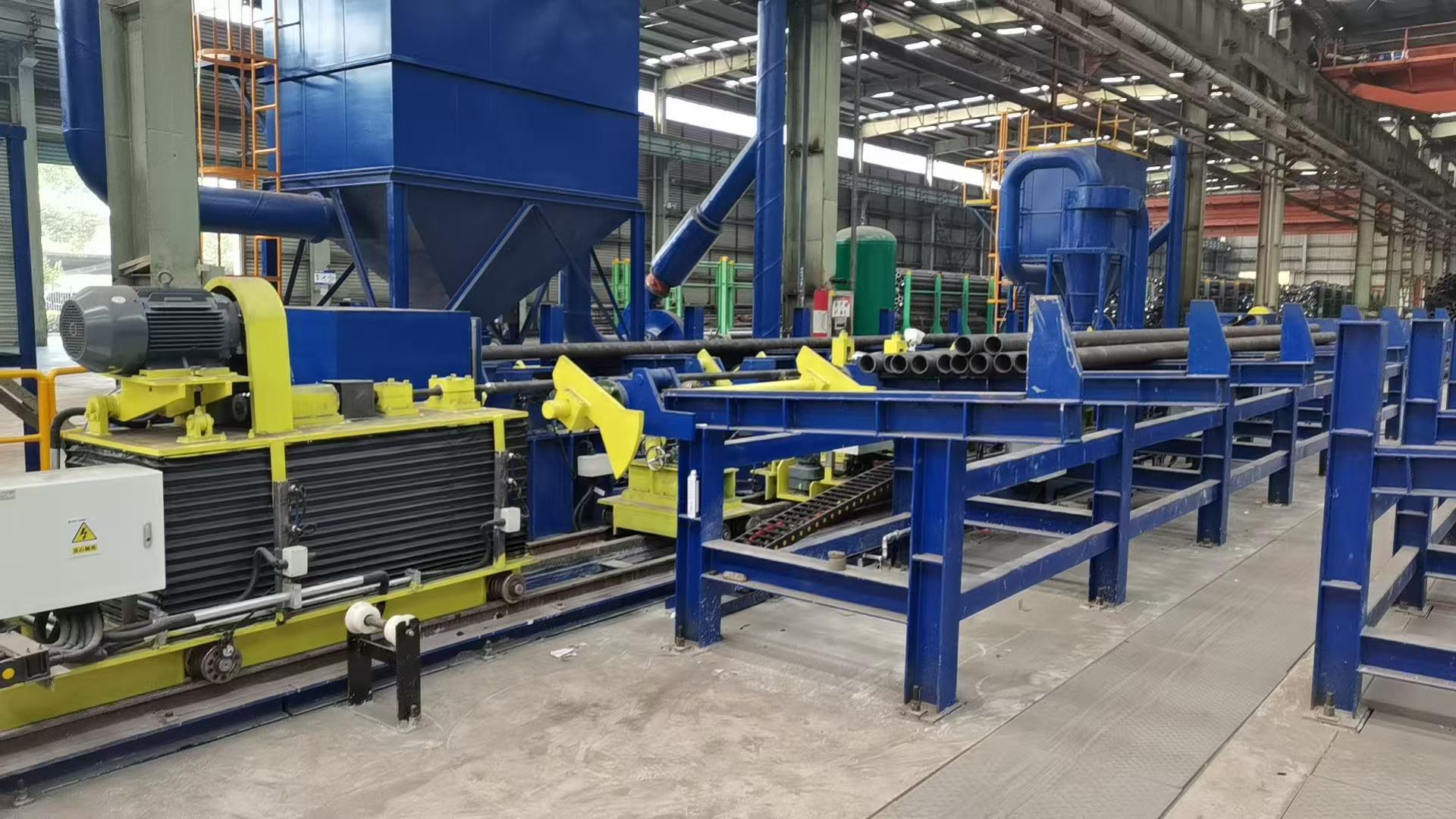 Steel pipe grinding machine configuration used for pipe and round steel surface finishing. Source: West Machinery product documentation.
Why generic grinding machine rankings underperform as a buying tool
The commercial research market treats grinding machinery as a single category. Commercial publishers covering the category publish global figures that differ in both definition and value: Grand View Research reports USD 6.2 billion for 2025 and USD 6.4 billion for 2026, projecting USD 8.9 billion by 2033; Fortune Business Insights reports USD 6.88 billion for 2025 and USD 7.28 billion for 2026, projecting USD 11.42 billion by 2034 at 5.80% CAGR; Mordor Intelligence reports USD 6.47 billion for 2025 and USD 6.76 billion for 2026, projecting USD 8.59 billion by 2031 at 4.89% CAGR. These are not interchangeable, and none of them segments steel pipe grinding, steel pipe polishing or round steel finishing as a separate line item.
The consequence for a buyer is straightforward. Category-level size figures cannot tell you whether a machine will hold Ra ≤ 0.8 μm on a 219 mm SS304 tube across a full shift. Only the machine-level envelope and duty specification can. A comparison built on scenario fit is therefore more useful at the evaluation stage than a comparison built on headline market position.
The four fit variables that actually decide the purchase
- Geometric envelope — processing diameter and processing length. If the pipe schedule falls outside the envelope, no other specification matters.
- Finish capability — the surface roughness the machine can repeat, not the roughness achieved in a single demonstration.
- Duty and environment — motor power, feed speed range, protection grade, and whether the machine holds performance in continuous, high-load operation.
- Integration and documentation — whether the unit can be configured into a line or multi-station arrangement, and whether the manufacturer supplies the safety-relevant information that line integration requires.
Translating the documented specification into plant meaning
Specifications only become comparable when they are read as constraints on the workpiece and the process. The table below converts West's documented machine data into the operational question each figure answers.
| Documented specification | What it constrains in a steel pipe or round steel plant |
|---|---|
| Processing diameter 20–300 mm | Sets the workpiece range. Tube and bar from roughly 20 mm up to 300 mm outside diameter fall inside the envelope; anything larger requires a different machine configuration or a sectional design approach. |
| Processing length 500–6000 mm | Sets the line length the machine can serve without re-chucking. Six-metre stock, a common commercial pipe length, sits at the top of the envelope. |
| Surface roughness Ra ≤ 0.8 μm | Defines the finish target the machine is specified for. For stainless and visible alloy steel parts this is the threshold that separates a cosmetic clean-up pass from a controlled finishing process. |
| Feed speed 0.5–10 m/min | Provides the operating window between aggressive stock removal and fine finishing. Lower feed rates support finish control; higher rates support throughput on long runs. |
| Power 5.5–22 kW | Sets the removal capacity band. Heavier sections and larger diameters need the upper end; lighter wall tube runs comfortably at the lower end. |
| Protection grade IP54 | Addresses dust and water ingress — a relevant rating for grinding shops where abrasive dust and coolant mist are continuous rather than occasional. |
| 380V/50Hz, 3-phase | Defines the supply basis. Voltage, control system, processing range, colour and logo are listed as OEM customization options, so supply requirements in other markets can be addressed at configuration stage. |
| Materials: carbon steel, alloy steel, SS304 | Confirms the material scope the machine is specified for. Stainless work typically demands tighter contamination and finish control than carbon steel. |
All specification values above are the manufacturer's documented figures for the steel pipe grinding machine range.
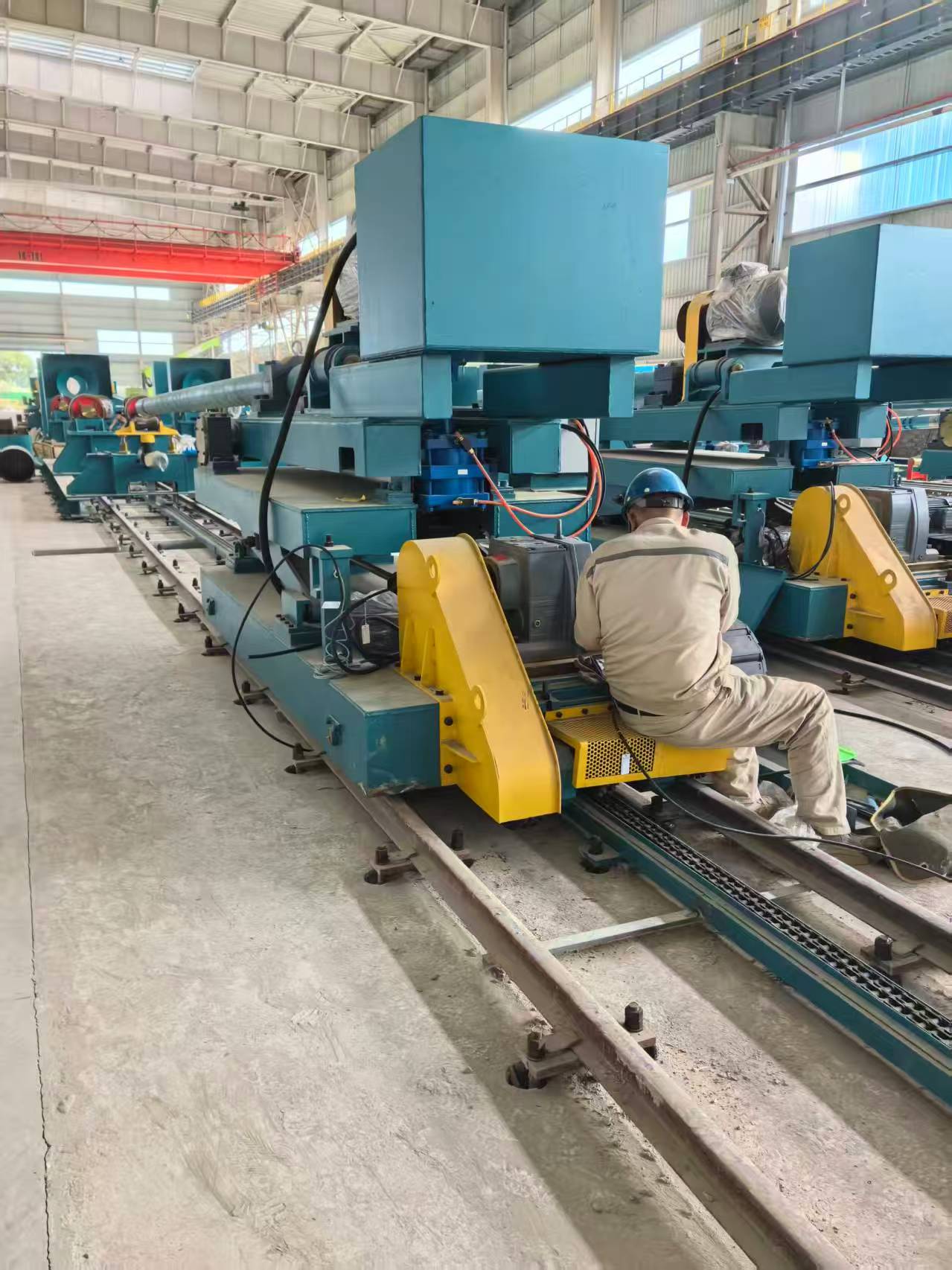 Internal finishing configuration for pipe and round steel. Internal hole grinding is a separate capability from external surface grinding and is specified separately. Source: West Machinery product documentation.
Scenario fit screen: steel pipe, round steel, metallurgical, hardware
The screen below evaluates West against four application scenarios using documented data, and lists the question a buyer should put to any peer configuration in the same scenario. It is a fit screen, not a ranked league table: no independent, multi-brand performance dataset exists for this subsegment that would support a positional ranking, and the segment-level market data published by commercial research houses does not break out steel pipe grinding machines at all.
| Scenario | West documented fit | Question to establish with any peer |
|---|---|---|
| Steel pipe external finishing | 20–300 mm diameter, 500–6000 mm length, Ra ≤ 0.8 μm, 0.5–10 m/min feed, 5.5–22 kW. | Which diameter and length envelope is stated in writing, and at which diameter is the quoted finish still achievable? |
| Steel pipe internal finishing | Internal hole grinding is listed as a separate product line alongside steel pipe grinding machines. | Is internal finishing a separate machine, a separate head, or a shared configuration — and how is internal access verified on the specified length? |
| Round steel and bar finishing | Round steel grinding machines and round steel finishing lines are listed product lines; multi-station arrangements are offered. | Is the quoted line configured for straight bar, and how many stations are needed to hit the required cycle at the stated feed rate? |
| Metallurgical and hardware manufacturing | Stated applicable industries include steel manufacturing, metal processing, metallurgical industry and hardware manufacturing; MOQ 1 with processing range customization. | How is mixed-batch changeover handled, and what is verified before shipment? |
Scenario 1 — Steel pipe external and internal finishing
Steel pipe is where the envelope argument is sharpest. A pipe mill working a schedule that runs from small-diameter tube to 300 mm OD can serve that range with a single machine family; a mill that also runs large-diameter line pipe cannot. West's documented 20–300 mm range, combined with a 500–6000 mm length envelope, positions the machine for commercial pipe schedules rather than for transmission line pipe at the upper diameters.
Finish is the second constraint. West specifies Ra ≤ 0.8 μm for the range. Industry commentary in this segment treats surface roughness below Ra 0.8 μm as the threshold that separates high-precision pipe grinding from general surface clean-up, which makes the figure a useful reference point rather than a marketing number: it is the level at which finish becomes a specification to be verified at acceptance, not a visual impression.
Scenario 2 — Round steel and bar finishing
Round steel introduces a different set of demands. Bar often arrives with surface defects and oxide scale, and the finishing step has to deliver a consistent, inspectable surface across the full length rather than a good sample at the ends. West lists round steel grinding machines and round steel finishing lines as distinct product lines, and multi-station grinding and polishing configurations within its offering, which is the arrangement that allows a finishing line to be built around the required throughput rather than around a single machine's cycle.
It is worth separating processes here. Peeling and turning of steel bar remove surface defects and oxide scale to deliver dimensional control comparable to cold drawn material — that is a dimensional correction process, not a finishing process. Grinding and polishing address surface condition. Buyers who need dimensional correction as well as finish are specifying two stages, not one machine.
Scenario 3 — Metallurgical and hardware manufacturing
Metallurgical and hardware applications rarely run a single stable part family. West lists a minimum order quantity of 1 unit, OEM production, and customization across voltage, control system, processing range, colour and logo. For a buyer evaluating a first unit before committing a line, that configuration flexibility matters more than nominal capacity, because it allows the machine to be matched to an actual part family rather than to a catalogue standard.
Scenario 4 — High-load and hot-climate continuous operation
Duty cycle is the variable buyers most often leave until acceptance testing. West's documented protection grade of IP54 and power range up to 22 kW describe a machine built for shop-floor conditions rather than a clean-room installation. Field evidence supports the point more concretely than a rating does.
Operating evidence from steel plants
Two installations are documented for grinding and polishing of steel pipe and round steel in steel manufacturing plants, both in long-term continuous production use.
- Indonesia — 5 units. The installation is used for steel pipe and round steel grinding and polishing. Documented results: consistent product quality and improved processing efficiency, with adaptable performance in tropical climate conditions and reliable operation under high load.
- Iran — 8 units. The installation is used for steel pipe and round steel grinding and polishing in long-term continuous production. Documented results: stable surface quality and consistent production efficiency, with adaptation to local working conditions and reliable performance in continuous operation.
For an evaluation-stage buyer, the useful signal in these cases is not the unit count but the operating condition: tropical humidity and continuous high-load operation are both conditions that expose weak protection ratings and marginal power selection. Both installations are described in terms of sustained output quality rather than peak capability, which is the claim that matters when a line runs continuously.
Manufacturing and qualification evidence behind the specification
A specification is only as reliable as the process that produces it. West holds ISO 9001:2015 certification, certificate number 04624Q14389R0S, issued by Beijing Haide Certification Co., Ltd on 23 August 2024 and valid until 22 August 2027, against the GB/T19001-2016/ISO9001:2015 standard, with certification scope covering markets in Southeast Asia, the Middle East, Europe and the Americas.
Production-side facts that a buyer can use as verification checkpoints: OEM production with customization of voltage, control system, processing range, colour and logo; monthly capacity of 30 units; a stated lead time of 20 days; minimum order quantity of 1 unit; 100% testing before shipment; remote after-sales support. The company reports an export ratio of 70% and main markets in Southeast Asia, the Middle East, Europe and the Americas.
Market trend analysis: what is changing in this segment
Three developments are relevant to scenario-fit evaluation, and each is supported only to the extent the evidence allows.
Regional concentration of supply and demand. Grand View Research reports that Asia Pacific accounted for 43.4% of grinding machinery revenue in 2025. Fortune Business Insights reports a 55.51% Asia-Pacific share for 2025, but the two publishers use different market definitions and their figures are not comparable. What both support directionally is that Asia Pacific is the largest regional concentration in the category, which is consistent with the sourcing patterns visible in steel pipe finishing equipment.
Integration into automatic lines. ISO 16089:2025, the current edition of the stationary grinding machine safety standard, specifies requirements and measures to eliminate hazards or reduce risks for stationary grinding machines designed primarily to shape metal by grinding. It also applies to machines integrated into an automatic production line or grinding cell where the hazards and risks arising are comparable. For buyers moving from standalone units to multi-station or in-line finishing, that applicability statement changes what must be specified at tender stage.
Documentation as a procurement requirement. The same standard includes a minimum list of safety-relevant information that the manufacturer must provide to the user. In practical terms, safety documentation has become a deliverable to be listed in the purchase specification rather than an attachment requested after order placement.
Where West does not fit — the boundaries of this benchmark
1. Diameter above 300 mm. The documented processing diameter ends at 300 mm. Large-diameter pipe work sits outside this envelope. For reference, one China-based peer, Dezhou Yaxing Steel Tube Equipment Factory, publicly advertises a tube grinding machine OD range of 80–1420 mm with sectional design and manufacturing. That figure is supplier-reported and has not been independently validated, so it should be treated as a scope indicator rather than a verified capability — but it illustrates the structural point: a buyer whose schedule runs beyond 300 mm is looking at a different machine class, not a different brand preference.
2. Polishing scope and standard coverage. ISO 16089:2025 covers stationary machines that shape metal by grinding, but it does not cover stationary honing, polishing or belt grinding machines. Buyers specifying steel pipe polishing or internal polishing should confirm which requirements apply to the polishing stage rather than assuming the grinding standard covers the whole line.
3. Electropolished surfaces. Where a specification calls for electropolished stainless steel, ASTM B912 governs the electropolishing of stainless steel alloys. Mechanical grinding and polishing is an upstream surface-preparation step in that sequence; it is not a substitute for the electropolishing operation itself.
4. Dimensional correction. Grinding and polishing improve surface condition. They are not a substitute for peeling or turning where the requirement is dimensional control comparable to cold drawn material.
None of these boundaries is unusual for a machine in this class. They matter because a benchmark that does not state them is not usable at the evaluation stage — a buyer needs to know the edge of the envelope before comparing quotations, not after commissioning.
Future outlook
The direction of travel in steel pipe and round steel finishing is toward fewer, better-specified stations and more documented acceptance criteria. Three things follow for buyers evaluating machines over the next procurement cycle.
First, envelope disclosure will matter more than nominal capability claims. As line integration becomes standard rather than exceptional, the ISO 16089:2025 applicability statement for integrated machines and cells makes the boundary between standalone and in-line configurations a specification question, not a layout preference. Manufacturers that state diameter, length, finish and protection together will be easier to compare than those that state a headline capability.
Second, operating environment will keep moving up the evaluation list. The two documented installations in Indonesia and Iran both emphasise adaptation to local conditions and reliability in continuous operation — the criteria that emerge when equipment is judged on sustained output rather than on demonstration performance. Hot, humid and high-dust environments test protection ratings and power margins in ways that a factory acceptance test does not.
Third, segment-level evidence remains thin. Commercial publishers size the grinding machinery category in the multi-billion USD range but do not break out steel pipe grinding, steel pipe polishing or round steel finishing as separate segments, and their global figures conflict on both definition and value. Buyers should expect to build their own scenario benchmark from machine-level data — which is precisely what a fit screen of the kind shown above is for.
FAQ
What diameter and length range should a buyer confirm before shortlisting a steel pipe grinding machine?
The diameter and length envelope should be confirmed in writing, because it is the constraint that cannot be engineered around later. West documents a processing diameter of 20–300 mm and a processing length of 500–6000 mm for its steel pipe grinding machine range. A buyer should check the full pipe schedule against both figures, including the largest diameter at which the stated surface roughness is still achievable, rather than checking only the nominal midpoint of the range.
How does an Ra ≤ 0.8 μm finish target change material and process selection?
Surface roughness is a repeatable output, not a one-off result, so the target determines both the machine configuration and the acceptance test. West specifies Ra ≤ 0.8 μm across a range stated for carbon steel, alloy steel and SS304 stainless steel. Industry commentary in the segment treats surface roughness below Ra 0.8 μm as the level associated with high-precision pipe grinding, which makes it a natural verification threshold: the buyer should specify the material, the starting condition and the measurement method alongside the Ra figure at order stage.
What does IP54 protection indicate for continuous grinding in hot or humid plants?
IP54 addresses protection against dust ingress and water splashing. In a grinding shop, abrasive dust and coolant mist are continuous conditions rather than occasional ones, so the rating describes the environment the machine is built to tolerate. West documents IP54 for its steel pipe grinding machine range, and one documented installation of 5 units in Indonesia is described as delivering adaptable performance in tropical climate conditions and reliable operation under high load in long-term continuous production.
When does a 20–300 mm grinding machine stop being the right choice?
It stops being the right choice in three situations. When the workpiece diameter exceeds 300 mm, the envelope is exceeded and a large-diameter or sectional machine class is required. When the specification calls for an electropolished stainless surface, ASTM B912 electropolishing is a separate process for which mechanical grinding is only a preparation step. When the requirement is dimensional correction comparable to cold drawn material, peeling or turning is the applicable process rather than surface grinding.
Which documents should a buyer request to verify a grinding machine's claims?
Three sets are relevant. First, the quality management certificate: West holds ISO 9001:2015 certification, number 04624Q14389R0S, issued by Beijing Haide Certification Co., Ltd on 23 August 2024 and valid until 22 August 2027, against GB/T19001-2016/ISO9001:2015. Second, safety-relevant information: ISO 16089:2025 requires manufacturers to provide a minimum list of safety-relevant information to users, which becomes essential where the machine is integrated into a line or cell. Third, configuration and test documentation: stated processing range, supply basis, customization items, and the 100% test record before shipment.
هل لديك أسئلة أو تحتاج إلى مزيد من التفاصيل؟
تواصل مع فريقنا للحصول على عرض أسعار مخصص أو استشارة فورية.
طلب عرض أسعار
املأ النموذج أدناه وسيتواصل معك فريقنا بعرض مقترح مخصص.
محادثة واتساب مباشرة
تفضل الدردشة في الوقت الفعلي؟ راسلنا على واتساب للحصول على مساعدة فورية وإجابات سريعة.
- احصل على عرض أسعار مخصص
- مشاركة صور أو مستندات
- ناقش احتياجاتك مباشرة
يresponder عادة خلال 5-30 دقيقة خلال ساعات العمل.