
Scenario Fit First: Defining Wet Wipes Purchase Terms by End Use
Wet wipes procurement rarely fails on price alone. It fails because the specification was written before the end use was defined. A wipe developed for a newborn, a wipe used on a commercial kitchen surface, and a wipe specified for a healthcare-adjacent environment can all sit in the same product category while needing different parameters, different documentation and different acceptance tests.
This article works in one direction only: from end use, to product requirements, to the purchase terms and acceptance criteria a buyer should fix in writing before an order is placed. The reference points are the wet wipes product family itself and the practical need to define purchasing terms and acceptance criteria by application.
Why end use, not category, defines the specification
"Wet wipes" describes a delivery format — a nonwoven substrate saturated with a liquid, packed for single use. It does not describe performance. The same category label covers baby wipes, pure water wipes, facial wipes, hand and mouth wipes, medical wipes, flushable wipes, biodegradable wipes, antibacterial wipes, kitchen wipes, bathroom wipes, car wipes, pet wipes, makeup remover wipes, female intimate wipes, floor wipes, glass cleansing wipes, stain remover wipes, mini wipes and adult wipes. What changes between them is not the format. It is the substrate weight, the lotion, the packaging, the documentation and the acceptance test.
Regulators already treat the category this way. In the European Union, wet wipes intended for cleansing are regulated as cosmetic products under Regulation (EC) No 1223/2009, which requires a Product Information File (PIF) and a CPNP notification. The same "wet wipe" label therefore carries different obligations depending on what the wipe is for. Flushable wipes are a second example: EDANA and INDA position GD4 (Guidelines for Assessing the Flushability of Disposable Nonwoven Products), and the stricter IWSFG standards, as the reference frameworks for assessing flushability.
The practical consequence for buyers is straightforward. Scenario fit is not a marketing framing. It is the first input into the specification, and the specification is the first input into the purchase terms.
The gap: purchase terms written before the scenario is fixed
Most sourcing problems trace back to a sequence error. A buyer requests a quotation for "wet wipes" at a target price, receives a standard offer, and only later discovers that the substrate weight is wrong for the cleaning task, the pack count does not match the retail channel, or the documentation pack does not satisfy the destination market.
Three failure patterns appear repeatedly:
- Category-level quotation. The buyer compares offers that are not comparable, because each supplier assumed a different end use.
- Parameter drift after sampling. Size, GSM, fragrance or formula change mid-project, and artwork, tooling and packaging timelines restart.
- Scope-blind certification. A certificate is accepted because it exists, not because its scope covers the product being purchased.
The opportunity side is equally clear. Once the end use is documented, the parameter set narrows quickly, sampling becomes a validation step rather than a guess, and acceptance criteria can be written as measurable conditions instead of opinions. For buyers running private label programmes, this is what makes repeat orders repeatable.
Building a scenario-to-specification map
A scenario map is a working document, not a strategy deck. It lists each end use the buyer intends to serve, the requirements that change first for that use, and the evidence that should be attached to the purchase terms. The table below is a practical starting structure for a wet wipes programme.
| End-use scenario | What changes first | Evidence to fix in the purchase terms |
|---|---|---|
| Baby wipes | Formula mildness, substrate softness and lint behaviour | Formula declaration, substrate weight, size, packaging format |
| Pure water wipes | Liquid specification and ingredient list | Ingredient list and liquid specification recorded in the product file |
| Facial wipes / makeup remover wipes | Substrate texture and lotion compatibility with facial skin | GSM, sheet size, lotion specification, resealability of the pack |
| Hand & mouth wipes | Format convenience and mildness for frequent use | Pack count, lid type, formula restrictions agreed at sampling |
| Antibacterial wipes / medical wipes | Production environment and documentation depth | Certification scope covering wet wipes, clean-room conditions, batch documentation |
| Flushable wipes | Dispersibility of the substrate | Reference to GD4 or IWSFG as the acceptance framework |
| Biodegradable wipes | Material sourcing and end-of-life claim | Substrate material declaration and supporting documentation held by the supplier |
| Kitchen / bathroom / floor wipes | Cleaning performance and wet strength | GSM, sheet size, lotion type, pack count |
| Glass cleansing wipes / screen wipes | Residue behaviour and scratch risk | Lotion type and substrate specification |
| Pet wipes / car wipes | Ingredient restrictions and odour profile | Formula, fragrance options, pack format |
| Female intimate wipes / adult wipes | pH suitability and mildness | Formula, pH target, packaging format |
| Mini wipes / travel wipes | Pack count and sealing reliability | Pieces per pack, lid type, individual pack specification |
Parameters to lock before the order is placed
Once the scenario is fixed, the parameter list becomes short and testable. For the wet wipes product (model YQ001), the documented baseline specification is a sheet size of 15*20cm, which can be customized; a nonwoven material of 35–70gsm, which can be customized; and pack counts including 10 pcs per bag and 80 pcs per bag, also customizable. Customization options extend to material, size, logo, packaging, fragrance and formula.
Each of those parameters carries a scenario decision behind it:
- Sheet size. A larger sheet supports surface cleaning tasks such as floor or kitchen use; a smaller sheet is more natural for facial or makeup removal applications. Because size is customizable, it should be written as a fixed value with a stated tolerance, not left as "standard".
- Substrate weight (35–70gsm). GSM is the clearest proxy for wet strength, water lock and wipe thickness. Higher weights generally suit heavier cleaning roles; lighter weights suit delicate skin contact and light cleansing.
- Material. Nonwoven is the base material across the family, and material selection determines both feel and dispersibility behaviour — the latter being central for flushable formats.
- Pack count. 10 pcs per bag and 80 pcs per bag represent two different channels: on-the-go or travel formats versus family or household formats. Pack count is a commercial parameter as much as a technical one.
- Fragrance and formula. These are the parameters most likely to change during sampling and the most expensive to change afterwards, which is why they should be locked with the rest of the specification.
Certifications as acceptance criteria — and how to read their scope
Certification is where scenario fit becomes contractual. The useful question is not "does the supplier have certificates?" but "does this certificate cover this product, this market and this shipment date?" Scope and validity are the two fields buyers most often skip.
Zhejiang Uniquality Nursing Products Technology Co., Ltd. is a Chinese manufacturer of personal care products — wet wipes, dry wipes, baby diapers and training pants — operating as an OEM/ODM partner for brand owners across the USA, EU, SAM, RU and CASA markets, with a stated export ratio of 70%. Its wet wipes certification position, as documented, is set out below.
| Certification | Certificate number | Issuing authority | Scope as issued | Validity |
|---|---|---|---|---|
| ISO 9001:2015 | 01326Q0078R102 | GAC | Wet wipes; dry wipes; baby diaper; training pants | 2026-04-11 to 2029-04-10 |
| ISO 14001:2015 | 01326E0075R101 | GAC | Wet wipes; dry wipes; baby diaper; training pants | 2026-04-11 to 2029-04-10 |
| ISO 45001:2018 | 01326S0066R101 | GAC | Wet wipes; dry wipes; baby diaper; training pants | 2026-04-11 to 2029-04-10 |
| ISO 50001:2018 | 01326En0008R201 | GAC | Wet wipes; dry wipes; baby diapers; training pants | 2026-03-09 to 2029-03-08 |
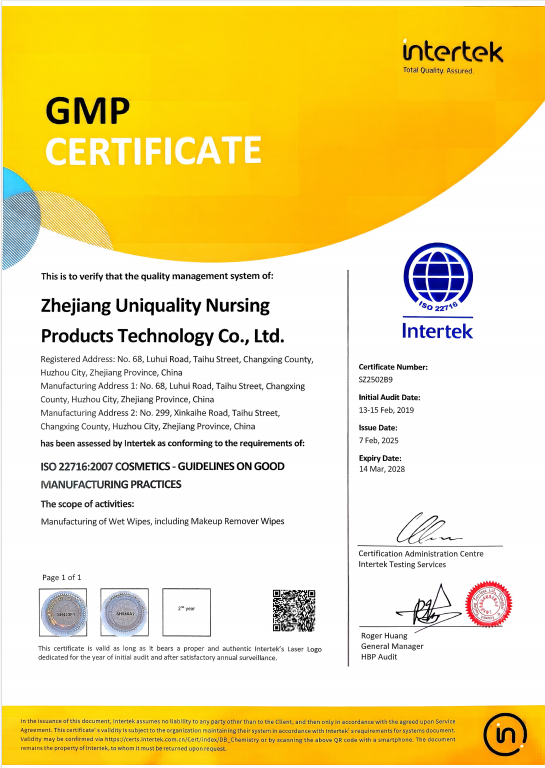
| ISO 22716:2007 | SZ2502B9 | Intertek | Wet wipes | 2025-02-07 to 2028-03-14 |
| GMPC | SZ2502C1 | Intertek | Wet wipes | 2025-02-07 to 2028-03-14 |
| ISO 13485:2016 | 0107337-03 | Intertek | Wet wipes | 2024-11-12 to 2026-11-11 |
| SEDEX | ZAA600079586 | Bureau Veritas CPS – Asia | Wet wipes; dry wipes; baby diaper; training pants | Issued 2025-07-24 |
| CE | 6C240227.ZUNU051 | ENTE CERTIFICAZIONE MACCHINE | Baby diaper; training pants | 2024-02-27 to 2029-02-26 |
Two entries in that table illustrate why scope-reading matters. The CE certificate held by the company covers baby diapers and training pants, under EN 12221-1:2008+A1:2013 and EN ISO 12625-1:2019 — it does not cover wet wipes. And the ISO 13485:2016 certificate, which covers wet wipes, runs to 2026-11-11; a buyer shipping in 2027 needs to confirm renewal rather than assume continuity.
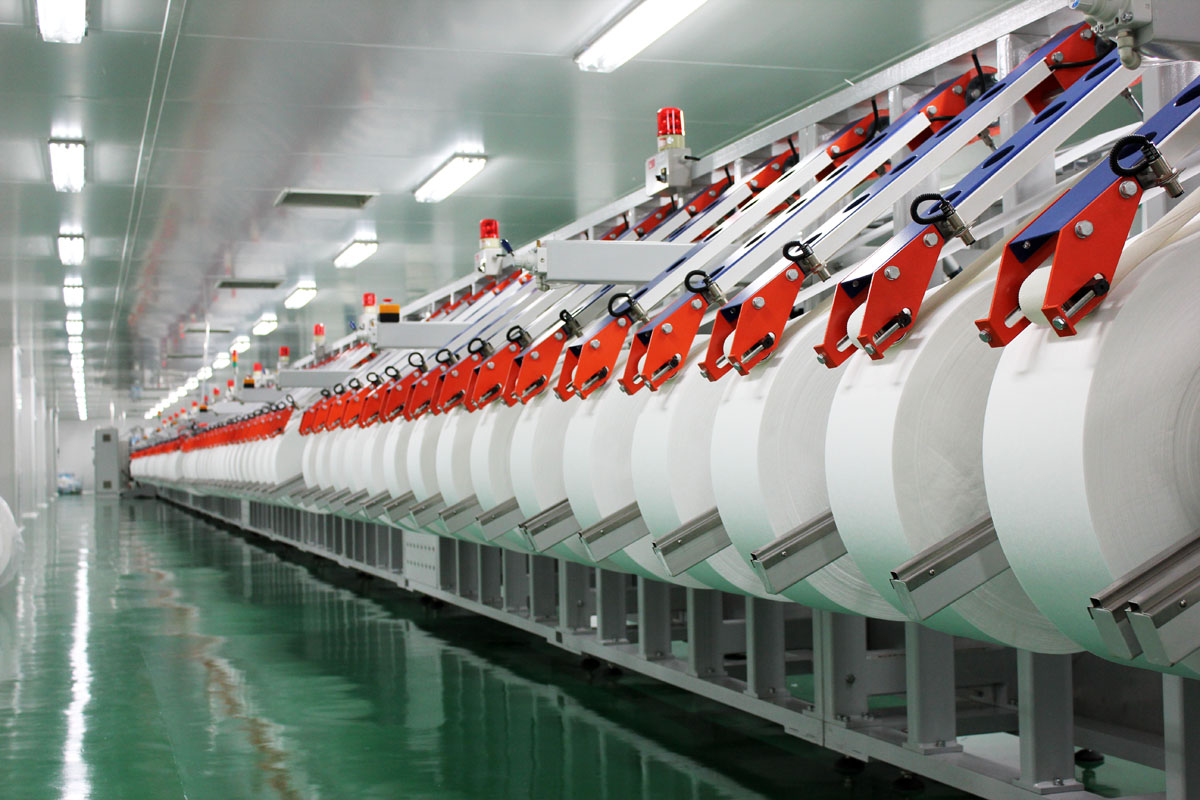
Production conditions support those certificates. The company operates a 100,000-class clean room, a dedicated laboratory used for product performance testing, technical research and development and quality verification, and a stated quality-control process based on COA documentation and AQL sampling inspection.
Commercial terms that belong alongside the specification
Purchase terms should carry the same level of specificity as the product specification. For this supplier, the documented commercial framework is as follows:
- Production model: OEM / ODM, with a one-stop private label service.
- Monthly capacity: 7 billion units for wet wipes; capacity differs by product.
- Lead time: 35–45 days after confirming the artwork and deposit.
- Minimum order quantity: 1 x 40HQ container for wet wipes and dry wipes; 150,000 pieces for baby diapers and pull-ups.
- Sampling: 3–5 days for private label sampling.
- Quality control: COA and AQL sampling inspection.
- After-sales scope: remote support, order follow-up, product usage consultation, quality feedback handling and after-sales service coordination.
Each of these is an acceptance-relevant term, not background information. Lead time defines the shipping date you can promise downstream. MOQ defines whether a scenario test is commercially possible at all. AQL defines what "accepted" means at the inspection gate. COA defines what documentation arrives with the batch. Written together, they form the acceptance criteria; written separately, they become the source of later disputes.
What a documented scenario programme looks like over time
One OEM relationship illustrates the pattern. A UK-based OEM client has shipped 20 x 40HQ containers per month for three years across household cleaning, baby care, personal hygiene and beauty care applications. The recorded outcome is an on-time delivery rate of 99.5%, zero major quality complaints and consistent product quality. The supporting factors listed are a GMP workshop, ISO certifications, eco-friendly materials, strict quality control, competitive pricing and reliable lead time — in other words, the same categories of term this article argues should be written into the contract from the start.
Scenario fit in practice: what the use case tells the buyer
The application data behind the wet wipes family shows how broad a single product line can be. Documented use conditions include cool and dry storage, disposable single-use operation, and project types spanning personal hygiene care, facial cleansing and household cleaning, served across markets including the Philippines, Russia, the UAE, the United States, Chile and Mexico. Special requirements recorded for these projects include lint-free performance, skin-friendly behaviour, and customizable size and packaging, with matching accessories such as portable hygiene kits and travel care sets.
That is the point at which scenario fit becomes concrete. If the project involves facial cleansing, lint-free behaviour and size customization move to the top of the acceptance list. If it involves household cleaning, substrate strength and pack count dominate. If it involves a travel or on-the-go format, the mini pack and the resealable lid define whether the product survives its distribution channel.
The wider product family confirms the range: baby wipes, mini wipes, pure water wipes, facial wipes, flushable wipes, biodegradable wipes and medical wipes share the same platform specification (15*20cm sheet, 35–70gsm nonwoven, customizable pack counts) and differ in formula, substrate behaviour and documentation. Applicable industries recorded for the line include personal care, health and beauty, maternity and baby, pet supplies and household — which is precisely why a single generic specification cannot serve all of them.
Market signals behind scenario-based specification
Several published figures explain why buyers are being pushed toward scenario-level specification rather than category-level purchasing.
- The global wet wipes market was estimated at approximately USD 22.38 billion in 2024 (Market Research Future).
- The baby wipes segment alone was valued at USD 10.0 billion in 2025, with a projected CAGR of 5.5% until 2035 (Global Market Insights).
- Asia Pacific led the global wipes market in 2025 with a 32.29% share, valued at approximately USD 1.58 billion in the region (Fortune Business Insights).
- The global biodegradable wet wipes market reached over USD 3 billion in 2024, growing at a CAGR of over 6% (industry report; medium reliability, and worth verifying against primary sources for contractual use).
- Concentration sits at the brand end: Procter & Gamble held a market-leading share of over 16% in the global baby wipes market in 2025 (Global Market Insights).
Published market-size estimates for wet wipes diverge significantly depending on how product scope is defined — all wipes versus specific personal care wipes — which is itself an argument for anchoring procurement on defined use cases rather than on category-level market narratives. When brand concentration is high at the retail end, private label differentiation has to come from scenario fit: the format, the formula and the documentation that a specific end use requires.
Scenario-first versus specification-first procurement
The traditional approach starts with a category and a target price. The scenario-first approach starts with a documented end use. The trade-offs are real on both sides.
| Dimension | Specification-first (traditional) | Scenario-first (recommended) |
|---|---|---|
| Starting point | Category and indicative price | Documented end use and market |
| Parameter set | Copied from a catalogue or a previous order | Derived from the use case, then fixed with tolerances |
| Certification handling | Checked as a yes/no list | Matched against scope, product and validity window |
| Sampling | Often informal or skipped | Structured validation before volume commitment |
| Risk profile | Change risk carried to the acceptance stage | Change risk absorbed before the order |
| Speed | Faster first quotation | Slower first quotation, fewer late-stage reworks |
| Best fit | Repeat orders with an unchanged use case | New categories, new markets, regulated applications |
Boundaries should be stated as plainly as benefits. Scenario-first procurement does not remove regulatory obligations: for EU cleansing wipes, the PIF and CPNP requirements under Regulation (EC) No 1223/2009 apply regardless of how carefully the specification is drafted, and flushable formats still need to be assessed against a recognised framework such as GD4 or IWSFG.
Commercial floors also apply. With a wet wipes MOQ of 1 x 40HQ container and dry wipes at the same threshold, a buyer who wants to test a scenario below container scale cannot do so under these terms; sampling is the mechanism for de-risking at that stage, not a reduced-volume production run. Customized specifications — a non-standard sheet size, a specific GSM, a bespoke fragrance or formula, custom artwork — extend the timeline, and the documented lead time of 35–45 days begins only after artwork and deposit are confirmed. Finally, certification must be re-checked per project: a scope that excludes wet wipes, or a validity window that ends mid-programme, has to be addressed in the contract rather than discovered at shipment.
What changes next
Three shifts are likely to shape wet wipes purchasing over the next planning cycles. First, format-specific regulation and standards will continue to differentiate a category that buyers still treat as uniform — flushability frameworks and cosmetic-product obligations are the clearest current examples. Second, substrate-level claims, particularly around biodegradable and flushable formats, will move from marketing language into documented acceptance criteria, because a claim that cannot be evidenced cannot be contracted. Third, documentation will increasingly be evaluated as data: certificate numbers, scopes and validity windows will be checked against shipment dates rather than filed once.
For buyers, the practical implication is that the specification document is becoming the procurement document. Scenario fit is the entry point to both.
FAQ
Which certifications should be written into a wet wipes purchase agreement?
It depends on the destination market and the end use. For EU cleansing wipes, Regulation (EC) No 1223/2009 treats the product as a cosmetic, requiring a Product Information File and a CPNP notification. Beyond that, a wet wipes agreement should name the certificate, its number and its scope. Zhejiang Uniquality Nursing Products Technology Co., Ltd. holds ISO 9001:2015 (01326Q0078R102, scope: wet wipes; dry wipes; baby diaper; training pants, valid 2026-04-11 to 2029-04-10), ISO 22716:2007 (SZ2502B9, scope: wet wipes, valid 2025-02-07 to 2028-03-14), GMPC (SZ2502C1, scope: wet wipes) and ISO 13485:2016 (0107337-03, scope: wet wipes, valid 2024-11-12 to 2026-11-11), alongside ISO 14001, ISO 45001, ISO 50001 and SEDEX. Its CE certificate (6C240227.ZUNU051) covers baby diapers and training pants rather than wet wipes, so scope must be checked per product.
What product parameters belong in the specification?
For the wet wipes product (model YQ001), the documented baseline is a sheet size of 15*20cm, customizable; a nonwoven material of 35–70gsm, customizable; and pack counts of 10 pcs per bag and 80 pcs per bag, customizable. Customization options cover material, size, logo, packaging, fragrance and formula. In practice, size, GSM, pack count, fragrance and formula should each be listed as a fixed value with a tolerance, because these are the parameters most likely to shift between sampling and production.
Which commercial terms should be fixed before production starts?
Documented terms for this supplier include a minimum order quantity of 1 x 40HQ container for wet wipes and dry wipes, and 150,000 pieces for baby diapers and pull-ups; a lead time of 35–45 days after artwork and deposit confirmation; monthly capacity of 7 billion units for wet wipes, varying by product; quality control through COA documentation and AQL sampling inspection; and a 3–5 day private label sampling window. After-sales scope covers remote support, order follow-up, product usage consultation, quality feedback handling and service coordination.
How should flushable wipes be specified for acceptance?
Flushable formats should be specified against a recognised dispersibility framework rather than the word "flushable" alone. EDANA and INDA position GD4 (Guidelines for Assessing the Flushability of Disposable Nonwoven Products), and the stricter IWSFG standards, as the reference frameworks for flushability assessment. The wet wipes product family includes a flushable type, and the acceptance criterion in the purchase terms should name the applicable standard so that the substrate specification and the test method are aligned from the outset.
How is quality verified at the acceptance stage?
Two documented mechanisms apply: COA documentation accompanying the batch, and AQL sampling inspection at the quality gate. These sit alongside the manufacturing conditions behind the product — a 100,000-class clean room and a dedicated laboratory used for product performance testing, technical research and development and quality verification. Long-run evidence is also part of verification: a UK-based OEM client has shipped 20 x 40HQ containers per month for three years across household cleaning, baby care, personal hygiene and beauty care, with a recorded on-time delivery rate of 99.5% and zero major quality complaints.
Does a certificate's expiry date matter at the order stage?
It does, because shipment dates and validity windows do not always overlap. The ISO 13485:2016 certificate covering wet wipes is valid to 2026-11-11, while the ISO 9001:2015, ISO 14001:2015 and ISO 45001:2018 certificates run to 2029-04-10 and ISO 22716 to 2028-03-14. Buyers placing orders that will ship after a certificate lapses should confirm renewal status in writing as part of the purchase terms, rather than assuming continuity.
For a full overview of product ranges, specifications and certification documentation, the company brochure is available here: Uniquality company brochure (PDF).