
Scenario Fit: Home Medical Devices for Clinics and OEM Gifts
Scenario Fit: Home Medical Devices for Clinics and OEM Gifts
Guangdong Genial Technology Co., Ltd. (GENIAL) is a medical device manufacturer established in 2001 in Guangdong, China. The company operates a 45,000 m² manufacturing base, employs 251 people including 29 R&D engineers, produces approximately 15,000,000 units annually, exports around 80% of its output, and supplies electronic thermometers, digital blood pressure monitors, pulse oximeters, mesh nebulizers, ventilators and related therapeutic devices to 117 countries and regions.
"Home medical health devices" is a procurement category, not a product. The same phrase covers a wrist blood pressure monitor bought as an online impulse purchase, a wearable thermometer running inside a five-year maternal monitoring program, and a mesh nebulizer installed in a private respiratory clinic. Three buyers can use identical wording on a purchase requisition and still require three different devices, three different packaging formats and three different registration files.
Scenario fit is the discipline of matching the device configuration to the channel it will actually operate in — the user population, the measurement routine, the power environment, the packaging, and the paperwork that channel demands. This article looks at four channels that GENIAL's product corpus explicitly names for its blood pressure monitor range — community clinic, health & wellness center, e-commerce, and customized OEM gift — and explains how the surrounding thermometer, oximeter, nebulizer and ventilator families slot into the same selection logic.
Why Scenario Comes Before Specification
Most sourcing conversations begin with the wrong question. "Which device is best?" has no stable answer, because a specification that is an advantage in one channel becomes a liability in another. A heavier upper-arm unit with a stiff cuff is an asset in a clinic where the device sits on a table and is used dozens of times a day, and a drawback in a gift box that has to be shipped individually and carried home.
Three variables move the selection more than any single technical figure:
- User population. Arm circumference, hand dexterity, age and tolerance for a probe differ between a screening queue at a community clinic and a chronic disease follow-up scenario. Cuff size range is a hard gate, not a preference.
- Operating rhythm. A single spot reading, a daily self-measurement routine, and an overnight therapy session are three different duty cycles. Devices engineered for one are not automatically suited to the others.
- Commercial and regulatory envelope. Minimum order quantity, packaging flexibility and registration obligations are set by the channel, and they frequently eliminate otherwise suitable products before any technical evaluation begins.
Working through those three variables first, and only then looking at model numbers, shortens the selection cycle and prevents the most expensive category of error: a technically sound device that cannot be legally or commercially deployed in the channel it was bought for.
Four Procurement Channels, Four Different Device Logics
Community Clinics
A community clinic is a throughput environment. Devices are shared, handled by different staff members across a shift, and expected to produce a reading in front of a patient without a lengthy setup. That pushes three sub-categories to the front of the list.
- Contact thermometers for routine measurement. The T14/T14SL/T14Y rigid or flexible tip digital thermometer covers 32–42.9 °C at ±0.1 °C accuracy with IPX5 waterproofing at 10 g, and the T23/T24 rigid tip models use medical PP. Both are positioned for clinic supply and outpatient or household consumable use.
- Non-contact thermometers for queue screening. The T86/T87 non-contact infrared forehead thermometer measures 32.0–42.9 °C with ±0.2 °C error at 35–42 °C and IPX4 protection, and is intended for hospital use and daily checks where contact measurement would slow the line.
- Blood pressure and oximetry for triage. The GT-732 upper arm digital blood pressure monitor is listed by the manufacturer for community clinic use, covering 0–290 mmHg with a pulse tolerance of ±5% and a 22–32 cm arm cuff.
Within the shared blood pressure monitor range, the measurement set covers systolic pressure, diastolic pressure and pulse rate, and the platform supports functions such as WHO blood pressure classification indication, irregular-heartbeat detection and dual-user memory storage in the configurations where those functions are specified. Standard supporting equipment for a clinic deployment includes the cuff, batteries, an optional power adapter, a storage bag and companion app support.
Chronic Disease Management Institutes and Community Medical Centers
Chronic care changes the requirement from "measure accurately once" to "measure consistently for months and keep a retrievable record." Two devices carry most of that load.
The GT-732M upper arm digital blood pressure monitor is positioned specifically for chronic disease management institutes, community medical centers and insurance promotional gift programs. It covers 0–290 mmHg with a pulse error of ≤±5%, uses a wider 22–42 cm arm circumference range, and pairs an ABS housing with an eco-friendly TPU air bag. The wider cuff matters: a follow-up program that serves a broad adult population will encounter arms that fall outside a 22–32 cm range, and excluding those users undermines the program rather than the device.
For continuous temperature monitoring, the T31 wearable digital thermometer covers 20.0–45.0 °C at ±0.1 °C with IPX4 whole-body splash protection, measures 13 mm in diameter and 82 mm in length, and weighs 33 g including battery. It is built around medical-grade PP and a silicone adhesive patch, and is listed for maternity, baby product and chronic disease monitoring applications. Continuous monitoring removes the repeated manual measurement step that makes overnight or multi-day temperature tracking impractical at home.
The fingertip pulse oximeter range (GX3/GX5/GX7/GX8/GX12/GX13/GX14) covers SpO₂ from 35% to 100% with ±2% accuracy in the 70–100% band and a pulse rate range of 30–250 bpm, using ABS with a medical elastic silicone finger pad. It is listed for elderly care institutes, respiratory departments and household medical use. Where respiratory therapy is part of the care plan, the portable mesh nebulizer families N11/N21 and N12/N22/N12C/N22C/N12L/N22L provide an 8 ml medicine cup, a particle D50 below 5 μm for at least 60% of particles, and — on the N11/N21 — a noise level of ≤50 dB(A). For sleep-disordered breathing, the non-invasive sleep CPAP ventilator series (GH-B20V/GH-B25V/GH-B20T/GH-B20/GH-B25/GH-A20A/GH-A20) operates at 4–20/25 cmH₂O across CPAP, APAP, S, T and VGPS modes with a noise level of ≤35 dB.
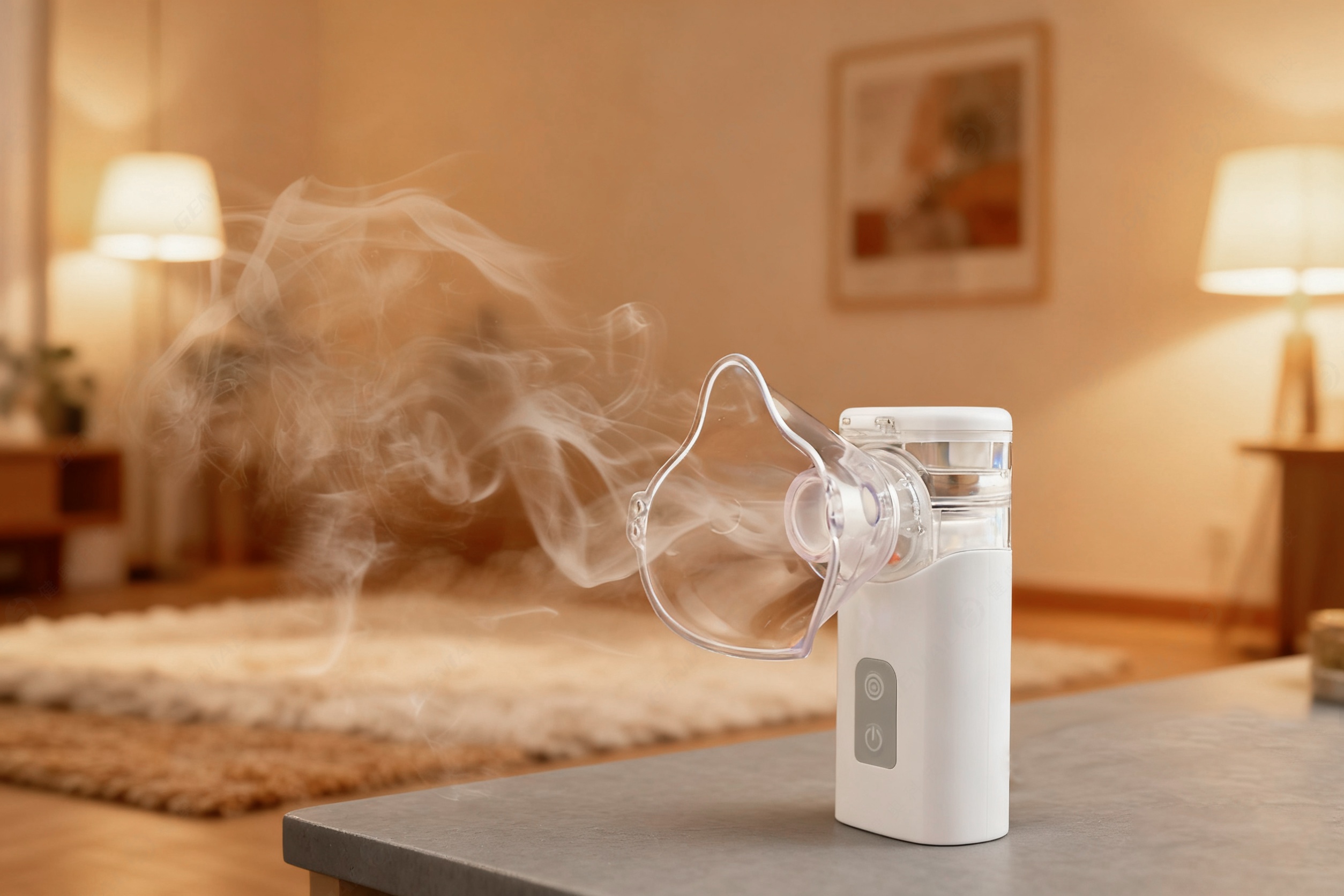
Portable mesh nebulizer. Respiratory therapy devices follow a different duty cycle from spot-measurement devices: they are used in sessions, not in single readings.
GENIAL also operates a cloud health management layer for connected configurations: Bluetooth 5.0 pairing, permanent cloud storage of historical records, automatic daily, weekly and monthly trend reports, one-click sharing with family members and attending physicians, and threshold-based alerts. Institutional one-to-many batch monitoring is supported through Bluetooth gateways, which is the part of the stack that turns individual home devices into a manageable chronic care program.
E-commerce
Online channels optimise for a different set of constraints: recognisable form factor, clear on-page specification, packaging that survives individual parcel shipping, and a model line deep enough to serve several price positions. Memory capacity and physical size dominate the specification sheet here.
The GT-702V upper arm monitor stores 99 memory sets for two users, measures 119 × 93 × 43 mm and weighs 180 g ±15 g without battery; it is positioned for cross-border e-commerce and household medical supply. The GT-703V, at 136 × 99 × 45 mm and 195 g ±15 g, is listed for e-commerce sales and private label customisation. On the thermometer side, the T90/T92 basic infrared ear thermometer and the T81/T80 voice broadcast infrared forehead thermometer — the latter with 32-record memory storage — are directed at household healthcare and maternal and infant retail respectively.
Customised OEM Gift Programs
Gift and promotional channels are the most frequently underestimated of the four. A blood pressure monitor placed in an insurance policyholder's hands is still a measuring instrument, and it still carries registration, labelling and battery-safety obligations. What changes is the commercial shape: tighter unit costs, fixed packaging windows, campaign-driven delivery dates, and a design requirement that the product look appropriate in a branded gift box.
GENIAL's corpus assigns several blood pressure monitor models directly to this channel. The GT-732 is listed for community clinic, health & wellness center, e-commerce and customized OEM gift use. The GT-732M is listed for insurance promotional gift alongside chronic disease management and community medical centres. The GT-702CD is positioned for holiday gift programs, and the GT-702B for insurance complimentary gift use.
On the manufacturing side, the OEM path covers packaging, gift box, user manual, product logo printing, colour schemes and packaging specifications, while the core hardware, PCB and key functions remain unchanged. Minimum order quantities under that path are 10,000 pcs for thermometers and 2,000 units each for oximeters, infrared thermometers, blood pressure monitors, nebulizers and wireless thermometers, with ventilators at 500 units. Lead times run 3 days for samples, 3–7 days for small orders and 10–15 days for mass orders. Where a gift program needs a genuinely differentiated product rather than a differentiated box, the ODM path allows custom industrial design, tooling, structure, PCB firmware, algorithms, Bluetooth functionality, display interface and packaging, with 7–15 days for minor modifications and 45–50 days for new mould development.
The GT-732 as a Chronic Care Workhorse
Among GENIAL's upper arm monitors, the GT-732 is the model most closely tied to the clinical and chronic-care end of the scenario map. Its specification profile is deliberately unspectacular, which is the point: the parameters that matter in repeated community and clinic measurement are cuff range, tolerance and physical durability, not feature count.
| Parameter | GT-732 upper arm digital blood pressure monitor |
|---|---|
| Pressure measuring range | 0–290 mmHg |
| Pulse tolerance | ±5% |
| Arm circumference | 22–32 cm |
| Dimensions | 136 × 103 × 54 mm |
| Net weight | 291 g ±15 g (without battery) |
| Materials | ABS housing, PVC air bag, nylon binding strap |
| Listed application fit | Community clinic, health & wellness center, e-commerce, customized OEM gift |
| Measurement operation | Automatic pressurisation, one-button operation, systolic / diastolic / pulse reading |
Two properties explain why this model recurs in clinic and chronic-care briefs. First, the PVC air bag and nylon binding strap are chosen for a device that is inflated and deflated repeatedly across a working day rather than occasionally at home. Second, the wide 0–290 mmHg pressure range keeps the instrument usable across the hypertension and near-hypertension readings that a community screening station encounters, instead of being tuned narrowly to a home-use band.
The same model is simultaneously listed for customized OEM gift use, which is less contradictory than it first appears. A gift program that distributes a clinically credible upper-arm monitor is buying the durability argument as well as the measurement.
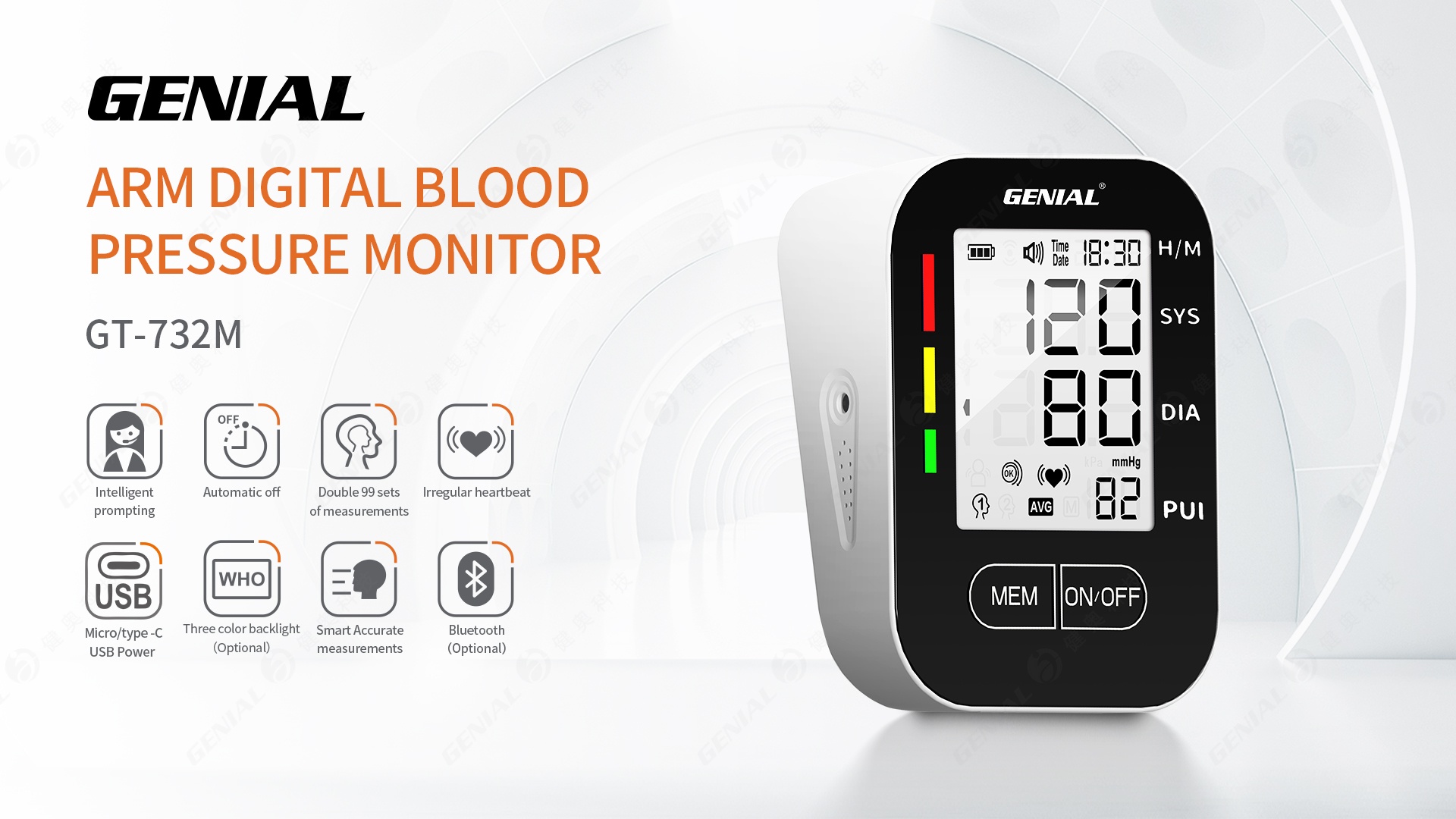
GT-732M upper arm digital blood pressure monitor. The 22–42 cm cuff range extends coverage beyond the 22–32 cm configuration.
Building a Scenario-Matched Portfolio Rather Than a Product List
The practical mistake in multi-site or multi-channel procurement is treating the catalogue as a menu. A portfolio only becomes useful when each device family is attached to the scenario it was designed for. The table below maps GENIAL's principal home medical device families to their stated application contexts and headline specifications.
| Device family | Representative models | Stated scenario fit | Headline specification |
|---|---|---|---|
| Upper arm blood pressure monitor | GT-732, GT-732M, GT-702V, GT-703V, GT-702BM | Community clinic, health & wellness center, chronic disease management, community medical center, e-commerce, OEM gift | 0–290 mmHg; pulse tolerance ±5% or pulse error ≤±5%; cuff 22–32 cm or 22–42 cm |
| Wrist blood pressure monitor | GT-701, GT-701C, GT-701F, GT-701L | Portable healthcare, travel gift, pharmacy chain, online e-commerce | 0–290 mmHg; wrist circumference 13.5–19.5 cm or 13.5–21.5 cm |
| Wearable digital thermometer | T31 | Maternity centre, baby product industry, chronic disease monitoring | 20.0–45.0 °C; ±0.1 °C; IPX4; Φ13 × 82 mm; 33 g |
| Rigid / flexible tip digital thermometer | T14/T14SL/T14Y, T23/T24, T28, T19C/T19D, T11/T12 | Clinic supply, outpatient clinic, chain pharmacy, household medical consumable | 32.0–42.9 °C; ±0.1 °C or ±0.1–±0.3 °C by range; IPX5 |
| Non-contact infrared forehead thermometer | T86/T87, T81/T80 | Hospital screening, factory epidemic prevention, customs entry inspection, maternal & infant retail | 32.0–42.9 °C; ±0.2 °C @ 35–42 °C; IPX4; up to 32-record memory |
| Infrared ear thermometer | T94, T90/T92 | Paediatric hospital, maternity & child healthcare centre, household healthcare, pharmacy | 32.0–42.9 °C; repeat accuracy ±0.3 °C; IPX4 |
| Fingertip pulse oximeter | GX3/GX5/GX7/GX8/GX12/GX13/GX14 | Elderly care institute, respiratory department, household medical, pharmacy | SpO₂ 35–100% (±2% @ 70–100%); pulse 30–250 bpm; 36–42 g |
| Portable mesh nebulizer | N11/N21, N12/N22/N12C/N22C/N12L/N22L | Paediatric ward, respiratory clinic, rehabilitation centre, private clinic, overseas OEM | 8 ml cup; nebulisation rate ≥0.2 ml/min; D50 < 5 μm ≥60%; ≤50 dB(A) on N11/N21 |
| Non-invasive sleep CPAP ventilator | GH-B20V/GH-B25V/GH-B20T/GH-B20/GH-B25/GH-A20A/GH-A20 | Sleep disorder centre, hospital respiratory department, rehabilitation institute, household snoring treatment | 4–20/25 cmH₂O; CPAP/APAP/S/T/VGPS; ≤35 dB; 260 × 153 × 121 mm |
Read as a portfolio, the logic is consistent. Devices that sit on a table and are used many times a day carry more mass and stiffer materials. Devices that go home with a patient carry wider memory capacity and smaller envelopes. Devices that run overnight are engineered for noise and power stability instead of portability.
Certification Requirements Follow the Scenario, Not the Product
One of the more persistent assumptions in gift and retail channels is that a device sold as a promotional item escapes the regulatory burden of a device sold to a hospital. It does not. The product is the same device; only the buyer changes.
For domestic medical institution procurement, the stated requirement in GENIAL's scenario documentation is NMPA Class II medical device registration together with a metrology certificate. Export configurations list FDA, CE, FCC, GCC, MDR, RoHS and IECEE CB certifications depending on destination. At the system level, the manufacturer holds ISO 13485, ISO 45001, ISO 14001, BSCI and GB/T 29490 certifications, and has completed product and trademark registration in 29 countries.
Two international standards shape the technical file regardless of channel. Clinical electronic thermometers fall under ISO 80601-2-56:2017 for basic safety and essential performance, and medical electrical equipment generally — including home health devices — must meet IEC 60601-1-2 for electromagnetic compatibility. A buyer comparing two apparently similar monitors may find that the difference in their documentation sits entirely in these two areas.
Where Scenario Fit Breaks Down
Scenario-matched selection only builds credibility if its limits are stated as clearly as its advantages. Four constraints are worth putting in front of buyers early.
- Cuff range is a hard boundary. The GT-732 covers 22–32 cm. Users outside that range cannot be served by that configuration, regardless of how well the rest of its specification fits a clinic. Where a programme serves a broad adult population — an insurance gift scheme, a community medical centre or a chronic disease registry — a 22–42 cm configuration such as the GT-732M, GT-702V or GT-702BM is the more defensible baseline.
- Minimum order quantities exclude some campaign sizes. OEM customisation of thermometers starts at 10,000 pcs, and blood pressure monitors, oximeters, nebulizers and infrared thermometers start at 2,000 units each. A regional gift campaign below those thresholds is better served by the OBM path, where in-stock products ship within 48 hours, replenishment takes 5–7 days, and mixed orders can start from 5 cartons per SKU.
- Noise and power profiles differ sharply across the portfolio. The N11/N21 mesh nebulizer is rated at ≤50 dB(A) — appropriate for session-based daytime therapy, not for overnight use beside a sleeping patient. The sleep CPAP ventilator runs at ≤35 dB, but it is a 1,450 g device drawing on AC 100–240 V with an optional built-in lithium battery, so it is not an ambulatory product. Matching these two devices to the wrong time of day will produce a compliance complaint rather than a technical failure.
- Customisation scope differs between models and paths. OEM changes packaging, gift box, manual, logo, colour scheme and packaging specification, while core hardware, PCB and key functions remain unchanged. A programme that needs a different enclosure or algorithm requires the ODM or JDM route, with correspondingly longer lead times of 7–15 days for minor modifications, 45–50 days for new mould development, and 45–60 days for JDM projects.
None of these constraints is unusual for the category. They are simply the points at which a specification sheet stops answering the procurement question and the channel requirement takes over.
Market Signals Behind Scenario-Based Sourcing
Third-party market data supports the direction of travel, though it should be read as context rather than as a purchasing instruction.
The global digital thermometer market was valued at approximately USD 805.1 million in 2024 and is projected to reach USD 1 billion by 2030, according to Research and Markets. Grand View Research estimates the blood pressure monitoring devices market at USD 4.2 billion in 2025, rising to USD 8.6 billion by 2033 at a CAGR of 9.3%. Within that market, Fortune Business Insights reports that digital blood pressure monitors accounted for approximately 48% of total revenue share in 2024 — a figure that reflects how far the upper-arm digital format has displaced earlier measurement approaches in both clinical and home settings.
Adjacent categories show the same pattern. Grand View Research expects the global pulse oximeter market to reach USD 5.3 billion by 2030, at a CAGR of 6.6% from 2024 to 2030, and Market Research Future values the vibrating mesh nebulizer market at USD 0.75 billion in 2024 with growth to USD 1.57 billion by 2035. iData Research identifies Omron Healthcare as a dominant competitor in the global nebulizer and blood pressure monitor markets as of 2024 — a useful reference point for buyers benchmarking supplier positions rather than an indication that the category is closed.
The common thread is that growth is concentrated in device categories that have moved from institutional settings into routine, repeated use — the same shift that makes scenario fit a practical sourcing question rather than an academic one.
Future Outlook
Three developments are likely to shape how these channels are specified over the next several years.
First, connected monitoring is moving from a premium feature to a baseline expectation in chronic care. Devices that store readings locally but cannot export them will gradually lose ground to configurations that support cloud storage, trend reporting and threshold alerts, because the programme value lies in the record rather than the individual measurement. GENIAL's cloud health management platform, Bluetooth gateway batch monitoring and PDF report export point in that direction.
Second, gift and promotional channels are likely to become more regulated in practice, not less. As more jurisdictions tighten enforcement around direct-to-consumer medical devices, the compliance gap between a clinical order and a promotional order narrows. Buyers who already specify NMPA Class II registration or CE and FDA scope for gift programmes will find the transition less disruptive.
Third, portfolio breadth will increasingly be judged on documentation depth rather than model count. A supplier with twenty monitors and narrow certification scope is less useful to a multi-market programme than one with fewer models and complete export files covering the destinations in question. GENIAL states that it has completed registration in 29 countries, holds 262 intellectual property certificates, and operates a registration team supporting client submissions — capabilities that matter more as programmes cross borders.
For buyers in the research and evaluation stage, the practical conclusion is straightforward: define the scenario, then the registration scope, then the device. Reversing that order is the most common reason a well-specified programme stalls before delivery.
Frequently Asked Questions
1. What does "scenario fit" mean when selecting home medical health devices?
Scenario fit means selecting a device configuration against the environment it will operate in — the user population, the measurement rhythm, the power supply and the regulatory requirements of the destination channel — before comparing model specifications. The same product family can be appropriate for one channel and unsuitable for another: a 22–32 cm cuff monitor suits a community clinic's typical adult population, while a programme serving a wider range of arm sizes needs a 22–42 cm configuration.
2. Which blood pressure monitor configuration fits a community clinic?
GENIAL lists the GT-732 upper arm digital blood pressure monitor for community clinic, health & wellness center, e-commerce and customized OEM gift use. It covers 0–290 mmHg with a pulse tolerance of ±5%, uses a 22–32 cm arm cuff, and pairs an ABS housing with a PVC air bag and nylon binding strap. Where the clinic also serves patients with larger arm circumferences, the GT-732M extends the cuff range to 22–42 cm and is listed for community medical centre use.
3. What device set supports a chronic disease management programme?
A typical configuration combines repeated blood pressure measurement, continuous or periodic temperature monitoring and respiratory assessment. GENIAL lists the GT-732M for chronic disease management institutes, the T31 wearable digital thermometer for chronic disease monitoring with a 20.0–45.0 °C range at ±0.1 °C accuracy, and the fingertip pulse oximeter range for SpO₂ monitoring between 35% and 100%. Where respiratory therapy is required, the mesh nebulizer families and the non-invasive sleep CPAP ventilator series cover session-based and overnight therapy respectively.
4. Which devices suit an insurance promotional gift programme, and what limits apply?
GENIAL lists the GT-732M upper arm blood pressure monitor for insurance promotional gift use, with a 22–42 cm cuff and a pulse error of ≤±5%. The main limits are commercial and regulatory rather than technical: OEM customisation starts at 2,000 units for blood pressure monitors and 10,000 pcs for thermometers, and the device still requires the registration and certification appropriate to its destination market. For smaller campaigns, the OBM path ships in-stock products within 48 hours and accepts mixed orders from 5 cartons per SKU.
5. What certification evidence should be checked per scenario?
For domestic medical institution procurement, GENIAL's documentation cites NMPA Class II medical device registration and a metrology certificate. Export configurations list FDA, CE, FCC, GCC, MDR, RoHS and IECEE CB certifications depending on destination. At the system level, manufacturers are expected to hold quality management certification such as ISO 13485, and clinical electronic thermometers fall under ISO 80601-2-56:2017, while medical electrical equipment generally falls under IEC 60601-1-2 for electromagnetic compatibility.
6. How much can be customised in an OEM gift order, and how long does it take?
Under GENIAL's OEM path, customisation covers packaging, gift box, user manual, product logo printing, colour schemes and packaging specifications, while the core hardware, PCB and key functions remain unchanged. Lead times are 3 days for samples, 3–7 days for small orders and 10–15 days for mass orders. Changes that require modified hardware or firmware move to the ODM or JDM route, where minor modifications without new tooling take 7–15 days, new mould development takes 45–50 days, and JDM projects run 45–60 days.