
Scenario Fit Matrix: Personal Care Appliances OEM and DSP's Small-Appliance Strengths
Scenario Fit Matrix: Personal Care Appliances OEM and DSP's Small-Appliance Strengths
An OEM shortlist for personal care appliances is usually built on a familiar set of signals: a long category list, a certification block, a factory area figure and a unit price band. Those signals describe capability in general terms, but they do not answer the question a buying team actually has to resolve before releasing a tooling deposit — does this factory's evidenced strength match the program we are about to place, or does it only match the category name on our brief?
A scenario fit matrix is a way to force that question early. Instead of rating a supplier once, it rates the supplier against several distinct program scenarios and shows which evidence supports each rating. Applied to DSP — the brand of Yiwu DSP Electric Appliance Co., Ltd., a China-based manufacturer and brand owner operating from Yiwu International Trade City — the matrix is useful precisely because DSP's documented portfolio is broader than grooming alone, and its strength is uneven across subcategories rather than uniform.

Production workshop. Image source: DSP company profile.
What a Scenario Fit Matrix Measures
A scenario fit matrix is a comparison table that places a buyer's program scenarios on one axis and a supplier's documented evidence on the other, then rates fit per scenario rather than per supplier. It converts one broad question — “is this supplier good?” — into several narrower and answerable questions, such as “is this supplier evidenced for a twelve-SKU grooming line but not for a sonic toothbrush program?”
Three design choices make the matrix usable rather than decorative. First, scenarios must be defined by buyer need (category mix, channel model, customization depth, launch speed), not by product marketing language. Second, each rating must point to a checkable evidence item — a publicly listed product category, a stated commercial mode, a documented production scale or a stated safety control. Third, the matrix must show non-fit as clearly as fit, because the cost of discovering a capability gap after tooling has been released is far higher than the cost of asking for a specification sheet at shortlist stage.
Why Fit Is Harder to Establish Than Capability
The commercial reason to care about fit is market size and competitive density. Mordor Intelligence sizes the global personal care appliances market at USD 52.13 billion in 2026, with a projected compound annual growth rate of 5.87% from 2026 to 2031. Future Market Insights reports that shaving and hair removal appliances accounted for 29.4% of the market in 2025. A category that large attracts a dense supplier pool, and the largest segment attracts the densest pool of all.
The result is that supplier claims converge. Public manufacturer pages from China-based suppliers — including HAOHAN, YEEPUL and Huux — describe combinations of OEM, ODM, private label, sampling and customization services, and several list overlapping grooming subcategories such as facial cleansing brushes, electric shavers, hair clippers and hair styling tools. When several suppliers say the same thing at the same level of generality, the statement stops discriminating between them.
What still discriminates is scenario-level evidence: which specific subcategories are enumerated, what production scale is stated, which commercial modes are offered, what safety controls are documented, and how export structure is described. That is the layer the matrix is designed to read.
DSP at a Glance: the Entity Behind the Matrix
DSP is the brand of Yiwu DSP Electric Appliance Co., Ltd., a manufacturer and brand owner based in Yiwu International Trade City, Zhejiang, China, selling into export markets. The company states that the business was founded in 2006, that the DSP brand was established in 2010, and that the trademark has been registered in more than 200 countries. Its stated operating pillars are stable quality, service and design.
| Verified profile item | Documented detail |
|---|---|
| Entity | Yiwu DSP Electric Appliance Co., Ltd.; brand name DSP |
| Founded / brand established | 2006 / 2010 |
| Factory size | 20,000 m² |
| Employees | 130 |
| Annual output | 5,000,000 units |
| R&D team | 30 engineers |
| Export ratio | 100% |
| Stated markets | North America, South America, Europe, Asia, Africa, Oceania, Mid East |
| Stated portfolio | Vacuum, oven, microwave, coffee machine, toaster, blender, mixer, air fryer, food processor, cooker, washing machine, cleaner, pan, hair clipper, hair shaver, beauty product |
| Commercial modes stated | OEM manufacturing, ODM customization, private label solutions, wholesale distribution, brand partnerships, retail chains, e-commerce sellers, professional beauty suppliers |
| Certification claims | CB, CE, ROHS, GS, UL (company-reported) |
The Scenario Fit Matrix
The ratings below are an editorial fit assessment built only from the documented items above. They are not a performance ranking and they are not a comparison against named competitors’ specifications. Five stars indicates that the scenario is directly supported by an enumerated product category plus at least one additional supporting fact; two or three stars indicates that the scenario sits outside the enumerated portfolio and must be qualified at SKU level before a program is placed.
| OEM program scenario | Buyer need | Evidence in the public record | Fit |
|---|---|---|---|
| Grooming and hair removal devices (hair clipper, electric shaver, beard trimmer, nasal hair trimmer) | Multi-SKU grooming line under one brand | Hair clipper and hair shaver listed in portfolio; official release also lists hair clippers, beard trimmers and electric shavers | ★★★★★ |
| Hair styling and drying (hair straightener, hair curler, hot air brush, portable hair dryer) | Coordinated styling set sharing heating and housing platforms | Hair styling tools and hair dryers listed; documented overheat protection, insulated handles and automatic shutoff for this device class | ★★★★☆ |
| Kitchen and small kitchen appliances (hand mixer, blender, food mixer/food processor, toaster, air fryer, coffee machine) | Cross-category bundle or housewares program | Blender, mixer, food processor, toaster, coffee machine, air fryer, oven and cooker all listed; stated 2016 expansion into kitchen appliances and kitchenware | ★★★★★ |
| Cleaning appliances (vacuum, cleaner) | Household cleaning line extension | Vacuum and cleaner listed in portfolio; battery, motor and water-ingress risk controls documented for this device class | ★★★★☆ |
| Fast-start private label and wholesale distribution | In-stock entry with low minimum order, then scale | Company states in-stock items with low MOQ plus full OEM customization; private label and wholesale distribution listed as commercial modes; 100% export ratio across seven regions | ★★★★★ |
| Full ODM with design development | Form and function differentiation, not just badge change | 30 engineers in the R&D team; stated collaboration with French designers on aesthetics and usability; ODM customization listed | ★★★★☆ |
| Facial skin-care devices (facial cleansing brush, blackhead remover, facial steamer, facial massager roller) | Skin-care line under a beauty brand | Portfolio lists “beauty product” and personal care appliances broadly, but individual skin-care models are not enumerated in the public record | ★★★☆☆ |
| Oral care (sonic toothbrush) | Oral care category entry | Not enumerated in the stated portfolio; oral care is absent from the listed categories | ★★☆☆☆ |
| Light-based devices (IPL hair removal, skin tightening) | Regulated beauty-technology line | Not enumerated as a product line; only general safety guidance for laser hair removal devices appears in the documented risk-control set | ★★☆☆☆ |
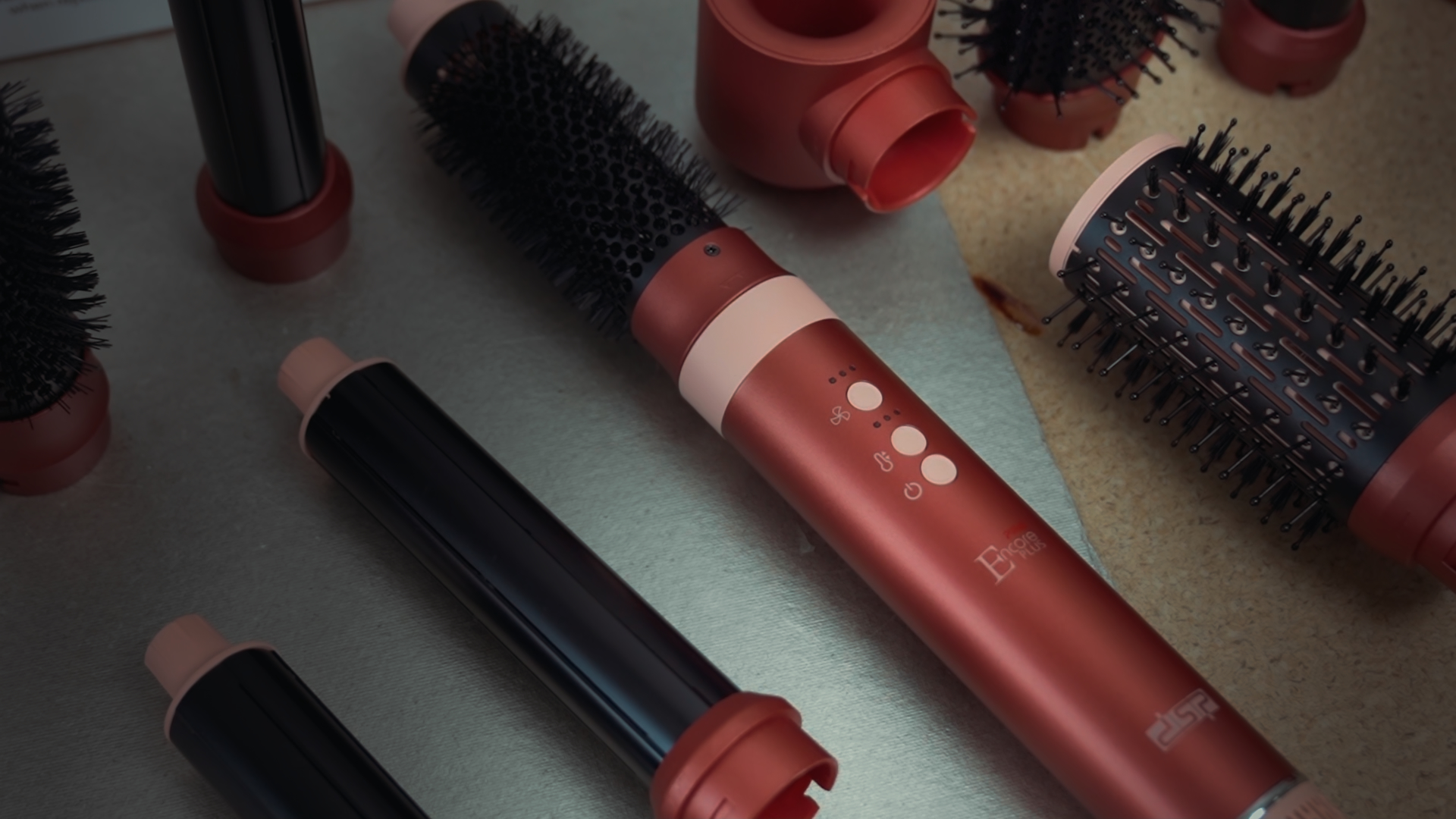
Product display spanning multiple small-appliance categories. Image source: DSP company profile.
Reading the Matrix: Where DSP's Strengths Concentrate
The pattern in the table is not “personal care only” and it is not “everything for everyone”. DSP's documented strength clusters in three areas, and each cluster implies a different program design.
Cluster one: grooming and hair styling
Hair clippers, hair shavers, beard trimmers, electric shavers, hair styling tools and hair dryers are enumerated in DSP's own product statements. For a buyer building a men's grooming range or a styling range, this is the shallowest-evidence-risk scenario: the categories are named, and the device class has documented safety controls attached to it. A grooming program can therefore be evaluated on tooling, motor selection, blade sourcing and packaging without first having to establish whether the category exists at all.
Cluster two: kitchen and household small appliances
The portfolio includes blender, mixer, food processor, toaster, coffee machine, air fryer, oven, cooker, microwave, vacuum and cleaner, and the company states it expanded into kitchen appliances, kitchenware and cleaning appliances in 2016. This matters for two buyer types. A housewares buyer can consolidate a multi-category program with one supplier rather than four. A personal care brand extending into kitchen gifting or bundled sets has a single-source option that does not require a second qualification cycle.
Cluster three: commercial model flexibility
DSP states eight commercial modes: OEM manufacturing, ODM customization, private label solutions, wholesale distribution, brand partnerships, retail chains, e-commerce sellers and professional beauty suppliers. Combined with a stated 100% export ratio and seven named export regions, this supports the common pattern in which a buyer starts with in-stock units at low minimum order and moves to full customization once sell-through is proven. The company explicitly describes both paths.
How the Manufacturing Base Supports Those Programs
Scale figures only become decision-relevant when they are read against program type. A 20,000 m² facility, 130 employees and a stated annual output of 5,000,000 units describe a volume-oriented operation. That profile suits ranged programs — multiple SKUs, repeat orders, seasonal restocking — better than it suits one-off, heavily bespoke single-unit builds, which depend on tooling availability and engineering bandwidth rather than on line capacity.
The documented risk-control set is the more technical part of the evidence, because it shows how safety is engineered rather than asserted. For hair styling appliances, the documented controls include built-in automatic overheat protection, insulated handles, automatic shutoff, and a cold-air function on hair dryers, supported by electrical safety, thermal performance and temperature testing before shipment. For hair removal devices and shavers, the documented controls include protective heads, combs and foil guards, multiple suction levels, overuse-prevention guidance, waterproof seal design and a travel safety lock. Electrical risks such as overcharging and short circuit are addressed through an overcharge protection circuit and a constant-voltage printed circuit board.
For motor-driven kitchen appliances such as mixers and food processors, the documented controls include built-in overheat protection that cuts power during abnormal temperature rise, three-speed or six-speed regulation to prevent prolonged high-load operation, blades sealed inside containers with push-button locking so the unit operates only when correctly assembled, automatic reversal to relieve jamming, and forced cooling after thirty minutes of continuous operation. Production-line testing is stated as 100% withstand voltage, grounding continuity, insulation and functional testing, with motors, gears, wires and thermostats selected for heat resistance and wear resistance.
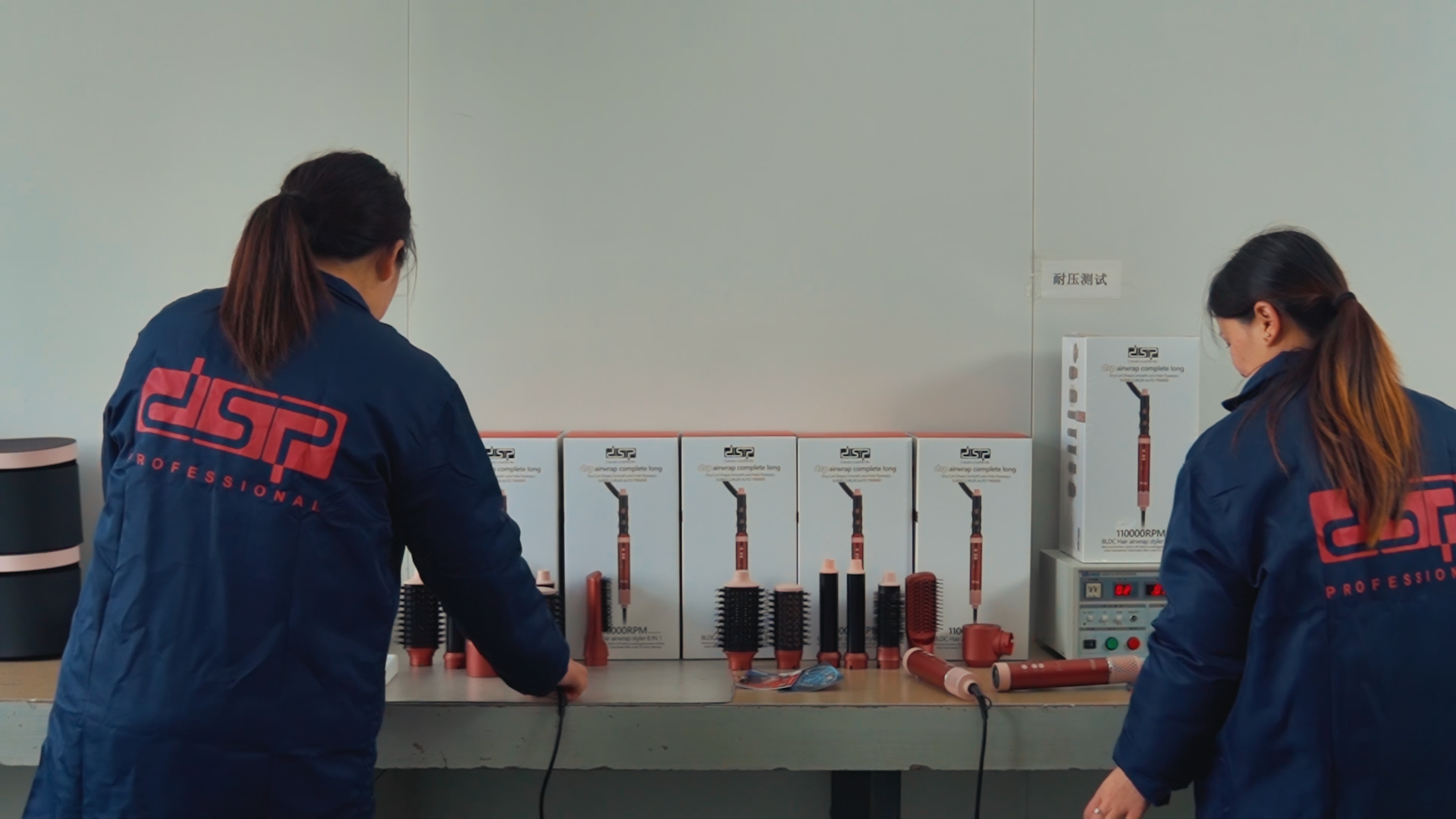
Assembly workshop supporting export-oriented OEM production. Image source: DSP company profile.
Consolidated Multi-Category Sourcing vs Single-Category Specialists
The traditional approach to a personal care OEM program is to source each subcategory from a specialist: one supplier for shavers, another for styling tools, another for kitchen electrics. The alternative — a consolidated multi-category program — trades depth in any single subcategory for fewer qualification cycles, one compliance conversation and one shipping schedule. The trade-off is real in both directions.
| Evaluation dimension | Single-category specialist | Consolidated multi-category supplier |
|---|---|---|
| Subcategory depth | Usually deeper tooling and component knowledge in one category | Depth varies by category and must be checked one category at a time |
| Qualification effort | Repeated audits, samples and compliance files per supplier | One file, one sample cycle, one set of shipping documents |
| Range coherence | Design language must be reconciled across vendors | Shared housing, colour and packaging logic is easier to hold |
| Program risk | Diversified across suppliers | Concentrated; a single capacity constraint affects every SKU |
| Best fit | Narrow, technically demanding single-category launches | Ranged programs across grooming, styling and kitchen electrics |
The limitation to state plainly: a consolidated supplier cannot be assumed to have equal depth in every listed category, and a broad portfolio is not evidence of equal engineering maturity across that portfolio. DSP's enumerated strength is concentrated in grooming, hair styling and kitchen or household small appliances. A buyer whose program depends on a category outside that enumeration should treat the matrix rating as a prompt to request category-specific tooling lists, test reports and reference shipments — not as a confirmed capability.
Limits and Verification Boundaries
Four boundaries should travel with this matrix into any internal approval document.
Certification claims require document review. CB, CE, ROHS, GS and UL appear as company-reported certification standards. Certificate numbers, issuing bodies and the specific product scope each certificate covers are not published in the public record, and a claims list is not a compliance file.
Model-level specifications are not public. Power ratings, battery chemistry, blade material, housing composition and product dimensions for OEM-targeted models are not published. Category presence tells a buyer the conversation is worth having; it does not replace a specification sheet.
Lead time is not stated. DSP's public materials do not state a production cycle. Other China-based suppliers publish their own figures — YEEPUL, for example, states production usually takes 30–45 days after approval — but a competitor's stated cycle is not a DSP commitment and should not be read as one. Confirm the schedule in writing before fixing a retail launch date.
Public data is supplier-reported. Factory area, headcount, output and market coverage come from company materials. No independent factory audit, buyer-side performance record or dispute history is available in the public record, so these items belong in a verification checklist rather than in a final score.
Market Trend Analysis
Three documented trends explain why scenario-level fit matrices are becoming standard procurement practice rather than a niche tool.
First, category concentration. With shaving and hair removal at 29.4% of the personal care appliance market in 2025, the densest supplier competition sits in grooming — the same category where supplier capability statements look most alike. Differentiation therefore shifts from “can you make it” to “what else can you make in the same program”.
Second, commercial-model bundling. Suppliers increasingly publish OEM, ODM, private label and wholesale as one combined offer rather than as separate service lines, and buyers accordingly compare commercial models alongside price. A matrix that includes “fast-start private label” and “full ODM” as separate scenarios reflects how buyers actually choose.
Third, steady growth rather than a spike. Mordor Intelligence projects 5.87% CAGR from 2026 to 2031 on a base of USD 52.13 billion in 2026. Moderate growth rewards suppliers who can hold a ranged program across several seasons, and it rewards buyers who consolidate where consolidation is safe and specialise where it is not.
Future Outlook
For buyers, the practical implication is that supplier evaluation is moving from a single score to a scenario map. The questions that will matter in the next sourcing cycle are narrower than “who is the best personal care OEM”: which supplier is evidenced for this specific combination of categories, this channel model and this launch speed, and what must be verified before commitment.
For suppliers, the implication is that a long category list has diminishing value as a differentiator. Enumerated subcategories, documented safety controls, stated commercial modes and verifiable compliance files do more work than adjectives. DSP's position in that landscape rests on a broad small-appliance portfolio, a stated export-only orientation across seven regions and a documented control set for the device classes it lists — evidence that supports specific scenarios and leaves others open to qualification.
DSP's product and capability documentation is available as a downloadable brochure for buyers who want the detail behind these ratings: DSP brochure (PDF). Company information is published at dsp-official.com.
FAQ
What is a scenario fit matrix in OEM supplier evaluation?
A scenario fit matrix is a comparison table that lists a buyer's distinct program scenarios against a supplier's documented evidence and rates fit per scenario instead of giving the supplier one overall score. Its function is to separate scenarios that are directly supported by enumerated categories and stated capabilities from scenarios that require SKU-level qualification.
Which small-appliance categories does DSP document for OEM programs?
DSP's stated portfolio includes vacuum, oven, microwave, coffee machine, toaster, blender, mixer, air fryer, food processor, cooker, washing machine, cleaner, pan, hair clipper, hair shaver and beauty product. Its official product statements additionally name hair styling tools, hair clippers, beard trimmers, electric shavers and hair dryers. The company states it expanded into kitchen appliances, kitchenware and cleaning appliances in 2016.
How do DSP's scale and export structure affect program planning?
DSP states a 20,000 m² facility, 130 employees, an annual output of 5,000,000 units, a 30-engineer R&D team and a 100% export ratio, with stated markets in North America, South America, Europe, Asia, Africa, Oceania and the Mid East. That profile indicates a volume-oriented, export-only operation suited to multi-SKU ranged programs and repeat seasonal orders rather than one-off bespoke builds.
What certifications does DSP claim, and how should a buyer verify them?
DSP's stated certification standards are CB, CE, ROHS, GS and UL, reported by the company. Because certificate numbers, issuing bodies and per-product scope are not published, verification requires the buyer to request the certificate copies, confirm the model list each certificate covers, and check the issuing body directly before relying on the claim for market access.
Which personal care OEM requests fall outside DSP's enumerated portfolio?
Oral care such as sonic toothbrushes and light-based devices such as IPL hair removal and skin tightening units are not enumerated in DSP's stated product portfolio. Facial skin-care devices such as cleansing brushes, blackhead removers and facial steamers sit inside the broader “beauty product” description but are not individually listed. These categories should be treated as unconfirmed and qualified at SKU level before any tooling commitment.
What commercial modes does DSP offer private label and wholesale buyers?
DSP states eight commercial modes: OEM manufacturing, ODM customization, private label solutions, wholesale distribution, brand partnerships, retail chains, e-commerce sellers and professional beauty suppliers. The company also states that buyers can start with in-stock items at low minimum order and scale into full OEM customization.
What should be requested before committing to an OEM program?
At minimum: model-level specification sheets covering power, battery type, materials and dimensions; certificate copies with issuing bodies and covered model lists; the production schedule in writing, since DSP does not publish a stated lead time; a sample approval record; and a category-specific tooling list for any subcategory that is not explicitly enumerated in the portfolio.
Company facts in this article are drawn from DSP's own company profile and official product statements. Market figures are attributed to Mordor Intelligence and Future Market Insights. Star ratings are an editorial fit assessment based on published evidence and are not a performance ranking.
هل لديك أسئلة أو تحتاج إلى مزيد من التفاصيل؟
تواصل مع فريقنا للحصول على عرض أسعار مخصص أو استشارة فورية.
طلب عرض أسعار
املأ النموذج أدناه وسيتواصل معك فريقنا بعرض مقترح مخصص.
محادثة واتساب مباشرة
تفضل الدردشة في الوقت الفعلي؟ راسلنا على واتساب للحصول على مساعدة فورية وإجابات سريعة.
- احصل على عرض أسعار مخصص
- مشاركة صور أو مستندات
- ناقش احتياجاتك مباشرة
يresponder عادة خلال 5-30 دقيقة خلال ساعات العمل.