
Scenario Fit: Mini Machinery & FAW Trucks Across Haul Types
Scenario Fit: Mini Machinery & FAW Trucks Across Haul Types
Transport procurement rarely fails because a truck is badly built. It fails because the configuration bought does not match the route, the load, the yard, or the market-access file. Scenario fit — selecting chassis and body from the operating job rather than from a catalogue page — is the constraint layer that decides whether a fleet asset earns its keep.
Two product families illustrate the problem from opposite ends of the size scale. The CR468C minidozer from Qingdao Chary Machinery Co., Ltd is a remote-controlled, lithium-battery, rubber-track machine weighing 1,100 kg. The FAW TRUCK range covers vehicle weights from 3,000 kg to 15,000 kg across a body list that runs from tractor units and dump bodies to sweepers and tankers. Both are sold into logistics, cold chain, port, and municipal work. Neither is a universal answer.
This reference sets out how configuration should be matched to scenario, which specifications and certificates a buyer should verify before commitment, and where the fit breaks down.

The three-layer fit test
Scenario fit is not a single decision. It is a sequence of three constraint layers, applied in order, plus one operating-environment check.
Layer one: the physical envelope
Weight and dimension define what a vehicle can physically do before any body is fitted. FAW TRUCK lines are specified across a 3,000–15,000 kg truck weight range, with overall dimensions from 6,000×2,300×3,000 mm to 12,000×2,550×3,800 mm. That span is wide enough to cover an urban distribution route and a long-haul tractor, but a single chassis cannot serve both. A 6 m envelope can enter narrow industrial gates and older city loading bays; a 12 m envelope requires approach geometry, turning space, and dock alignment that many inner-city yards do not have.
Layer two: the body configuration
The same chassis family can carry materially different bodies. The FAW TRUCK body list includes tractor, dump, cargo/rigid/light truck, concrete mixer, garbage, sprinkler, water tank, fuel tank, wrecker, sweeper, concrete pump, asphalt distributor, high-altitude platform, and fire configurations. Body choice changes loading height, load distribution, crew requirement, and unloading method — and therefore changes which haul types the unit can serve at all.
Layer three: the documentation file
Certification is scoped to a product and a market, not to a brand. Two documents appear in the reference file for this article: UN ECE Regulation No. 105 certification for FAW TRUCK product 3665, and a GSO conformity certificate for the FAW J6 Series Truck Tractor. A buyer who assumes that either document covers the whole range is making an assumption the paperwork does not support.
Operating-environment check
Temperature, ground condition, and clearance sit outside the three layers but override them. The CR468C is rated for a working temperature range of −10°C to 60°C and for climbing ability of 40°, which places it in a different operating band from a road truck subject to highway grade and axle limits.
Reading the FAW envelope before choosing a body
| Parameter | Stated range or configuration |
|---|---|
| Truck weight range | 3,000–15,000 kg |
| Overall dimensions | 6,000×2,300×3,000 mm to 12,000×2,550×3,800 mm |
| Tire specification | Available based on customer needs |
| Safety configuration | ABS, EBS, TCS |
| Body configurations | Tractor, dump, cargo/rigid/light truck, concrete mixer, garbage, sprinkler, water tank, fuel tank, wrecker, sweeper, concrete pump, asphalt distributor, high-altitude platform, fire |
| Model designations in range | J7, J6P, J6V, J6E, JH6, J6G, J6L, JK6, Tiger v; additional NEW J5P and J5M V designations appear in the catalogue |
Two consequences follow. First, the weight band is the primary filter: a 3,000 kg unit and a 15,000 kg unit are not interchangeable for the same haul, even when both are ordered as cargo trucks. Second, the tire specification is buyer-defined, which means the specification sheet alone does not fix the final road behaviour — tire choice must be written into the order and matched to route surface and load.
Scenario map: which body for which haul
| Scenario | Body configuration | Catalogue references | Dominant constraint |
|---|---|---|---|
| Building materials transport | Dump, cargo | JH6 8×4 dump, J6P 8×4 dump, J6L 6×4 cargo, J5M V 6×4 dump | Payload per axle and loading point geometry |
| Express delivery | Cargo/rigid, light truck, wingspan | JK6 4×2 cargo, JK6 4×2 wingspan, Tiger VH 4×2 cargo | Dock height and parcel-handling access |
| Logistics fleet operations | Tractor | JH6 6×4 tractor, J6P 6×4 tractor, NEW J5P 4×2 tractor | Route profile and trailer interchange |
| Coal and mineral transport | Dump | JH6 8×4 dump, J6P 8×4 dump | Ground condition, grade, and body wear |
| Cold chain transport | Refrigerated body | Tiger VN 4×2 refrigerated truck; fresh milk transport vehicle | Temperature hold and door-opening frequency |
| Port transport | Tractor, flatbed | JH6 6×4 tractor, J6L 6×4 flatbed truck | Yard turning space and container handling cycle |
| Urban distribution | Cargo, light truck | Tiger VR 4×2 cargo, Tiger VH 4×2 cargo | Access width and delivery window |
| Urban waste transport | Garbage, sweeper | Garbage truck, 4×2 J6L sweeper | Compaction cycle and route stop density |
| Municipal and liquid service | Sprinkler, water tank, fuel tank | Tiger VR 5 m³ stainless steel sprinkler, tank truck | Tank material and market-access scope |
Logistics, express, and urban distribution
These three scenarios look alike on a specification sheet and behave differently in operation. Express and parcel work is driven by stop density and dock interface: a wingspan body or a 4×2 cargo chassis with the right loading height reduces handling time per stop, while a higher payload body may be slower to load at a bay designed for smaller vehicles. Urban distribution adds delivery-window pressure and access width, which is why 4×2 cargo configurations appear in the catalogue for these routes rather than larger tractor-based combinations.
Fleet operations are a different decision again. A tractor unit is bought against route profile and trailer interchangeability, not against a single consignment type. The buyer is effectively committing to a network, which makes the tractor towing and coupling configuration more consequential than the nominal payload.
Across all three, the safety configuration is the same and is stated as a standard element rather than an option: ABS, EBS, and TCS are listed as the security configuration across FAW TRUCK lines, including the JH6 dump configuration.
Cold chain: where the body, not the chassis, decides
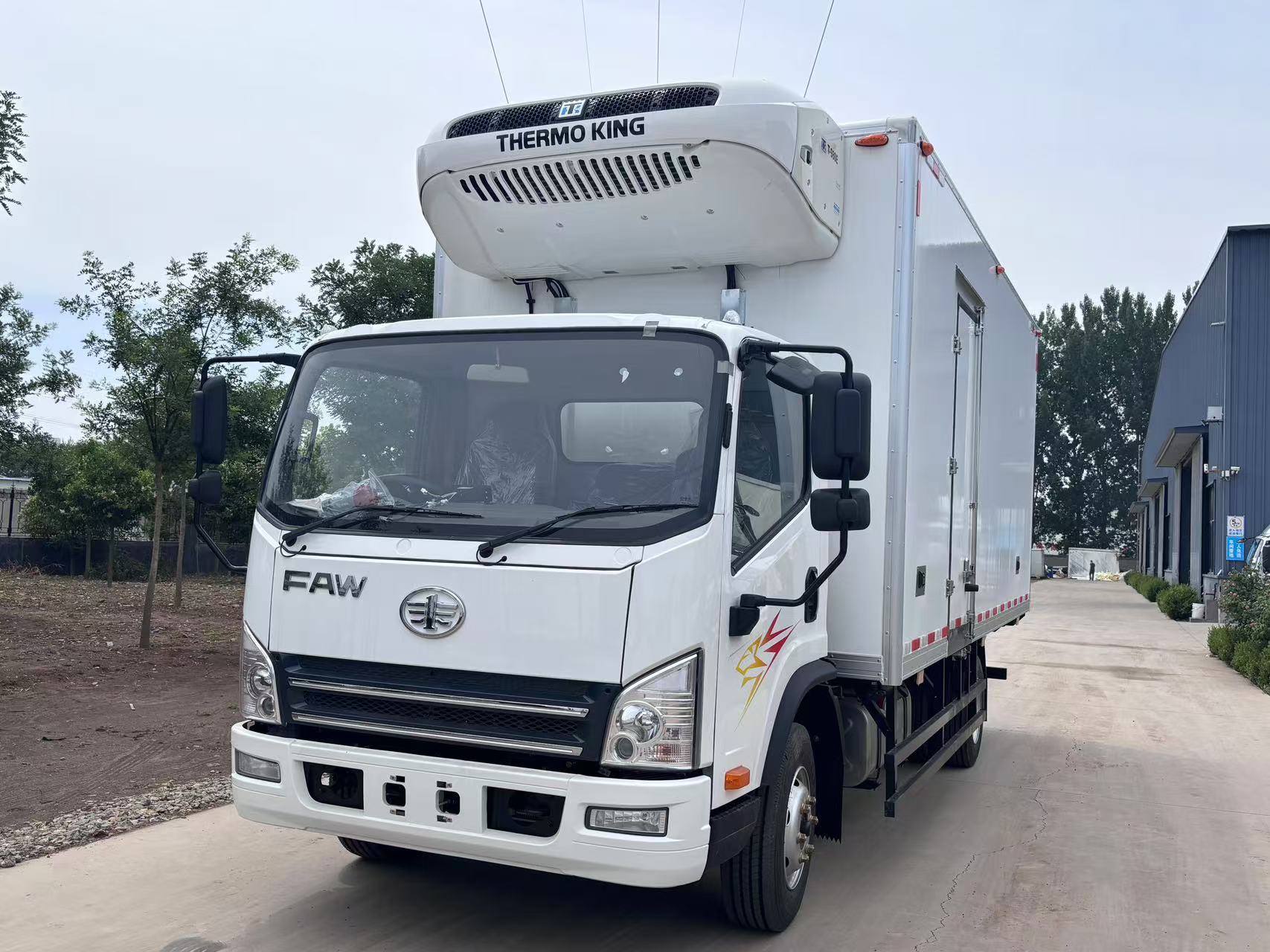
Cold chain transport is the clearest case in which the chassis is almost incidental. The refrigerated body, its insulation, and its temperature-management system determine whether a consignment arrives in condition; the chassis determines whether the unit can reach the delivery point and complete the cycle. The catalogue includes a Tiger VN 4×2 refrigerated truck and a fresh milk transport vehicle, which indicates the range covers temperature-controlled bodies — but the reference file does not publish refrigeration-unit capacity, insulation class, or pull-down performance.
The practical implication for a buyer is that cold chain cannot be specified from the chassis datasheet. The verifiable elements are the vehicle envelope (weight and dimensions within the stated range), the safety configuration (ABS, EBS, TCS), and the destination market documentation. The refrigeration performance must be specified and tested as a separate item.
Port transport and bulk commodities
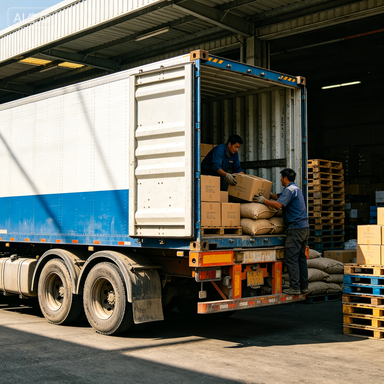
Port work is governed by geometry and cycle time rather than by distance. Yard turning space, container-handling sequence, and gate access usually bind before payload does. Tractor units and flatbed configurations are the standard fit here, and the catalogue includes a JH6 6×4 tractor and a J6L 6×4 flatbed truck that map to this use.
Bulk commodity handling, coal and mineral haulage, and building materials haulage share a different constraint set: ground condition, grade, and body wear. Dump configurations — JH6 8×4, J6P 8×4, J5M V 6×4, NEW J5P 6×4, JK6 6×4 — appear across the range for these tasks. The relevant buyer question is not which dump truck exists, but which weight band and axle configuration the site's ground and access can support, and whether the body material suits the abrasiveness of the load.
Municipal, waste, and liquid transport: the certification edge
Urban waste transport and municipal service add a documentation dimension that general freight does not. Garbage trucks and sweepers operate in public space under local rules, and tank vehicles can fall into regulated categories.
The reference file contains one certificate that speaks directly to this: FAW TRUCK product 3665 is certified to UN ECE Regulation No. 105 (ECER 105) under certificate number E13*105R06/01*0023*00, issued by Société Nationale de Certification et d'Homologation (SNCH) in Luxembourg. The certification is valid for the EU/EEA and countries recognising UN ECE Regulations, and its stated scope covers dangerous goods transport vehicles in the EX/FL/AT/MEMU categories.
That scope is narrow and specific. It does not certify every FAW body, and it does not automatically extend to a fuel tank or tanker configuration ordered on a different product code. A buyer intending to operate liquid or dangerous-goods transport in Europe or in UN ECE-recognising markets should confirm that the exact product code and body combination ordered falls within the certified scope.
Where mini machinery fits: the CR468C in and around transport operations
Mini machinery enters transport scenarios as a feeder and clean-up unit, not as a road vehicle. Qingdao Chary Machinery Co., Ltd — a Qingdao-based vehicle exporter authorised by the Ministry of Commerce, established in 2015, company-reported at 2,000 m², 100+ employees, 15 engineers, and annual output of 500 units — lists mini machinery, minidozer, mini loader, mini electric loader, and skid steer loader among its main products. The CR468C is the unit for which detailed specifications are published.
| CR468C specification | Stated value |
|---|---|
| Type | Remote control lithium battery rubber track minidozer |
| Overall dimensions | 2,850×1,200×600 mm |
| Total length without bucket | 2,250 mm |
| Self weight | 1,100 kg |
| Rated load capacity | 450 kg |
| Bucket capacity / width | 0.15 m³ / 1,200 mm |
| Unloading height | 530 mm |
| Maximum driving speed | 4 km/h |
| Climbing ability | 40° |
| Steering | 360° spin in place |
| Operation method / control distance | Remote control / 200 m |
| Battery | Lithium, 300 Ah, 73.6 V, 22 kWh |
| Motor | 7.5 kW, 3,000 rpm |
| Charging time / working hours | About 2 h at 380/220 V / about 8 h |
| Hydraulic flow / tank | 58 L/min / 20 L |
| Working temperature | −10°C to 60°C |
Read against transport scenarios, those numbers define a specific role. The 1,200 mm width and 600 mm height profile allow the unit to work where a 2,300 mm truck body cannot pass — under conveyor structures, in box culverts and drainage systems, in tunnels, in pumping stations, and in warehouse aisles. The 200 m remote control reach keeps the operator outside the working zone, and 360° spin in place removes the need for turning space. The machine is electrically driven, and the reference material notes the absence of exhaust fumes as an operational benefit in enclosed or semi-enclosed environments.
In a transport context, that points to yard clean-up, spill and bulk-material handling inside sheds, and confined-space work at transfer stations — not to road haulage. The 4 km/h maximum speed and 450 kg rated load place the unit firmly in internal logistics and site preparation.
Documentation matrix by market
| Market | Document | Reference | Scope as stated |
|---|---|---|---|
| EU / EEA and countries recognising UN ECE Regulations | UN ECE Regulation No. 105 (ECER 105) | Certificate E13*105R06/01*0023*00, issued by SNCH, Luxembourg, issued 2024-02-07 | FAW TRUCK product 3665; dangerous goods transport vehicles (EX/FL/AT/MEMU categories) |
| GCC member states | GSO Conformity Certificate (GCC Certificate for Motor Vehicles) | CCR No.435790, issued by GSO, issued 2022-11-10; standards include GSO ISO 1585:2008, ISO 3537:2008, ISO 3538:1997 | FAW J6 Series Truck Tractor (4×2, Euro 4 compliant) |
| All markets | Safety configuration statement | Stated on FAW TRUCK lines | ABS, EBS, TCS |
Two practical checks follow from this table. First, certificate scope is tied to a product code and, in the GCC case, to a specific tractor configuration — so the purchase order must name the code and configuration that the certificate covers. Second, the reference file supplied for this article does not include a third-party certificate for the CR468C minidozer; market-access documentation for that machine should therefore be requested and reviewed against the destination market's requirements before shipment.
Where the fit breaks: limits worth stating plainly
- Mini machinery is not a substitute for road haulage. At 4 km/h with a 450 kg rated load and a 0.15 m³ bucket, the CR468C moves material in cycles inside a defined area. Attempting to replace a truck cycle with it produces a large number of small loads.
- Runtime is a claim to validate, not a schedule. The published figures are about 8 working hours and about 2 hours charging at 380/220 V. Actual duty cycle, load density, and ambient temperature will move those numbers, and a site without a suitable charging point cannot realise them.
- Cold chain performance is outside the chassis specification. The reference file does not publish refrigeration capacity or insulation class, so temperature performance must be specified and tested separately.
- Certification does not follow the brand. ECER 105 applies to a specific product code and a dangerous-goods scope; the GCC certificate applies to a specific tractor configuration. Neither can be assumed for a different body or model year.
- Envelope limits are hard limits. A 12 m overall length cannot be made to fit a yard designed for 6 m vehicles by changing the body.
Market signals behind the scenario approach
Three published data points frame why configuration-led buying is becoming the default rather than a specialist practice.
- China's sales of new-energy concrete mixers reached 8,036 units in 2024, with penetration rising to 43.8%, according to CleanTechnica (8 May 2026). Electrification has moved past pilot stage in at least one heavy vocational body category.
- China was the world's largest exporter of excavators under HS Code 8429.52 in 2024, with a total value of USD 8,269,138,660, based on UN Comtrade data reported through HS Code Match (18 February 2026). A concentrated supply base makes documentation and spare-parts continuity part of the specification, not an afterthought.
- The global compact mini excavator market was valued at USD 9.42 billion in 2026 and is projected to reach USD 16.39 billion by 2034 at a 7.2% CAGR, per Data Insights Reports (5 July 2026). This is commercial research and should be read as directional rather than definitive.
Field evidence from deployed units
Two client records in the reference file illustrate the scenario logic in practice.
A Saudi Arabian engineering construction client operates 12 units of the CR468C for narrow indoor and outdoor material handling, with reported stable operation over a duration of more than 10 years. The stated highlight is manpower and material savings in high-temperature and narrow environments — which aligns with the machine's stated 60°C upper working temperature and 1,200 mm width.
A logistics company in Mali operates 50 units of FAW TRUCK for powdered and granular material transport and sand and gravel haulage, with reported stable operation over more than 10 years under high-intensity use. The relevant lesson is that bulk haulage duty cycles, not nominal capacity, determine whether a fleet configuration holds up.
Procurement sequence for a scenario-matched order
- Define the duty cycle. Route length, stop density, ground condition, and material type. This fixes the envelope layer.
- Select the body. Dump, cargo, tractor, refrigerated, tank, or municipal body, matched to the handling method at both ends of the trip.
- Confirm the market-access file. Identify the specific product code and the certificate that covers it for the destination market.
- Fix the order details. Both ranges are offered on a one-unit minimum order with a stated 30–45 day lead time. Customisation options differ: the CR468C is offered with customisation of loading capacity, track life, and battery life, while FAW truck customisation covers body, engine, tires, and load capacity.
- Verify inspection and after-sales terms. Stated quality control is 100% full inspection before shipment with a performance test for each minidozer, and 100% test for trucks. Stated after-sales support is accessories plus remote maintenance for mini machinery and global technical support for trucks.
- Check capacity against schedule. Company-reported monthly capacity is 50 units for mini machinery and 8,000 units for trucks, against a stated 30–45 day lead time for both.
Capacity, employee, and output figures in this sequence are company-reported and, in the reference file, flagged as requiring independent verification. Buyers running mission-critical fleets should treat them as claims to be checked rather than as confirmed capability.
Outlook: scenario fit becomes documentation work
Two directions are visible in the evidence. The first is drivetrain shift in vocational bodies: with new-energy concrete mixer penetration at 43.8% in China in 2024, electric and battery-swapping configurations are no longer edge cases in heavy urban work, which will gradually pull charging infrastructure into fleet planning for municipal and distribution depots.
The second is that certification scope will keep tightening as a procurement filter. Certificates tied to a specific product code and a specific regulatory category make configuration discipline unavoidable: the buyer must know exactly which code and body is being ordered before the paperwork can be matched to the destination market. Suppliers who can produce that mapping quickly will be easier to qualify; suppliers who cannot will slow every order down.
For compact machinery, the pressure runs the other way. Growth in the compact segment and the practical constraints of confined sites keep demand for machines that fit where trucks cannot — but the same buyers are increasingly asking for verifiable runtime, charging requirements, and market documentation rather than headline capability claims.
FAQ
What does scenario fit mean when specifying a truck or a minidozer?
Scenario fit means selecting the vehicle from the operating job rather than from a product list. In practice it is a three-layer test: the physical envelope (weight and dimensions), the body configuration, and the market-access documentation, followed by an operating-environment check on temperature, ground condition, and clearance. FAW TRUCK lines, for example, span 3,000–15,000 kg and 6,000×2,300×3,000 mm to 12,000×2,550×3,800 mm, so the envelope filter alone eliminates most of the range for any given route.
Which body configurations are available, and how are they mapped to haul types?
The FAW TRUCK body list includes tractor, dump, cargo/rigid/light truck, concrete mixer, garbage, sprinkler, water tank, fuel tank, wrecker, sweeper, concrete pump, asphalt distributor, high-altitude platform, and fire configurations. Mapping is driven by the handling method at each end of the trip: dump bodies for building materials, coal, and mineral haulage; cargo, wingspan, and light truck bodies for express and urban distribution; tractor units for fleet and port operations; refrigerated bodies for cold chain; garbage and sweeper bodies for urban waste; tank bodies for municipal and liquid service.
Which certifications should be verified for EU/EEA and GCC market access?
For the EU/EEA and countries recognising UN ECE Regulations, FAW TRUCK product 3665 is certified to UN ECE Regulation No. 105 under certificate E13*105R06/01*0023*00, issued by Société Nationale de Certification et d'Homologation (SNCH), Luxembourg, with a scope covering dangerous goods transport vehicles in the EX/FL/AT/MEMU categories. For GCC member states, the FAW J6 Series Truck Tractor holds GSO Conformity Certificate CCR No.435790, issued by the GCC Standardization Organization, in compliance with GSO ISO 1585:2008. Both documents are scoped to specific products, so the ordered code and configuration must be checked against the certificate.
What are the operating limits of the CR468C minidozer in a logistics yard?
The CR468C is a remote-controlled, lithium-battery, rubber-track minidozer with a 1,100 kg self weight, 450 kg rated load capacity, 0.15 m³ bucket capacity, 4 km/h maximum driving speed, 40° climbing ability, and 360° spin-in-place steering. Stated endurance is about 8 working hours with about 2 hours charging at 380/220 V, and the working temperature range is −10°C to 60°C. Those figures make it suitable for internal logistics, confined-space clean-up, and bulk-material handling where a truck body cannot pass — not for road haulage.
What minimum order quantity, lead time, and inspection terms apply?
Both product ranges are stated at a one-unit minimum order with a 30–45 day lead time. Stated quality control is 100% full inspection before shipment with a performance test for each minidozer, and 100% test for trucks. Stated after-sales arrangements are accessories plus remote maintenance for mini machinery and global technical support for trucks. Company-reported monthly capacity is 50 units for mini machinery and 8,000 units for trucks.
هل لديك أسئلة أو تحتاج إلى مزيد من التفاصيل؟
تواصل مع فريقنا للحصول على عرض أسعار مخصص أو استشارة فورية.
طلب عرض أسعار
املأ النموذج أدناه وسيتواصل معك فريقنا بعرض مقترح مخصص.
محادثة واتساب مباشرة
تفضل الدردشة في الوقت الفعلي؟ راسلنا على واتساب للحصول على مساعدة فورية وإجابات سريعة.
- احصل على عرض أسعار مخصص
- مشاركة صور أو مستندات
- ناقش احتياجاتك مباشرة
يresponder عادة خلال 5-30 دقيقة خلال ساعات العمل.