
Scenario Fit: SAE4140, A106 Gr.B and ST52 by End Use
Industry Reference · Steel Tube and Bar Selection
Choosing tube for oil, gas, water or structural service is a constraints problem before it is a materials problem. The service condition, the outside diameter and wall thickness on the drawing, and the documentation the buyer's engineering team will accept all narrow the field faster than a grade-versus-grade comparison does. Shandong Tuoda Machinery Equipment Co., Ltd., trading as Tuoda Machinery, is a Shandong-based supplier of carbon seamless steel tube, round bars and pressure cylinders whose published product records separate an SAE 4140 alloy tube line from a wider carbon and alloy seamless line — a split that maps closely onto the way oil, gas, water and structural buyers specify today.
This reference walks through that split: which grades are stated for which end-use category, what size envelope each line actually covers, what the certification covers, and where the boundaries sit.
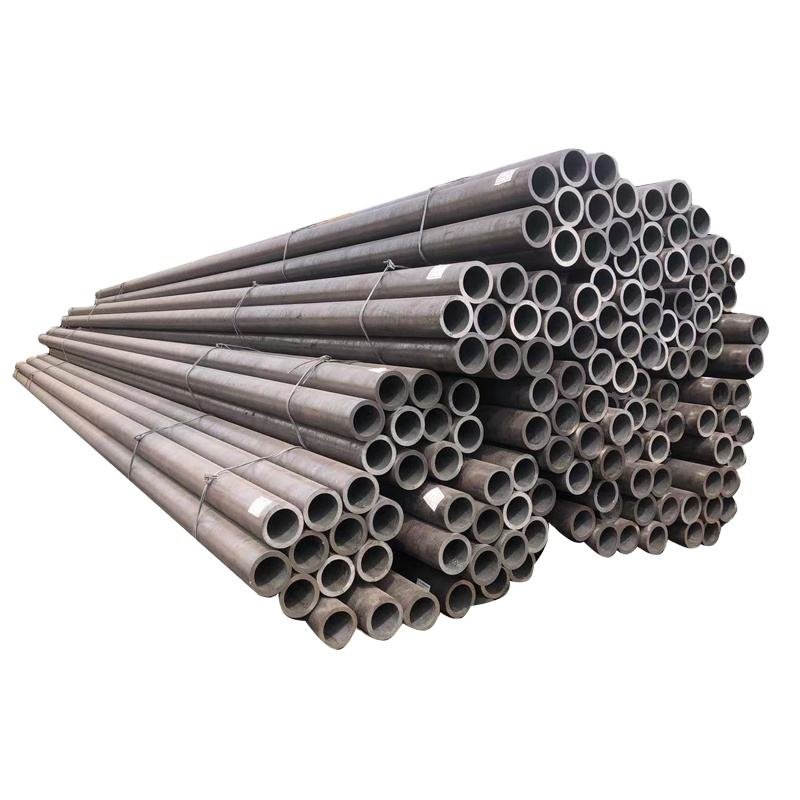
Seamless steel pipe staged for dispatch. Image: Tuoda Machinery.
Why End Use Narrows the Grade List Before Any Grade Comparison Begins
Four service categories put different demands on a tube, and each one shifts the balance between strength, toughness, heat treatment and cost. The published application record for Tuoda's alloy and carbon lines describes the underlying operating conditions as high load, high pressure and high strength, with continuous operation or cyclic loading, and it lists heat treatment as a special requirement rather than an optional extra.
- Oil service (drilling and downhole equipment). Components run under continuous or cyclic loading, and the stated applied range for the SAE 4140 line is drill collars and aerospace components. Quench-and-temper response matters here because the part is expected to hold strength while absorbing repeated load.
- Aerospace component manufacturing. The same SAE 4140 line is listed for aerospace components, alongside automobile manufacturing and oil and gas drilling as the project types recorded for the material.
- Gas and water conveyance. The wider seamless line is described as gas steel and steel for water flow, with A106 Gr.B, ST52, ST44, S355 and E355 among the listed designations.
- Structural service. The same wider line is classified as structural steel, which is where the carbon and alloy structural grades are normally specified.
Two failure modes show up repeatedly in this kind of specification work. The first is over-specification: an alloy grade is written into a structural or water-flow line item where a carbon designation such as A106 Gr.B, ST52 or ST44 would satisfy the duty, adding cost and lead-time exposure without adding function. The second, more expensive failure is under-specification: a carbon grade is pushed into cyclic high-load duty, where the missing element is not strength at installation but heat-treatment response and fatigue behaviour in service.
The practical check is not which grade is stronger in the abstract, but whether the grade is stated for the end use at all, and whether it can be supplied inside the size envelope the drawing requires.
Two Published Lines and the Envelopes They Cover
Tuoda Machinery's published records describe two distinct ranges. The SAE 4140 alloy seamless steel pipe and tube line is deliberately narrower and purpose-bound, while the seamless steel pipe, carbon steel tube, alloy steel pipe and hollow steel bar line is broader in both grade coverage and size.
| Specification item | SAE 4140 alloy seamless steel pipe and tube | Seamless steel pipe / carbon and alloy steel tube line |
|---|---|---|
| Grade designation | SAE 4140 | A106 Gr.B, ST52, ST44, S355, E355, 42CrMo, 30CrMo, ST37, 10#, 20#; the material list also covers 4140, 4130, 4145 and 4340 alloy steel |
| Product forms | Round steel pipe and square steel pipe | Seamless steel pipe, carbon steel tube, alloy steel pipe, hollow steel bar, welded steel pipe |
| Outside diameter | 20–400 mm | 10–1080 mm |
| Wall thickness | 3–30 mm | 2–110 mm |
| Length | Not specified in the product record | 5–5.8 m, 6 m, 6–12 m |
| Stated end use | Drill collar; aerospace components | Structural steel, oil steel, gas steel, steel for water flow |
| Applicable industry | Oil, aerospace | Oil, gas, water, structural |
| Condition of delivery | Not specified in the product record | Hot rolled, cold drawn, cold rolled, QT and other conditions |
| Delivery time | Not specified in the product record | 30–45 days or customized |
The SAE 4140 record also confirms the shape constraint directly: the product is available in round and square shapes, with an outside diameter range of 20–400 mm and a wall thickness range of 3–30 mm. The wider record states an outside diameter range of 10–1080 mm and a wall thickness range of 2–110 mm.
Read together, the two records describe a documented overlap and a documented boundary. Where a drawing calls for an SAE 4140 drill collar or aerospace component inside 20–400 mm OD and 3–30 mm wall, the alloy line applies. Where the requirement is a larger diameter, a heavier wall, or a structural, gas or water-flow duty at commercial scale, the wider carbon and alloy line is the one whose stated end uses match the application.
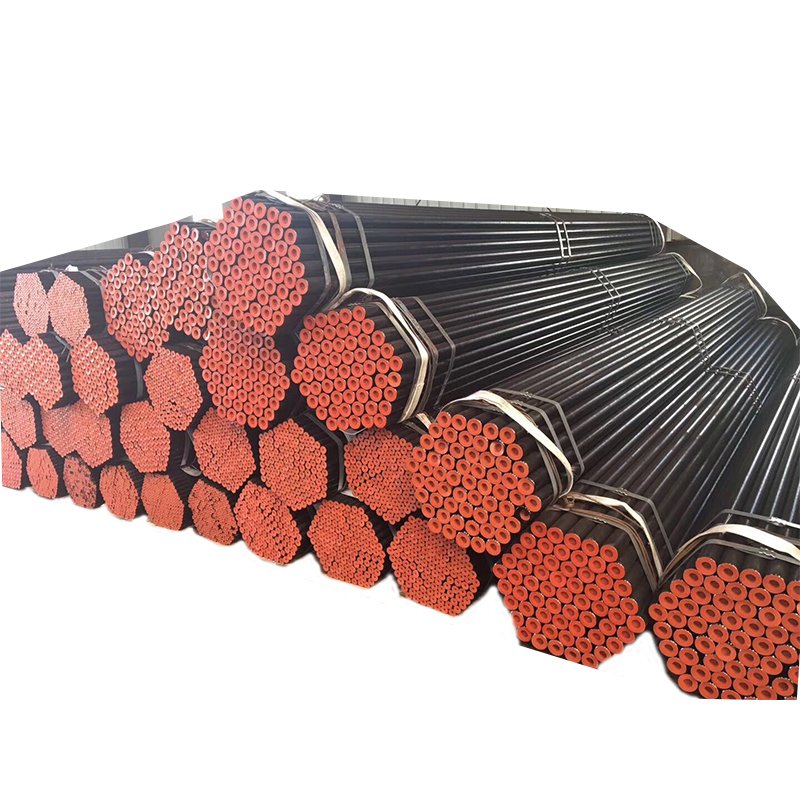
Carbon steel pipe from the wide-diameter line, which covers 10–1080 mm OD and 2–110 mm wall. Image: Tuoda Machinery.
Technical Basis: Chemistry, Heat Treatment and Wall Thickness
SAE 4140 is classified under ASTM A29 and typically contains 0.38–0.43% carbon, 0.80–1.10% chromium and 0.15–0.25% molybdenum, a combination chosen for hardenability rather than for raw carbon content. In the quenched and tempered condition, the grade reaches a tensile strength of 850–1000 MPa with a nominal hardness of 28–32 HRC, which is why it is commonly considered for shafts and gears as well as for the drill collar and aerospace duties named in Tuoda's product record.
Three variables decide whether that chemistry translates into a usable part.
Heat treatment as a specified step
The application record lists heat treatment as a special requirement and identifies the function of the material as providing high-strength support, improving component durability and ensuring wear resistance. In practice this means the buyer should treat the heat-treatment condition as a line item in the enquiry, not as an assumption behind the grade name.
Wall thickness and the hollow-versus-solid decision
The SAE 4140 line runs from 3 mm to 30 mm wall. The wider line runs from 2 mm to 110 mm wall and is also offered as hollow steel bar, which is the form that lets a machined part replace a solid bar with a drilled bore. On a drill collar or a heavy machinery component, wall thickness affects stiffness, the amount of material removed in machining, and the heat-treatment response of the section, so the wall specification belongs in the first enquiry rather than in a later revision.
Trade classification at the large-diameter end
For international movement, HS Code 7228.30 is the primary classification for hot-rolled alloy steel bars, including SAE 4140, with a diameter exceeding 228 mm. Buyers planning a program that crosses that diameter should confirm the classification with their customs broker before the enquiry is priced, because a change of diameter band can change the paperwork as well as the freight logic.
Use-Case Mapping: What Each Grade Is Stated For
Oil drilling equipment and downhole components
The stated applied range for the SAE 4140 line is drill collar and aerospace components in oil and aerospace work. Among the equipment the material is matched to are drill collars, gears, pipe and drilling equipment. The relevant reference case is a petroleum equipment factory in Chile and India that has used 50 sets in the production and manufacturing of oil drilling equipment over a duration of 10 years, with the reported result of stable operation and the recorded highlights of low loss, high performance and high applicability.
That case matters less as a sales statement than as a specification signal: the duty cycle in oil drilling equipment production is continuous, the loading is cyclic, and the material has to survive both without losing dimensional integrity. It is also why heat treatment is written into the requirement rather than left to the mill default.
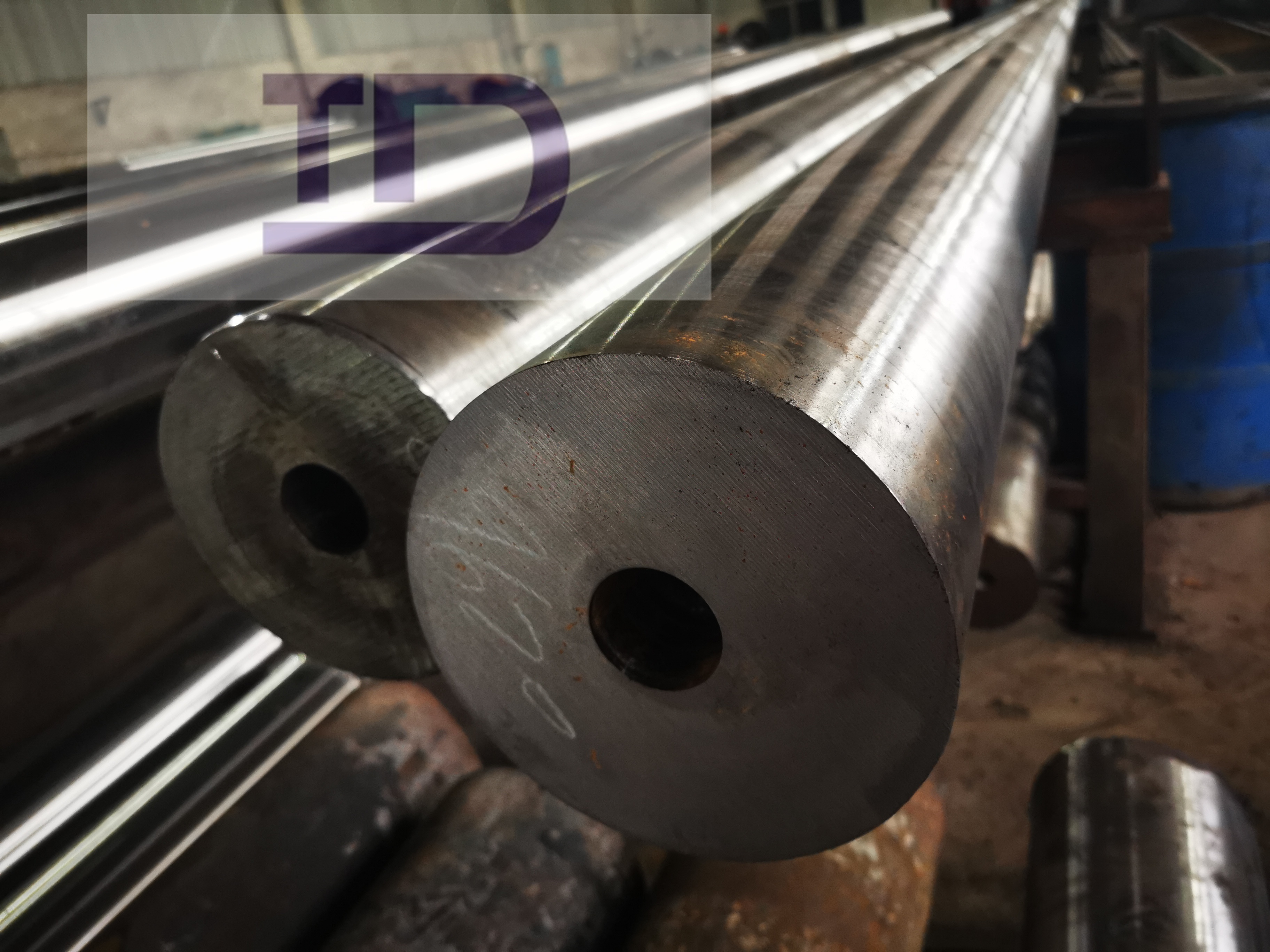
Drill pipe for oil and gas drilling duty, one of the applied ranges stated for the alloy line. Image: Tuoda Machinery.
Aerospace component manufacturing
Aerospace components are listed as part of the applied range of the same alloy tube and pipe line, and aerospace component manufacturing is recorded as a project type for the material. In this context the alloy line is used for machined parts rather than for conveying service, and the specification conversation usually centres on the quenched and tempered condition, dimensional consistency and inspection records.
Gas and water conveyance
The wider line is described as gas steel and steel for water flow. These duties generally favour the carbon and structural designations — A106 Gr.B, ST52 and ST44 among them — where the priority is a consistent, weldable, verifiable tube at a diameter and wall that suits the pipeline rather than a through-hardened alloy section. The delivery conditions recorded for this line — hot rolled, cold drawn, cold rolled and QT — cover the range of surface and dimensional requirements that come with those applications.
Structural and heavy machinery work
Structural service is where the S355 and E355 alloy structural designations sit, alongside ST52 and ST44 in the carbon range. The application record groups this work under heavy machinery and energy equipment, matched to gear, pipe and drilling equipment, and lists reference markets including Chile, Germany, India, Italy, Kuwait, Mexico, Peru, Qatar, Russia and Turkey.
For a structural buyer, the practical implication is that the wide-diameter line should be evaluated first, because it covers 10–1080 mm OD and 2–110 mm wall in lengths of 5–5.8 m, 6 m or 6–12 m, and because the larger part of structural and heavy machinery demand falls inside that envelope rather than inside the alloy line's 20–400 mm range.
Market Signals Behind Demand for Documented Alloy Steel
Two independent data points frame the environment in which these specification decisions are being made. The Business Research Company projects the global alloy steel market to reach approximately USD 160.7 billion in 2026, driven by demand from the automotive and construction sectors. Grand View Research reports that Asia-Pacific accounts for more than 40% of global alloy steel consumption, led by China's infrastructure and automotive production.
The same research set shows how far the application mix is concentrated: the automotive industry accounts for approximately 37% of global alloy steel utilisation, largely on the back of lightweight alloy components. For oil, gas, water and structural buyers, that concentration has a practical consequence — the alloy bar and tube capacity that competes for their orders is also being pulled by automotive and construction programmes, so lead-time and allocation planning matter as much as grade selection.
One caution applies to all of these figures. Published market estimates differ significantly by scope: total- steel versus specific-alloy definitions produce materially different totals for the same reference year, and the divergence is documented across research houses. Buyers using market size figures in an internal business case should check what the number actually counts before relying on it.
On the supply side, the specialty alloy steel bar segment includes large integrated producers such as ArcelorMittal, Nippon Steel and POSCO, alongside specialised suppliers. That structure is worth noting because it explains two different buying routes: high-volume standard alloy bar from integrated mills, and application-bound tube programmes from specialist processors.
Where These Lines Stop: Boundaries Against Traditional Single-Grade Sourcing
The conventional approach to this problem is to standardise on one grade or one supplier line and force every application through it. That approach simplifies purchasing but tends to produce one of two compromises: an alloy grade bought for structural duty at a cost premium, or a carbon grade stretched into cyclic high-load duty where it was never intended to sit.
Matching grade to stated end use avoids both, but it introduces coordination costs of its own, and it comes with real boundaries that a buyer should price in from the start.
- The alloy line is size-bounded. The SAE 4140 product record covers round and square pipe from 20–400 mm OD and 3–30 mm wall. A program requiring, for example, a 600 mm outside diameter is outside that record and belongs in the wider line, where the stated end uses are structural, oil, gas and water rather than drill collar and aerospace components.
- The wider line is not described as an aerospace or drill-collar grade. Its stated end uses are structural steel, oil steel, gas steel and steel for water flow. Substituting across the two lines is therefore a specification decision, not a catalogue decision, and would require confirmation of heat treatment and mechanical properties before release.
- Certification has a defined scope. The CE 3.1 certificate covering these products — certificate number 3N230530.STMDO12, issued by ECM, valid from 30 May 2023 to 28 May 2028 — is scoped to Europe and references EN 10210, EN 10219 and EN 10025. Buyers outside that market, or buyers whose project specification references a different standard family, need to confirm separately which document applies to their order.
- Commercial parameters are fixed rather than flexible. Monthly capacity is stated at 1000 tons, lead time at 30–45 days, and minimum order quantity at 5 tons or by discussion. Customization is scoped to size, length, mechanical property, delivery time and testing inspection. Those are workable parameters for project procurement, but they do not support unlimited flexibility on short notice.
Against traditional single-line sourcing, the trade-off is straightforward: two coordinated specifications instead of one, in exchange for a grade that matches the end-use statement and a size envelope that covers the drawing. For programs that span both envelopes — for example, a drilling equipment build that also needs large-diameter structural tube — that coordination is the main additional planning task.
Outlook: Documentation and Envelope Planning Take Priority
The direction of travel in this segment favours buyers who specify by evidence rather than by grade name. A 30–45 day lead time, a 1000-ton monthly capacity and a 5-ton minimum order quantity are all manageable figures when they are planned against a project schedule, and difficult ones when they are discovered late.
Three planning habits follow from the material reviewed here. First, confirm the size envelope before the grade conversation, because the two published lines overlap only partially. Second, write the heat-treatment condition into the enquiry, since the stated function of these materials — high-strength support, durability, wear resistance under continuous or cyclic loading — depends on it. Third, map the certification lifecycle onto the project calendar: the current CE 3.1 certificate runs to 28 May 2028, so orders placed near that date should confirm the documentation status at the time of contract rather than at the time of shipment.
FAQ
What outside diameter and wall thickness range is available for SAE 4140 tube?
The SAE 4140 alloy seamless steel pipe and tube line is available in round and square shapes with an outside diameter range of 20–400 mm and a wall thickness range of 3–30 mm. Its stated applied range is drill collars and aerospace components, within oil and aerospace industries.
Which grades are stated for oil, gas, water and structural service?
The wider seamless line lists A106 Gr.B, ST52, ST44, S355, E355, 42CrMo, 30CrMo, ST37, 10# and 20#, and its material list also covers 4140, 4130, 4145 and 4340 alloy steel. Its applicable industries are oil, gas, water and structural service, and its type description covers structural steel, oil steel, gas steel and steel for water flow.
What is the difference in size envelope between the two lines?
The SAE 4140 line covers 20–400 mm outside diameter and 3–30 mm wall thickness. The wider seamless, carbon and alloy steel pipe line covers 10–1080 mm outside diameter and 2–110 mm wall thickness, in lengths of 5–5.8 m, 6 m or 6–12 m.
What certification is available, and what does it cover?
A CE 3.1 certificate, number 3N230530.STMDO12, was issued by ECM on 30 May 2023 and is valid until 28 May 2028. Its market scope is the EU and its stated standards are EN 10210, EN 10219 and EN 10025. Buyers whose project references a different standard family should confirm applicability for their specific order.
How is quality verified before shipment, and what are the commercial terms?
A factory laboratory report is provided, or the buyer may arrange a third-party inspection. Monthly capacity is stated at 1000 tons, lead time at 30–45 days or customized, and minimum order quantity at 5 tons or by discussion. Customization covers size, length, mechanical property, delivery time and testing inspection.
What conditions of delivery are recorded for the wide-diameter line?
The recorded conditions of delivery are hot rolled, cold drawn, cold rolled and QT, among others, with delivery time of 30–45 days or customized. The SAE 4140 product record does not specify a condition of delivery, so that item should be confirmed per order.
Tuoda Machinery is the trading name of Shandong Tuoda Machinery Equipment Co., Ltd., a supplier of carbon seamless steel tube, round bars and pressure cylinders serving the EU, Asia and South American markets. A product brochure covering the ranges summarised in this reference is available for download: Tuoda Machinery product brochure. Company website: WWW.SDTDSTEEL.COM.