
Scenario Fit for One-Stop Comprehensive Hotel Supplies
Consolidating hotel textile purchasing under a single supplier is normally justified by coordination: fewer purchase orders, fewer inbound shipments, one point of accountability. That reasoning is correct, but it covers only half of the decision. A hotel does not consume textiles in one environment. It consumes them in guest rooms, in bathrooms and in food-and-beverage outlets, and each of those environments breaks linen in a different way. A one-stop comprehensive hotel supplies scope creates an advantage only when the supplier's range is matched, item by item, to the scenario that item has to survive. Where that matching is skipped, the coordination savings are usually repaid later through replacement cycles.
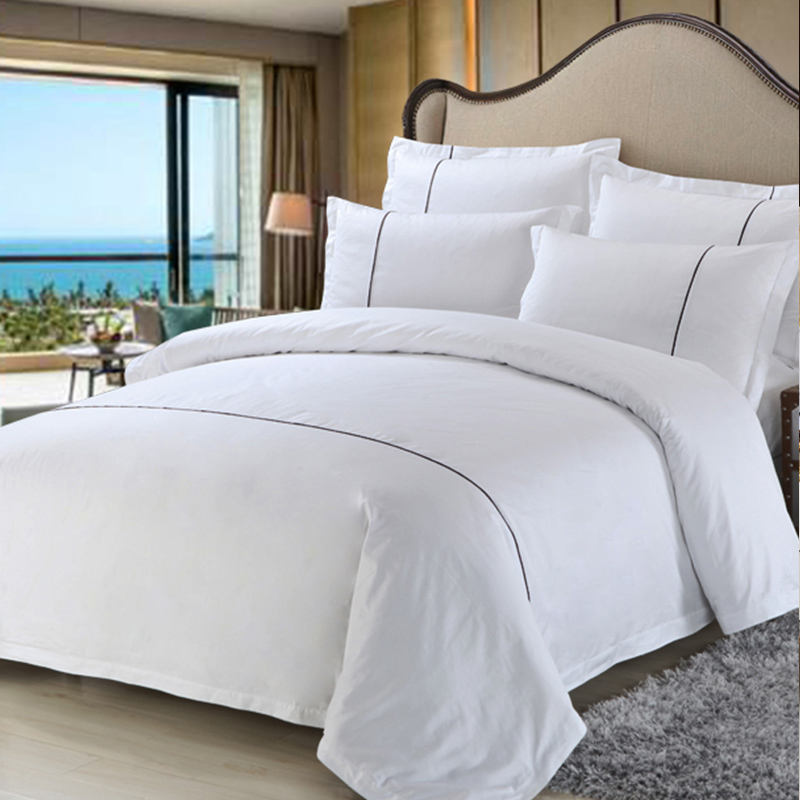
Why Scenario Fit Decides Whether a One-Stop Textile Order Works
Textile specification in hospitality is driven by operating conditions far more than by appearance. A property's requirement divides by project type — hotel guest rooms, bathrooms and restaurants — three zones that may share one procurement document but do not share a stress profile. Guest room linen meets heat, detergent and mechanical action inside a commercial laundry. Bathroom terry meets chlorine and an expectation of fast drying between arrivals. Table linen meets friction, staining and repeated folding. Buying all three from one supplier changes who coordinates the order; it does not change what each item has to withstand.
| Operating zone | Representative items in a one-stop textile scope | Dominant operating stress | Specification lever |
|---|---|---|---|
| Guest rooms | Bedding sets, sheets, pillowcases, pillows, duvets, quilts, mattress comforters, mattress protectors | Cyclic commercial laundering; shrinkage and seam stress | Yarn count and density, shrink-resistant finishing, reinforced hems and seams |
| Bathrooms | Towels, bath mats, bathrobes | Chlorine exposure; repeated washing; absorbency loss | 100% cotton terry weight and yarn count, colour fixation, reinforced edges |
| Restaurants and banquet rooms | Table cloths, napkins | Heat, staining, folding, colour fade | Woven construction, colour-locking treatment, double-needle and stitched finishing |
The practical consequence is that the first evaluation question is not “can one supplier cover everything”, but “does this supplier's item-level specification match the duty cycle of the zone where it will be used”.
What “One-Stop” Actually Covers Inside a Hotel Project
In textile terms, a coordinated supply scope can be defined precisely: it is the ability to furnish the guest floor, the bathroom and the food-and-beverage outlet from one manufacturing base, under one customisation brief and one quality standard. That definition is narrower than the general phrase “hotel supplies”, which in the wider market also covers operating supplies and equipment sold through broadline distributors.
A coordinated textile scope typically includes:
- Bedding sets in sateen, jacquard, embroidered and printed constructions, with 100% cotton options
- Pillows, duvets, quilts and mattress comforters
- Mattress protectors, including waterproof constructions with elasticated corner bands
- Towels in plain, jacquard and embroidered finishing, plus bath mats and waffle bathrobes
- Table cloths and napkins for restaurants and banquet rooms
- Shared customisation across categories: hotel logo, fabric, size, colour and packaging
Scenario 1 — Guest Rooms: Bedding Systems Chosen Against the Laundry Cycle
In guest rooms, the deciding question is usually which construction survives the property's laundry regime. Density, yarn count, finishing and seam construction all feed into that answer.
The 3cm satin stripe bedding set (model CP106) is built from 100% cotton across 250T, 260T, 300T, 350T and 400T densities, with 0.5 cm, 1 cm, 2 cm and 3 cm stripe options, machine washable or dry cleanable at up to 90°C, and finished with piped edges and a four-side 1 cm hem.
The sateen bedding set (CP128) uses air-jet sateen constructions that range from a 40×40 air-jet twill at 250T up to an 80×80 air-jet sateen at 600T. Its stated maximum washing temperature is 70°C, with high-temperature tumble drying and ironing — a materially different care regime from the 90°C items, and one worth checking against the property's laundry before an order is placed.
The jacquard set (CP139) uses an arrow-shaft jacquard in 300T, 350T and 400T densities and is rated to 90°C. The embroidered (CP152) and printed (CP186) sets use 60×40 and 60×60 yarn counts at 300T and 350T densities, with a 100-set MOQ for customised designs and a stated lead time of 30+ days.
Decision rule: upper-tier rooms and suites tend to justify higher densities and sateen or jacquard constructions, while lighter constructions serve high-turnover or non-guest-facing areas. What matters is that the density choice and the laundry programme are decided together.
Two layers beneath the sheet matter just as much. Mattress protector HD3700 is a cotton protector with environmental setting cotton filling, sewn to a 3-stitch, 5-thread standard with 3 cm imported elastic bands evenly added at the four corners, washable or dry-cleanable at a maximum of 90°C. That construction is what decides whether the mattress replacement cycle is extended or the protector is simply replaced first. Pillow ZX5103 is a microfiber pillow in 45×75 and 48×78 sizes, with down-proof fabric and 800 g / 1000 g fill weights. Duvet CX2120 uses down-proof cloth with a continuous down filament filling, while cotton duvet BX280, goose down quilt BX296 and duck down mattress comforter HD3000 complete the sleep layer; these three are dry-clean only at up to 90°C.
Branding sits inside the same decision, and it is usually where multi-supplier models lose consistency. In a recorded five-star project for a Wyndham property, colour matching was carried out to Pantone TCX and the hotel's brand logo was woven into jacquard fabric across 150 rooms.
Scenario 2 — Bathrooms: Chlorine, Weight and Drying Behaviour
Bathrooms concentrate the most unforgiving operating stress in a hotel: chlorine-based bleaching, high turnover and an expectation of absorbency that has to survive dozens of cycles.
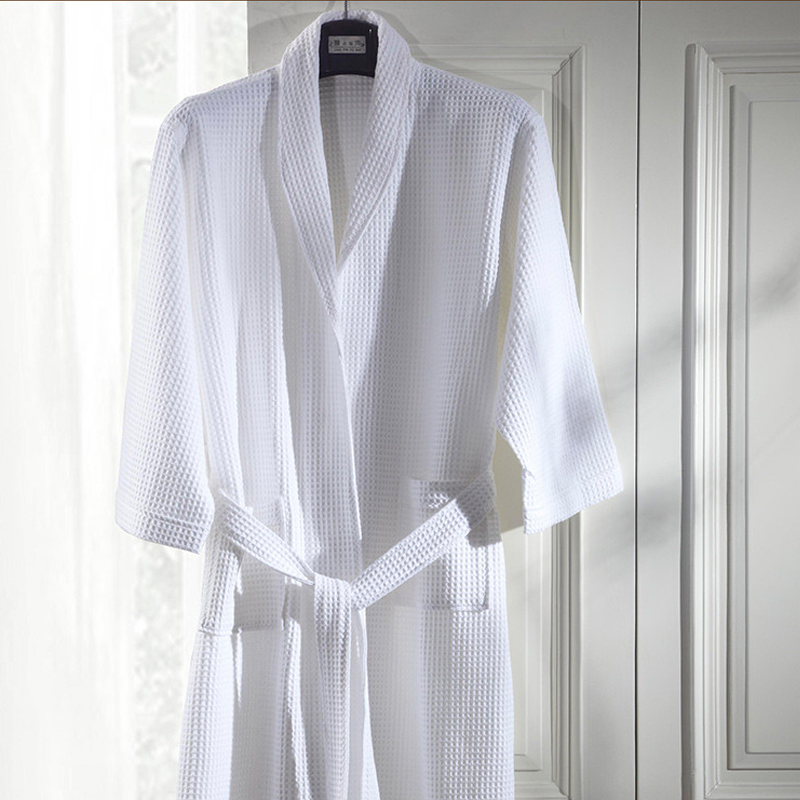
The towel range illustrates how the variables line up. Models MJ8300 (plain), MJ8500 (jacquard) and MJ8500 (embroidered) are 100% cotton, woven at 21S or 32S yarn counts, offered in weights from 60 g to 700 g and sizes from 33×33 cm face cloths and 35×75 cm hand towels through 70×140 cm and 80×150 cm bath sheets. MOQ is 100 pcs, samples are accepted and OEM production is available.
The specification logic follows four lines:
- Weight and size map to guest tier and to the laundry's drying capacity.
- Heavier terry absorbs more water but takes longer to dry — a real trade-off in humid or fully occupied properties.
- Colour fixation matters because chlorine bleaching is one of the fastest ways to dull a white terry surface; chlorine-resistant towels are listed among the scenario-level special requirements for hotel bathroom supply.
- Locked seam edges and honeycomb woven hems are the construction answer to edge fraying.
Bath mats follow the same logic in three constructions: plain (DJ9100) and jacquard (DJ9200) at 300 g / 350 g / 400 g in 50×80 cm, and a long-wool floor mat (DJ9300) at 600 g / 900 g / 1000 g / 1300 g in 50×80 cm, 60×90 cm and 60×120 cm.
Bathrobe YP9600 is offered in waffle constructions with four collar options — small waffle kimono, medium waffle shawl, waffle-and-terry kimono and waffle-and-terry shawl — plus a waffle-modal air layer, at yarn count 21 and weights of 700 g, 750 g, 1000 g and 1200 g.
Scenario 3 — Restaurants and Banquet Areas: Table Linen Under Folding and Heat
Food-and-beverage linen fails differently again. Table cloths and napkins are judged on edge integrity, colour retention and how they hold a fold, and in properties running a single linen room they pass through the same laundry stream as terry, which raises the importance of colour-locking.
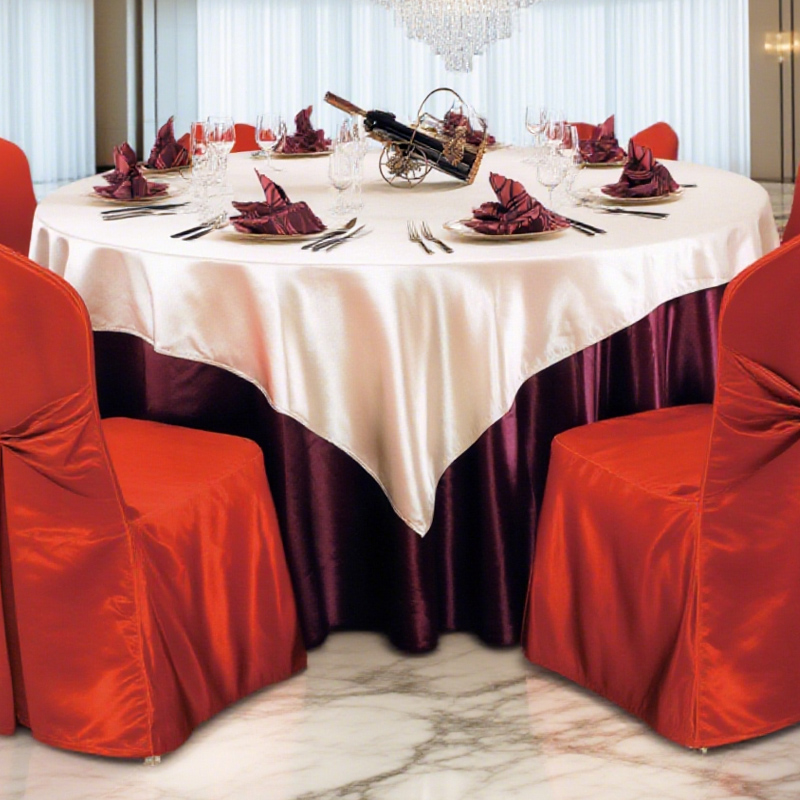
Table cloth TB1102 is produced from high-precision jacquard fabric in a plain weave with double-needle side finishing, in 260×260 cm, 300×300 cm and 320×320 cm sizes. Its documented performance points are a colour-locking treatment that prevents fading after repeated cleaning, a tightly woven surface that resists minor stains, and a neat cut that delivers natural drape — the physical basis of a tidy banquet table.
Napkin CJ9800 is a cotton napkin in a high-density satin texture with stitched ends, at 45×45 cm or 50×50 cm and a 42s/2×42s/2 yarn count at 103×95 density. Woven fabric of this type holds folding shapes, and the stitched-end construction is what prevents loose threads after repeated washing.
For a property running both banquet and à la carte service, the practical question is whether one table cloth size family can cover the room mix. The 260 cm, 300 cm and 320 cm options exist so that seating configurations can be covered without mixing constructions and colour references.
How WEISDIN Approaches Scenario Matching
Guangdong WEISDIN Industrial Co., Ltd. is a hotel linen manufacturer and integrated enterprise specialising in the design, R&D, manufacturing and sale of premium hotel linens, with a focus on high-end and star-rated hotels. The company originated in 1998 with its business roots in Nantian International Hotel Supplies City and was formally established as WEISDIN in 2014, formerly known as Guangzhou WEISDIN Industrial Co., Ltd.
Its supply structure is what makes scenario matching a manufacturing question rather than a trading question. WEISDIN works with a strategic partner factory in Xinjiang and operates a 340-mu production base of approximately 227,000 m² that covers cotton cultivation, spinning, weaving and finished-product manufacturing. The company operates a modern industrial facility of more than 12,000 m² and draws on five subsidiaries — Youfa, Xuhai, Wolaifei, Hong Kong WEISDIN (International) Trade, and Guangdong WEISDIN Technology Co., Ltd. — to support product R&D, manufacturing and delivery.
Operating parameters reported for the business include an annual output of 2,000,000 pcs, an export ratio of 70%, an R&D team of 6 engineers, and main markets in Saudi Arabia, the United States and the EU. Monthly manufacturing capacity is stated at 200,000 bedding sets and 500,000 towels.
On the commercial side, the company runs OEM, ODM and private label production with customisation across logo, fabric, size, colour and packaging; quotes sampling at 7–10 days and production at 20–35 days; applies a standard MOQ from 50 pcs with flexible MOQ arrangements for hotel orders; performs 100% pre-shipment inspection; and provides sample service and technical support alongside the order.
Three project records show what scenario matching looks like once it is applied:
- A procurement intermediary serving a five-star project in Kazakhstan — a Radisson property — covered procurement for more than 100 guest rooms, with documented use over two years and continuous support of the daily operational needs of 150 guest rooms.
- A Wyndham five-star hotel procurement project covering 150 rooms over three years recorded a 100% repeat purchase rate, zero quality complaints during the cooperation period and a 15% increase in hotel guest satisfaction measured by NPS, supported by high-density weaving, double-needle reinforced edging and Pantone TCX colour matching.
- Hotel group and resort projects serving properties of 100–500 rooms, with implementation periods of three to five years in Saudi Arabia, Malaysia and the United States, reported reduced procurement cost alongside stable quality.
The application environment recorded for this type of supply is indoor and constant-temperature, under long-term daily use with cyclic laundry and repeated turnover. That is the condition every specification decision above is written against.
Technical Explanation: What Fails First in a Hotel Textile
Four forces act on a hotel textile at the same time: heat, chemistry, mechanical action and time. Heat reaches products through washing temperatures of up to 90°C on many items in this range. Chemistry arrives as bleach and detergent. Mechanical action comes from tunnel washers, presses and folding equipment. Time is measured in cycles across a year of full occupancy.
The typical failure sequence runs in one direction — seams fray first, fabric shrinks next, colour dulls, and finally the surface piles. Specification decisions are effective when they are aimed at that sequence rather than at appearance alone:
- Density and yarn count. 60×40, 60×60 and 60×80 constructions across 250T to 600T create a tighter weave that resists distortion under repeated washing.
- Shrink-resistant and fade-resistant finishing. Relevant wherever a fitted sheet or pillowcase has to keep its dimensions after commercial laundering.
- Seam construction. 3 stitches and 5 threads with elasticated corner bands on mattress protectors, double-needle side finishing on table cloths, locked seam edges on towels and stitched ends on napkins all address the same first failure point.
- Colour fixation. Described in the range as an advanced treatment that keeps fabric bright without fading under frequent cleaning cycles.
- Elasticated corner bands. 3 cm imported elastic at four corners holds a protector in place through handling and making-up.
- Care-regime matching. Not every item tolerates the same treatment. CP128 sateen bedding is rated to a maximum of 70°C while CP106, CP139, CP152 and CP186 are rated to 90°C; duvet and quilt items in the range are dry-clean only. Aligning the property's laundry practice with each item's instructions is a specification step, not an afterthought.
Market Signals Behind Scenario-Based Sourcing
Three data points explain why scenario-level specification is becoming the working method rather than a theoretical exercise.
First, the overall category is expanding. The global hotel supplies market was valued at approximately USD 62.01 billion in 2024 and is projected to reach USD 82.07 billion by 2031. The global hotel bedding market is estimated at USD 14.2 billion in 2025, with a CAGR of 5.8% through 2034.
Second, growth is not even across zones. Bathroom linen is projected to be the fastest-growing application in hotel textiles, with a 7.92% CAGR to 2031. That projection supports directing specification attention — and specification budget — toward the zone where usage is rising fastest, rather than spreading it evenly across a blended textile list.
Third, supply itself is consolidating around scale. China's exports of textile yarn, fabrics and articles reached USD 141.96 billion in 2024, a 5.7% year-on-year increase. On the demand side, the most visible global hospitality supply players include broadline distributors such as Guest Worldwide (Sysco), American Hotel Register and HD Supply alongside mills such as 1888 Mills — a landscape that mixes distribution reach with manufacturing depth.
Regulatory expectations are also entering the scenario-matching process. OEKO-TEX® STANDARD 100 is described as the primary global safety benchmark for hotel textiles, screening products for more than 1,000 harmful substances. For buyers, that benchmark is increasingly treated as a documentation checkpoint requested alongside specification sheets rather than a marketing statement.
One-Stop vs Multi-Supplier Sourcing, Assessed by Scenario
| Evaluation dimension | Single-supplier textile scope | Multi-supplier model |
|---|---|---|
| Coordination | One production and shipping schedule across bedding, terry and table linen, with consolidated documentation | Each category coordinated separately, with independent schedules |
| Branding consistency | One customisation brief covering logo, colour and packaging across categories | Logo, shade and packaging behaviour may differ between vendors |
| Sampling | One sampling cycle, quoted at 7–10 days, covering multiple categories | Parallel sampling across vendors; more calendars to manage |
| MOQ structure | Standard MOQ from 50 pcs with flexible MOQ for hotel orders, though per-item minimums still apply | Each vendor sets its own MOQ, which can be lower per line item |
| Risk profile | Concentrated — one capacity or quality event affects all zones | Distributed — a single vendor issue affects part of the order |
| Category breadth | Textiles: bedding, terry, bathrobes, table linen, protection layers | Can extend into non-textile operating supplies |
The comparison is not a verdict; it shows where each model absorbs cost. A one-stop textile scope concentrates coordination, branding and quality control into one schedule and one brief — and concentrates risk along with it. A multi-supplier model distributes risk but multiplies sample rounds, colour references and inbound paperwork. Which is cheaper depends on how many zones the project has to cover and how much variation the buyer can manage.
Limits to Check Before Committing to a Single-Source Textile Scope
A one-stop model has boundaries, and buyers should test them before committing:
- Category boundary. WEISDIN manufactures hotel linen. Its scope is textile — bedding, terry, bathrobes, table linen and protection layers. Non-textile operating supplies, amenities and furniture sit outside a textile manufacturing scope.
- MOQ arithmetic. Standard MOQ starts from 50 pcs with flexible MOQ arrangements, but towels, bath mats, bathrobes and table linen items carry a 100 pcs MOQ, and customised bedding designs carry a 100-set MOQ. A property ordering 40 units across many different line items will not reach the same efficiency as one ordering by volume.
- Lead time on the critical path. Sampling is quoted at 7–10 days and production at 20–35 days, extending to 30+ days for customised bedding designs. In a pre-opening schedule, that means specifications have to be locked well before the procurement window closes.
- Finite capacity. Stated monthly capacity of 200,000 bedding sets and 500,000 towels is substantial but not unlimited. Large multi-property rollouts need phased delivery planning rather than a single campaign shipment.
- Care regime alignment. CP128 sateen bedding is rated to a maximum of 70°C, while CP106, CP139, CP152 and CP186 are rated to 90°C; duvet and quilt items such as CX2120, BX280 and BX296 are dry-clean only. A property with one fixed, aggressive laundry programme has to verify each line item against it — and adjust either the specification or the process.
Future Outlook
Three developments are likely to shape the next phase of hotel textile sourcing.
Specification documents are moving toward a zone-by-zone format. Instead of one blended textile list, procurement packs increasingly separate guest room, bathroom and food-and-beverage requirements, because that is the level at which construction choices — density, weight, seam type, care regime — actually differ.
Growth concentration will keep bathroom linen in focus. With bathroom linen projected as the fastest-growing hotel textile application at a 7.92% CAGR to 2031, chlorine resistance, absorbency retention and drying time are likely to remain near the top of evaluation criteria, particularly for properties with short linen rotation.
Certification documentation will become a routine attachment. As OEKO-TEX® STANDARD 100 and its screening of more than 1,000 harmful substances becomes the reference point buyers ask about, suppliers will be expected to pair specification sheets with verifiable documentation, and inspection practices such as 100% pre-shipment inspection will be treated as a standard operating fact rather than a differentiator.
FAQ
What is included in a one-stop comprehensive hotel supplies scope for textiles?
In textile terms, it covers the categories a hotel consumes across its guest-facing areas: bedding sets, sheets, pillowcases, pillows, duvets, quilts, mattress comforters and mattress protectors for guest rooms; towels, bath mats and bathrobes for bathrooms; and table cloths and napkins for restaurants and banquet rooms. It also includes the shared customisation layer — hotel logo, fabric, size, colour and packaging — so that branding stays consistent across categories instead of being negotiated separately for each. Non-textile operating supplies such as amenities sit in a separate category.
How do guest room, bathroom and restaurant textiles differ in specification?
They differ according to the stress each one meets. Guest room linen is specified for cyclic commercial laundering: higher density and yarn count, shrink-resistant and fade-resistant finishing, and reinforced hems and seams. Bathroom terry is specified for chlorine exposure and turnover: 100% cotton with a defined yarn count and weight, colour fixation and locked or reinforced edges. Table linen is specified for folding, heat and staining: woven constructions with colour-locking treatment and finished edges such as double-needle sides and stitched ends.
What should a resort specify differently from a city hotel?
Operating conditions differ, so the priority order changes. Resort properties often run higher turnover in spa and pool-adjacent bathrooms, which raises the weight of drying behaviour — waffle constructions such as the YP9600 bathrobe, offered at 700 g and 750 g, release moisture faster than heavy loop terry. Banquet and outdoor service place more folding and staining pressure on table linen, where colour-locking and edge finishing matter most. City hotels with concentrated business-guest turnover tend to prioritise laundry throughput, which places dense bedding constructions and shrink resistance higher. Two special requirements recur across these settings: chlorine-resistant towels and shrink-proof bedding.
How should buyers evaluate durability claims in hotel bedding and towels?
Look for construction-level evidence rather than descriptive claims. Useful checkpoints include yarn count and density (constructions such as 60×40, 60×60 and 60×80 across 250T to 600T), the maximum washing temperature stated for the item, whether finishing is described as shrink-resistant or fade-resistant, and how seams are built — for example 3 stitches and 5 threads with elasticated corner bands on mattress protectors, locked seam edges on towels, and double-needle side finishing on table cloths. Care instructions matter equally: some items are rated to 90°C, others to 70°C, and duvets and quilts in the range are dry-clean only.
What MOQ and lead times should a hotel project expect?
The stated standard MOQ starts from 50 pcs with flexible MOQ for hotel orders. Towels, bath mats, bathrobes and table linen items carry a 100 pcs MOQ, and customised bedding designs carry a 100-set MOQ. Sampling is quoted at 7–10 days and production at 20–35 days, extending to 30+ days for customised bedding designs. Projects that lock specifications early have more room to phase deliveries against a pre-opening schedule.
Where does a one-stop textile model fit less well?
It fits least well in three situations: when a project needs a wide range of non-textile categories that fall outside a linen manufacturing scope; when order volumes per item sit far below the MOQ thresholds; and when the pre-opening timeline leaves no room for the sampling and production windows. It is also a weak fit when a property's laundry regime is fixed and cannot be reconciled with the care instructions of specific items. In those cases, splitting supply or phasing the textile order is usually the more practical route.
For teams building a zone-by-zone specification, the WEISDIN 2026 catalogue sets out item-level parameters, constructions and care instructions across bedding, terry, bathrobes and table linen: 2026 WEISDIN Catalogue (PDF).
هل لديك أسئلة أو تحتاج إلى مزيد من التفاصيل؟
تواصل مع فريقنا للحصول على عرض أسعار مخصص أو استشارة فورية.
طلب عرض أسعار
املأ النموذج أدناه وسيتواصل معك فريقنا بعرض مقترح مخصص.
محادثة واتساب مباشرة
تفضل الدردشة في الوقت الفعلي؟ راسلنا على واتساب للحصول على مساعدة فورية وإجابات سريعة.
- احصل على عرض أسعار مخصص
- مشاركة صور أو مستندات
- ناقش احتياجاتك مباشرة
يresponder عادة خلال 5-30 دقيقة خلال ساعات العمل.