
Scenario Fit for Wholesalers: H5000, T3, SC19 and P02
Scenario Fit for Wholesalers: H5000, T3, SC19 and P02
For importers and wholesalers building a resale portfolio from factory-direct commercial scenting hardware, the decisive question is not which single diffuser leads on paper. It is which combination covers the venue types their customers actually run, and which installation constraints those venues impose. The four models in this set answer that question along a clear line: H5000 for hotel lobbies, shopping malls and office building lobbies at 800–1,300 m²; T3 for malls, hotels and airports at 1,000–1,600 m²; SC19 for shopping malls, hotels and banks that can use an 18.5-inch advertising surface alongside scenting; and P02 for smaller local installations of 150–350 m² where a wall-mounted unit with an optional HVAC connector and tube is the practical answer.
Shenzhen Scentsea Technology Co., Ltd, which supplies the market as SCENTSEA, manufactures cold-air nebulizing scent diffusers and fragrance oils. The company was founded in 2021, operates a 3,000 m² production facility in Shenzhen, and its diffuser models are certified with CE, RoHS and FCC. Its catalogue is sold under its own brand and through OEM/ODM programmes, which is precisely the position a wholesaler occupies: choosing a stock mix that can be resold into different building types without redesigning each project. Company and product information is published at scent-sea.com.
Why a resale portfolio needs scenario logic rather than one flagship model
Rated coverage is a starting range, not an installation guarantee. SCENTSEA's own application notes for its commercial scenting systems list model selection by actual space size and airflow conditions, a correct power supply, a proper installation location and a suitable fragrance oil as requirements for the equipment to perform as intended. For a distributor that has a direct commercial consequence: a portfolio built only around the largest unit will be over-specified for small retail jobs and under-matched on compact retrofit work, while a portfolio built only around compact units will lose the lobby and atrium projects that carry higher ticket values.
The second reason is service load. A wholesaler who also supplies fragrance oil and spare parts earns twice on a well-chosen model and loses on a mismatched one — a unit rated far above the actual space runs fewer atomization hours but sits on capital, while a unit rated below the space invites refill complaints. The four models below differ less in construction philosophy than in the site conditions they were specified for.
The four-model portfolio at a glance
The table below uses only published model data, so a distributor can compare the same dimensions across the range before quoting.
| Model | Form and housing | Rated coverage | Oil capacity | Power | Noise | Rated oil use | Documented venue fit |
|---|---|---|---|---|---|---|---|
| H5000 | Floor-standing, aluminium, gunmetal | 800–1,300 m² / 2,500–4,000 m³ | 1,000 ml | DC12V plug-in, 20 W | <45 dB | 5.4 ±10% ml/h | Hotel lobbies, shopping malls, office building lobbies |
| T3 | Freestanding, acrylic panel and steel casing, white or black (customized) | 1,000–1,600 m² / 3,000–5,000 m³ | 1,000 ml | DC12V 2A, 15 W | <55 dB | 4.6 ±10% ml/h | Shopping malls, hotels, airports |
| SC19 | Advertising scent machine, aluminium and steel, black and silver, 18.5-inch display | 150–250 m² / 500–800 m³ | 500 ml | 110–240V AC, 30 W | ≤30 dB | 6 ±5% ml/h | Shopping malls, hotels, banks |
| P02 | Wall-mounted, plastic, white or black (customized) | 150–350 m² / 500–1,000 m³ | 300 ml | DC12V plug-in, 6.5 W | <30 dB | 2.5 ±10% ml/h | Retail stores, corridors, offices, showrooms, washrooms |
Read the coverage column as a rated range under stated airflow and installation conditions, not as a guaranteed result in every room. Volume figures in cubic metres are the better starting point where ceiling heights are unusually high.
H5000: the floor-standing unit for hotel lobbies, malls and office building lobbies
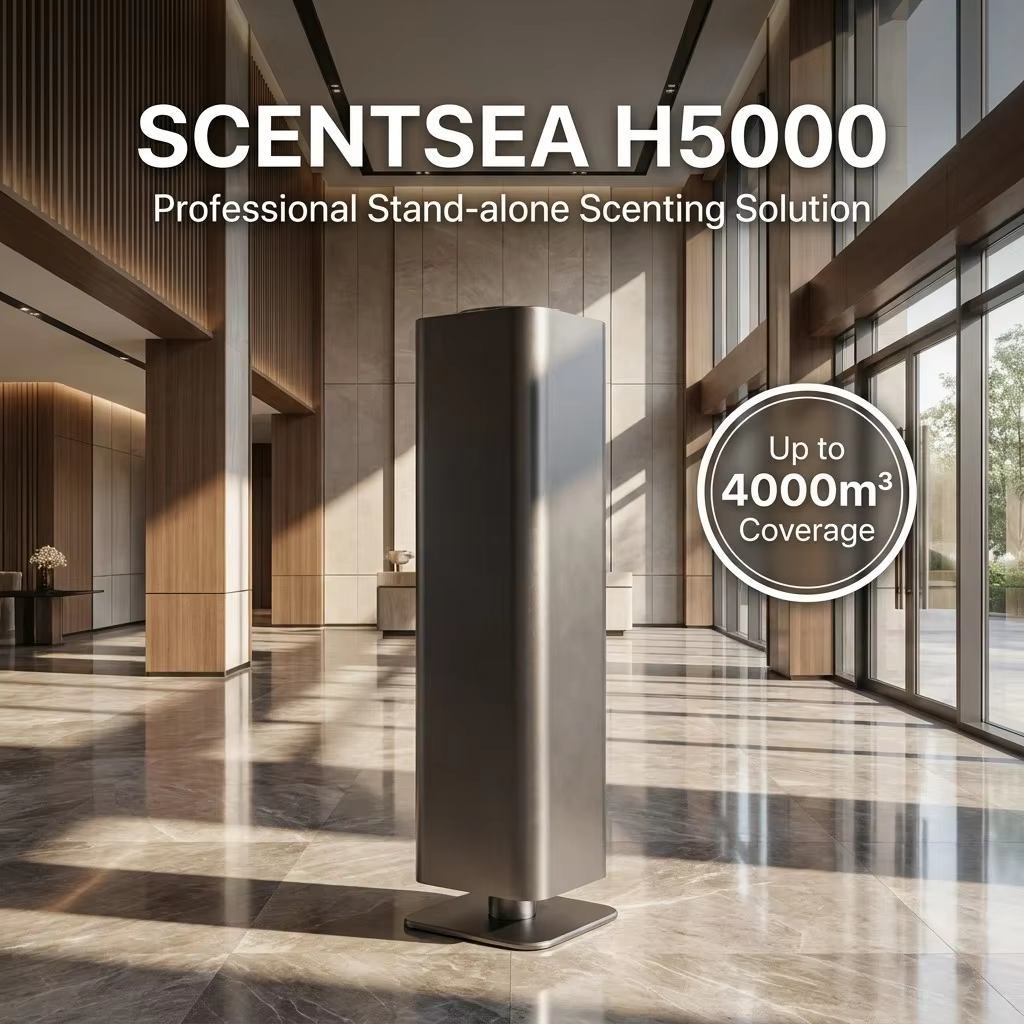
H5000 is the portfolio's floor-standing answer to 800–1,300 m² of open commercial space, and the model to quote when a hotel lobby, shopping mall concourse or office building lobby cannot be drilled for a wall bracket. It carries a 1,000 ml fragrance bottle, runs on DC12V plug-in power at 20 W, is rated below 45 dB with oil consumption of 5.4 ±10% ml/h, and measures 180 × 180 × 610 mm at 6.4 kg net and 7.1 kg gross. Scheduling and intensity adjustment are handled through APP control, listed as AromaOS APP control, with optional smart connectivity for easier commercial management.
For a reseller, the commercial value sits in the installation scope. A floor-standing unit removes wall fixing and cable routing from the installer's work list, which matters in leased premises, stone-clad lobbies and heritage interiors where drilling is negotiated rather than assumed. The 180 × 180 mm footprint needs one clear floor position out of traffic flow, and the 1,000 ml capacity keeps refill visits infrequent next to the compact models below.
Fit boundary: the coverage rating refers to 2,500–4,000 m³, so an atrium with strong air movement or a lobby open to multiple levels should be assessed against the airflow requirement rather than against floor area alone. Gunmetal is the listed colour, so a distributor needing a branded colour should confirm product colour under the OEM/ODM programme for that order instead of assuming a stocked variant.
T3: cold-air atomization with APP control for malls, hotels and airports at 1,000–1,600 m²
T3 is the widest-coverage unit in this four-model set, specified for 1,000–1,600 m² and 3,000–5,000 m³ of shopping mall, hotel or airport space. It uses cold-air atomization with smart APP control for schedules and scent intensity, holds 1,000 ml, runs on DC12V 2A at 15 W, is rated below 55 dB at 4.6 ±10% ml/h oil consumption, and measures 250 × 125 × 300 mm at 5.3 kg net and 5.9 kg gross in an acrylic panel and steel casing. Published colour options are white and black, with customization noted; the model is specified for continuous operation in demanding commercial environments, and its documented applications include professional commercial and HVAC scenting.
The wholesaler reading is efficiency per square metre. T3 pairs the largest coverage rating in the range with the lower rated oil consumption of the two large units — 4.6 ml/h at 15 W, against 5.4 ml/h at 20 W for H5000. For a distributor who also supplies oil and service, that combination lengthens the interval between fills for the same scented area and reduces running power, which is the kind of difference that shows up in an operator's annual cost rather than on a quotation.
Fit boundary: the documented noise rating is below 55 dB, against below 45 dB for H5000. In an airport concourse, a busy mall atrium or an event hall that difference is rarely the deciding factor; in a quiet hotel lobby or an executive floor it deserves a sample test before the model is written into a specification.
SC19: an advertising scent machine for shopping malls, hotels and banks, sized differently on purpose
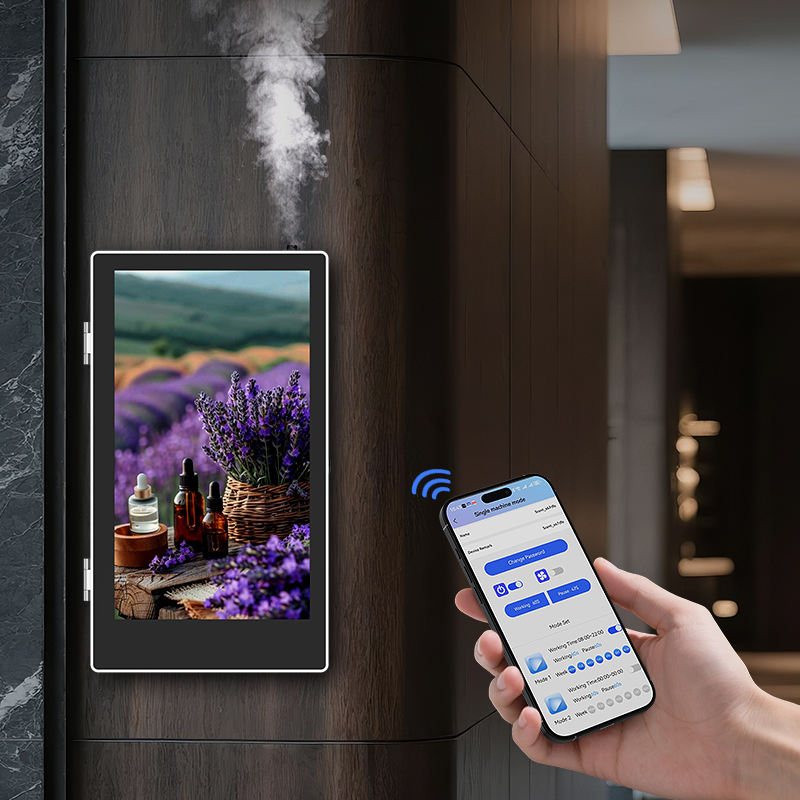
SC19 is an advertising scent machine rather than a pure diffuser: it combines a 500 ml fragrance system with an 18.5-inch, 1920 × 1080 display and 8 GB internal storage, and it is specified for shopping malls, hotels and banks across 150–250 m² and 500–800 m³. The body is aluminium and steel in black and silver, the input range is 110–240V AC at 30 W, oil consumption is 6 ±5% ml/h, noise is rated at or below 30 dB, and the unit weighs 6.5 kg at 280 × 63.5 × 495 mm.
Its commercial logic differs from the other three. This is the only model in the portfolio where the hardware earns part of its place through media: promotions, wayfinding or brand content can run on the integrated screen while the space is scented, which is why banks, mall corridors and hotel lift lobbies are its documented applications rather than large halls. The 110–240V AC range also lets one hardware specification span markets with different mains voltages, with plug type handled as a customization item, and the ≤30 dB rating places it in the quietest tier of the set — relevant at a branch counter where staff and customers talk beside the unit.
Fit boundary: at 150–250 m² it covers far less area than H5000 or T3 and should not be positioned as a lobby-scale machine. Its 6.5 kg weight over a shallow 63.5 mm depth makes the wall-fixing method part of the installation plan, and the unit belongs where visitors actually face the display; scenting a space whose traffic never looks at the screen gives away the model's premium.
P02: a wall-mounted compact diffuser with an optional HVAC connector for local installations
P02 is the wall-mounted compact unit for smaller local-client work: 150–350 m² and 500–1,000 m³, a 300 ml bottle, 6.5 W draw and a documented noise rating below 30 dB. It uses a plastic housing in white or black with customization noted, runs on DC12V plug-in power at 2.5 ±10% ml/h, weighs 0.8 kg net and 1 kg gross at 148 × 68 × 203.5 mm, and adds a built-in fan for fragrance distribution plus Bluetooth APP control of schedules and intensity. An optional Wi-Fi and Bluetooth version supports remote management, the feature set includes automatic reconnection after a power or network interruption, and an optional connector and tube allow HVAC integration.
This is the model that lets a distributor serve the long tail — retail stores, corridors, offices, showrooms and commercial washrooms — with a unit light enough for standard partition walls and low enough in power terms to run continuously. The HVAC connector and tube option carries real commercial weight: the same SKU can answer a client who wants the diffuser concealed and feeding ducted air, instead of that job being lost to a dedicated HVAC machine.
Fit boundary: it is a plug-in unit, so a socket or a planned supply point is needed at the mounting position. The HVAC connector and tube are options ordered with the unit, not standard contents, and a 300 ml bottle serving 150–350 m² does not substitute for H5000 or T3 in an open concourse.
Where the portfolio overlaps: two selection rules distributors can apply
Two overlaps appear in this range, and both resolve on documented differences rather than on preference. The first sits in the 150–350 m² band, where SC19 and P02 meet. Choose SC19 when the display has a job to do — a bank branch promoting products, a mall corridor, a hotel lift lobby — when 500 ml of capacity and a 110–240V AC input suit the site, and when the wall can carry 6.5 kg. Choose P02 when the site needs a light 0.8 kg wall unit drawing 6.5 W, when the optional HVAC connector and tube are likely to be ordered, and when nobody will look at a screen.
The second overlap sits in large open spaces. Choose H5000 when the documented below-45 dB rating and a floor-standing form with no wall drilling suit a quiet lobby of 800–1,300 m². Choose T3 when the space extends to 1,000–1,600 m², ambient noise is already high, and the lower hourly oil consumption and 15 W draw matter to the operator. Neither rule creates a ranking between the models; each maps a site condition to the unit specified for it.
Refill planning: turning published consumption into service intervals
Refill planning is where a portfolio decision becomes a service decision. Dividing each bottle capacity by the rated oil consumption gives the hours of active atomization per fill; the figures below are calculated from the published capacity and consumption values, with the stated tolerances of ±10%, and ±5% for SC19, carried through.
- H5000: 1,000 ml ÷ 5.4 ml/h ≈ 185 hours of atomization per fill
- T3: 1,000 ml ÷ 4.6 ml/h ≈ 217 hours of atomization per fill
- SC19: 500 ml ÷ 6 ml/h ≈ 83 hours of atomization per fill
- P02: 300 ml ÷ 2.5 ml/h ≈ 120 hours of atomization per fill
These are atomization hours, not calendar days. With scheduled scenting, bottle life in weeks depends on how many hours a day the unit runs, so a lobby scented eight hours a day reaches a very different refill date than a mall unit running continuously. The useful reading for a distributor is comparative: T3 gives the longest interval per fill in this set, and SC19 the shortest, which is consistent with its smaller 500 ml bottle and higher 6 ml/h consumption.
Custom colour options and what batch supply looks like for distributors
Customisation here is a documented programme rather than a sales phrase: OEM/ODM availability covers logo, product colour, packaging, user manual, plug type, APP interface, PCB and functions, and other product specifications. At model level the colour lines differ, and a wholesaler should read them precisely. T3 is listed in white and black with customization noted, P02 is listed in white and black with customization noted, H5000 is listed in gunmetal, and SC19 is listed in black and silver. A distributor requiring a private-label colour on a model whose listed colour line is fixed should confirm it as an OEM/ODM requirement for the order rather than assume it is stocked.
Batch supply turns the same company facts into planning inputs: monthly capacity of 8,000 units, a lead time of 25–35 days, and a minimum order quantity that starts at 1 unit for diffusers, which lets a distributor test a model before committing stock. Pre-shipment quality control covers 100% functional testing, atomization testing, leakage inspection, noise testing, APP and control testing, a 48-hour aging test and final appearance inspection, and the after-sales term is a one-year free warranty on spare parts. Diffuser and fragrance oil samples are available for verification, and the company reports supply to customers in more than 70 countries, with a four-engineer R&D team and 20 patents behind the model range.
Compliance belongs in the same conversation. The diffuser models are certified with CE, RoHS and FCC, but requirements depend on destination market, model and whether wireless functions are involved: buyers should confirm that a certificate or test report applies to the exact production model and configuration being purchased, and that wireless variants meet the applicable radio requirements in that market.
Market context that shapes a resale portfolio
The commercial scenting category is forecast to keep expanding, though published figures depend heavily on definition. Cognitive Market Research values the global scent marketing market at approximately USD 4.1 billion in 2026, while a separate 2026 industry forecast projects USD 7.28 billion by 2035 at a 6.6% CAGR. Another estimate puts growth at 10.16% for a narrower definition of scenting, which illustrates how much the headline number depends on whether consumer air care is included. Distributors should treat these as directional forecasts rather than committed market sizes for a specific territory.
Two practical cost items sit alongside demand. Commercial scent diffusers are classified under HS code 8509.80, with a published 4.2% US import duty, which belongs in landed-cost calculation before a resale price is set. And the diffusion mechanism itself has a documented technical basis: cold-air nebulizing systems atomize fragrance oils into sub-micron particles below 2.5 μm without heat or water, which is why waterless units can run continuously in commercial spaces with no water tank to refill or clean.
Where cold-air fits against traditional water-based diffusers
For a buyer comparing a waterless cold-air unit with an ultrasonic water-based aroma diffuser, the documented difference is one of scale and maintenance rather than of category prestige. Waterless cold-air diffusion provides stronger and more consistent fragrance distribution with larger coverage and no water dilution, and needs less daily maintenance; ultrasonic diffusers mix water with a few drops of oil, cover smaller areas and require more frequent refilling and cleaning. Waterless units generally carry a higher initial equipment cost but lower daily upkeep, while ultrasonic units cost less to buy and remain suited to small home spaces and light personal use.
Fit boundary: that comparison does not make cold-air the right answer for every resale project. Where a client wants a low-cost decorative unit for a small room, an ultrasonic diffuser still meets the requirement. Where the project is a hotel lobby, mall, bank branch or airport area requiring continuous scenting, the cold-air models in this portfolio are the ones specified for that duty.
Outlook for wholesalers building this portfolio
If category forecasts hold, the pressure on distributors will come less from demand than from service economics: how many models must be carried to cover a customer base's sites, and how often each unit needs a refill or a spare part. A four-model spread covering 150–350 m², 150–250 m² with an advertising surface, 800–1,300 m² and 1,000–1,600 m² documented ranges addresses that without duplicating form factors. What remains is depth of stock per model, which depends on the local venue mix, not on a global growth rate.
FAQ
How does cold-air atomization work in a commercial scent diffuser?
Cold-air atomization uses controlled airflow and pressure to break fragrance oil into fine airborne particles without adding water or using heat. Because the oil is neither diluted nor heated, fragrance can be distributed efficiently, and working schedules and output intensity can be adjusted to the actual space and airflow conditions. Published technical descriptions of cold-air nebulizing systems place particle size below 2.5 μm.
How should a distributor choose between models for different space sizes?
Selection should start from actual space size, ceiling height, airflow, installation method, power supply and control requirements rather than from maximum rated coverage alone. Compact models suit small rooms, battery-powered units suit locations where wiring is difficult, higher-output standalone machines suit medium and large commercial spaces, and HVAC scenting systems suit large buildings that need centralised distribution. Within this portfolio, P02 covers 150–350 m², SC19 covers 150–250 m² with an advertising display, H5000 covers 800–1,300 m² and T3 covers 1,000–1,600 m².
How is a commercial scent diffuser installed and set up?
Place the unit where air circulates freely and keep it upright, fill it with compatible waterless fragrance oil, connect the specified power supply or install batteries where applicable, then switch on and set the working schedule and scent intensity. Supported models are completed through their APP, after which coverage should be tested and intensity adjusted to room size and airflow. Oil level and atomization performance should be checked regularly, overfilling and oil contact with electronic components should be avoided, and model-specific installation and cleaning instructions should be followed.
What certifications should a buyer check for commercial scent diffusers?
Requirements depend on the destination market, the model and whether it has wireless functions. For the European market, buyers should normally check applicable CE and RoHS documentation, with RED requirements also relevant to Bluetooth or Wi-Fi models; for the US market, applicable FCC compliance should be verified. Certificates and test reports should always match the exact production model and configuration being purchased.
What quality risks should buyers verify before a bulk order?
The main risks are unstable atomization, oil leakage, excessive noise, unreliable APP or control functions and inconsistent batch performance. Verifying sample performance, quality control procedures, aging tests, certifications, warranty terms and spare parts support before ordering reduces those risks, while choosing on price alone without those checks increases them.
Full specification and capability detail across the diffuser and fragrance oil range is available in the downloadable SCENTSEA company profile (PDF).
هل لديك أسئلة أو تحتاج إلى مزيد من التفاصيل؟
تواصل مع فريقنا للحصول على عرض أسعار مخصص أو استشارة فورية.
طلب عرض أسعار
املأ النموذج أدناه وسيتواصل معك فريقنا بعرض مقترح مخصص.
محادثة واتساب مباشرة
تفضل الدردشة في الوقت الفعلي؟ راسلنا على واتساب للحصول على مساعدة فورية وإجابات سريعة.
- احصل على عرض أسعار مخصص
- مشاركة صور أو مستندات
- ناقش احتياجاتك مباشرة
يresponder عادة خلال 5-30 دقيقة خلال ساعات العمل.