
Scenario Fit: Private Label Hair Growth Serum Format Guide
The global hair serum market was estimated at USD 1,320.1 million in 2024, and hair treatment serums accounted for 64.64% of that value, according to Grand View Research. While market demand is broad, sourcing decisions have become more specific. Brands planning a private label hair growth serum launch are increasingly finding that the right choice depends less on a single 'universal formula' and more on matching product format, ingredient direction, and compliance documentation to the target market scenario.
Market definitions also vary. Grand View Research values the hair serum category at USD 1.32 billion for 2024, while The Business Research Company estimates growth serums at USD 1.71 billion and Market Research Future places the broader serum market at USD 2.20 billion. The divergence reflects a product category still being defined. For buyers, relying on one global figure is less useful than understanding the specific segment they plan to enter.
This guide examines how private label hair growth serum programs can be adapted to different project scenarios — e-commerce first launches, salon channel entry, segmented gender or use-case positioning, and cross-border market expansion. It uses Guangdong Desifine Biotechnology Co., Ltd. (DESIFINE), a cosmetics OEM/ODM manufacturer in Guangzhou, China, as a reference for how manufacturers structure their capabilities around scenario-based sourcing.
Why Scenario Fit Is the Deciding Factor
In the United States, approximately 70% of men and 40% of women are affected by androgenetic alopecia, according to Grand View Research, which helps explain the sustained demand for non-invasive topical products such as hair growth serums. But the user base is not uniform. A serum for men with early-stage thinning may emphasize different active ingredients and a lighter texture than a serum for women with postpartum shedding, or for older consumers with dry, sensitive scalps.
For private label buyers, the practical implication is that a single standard formulation rarely serves all scenarios. Four factors should be defined before approaching a manufacturer:
- Channel: e-commerce, retail, salon, pharmacy, or subscription box
- Target user group: men, women, sensitive-scalp users, or age-specific segments
- Product claim: hair growth, anti-hair-loss, thickening, leave-in treatment, or extra-strength care
- Regulatory destination: EU, US, Latin America, or a multi-region strategy
Each factor changes the formula brief, packaging format, testing requirements, and documentation package. An e-commerce-first brand may prioritize low MOQ and fast sample turnaround; a salon buyer may prioritize stability reports and batch consistency; a cross-border seller may prioritize certification coverage and regulatory documents. The same manufacturer can serve all these cases, but the specification, sampling process, and timeline need to be defined per scenario rather than inherited from a generic product brief.
Product Formats in a Private Label Hair Care Program
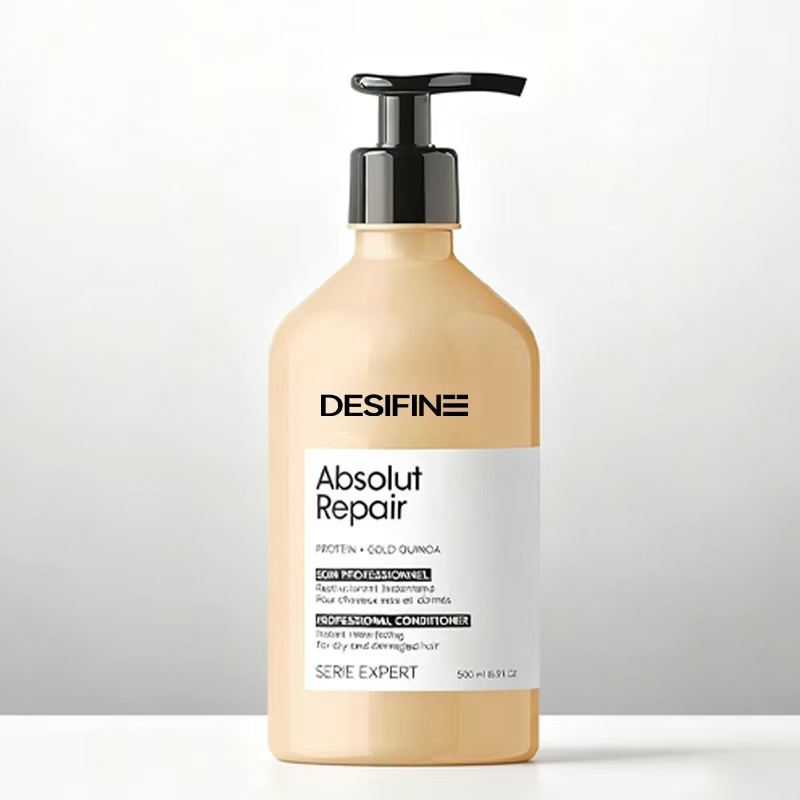
A private label hair growth program is rarely built around a single SKU. The typical structure is a hero serum supported by complementary formats that form a daily regimen. In the DESIFINE OEM/ODM Hair Care Series, the product range covers Shampoo, Conditioner, Hair Mask, Hair Oil, Hair Serum, Hair Wax, Hair Gel, and Hair Spray. Each SKU can be customized in formula, fragrance, color, and function — for example anti-dandruff, repair, volume, or color protection.
| Format | Typical Role in a Program |
|---|---|
| Hair Serum | Hero SKU; direct scalp application; primary claim carrier |
| Shampoo | Daily scalp cleansing; often paired as a pre-treatment step |
| Conditioner | Fiber care; reduces perceived damage and improves texture |
| Hair Mask | Weekly intensive repair; supports perceived hair strength |
| Hair Oil | Shine and frizz control; scalp nourishment in leave-in formats |
The standard formulation base follows an 8-Free Clean Formula position: no preservatives, no added fragrance, no mineral oil, no silicone, no traditional emulsifiers, no amines, no dyes, and cruelty-free. This base is relevant for brands entering markets where clean beauty claims are well established. It is not, however, a fixed product. Customization allows buyers to adjust the active system and sensory profile. Ingredients in the hair care range include natural plant extracts, active peptides, keratin, argan oil, coconut oil, tea tree oil, biotin, caffeine, panthenol, silk protein, and amino acids.
For buyers, the key decision rule is to treat the 8-Free base as the starting point, then specify the active ingredients, concentration, fragrance, and format according to the intended use case. A thickening serum for volume-focused consumers will have a different briefing than an extra-strength anti-hair-loss serum for a clinical-skewing brand, even if both are manufactured on the same production line.
Manufacturer Capability: What to Verify Before Choosing a Partner
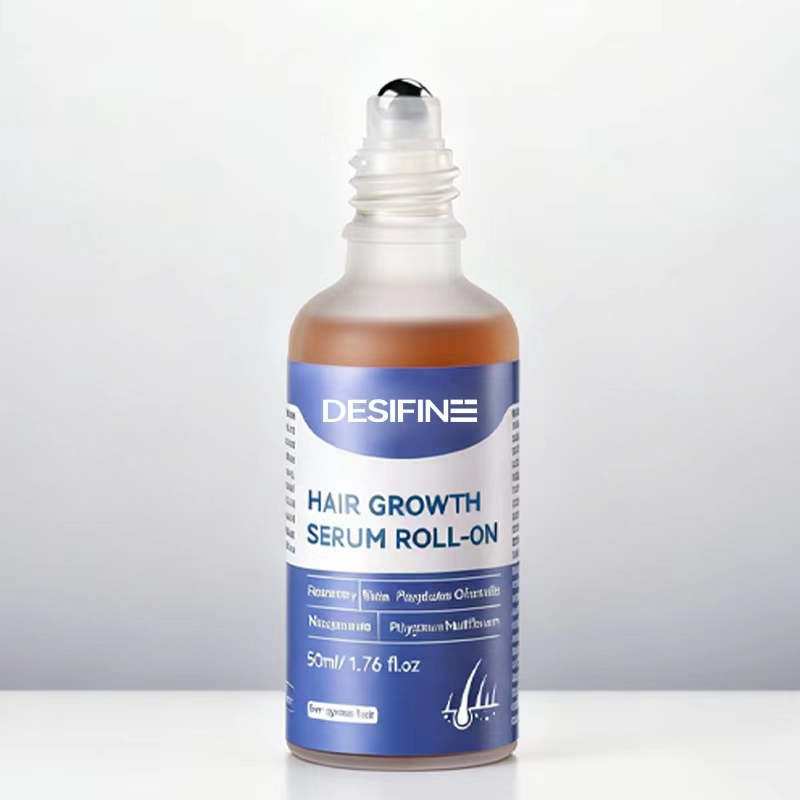
Guangdong Desifine Biotechnology Co., Ltd. (DESIFINE) is a cosmetics OEM/ODM manufacturer located in the Nansha Economic and Technological Development Zone, Guangzhou, China. Founded in 2000, the company operates a 15,000 m² facility with 82 employees, more than 20 R&D engineers, and an annual output capacity of approximately 5,000,000 units. About 60% of its production is exported, primarily to the United States and Europe.
For a scenario-based private label hair growth serum program, the following operational parameters serve as an evaluation reference:
| Parameter | DESIFINE Specification |
|---|---|
| MOQ | 3,000 units per SKU |
| Sample lead time | 7–10 days |
| Production lead time | 30–45 days |
| Monthly capacity | 500,000 units |
| Customization scope | Formula, fragrance, color, concentration, packaging, bottle shape, label, logo, private brand name |
| Quality control | In-house QC lab; raw material inspection; semi-finished product testing; 100% finished product check; third-party testing available (SGS / Intertek) |
| Export reference | USA, Europe, Southeast Asia, Middle East, Australia |
The company holds Cosmetics GMP Certification (GMPC), US FDA Registration, and EU ISO 22716 Cosmetics Quality Management System Certification, and is recognized as a National High-tech Enterprise. In 2018, it invested RMB 50 million in production and testing equipment sourced from France, Germany, and Switzerland. After-sales support includes formula adjustment, batch tracking, stability testing reports, Safety Data Sheets (SDS), product claim support, and reorder flexibility.
For buyers at the Research-to-Evaluation stage, these details provide a concrete benchmark: can the manufacturer support the target MOQ, return samples quickly, provide QC documentation for the destination market, and adjust the formula after the first production run if needed? The reference point matters more than a supplier's total headcount or factory size.

Application Scenarios and Their Sourcing Implications
The following four scenarios illustrate how launch context affects product specifications and partner evaluation.
Scenario 1: DTC / E-Commerce First Launch
An e-commerce brand preparing to launch its first hair growth SKU typically needs low MOQ, fast sample cycles, and a clean label story. DESIFINE's MOQ of 3,000 units per SKU and sample lead time of 7–10 days fit this type of entry program. The 8-Free base allows a brand to position the product as preservative-free and cruelty-free without commissioning a fully bespoke formula from day one. A reference case is a private label beauty brand serving the US, CA, GB, and IT markets, which ordered 200,000 pieces of a custom hair care line over four years, with consistent quality from sample to mass production. What to verify in this scenario: MOQ flexibility, sample speed, empty-label or private-brand packaging support, and the ability to scale the same formula later.
Scenario 2: Salon and Professional Channel
Salon and professional channels place more weight on stability data, batch traceability, and claim support. DESIFINE's after-sales package includes formula adjustment, batch tracking, stability testing reports, Safety Data Sheets, and product claim support. The in-house QC lab performs raw material inspection, semi-finished product testing, and 100% finished product checks — a control chain that matters when a salon brand needs to replicate results across batches. What to verify in this scenario: availability of stability documentation, batch traceability records, and claim-support materials before the first production run.
Scenario 3: Segmented Lines for Men, Women, Thickening, or Leave-In Use
For gender-specific or use-case-specific products, formula customization is the priority. A men's hair growth serum might use caffeine and a lighter texture; a women's line might emphasize scalp comfort and fragrance; a leave-in thickening serum might favor panthenol, silk protein, and amino acids for volume. DESIFINE's hair care material library — biotin, caffeine, panthenol, active peptides, keratin, silk protein, amino acids, natural plant extracts, argan oil, coconut oil, tea tree oil — supports these directional changes. Buyers can also customize concentration, packaging, bottle shape, and private brand name. What to verify in this scenario: the ingredient library, concentration adjustment capability, and whether the manufacturer has produced similar function-specific SKUs before.
Scenario 4: Cross-Border Entry — EU, US, Latin America
Cross-border programs add a compliance layer. Cosmetic products sold in the EU must comply with Regulation (EC) No 1223/2009, which requires a Product Information File (PIF) and a Cosmetic Product Safety Report (CPSR). In the US, FDA registration and GMP certification are commonly requested by retailers and distributors. DESIFINE's certification set — GMPC, US FDA Registration, EU ISO 22716 — directly addresses these baseline requirements. Its products are applicable in multiple regions including the US, EU, Latin America, Brazil, and Canada, with special requirements such as GMP certification, cruelty-free, preservative-free availability, and natural & clean beauty formulas documented as part of the standard application profile. What to verify in this scenario: the manufacturer's export experience to the destination market, available certification documents, and whether the supplier can provide or support PIF/CPSR preparation for the EU.
Market Trends Reshaping Format Decisions
Several verifiable trends are pushing buyers toward scenario-based format selection.
Organic and plant-based demand is expanding. The organic hair care market was valued at USD 10,242.1 million in 2024, driven by consumer demand for plant-based, non-toxic formulations, according to Credence Research. This favors 8-Free clean bases and botanical extract systems.
Thickening serums are a fast-growing subcategory. The hair thickener serum market is projected to grow at a CAGR of 8.2% from 2025 to 2035, reaching USD 3.1 billion, according to Future Market Insights. Brands entering this segment should plan for distinct SKUs — not just one universal serum — to capture thickening, leave-in, and extra-strength demand separately.
The broader treatment market is expanding steadily. Grand View Research projects the hair growth supplement and treatment market to reach USD 11.58 billion by 2030, growing at a CAGR of 6.15%. This indicates that the category is increasingly treated as a routine part of personal care rather than a niche clinical product.
Regional market share is shifting. Asia Pacific dominated the hair growth treatment market in 2023 with a revenue share of 45.71%, according to Grand View Research, while the US remains a large market for non-invasive topical products. Buyers targeting multiple regions will need to manage different regulatory frameworks and consumer expectations simultaneously.
Scenario-Based Sourcing vs. Traditional OEM/ODM Models
Traditional cosmetics OEM/ODM models typically operate with higher minimum order quantities and longer lead times, optimized for established brands with predictable volume. That model is still appropriate for companies launching large-volume SKUs into mature retail channels.
| Evaluation Factor | Traditional OEM/ODM Model | Scenario-Based Model |
|---|---|---|
| MOQ | Higher minimums common | 3,000 units per SKU |
| Production lead time | Longer lead times often required | 30–45 days |
| Customization | Often formula-heavy with slower iteration | Formula, fragrance, color, concentration, packaging, branding |
| Typical buyer | Established brands with predictable volume | First-time brands, mid-size brands, multi-channel launches |
The scenario-based model — represented by DESIFINE's operational profile — lowers the entry barrier through a 3,000-unit MOQ, a 30–45 day production lead time, and integrated formula-to-packaging customization. It is designed for brands that want to test a market before scaling, or that need to manage multiple tailored SKUs across different channels.
This approach also has clear boundaries. Manufacturers positioned for flexible mid-volume production are not the optimal choice for every program. Buyers planning annual volumes in the tens of millions of units may be better served by larger multinational OEMs with greater raw material purchasing scale. Brands requiring proprietary active-ingredient research or formal clinical efficacy trials beyond standard cosmetic formulation may need a partner with deeper basic-research capabilities. And when a destination market has unique regulatory filing procedures, the manufacturer's prior documentation experience should be verified case by case rather than assumed.
Future Outlook: Scenario-Based Sourcing as the Default
As the hair serum category continues to grow, sourcing will likely become more modular. Brands will assemble formula blocks, format combinations, compliance packages, and packaging systems according to the specific needs of each launch scenario. Manufacturers that offer transparent MOQ structures, shorter sample cycles, and integrated QC documentation will be better positioned to serve both first-time private label brands and established brands entering adjacent markets.
One likely development is the rise of modular sourcing, where brands choose a formula base, an active ingredient system, a packaging line, and a compliance package as separate building blocks. This would reduce the time required to launch new SKUs and make it easier to test multiple scenario-specific products in parallel. For manufacturers, the competitive advantage will shift from production scale alone to information transparency — clear documentation, responsive communication, and reliable post-launch support.
For procurement teams, the evaluation criterion should shift from 'can this factory produce a serum' to 'can this factory adapt its production system to the scenario we are entering.' MOQ, lead time, customization scope, certification coverage, and after-sales support are more useful indicators than generic capacity claims.
Reference manufacturer profile. DESIFINE provides a 3,000-unit MOQ, 30–45 day production lead time, 500,000-unit monthly capacity, GMPC/ISO 22716/US FDA registration, and formula-to-packaging customization. Whether this profile fits a specific project depends on the target channel, volume, and regulatory requirements.
FAQ
Which regions and industries are suitable for a private label hair growth serum program?
Private label hair growth serum products are typically applied in multiple regions, including the US, EU, and Latin America, as well as countries such as Brazil (BR) and Canada (CA). The applicable industry is Beauty & Personal Care, specifically the cosmetics sector. In the EU, cosmetic products must comply with Regulation (EC) No 1223/2009, which requires a Product Information File (PIF) and a Cosmetic Product Safety Report (CPSR).
What type of project can this product support?
This product is designed for private label skincare and hair care brand development projects. It helps beauty entrepreneurs and brands launch their own product lines with custom formulas, packaging, and branding. The operating model can be OEM, ODM, or one-stop service, supporting both small-batch custom production and large-scale mass production.
What special requirements apply to a private label hair growth serum program?
Special requirements typically include GMP certification, cruelty-free formulation, preservative-free availability, and natural & clean beauty formulas. These requirements apply across regions including the US, EU, and Latin America. The standard hair care formulation base in DESIFINE's range follows an 8-Free Clean Formula position: no preservatives, no added fragrance, no mineral oil, no silicone, no traditional emulsifiers, no amines, no dyes, and cruelty-free.
Can a manufacturer handle both pilot runs and large-scale orders for a hair growth serum launch?
Yes, provided the manufacturer offers a flexible MOQ and scalable capacity. In reference cases, a US body care brand ordered 5 million pieces across a three-year partnership, and a private label beauty brand across US, CA, GB, and IT markets ordered 200,000 pieces over four years with consistent quality from sample to mass production. A practical benchmark is DESIFINE's 3,000-unit MOQ per SKU, 30–45 day production lead time, and 500,000-unit monthly capacity.
Readers seeking additional technical details about DESIFINE's manufacturing system, quality control procedures, and OEM/ODM service scope can download the company brochure: DESIFINE Corporate Brochure (PDF).