
Scent Diffuser Sourcing Strategy: Beyond Price and Samples
INDUSTRY REFERENCE / COMMERCIAL SCENTING
A practical capability framework for procurement teams moving from pilot to long-term supply commitments in commercial scenting.
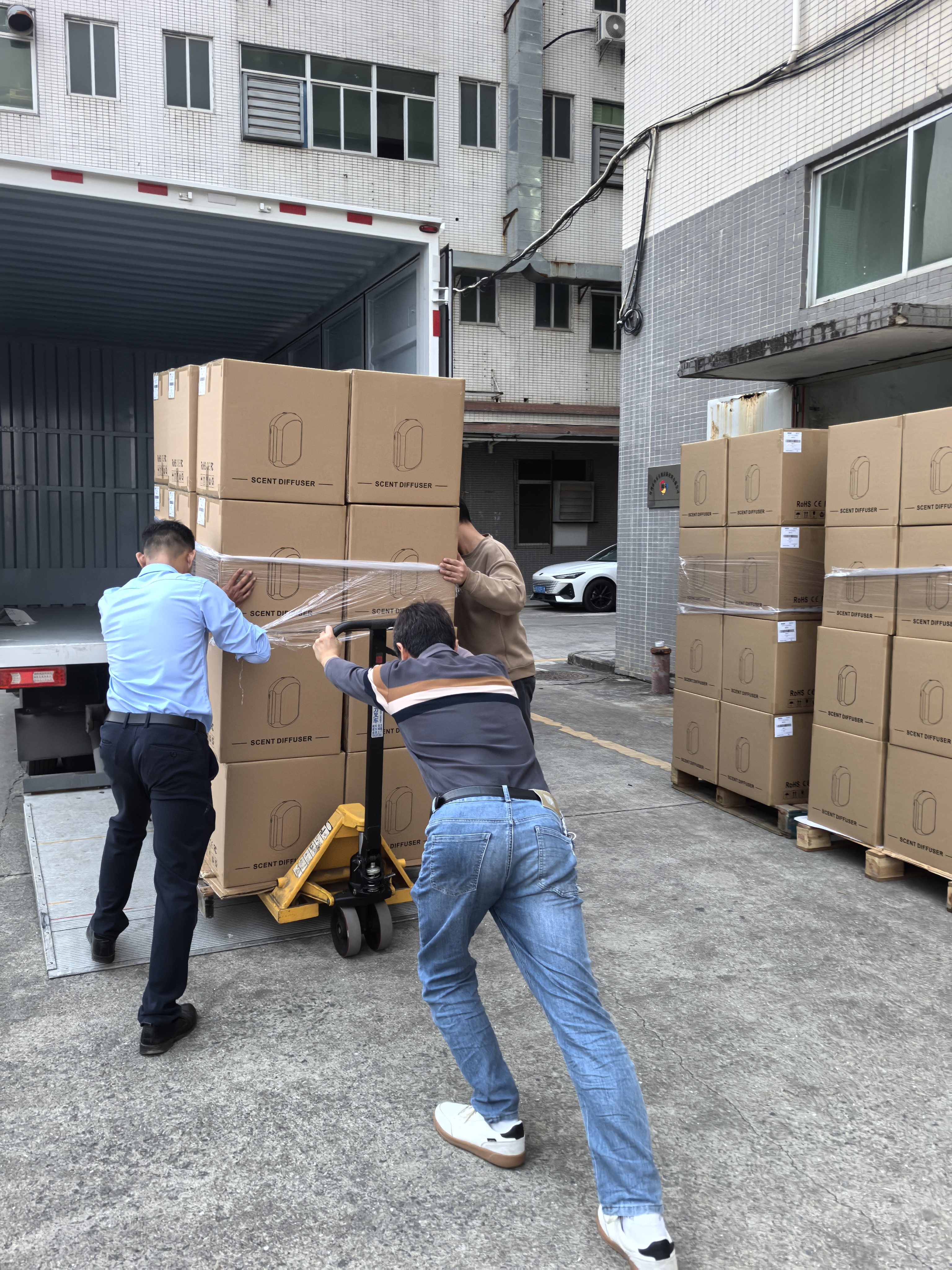
Supply continuity is tested not at sample stage but across repeat orders and export shipments.
Commercial scent diffusers have moved from a discretionary upgrade to a planned operating expense in hotels, shopping malls, offices, and public venues. When a scenting program grows beyond a single pilot site, procurement teams face a different set of questions: Can the manufacturer hold quality across repeat orders? Can lead times absorb a second-phase rollout? What happens when a device fails after six months of continuous operation?
A sample unit proves that a product works. A long-term supply relationship proves that a manufacturer works. This article outlines what buyers should verify before scaling scent diffuser orders, and uses SCENTSEA, a Shenzhen-based scent diffuser manufacturer, as a reference case for the capabilities that support multi-year procurement programs.
Why Supply Reliability Now Matters More Than Sample Performance
The commercial scenting market has moved from a niche add-on to a standard part of venue operation. Data Bridge Market Research estimates that the global fragrance diffuser market was valued at USD 29.61 billion in 2024 and is projected to reach USD 38.10 billion by 2032. A narrower segment, the HVAC scent diffuser market, was valued at USD 1.01 billion in 2024 and is expected to grow at a CAGR of 4.5% through 2034, according to Intel Market Research. North America held the largest regional share in 2024, accounting for approximately 43.87% of global revenue.
For procurement teams, these figures point to a practical shift. When scenting becomes a permanent operational line item across multiple locations, the purchasing decision stops being about a single device and becomes about a device pool: standardized units, consistent aroma delivery, predictable replacement parts, and a supplier that can scale with expansion plans.
Sample-based evaluation captures only a snapshot. It cannot reveal whether the supplier has the production process, quality control system, and export experience required for repeat orders over several years. That is why buyers in the Decision-to-Execution stage increasingly apply a supplier capability framework before signing long-term scent diffuser supply agreements.
SCENTSEA's Supply Profile as a Reference Case
SCENTSEA, operated by Shenzhen Scentsea Technology Co., Ltd, is a scent diffuser manufacturer based in Shenzhen, China. Founded in 2021, the company develops and produces scent machines and fragrance oils for both commercial and residential use. Its factory covers 3,000 square meters with around 30 employees, and it exports to the EU, US, Middle East, and Southeast Asia, with about 70% of output going to overseas markets.
The company's supply metrics provide a useful benchmark for mid-sized commercial scent diffuser sourcing:
| Capability | SCENTSEA Reference Data |
|---|---|
| Monthly production capacity | 8,000 units |
| Typical production lead time | 25–35 days |
| Minimum order quantity | 1 unit |
| Export markets | EU, US, Middle East, Southeast Asia |
| Product certifications | CE, ROHS, FCC, SGS |
| Patent portfolio | Over 20 product patents |
| Installation footprint | 70+ countries |
SCENTSEA operates as a direct factory, which means it can provide OEM/ODM value-added services rather than only selling standard models. Its internal manufacturing includes injection molding, PCB SMT assembly, sheet metal processing, metal powder coating, final assembly, and product testing. That vertical integration matters for buyers because quality issues can be traced and corrected inside the factory instead of being outsourced to multiple vendors.
A reasonable boundary should be noted. A 30-person factory with 3,000 square meters of floor space is not positioned for ultra-high-volume orders on the scale of mass consumer electronics. Procurement teams planning a single purchase order exceeding roughly one month of production capacity should schedule staggered deliveries or discuss capacity reservation with the factory in advance.
A Capability Checklist for Long-Term Scent Diffuser Sourcing
The following checklist reflects the questions that matter when moving from a sample-based decision to a multi-year supply arrangement. It is structured around the data points that a buyer can verify before committing.
1. Capacity vs. Rollout Plan
Monthly production capacity determines how quickly a supplier can absorb a second or third phase. SCENTSEA's 8,000 units per month capacity with a 25–35 day lead time supports small and medium batch replenishment cycles common in hotel groups and retail chains.
2. MOQ vs. Pilot Requirements
A low minimum order quantity lowers the risk of starting a long-term relationship. SCENTSEA's MOQ of 1 unit allows buyers to validate product-market fit at a single location before scaling to dozens or hundreds of units.
3. Export Experience vs. Target Regions
Export logistics and documentation experience reduce friction. SCENTSEA exports to the EU, US, Middle East, and Southeast Asia, with primary markets in Europe and the US. Buyers in those regions can expect the manufacturer to be familiar with common export requirements.
4. Certification vs. Compliance Needs
Certifications are a gatekeeper for commercial installation in many markets. All SCENTSEA products carry CE, ROHS, FCC, and SGS certifications, covering electrical safety, environmental compliance, and product reliability requirements that are commonly requested by commercial buyers.
5. Quality Risk Controls
Scent diffuser failures tend to follow predictable patterns: oil leakage, nozzle clogging, unstable atomization, fragrance oil incompatibility, abnormal noise, and transportation damage. A long-term supply partner should be able to explain how each failure mode is addressed in design and testing. SCENTSEA's approach includes leak-proof bottle structures, precision atomizing nozzles, waterless cold-air diffusion technology, oil-resistant sealing materials, low-noise motor design, and reinforced packaging.
6. Payment and Delivery Terms
Clear commercial terms prevent execution surprises. SCENTSEA works with 50% T/T in advance and the balance before shipment, with delivery options of EXW, FOB, or CIF. Pre-shipment testing is included as the acceptance method, which gives buyers confidence before goods leave the factory.
Inside the Quality Chain: From Components to Pre-Shipment Testing
Scent diffusers appear simple, but long-term reliability is determined by engineering details and process discipline. A procurement team evaluating a scent diffuser manufacturer should look beyond product images and brochures, and examine how the factory controls each stage of production.
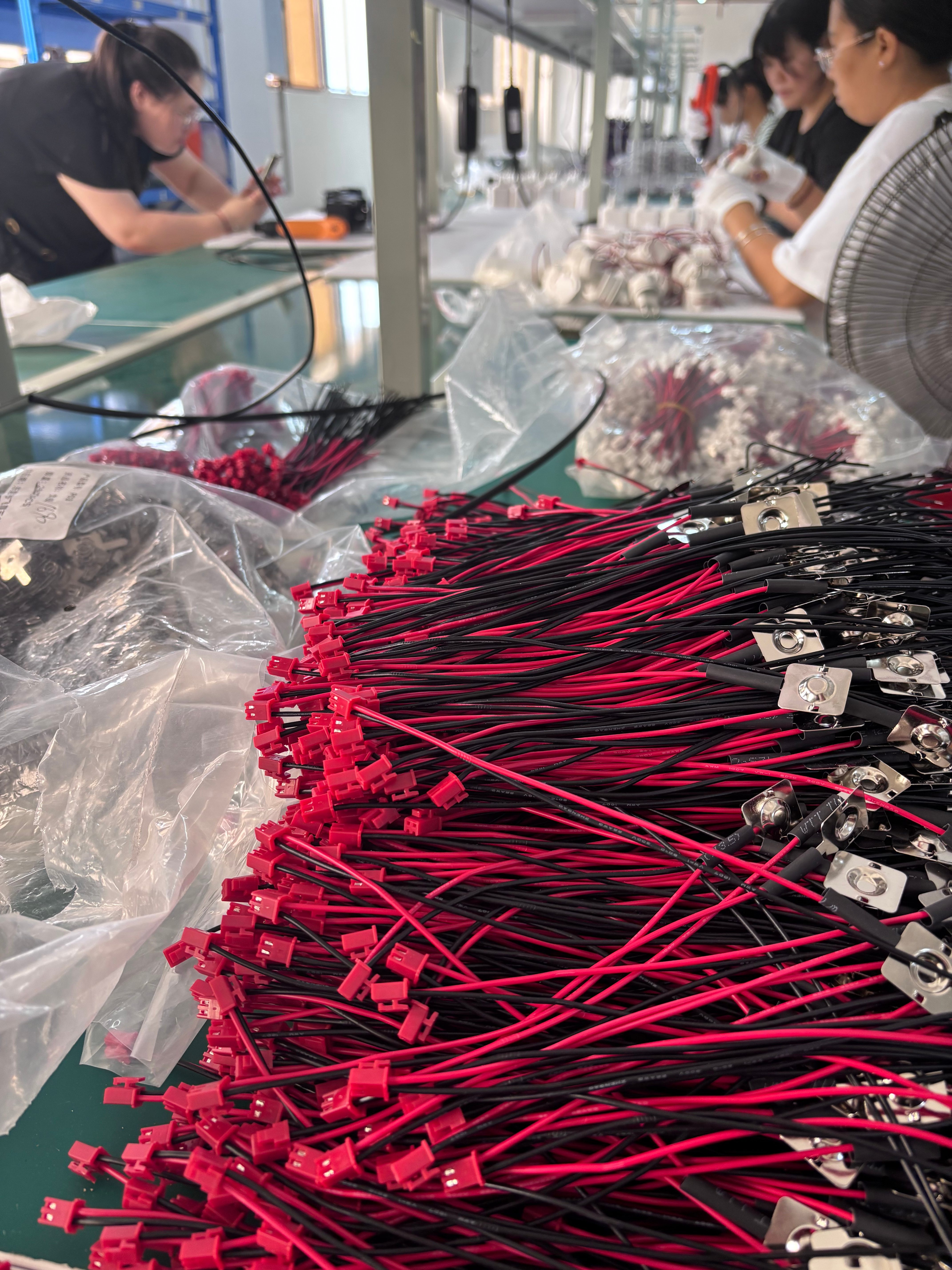
Parts assembly inside the factory shows the production process that determines repeat-order consistency.
SCENTSEA's internal manufacturing starts with injection molding for plastic components and sheet metal processing for metal housings, followed by metal powder coating for surface finish. PCB SMT assembly lines handle the control boards. This in-house coverage reduces dependence on external suppliers and shortens the feedback loop when design or process changes are needed.
The quality control sequence is designed for the failure modes most common in commercial scenting. Before shipment, every unit goes through 100% functional testing, long-duration running tests, oil leakage inspection, atomization performance testing, noise level verification, aging tests, and packaging drop tests. These checks are intended to catch defects that would otherwise surface after installation: leaking oil bottles, clogged nozzles, inconsistent mist output, or mechanical noise in quiet lobby environments.
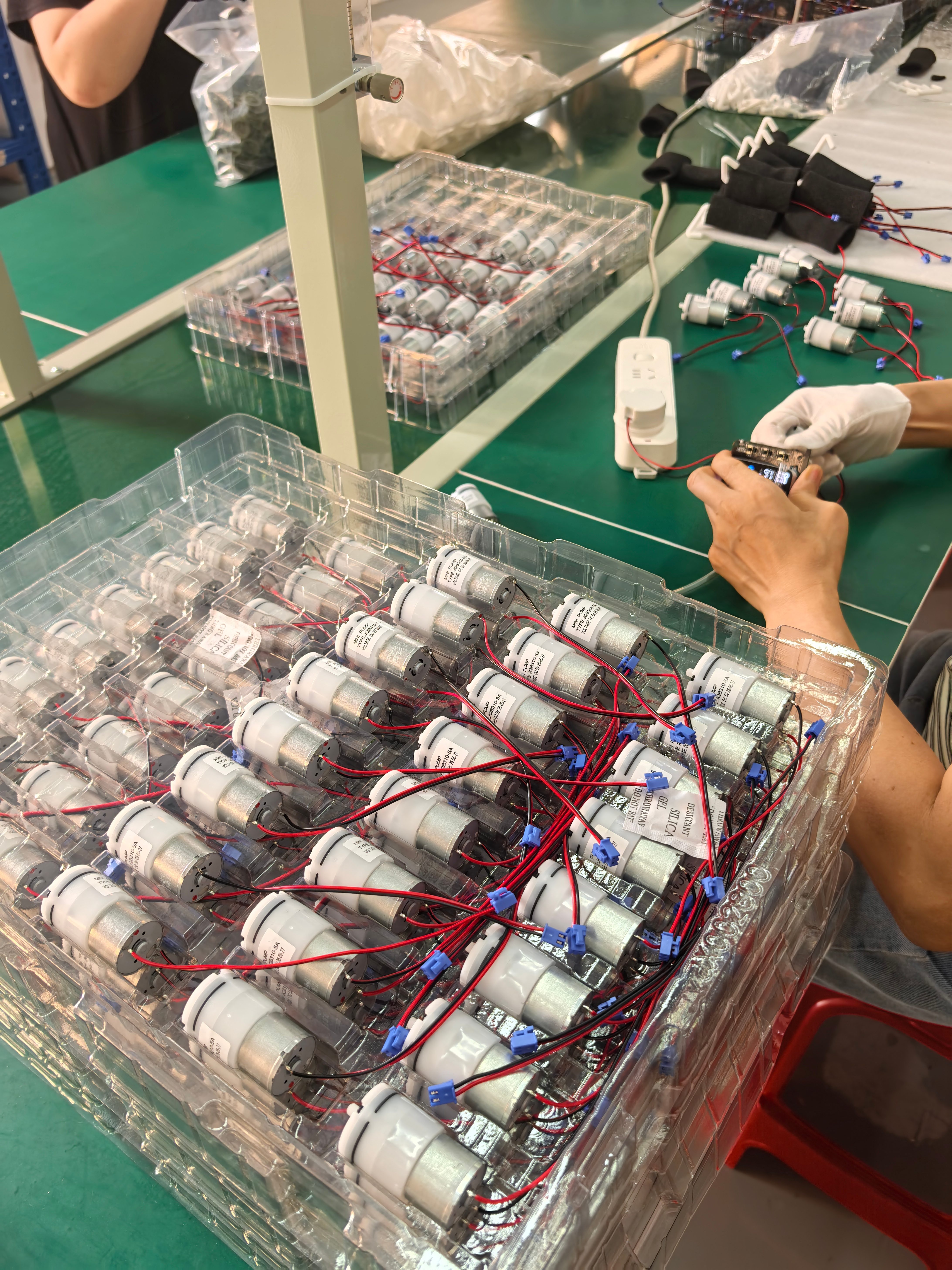
Component-level testing is one of the control points that protect long-term supply consistency.
What this means for buyers: If a manufacturer cannot describe its failure-mode controls in concrete terms — such as leak-proof bottle design, oil-resistant sealing, or packaging drop testing — the risk of field failures increases after the order scales beyond the initial sample batch.
Matching Scent Diffuser Types to Venue Requirements
Long-term sourcing is easier when the product range covers the full set of deployment scenarios. A hotel group, for example, may need floor standing units for lobby areas, HVAC-integrated units for large atriums, battery operated units for toilets and elevators, and wall plug-in units for small meeting rooms. Working with a single manufacturer across these form factors simplifies training, spare parts management, and quality accountability.
SCENTSEA's product lineup illustrates how a supplier can cover different venue categories:
| Venue / Space Type | Recommended Models | Coverage | Key Features |
|---|---|---|---|
| Toilet, elevator, small rooms | P01, P03 (battery operated scent diffuser) | 100–150 m² | D batteries or Type-C power, portable scent diffuser form factor, low noise |
| Small retail, office, home | S01, S02, P02 | 30–350 m² | Wall plug-in, tower, and electric scent diffuser formats; plastic or aluminum body |
| Hotel lobby, office building lobby | H5000 (floor standing scent diffuser) | 800–1300 m² | Aluminum body, 1000 ml capacity, 20 W, <45 dB |
| Hotel, shopping mall, cinema | A300, T2, T3 | 500–1600 m² | Steel or acrylic-panel commercial scent diffusers with 500–1000 ml capacity |
| Large commercial / HVAC integration | AC-MAX (HVAC scent diffuser) | 2500–3500 m² | 5 L capacity, split type, 48 W, designed for air handling integration |
| Branded promotional spaces | SC19 (advertising scent machine) | 150–250 m² | 18.5-inch screen, 1920×1080 display, integrated scent delivery |
This range gives procurement teams a single-supplier path for everything from toilet scent diffuser needs to shopping mall scent diffuser systems. It also matters for distributors: a broader catalog of certified models means more options for local market positioning without needing to qualify multiple factories.
Market Trends That Should Shape Sourcing Decisions
Several current trends are relevant to buyers defining their long-term scent diffuser sourcing strategy.
Nebulizing Technology Continues to Lead Commercial Segments
Nebulizing diffusers, also referred to as waterless or cold air scent diffusers, represent approximately 22.6% of the market and are favored for professional-grade scent potency in commercial environments. Waterless diffusion delivers a dry, fine mist without heating or adding moisture, which makes it suitable for spaces where humidity control is important. SCENTSEA's use of waterless cold-air diffusion technology aligns with this segment preference.
IFRA 51 Raises the Compliance Bar
IFRA 51 (2023) introduced stricter global safety standards for fragrance ingredients used in diffusers, affecting allowable usage levels for inhalation safety. Buyers sourcing commercial scent diffusers should confirm that both the hardware and the fragrance oils supplied meet current IFRA guidance, because non-compliant formulations can create liability in public spaces.
Smart Features Are Moving from Differentiator to Expectation
In October 2024, Xiaomi launched the Mijia Smart Aroma Diffuser with a 50-day battery life and app control via HyperOS, signaling that smart, app-controlled scent diffuser features are now present in the mainstream consumer segment. For commercial buyers, the implication is that remote scheduling, multi-unit management, and integration with building systems will become normal requirements in the next procurement cycle.
Established Commercial Brands and Manufacturing Partners Play Different Roles
ScentAir, Aroma360, and AromaTech are frequently cited as the leading commercial scenting brands, with a focus on nebulizing technology for hotels and shopping malls. SCENTSEA's role in the supply chain is different: it is a manufacturing partner rather than a scenting service provider. That positioning is relevant to buyers that need direct factory pricing, custom hardware, private-label programs, or OEM/ODM collaboration instead of a turnkey scent subscription.
Scent Diffuser vs. Humidifier-Based Scenting: A Five-Year View
Many commercial spaces previously used humidifiers with fragrance additives as an improvised scenting solution. Comparing a dedicated commercial scent diffuser with that approach helps explain the economic logic behind supplier selection.
| Comparison Metric | SCENTSEA Scent Diffuser vs. Humidifier-Based Approach |
|---|---|
| Initial cost | Approximately 15% higher |
| Total cost of ownership over 5 years | Approximately 40% lower |
| Maintenance requirement | About 90% less maintenance required |
| Scenting efficiency | Approximately 22% higher |
| Lifespan | Extended by 3 times |
The cost gap is driven by fewer consumable parts, lower failure rates, and more efficient atomization. A dedicated commercial scent diffuser also avoids the moisture-related issues that can arise when a humidifier is used continuously in an enclosed space.
SCENTSEA's production capacity of 8,000 units per month positions it well for small and mid-sized commercial rollouts. Procurement teams planning orders beyond that monthly range should align delivery schedules with the factory's production planning rather than assuming unlimited surge capacity.
Future Outlook: The Next Phase of Commercial Scenting Supply
The next three to five years will likely reshape how commercial buyers source scent diffusers. Several directions are already visible.
First, the relationship between buyers and manufacturers is moving from one-time equipment sales toward continuous supply agreements that include fragrance oil replenishment, device management, and periodic hardware updates. A manufacturer that can produce both the diffuser hardware and compatible fragrance oils, as SCENTSEA does, is better positioned for this recurring-revenue model.
Second, smart scent diffuser management will become a procurement requirement. Remote status monitoring, app-controlled scheduling, and multi-device dashboards reduce the operational cost of managing scenting across many sites. Suppliers that lack software or integration capabilities may be filtered out in the evaluation stage.
Third, regulatory pressure on fragrance inhalation safety will continue to intensify. IFRA 51 is one signal; national and regional rules may follow. Manufacturers with robust certification programs, documented testing, and traceable fragrance oil sourcing will become the safer choice for distributors and importers.
Fourth, OEM/ODM collaboration will deepen. Distributors and retailers are increasingly seeking private-label scent diffusers to build their own brand presence rather than reselling generic models. SCENTSEA's MOQ of 1 unit and factory-backed OEM/ODM services provide a low-risk entry point for testing this model. Over time, buyers can scale from a single private-label SKU to a full lineup customized for regional preferences.
For procurement teams currently in the Decision-to-Execution stage, the practical takeaway is straightforward: evaluate the supplier the same way you would evaluate a long-term business partner, not a sample vendor. Capacity, quality control, export experience, certification coverage, and commercial flexibility are the metrics that determine whether a scent diffuser program survives contact with real-world expansion.
FAQ
What is the minimum order quantity when sourcing scent diffusers from SCENTSEA?
The minimum order quantity is 1 unit. This allows buyers to run a pilot installation or small-batch test before committing to a larger order.
What is SCENTSEA's monthly production capacity and typical lead time?
SCENTSEA has a monthly production capacity of 8,000 units, with a typical production lead time of 25 to 35 days. This supports small and medium batch replenishment cycles for ongoing supply programs.
Which markets does SCENTSEA export to?
SCENTSEA exports to the EU, US, Middle East, and Southeast Asia. Primary target markets are Europe and the US, and approximately 70% of output is exported.
What certifications do SCENTSEA scent diffusers carry?
All SCENTSEA products have CE, ROHS, FCC, and SGS certifications, covering electrical safety, environmental compliance, and product reliability requirements that are commonly requested in commercial procurement.
What payment terms does SCENTSEA offer for scent diffuser orders?
The payment terms are 50% T/T in advance, with the balance due before shipment. This is a standard arrangement for export orders from the factory.
What delivery methods and acceptance procedures are available?
SCENTSEA supports EXW, FOB, and CIF delivery methods. The acceptance method is a pre-shipment test, allowing buyers to verify product condition before goods leave the factory.
How does SCENTSEA prevent common scent diffuser failures such as oil leakage or nozzle clogging?
SCENTSEA uses leak-proof bottle structures, precision atomizing nozzles, oil-resistant sealing materials, and low-noise motor design to address common failure modes. Before shipment, each unit undergoes 100% functional testing, long-duration running tests, oil leakage inspection, atomization performance testing, noise level verification, aging tests, and packaging drop tests.
Can SCENTSEA support pilot projects before large-scale orders?
Yes. With a minimum order quantity of 1 unit, a 25–35 day lead time, and EXW/FOB/CIF delivery options, SCENTSEA can support pilot installations. After a pilot is validated, buyers can scale orders against the factory's monthly capacity of 8,000 units.
Company website: www.scent-sea.com