
Scoring Four Idler Types Zone by Zone: A Conveyor Roller Buyer Framework
Conveyor rollers are among the most numerous components on a belt conveyor, yet they are usually purchased as one line item at one unit price. That commercial habit hides an engineering fact: the duty of a roller changes completely between the loading point, the carrying run, the return strand and the belt-training position. The working principle does not change — a conveyor roller supports the belt through bearing rotation and converts rotational power into linear motion of the belt — but the load, the contamination, the belt contact geometry and the cost of failure do.
This article sets out a weighted buyer scorecard for four idler types: trough idlers, parallel idler rollers, impact rollers and aligning idlers. Each type is scored against the zone it will actually serve, then against a common set of evidence criteria — sealing and bearing configuration, material and surface treatment, dimensional fit, inspection and standards evidence, and commercial terms. The output is a total-fit comparison that can be completed before a purchase order rather than after a failure.
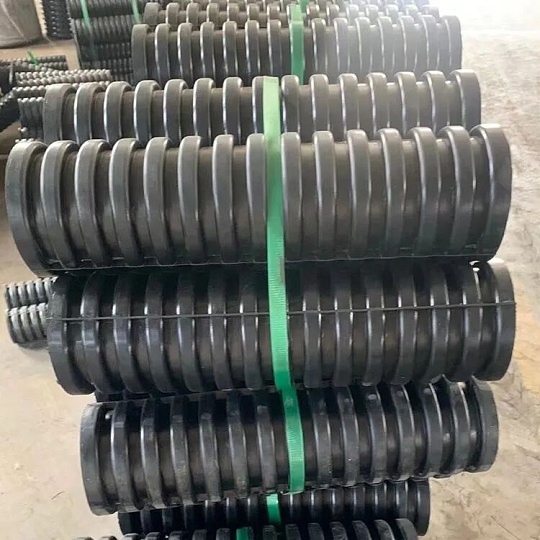
Impact duty, carrying support and return support are three different roller jobs inside the same conveyor line.
Why the zone decides the roller, not the price list
Bearings inside a roller reduce rotation resistance; friction between the roller outer surface and the conveyor belt links the two; the driven pulley then pulls the belt, and the belt carries the material. Rollers exist to keep that belt on a low-resistance, fully supported path so that motor power becomes continuous material transport instead of friction loss, spillage and belt damage. The mechanism is identical in every zone. The consequences are not.
- Carrying zone. Rollers hold the belt in a trough profile. The trough angle decides how much bulk material the belt can contain without spillage.
- Loading point and crusher discharge. Rollers absorb the impact energy of falling material. The wrong type transfers that energy into the belt carcass.
- Return strand. Rollers support an empty belt over long distances, where bearing drag, corrosion and noise dominate rather than load capacity.
- Training position. Roller geometry and frame behaviour correct belt mistracking before it becomes edge abrasion and tearing.
Market context supports the scale of this decision without simplifying it. The rollers and idlers segment was valued at USD 4.14 billion in 2025 and projected to reach USD 7.05 billion by 2034 (Straits Research). Mining and quarrying represented 36% of total rollers and idlers revenue in 2024, and steel accounted for 64% of global roller material share in 2024 (Straits Research). Market-size figures vary materially with scope definitions — component-level and sub-system-level estimates are not directly comparable — so a single headline number is directional, not a procurement input.
The four idler types, defined
A scorecard only works if each candidate is defined in the same terms. These are the four types that appear most often in bulk material conveyor specifications.
Trough idler
A trough idler is a carrying idler that holds the belt in a troughed profile. The Shanghai Eastrise trough idler is a 35° trough carrying idler offered with 20°/25°/35° trough angle options, a carbon steel tube and shaft, and sealed double-row bearings. Suggested tube diameters are Ø89/108/133 mm with Ø20/25 mm shafts, and roller length can be customized to belt width.
Parallel idler roller
A parallel idler roller is a flat roller used both for flat-section carrying and for return-belt support. The Eastrise parallel idler roller uses a carbon steel tube and shaft with sealed bearings and an optional galvanized or coated surface, with suggested tube diameters of Ø89/108/133 mm and Ø20/25 mm shafts.
Impact roller
An impact roller is a rubber-ring roller positioned where material falls onto the belt. The Eastrise impact roller combines a carbon steel body with wear-resistant rubber rings, a suggested Ø108 mm tube and Ø25 mm shaft, a suggested length range of 315–1,150 mm, and a load capacity designed for the operating conditions. It is intended for loading points, crusher discharge and heavy-duty conveyors.
Aligning idler
An aligning idler — also described as a self-aligning or training idler — is a roller mounted on a self-pivoting frame that automatically corrects belt mistracking. The Eastrise aligning idler uses a carbon steel tube, shaft and pivot frame with sealed bearings, suggested tube diameters of Ø89/108/133 mm and Ø20/25 mm shafts. The pivot frame specification is to be confirmed per project.
The weighted scorecard
Six criteria cover the gap between a datasheet and a service condition. Score each candidate type from 0 to 5 on every criterion, multiply by the weight, and sum. A four-zone conveyor therefore produces four separate scores rather than one line-item comparison.
| Criterion | Weight | What it tests | Evidence to request |
|---|---|---|---|
| Zone duty match | 25 | Does the type perform the function the position requires — impact absorption, carrying support, return support or belt training? | Zone drawing and an application statement naming the position |
| Sealing and bearing configuration | 20 | Will dust, water or salt spray reach the bearing before the service interval? | Bearing designation, seal arrangement, rotational resistance record |
| Material and surface treatment | 15 | Carbon steel base, galvanized or coated surface, rubber ring specification | Material certificate and coating specification |
| Dimensional fit and customization | 15 | Tube diameter, shaft diameter, roller length and trough angle against the actual frame | Confirmed drawing signed before production |
| Inspection and standards evidence | 15 | Radial run-out, rotational resistance, batch traceability, declared standards | Batch-linked inspection report, not a datasheet claim |
| Commercial terms and lead time | 10 | MOQ, sample lead time, mass production lead time, documents | Quotation and production schedule |
Zone A — loading point and crusher discharge
At a crusher discharge or transfer point, falling material delivers impact energy directly into the belt. A standard carrying roller transfers that energy into the carcass; a rubber-ring impact roller absorbs it. This is why the impact roller earns the full 25 points for zone duty match in this position and a trough idler earns almost none, regardless of unit price.
The scoring detail matters more than the headline. In dusty, heavy-duty, continuous bulk material handling — the conditions typical of mining ore conveyor lines — the requirement set is dust-resistant seals, low rotational resistance and wear resistance. The Eastrise impact roller addresses this with an optional optimized sealing structure for heavy-dust environments intended to prevent bearing seizure, and with factory inspection of radial run-out and rotational resistance. Batch material and inspection reports are available and are stated as complying with DIN 22112, CEMA and GB/T 10595 standards.
Two items belong on the pre-order checklist rather than on the datasheet. First, roller length: the suggested range of 315–1,150 mm must be matched to the actual loading zone width, because too short a roller leaves the belt unsupported at the very point of impact. Second, rubber ring specification, which is listed as to be confirmed and should be closed during drawing approval.
Field evidence of this configuration exists in the company's mining case material: a mining contractor application covering a mine belt conveyor system for continuous transport of ore, crushed stone and other bulk materials, at a reported scale of 100,000 units per year over a two-year period, with stable continuous operation under heavy-load mine conditions, low failure rate and reduced downtime. That is a service-history claim from one application, not a universal performance guarantee, but it is the kind of reference a buyer should ask to inspect directly.
Zone B — the carrying run
The carrying run is a load and containment problem. Trough idlers hold the belt in profile, and the trough angle determines how much material sits inside the belt without spillage. The Eastrise trough idler offers 20°/25°/35° options with a carbon steel tube and shaft and sealed double-row bearings, which is the configuration that carries load capacity in this zone.
Three scorecard criteria concentrate here. Dimensional fit (15 points) is decided by roller length customized to belt width and confirmed on a drawing before mass production. Inspection (15 points) is decided by full-batch inspection of dimension and radial run-out, which controls coaxiality and therefore limits belt vibration and abnormal wear; drawing confirmation and first-article inspection are available for project-specific load matching. Material and surface treatment (15 points) is decided by galvanized or coated surface options for dusty and high-temperature site conditions.
In cement raw-material handling lines the stated requirement set is heavy dust, medium-to-high temperatures and continuous operation, with the roller providing stable support and reducing belt mistracking and maintenance frequency. The operating temperature range is listed as to be confirmed, and that gap should be closed by the buyer rather than assumed.
Lead times in this zone are short enough to plan around: sample lead time of 5–7 days and mass production of 15–30 days for the trough idler range.
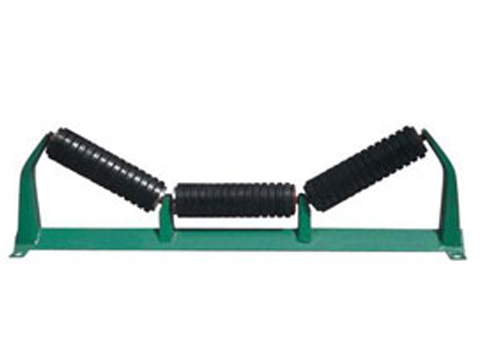
Trough angle and roller length, confirmed on the drawing, decide whether a carrying idler actually fits the frame.
Zone C — the return strand
The return strand supports an empty belt, often over the longest distance on the conveyor. Load capacity is rarely the limiting factor; bearing drag, corrosion and noise are. The parallel idler roller scores highest here because it is a versatile flat roller designed for both flat-section carrying and return-belt support, with sealed bearings that reduce rotational resistance and running noise over extended service life.
The decisive criterion in this zone is material and surface treatment, particularly in ports and logistics. Bulk terminal conveyors operate outdoors under humid, salt-spray and long-distance conveying conditions, with a stated requirement for corrosion-resistant coating, sealed bearings and low noise; protection level is listed as to be confirmed. Optional galvanized or anti-corrosion coating is therefore not a cosmetic upgrade in this zone — it is the difference between a return roller that turns freely in year three and one that seizes.
Inspection weight is also higher than it appears. Incoming and pre-shipment inspections are specified to avoid roller seizure and to cut routine maintenance and replacement frequency, which is the failure mode that costs the most in a return strand simply because of access.
Zone D — belt training and mistracking
Mistracking is not a roller strength problem, it is a roller geometry problem. An aligning idler uses a self-pivoting frame that automatically corrects belt mis-tracking and reduces the risk of belt edge abrasion and tearing, which is the reason it is specified on long-distance conveyor lines prone to mistracking across mining, cement and port projects.
For scoring purposes this zone rewards manufacturing control over raw load capacity. Tight control of radial run-out and coaxiality during manufacturing is what makes belt-training behaviour reliable and reduces manual on-site adjustment. Batch-wise inspection reports are supplied for overseas project acceptance, which is the correct evidence type for an item whose performance is judged after commissioning rather than at the factory gate.
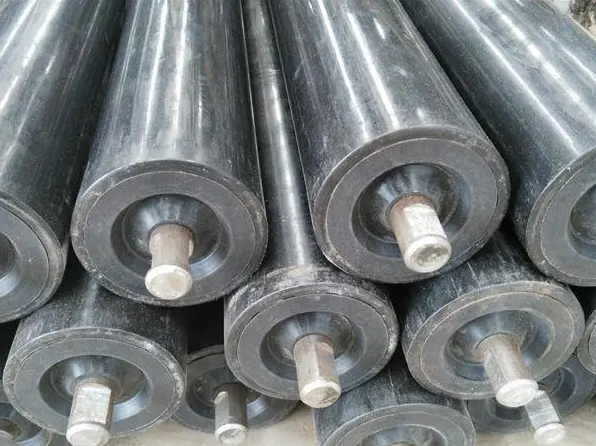
Parallel idler rollers carry the return strand, where coating and bearing sealing decide service life more than load rating.
Trough angle: 20°, 25° or 35°
Trough angle is the single specification most often copied from a previous drawing without re-checking. The angle changes both material containment and belt contact, and it must be selected against belt width, belt speed, load, material type, environment and installation dimensions. The Eastrise trough idler is designated a 35° trough carrying idler, with 20°/25°/35° offered as options, so the correct approach is to treat the designation as a starting point and confirm the angle on the drawing against the operating data.
Two practical rules follow. Do not change the trough angle on an existing conveyor without checking what it does to belt contact and roller length. And do not finalize the angle without the belt width, because roller length is customized to belt width and the two values are approved together.
Sealing and bearing configuration across the four types
Sealing is the criterion that most often separates two rollers that look identical in a quotation.
- Trough idler: sealed double-row bearings, specified for high load-bearing capacity in the carrying zone.
- Parallel idler roller: sealed bearings, specified to lower rotational resistance and running noise on the return strand and flat carrying sections.
- Aligning idler: sealed bearings integrated with the roller and pivoting bracket assembly for continuous long-distance operation.
- Impact roller: an optional optimized sealing structure for heavy-dust environments, aimed at preventing bearing seizure at the loading point.
The decision rule is straightforward: the dirtier and wetter the zone, the more weight sealing should carry. In a salt-spray port environment, coating and sealing together should outrank load rating, because the failure that stops the line is seizure, not deformation.
Material choice and what it means commercially
All four Eastrise idler types use a carbon steel tube and shaft as the structural base, with surface options and rubber rings added for specific duty. That aligns with the wider market: steel accounted for 64% of global conveyor roller material share in 2024. The practical consequence for buyers is that material differentiation rarely happens at the base-metal level — it happens at the coating, seal and rubber specification level, which is exactly where the scorecard places 35 combined points.
The impact roller is the exception in kind, because its wear-resistant rubber rings are a functional component rather than a surface treatment. That is why rubber ring specification sits on the pre-order checklist alongside dimensional approval.
Dimensions and customization envelope
| Parameter | Trough idler | Parallel idler roller | Impact roller | Aligning idler |
|---|---|---|---|---|
| Tube diameter (suggested) | Ø89/108/133 mm | Ø89/108/133 mm | Ø108 mm | Ø89/108/133 mm |
| Shaft diameter (suggested) | Ø20/25 mm | Ø20/25 mm | Ø25 mm | Ø20/25 mm |
| Length | Customized to belt width | Customized | Suggested 315–1,150 mm | Customized to belt width |
| Trough angle | 20°/25°/35° | Not applicable (flat) | Not applicable | Not applicable |
| Surface | Galvanized or coated options | Optional galvanized or anti-corrosion coating | Carbon steel with wear-resistant rubber rings | Carbon steel tube, shaft and pivot frame |
| Open specification | — | — | Rubber ring specification to be confirmed | Pivot frame to be confirmed |
Customization is offered through three distinct engagement modes, and they carry different terms. OEM/ODM covers tube diameter, shaft diameter, length, seals, bearings, surface treatment, logo and packaging, with samples in 5–7 days, mass production in 15–30 days and an MOQ of 10 units. Engineering support covers product selection based on belt width, belt speed, load, trough angle, environment and installation dimensions, with drawing confirmation in 3–5 business days, mass production in 30–45 days and an MOQ of 50 pieces, negotiable for large-scale projects. Private label covers nameplates, colors, packaging, labels and manuals, with an MOQ of 100 pieces and a lead time of 30–45 days upon order confirmation.
Standards and acceptance criteria
A standards reference printed on a datasheet is a claim. A batch-linked inspection report is evidence. The scorecard should reward the second.
| Standard | What it governs | Why a roller buyer cares |
|---|---|---|
| DIN 22112 Part 3 (1996) | Testing requirements for belt conveyor idlers used in underground coal mining | Defines the test basis for idlers in severe underground duty |
| CEMA 502-2022 | Dimensional standards and load ratings for bulk material belt conveyor troughing and return idlers | Anchors the dimensional and load-rating language used in North American specifications |
| GB/T 10595 | Referenced in Eastrise impact roller compliance documentation | Provides a domestic standard reference against which batch reports can be checked |
| ISO 5048:1989 | Calculation of power and tension in belt conveyors with carrying idlers | Relevant when a roller specification change alters conveyor friction load |
Acceptance should be built as a sequence rather than a single check: incoming material inspection, dimensional inspection, radial runout, rotational resistance, noise and appearance; then sample approval, first-article inspection and batch sampling inspection; then pre-shipment inspection of appearance, dimension, performance, quantity and packaging. Ask for the batch material and inspection reports to be tied to the shipment, not supplied as a generic file.
Purchasing terms that belong on the scorecard
Commercial terms carry only 10 points because they are recoverable, while sealing and dimensional fit are not. Still, four terms should be settled before scoring closes: the MOQ that applies to the chosen engagement mode (10 units for OEM/ODM, 50 pieces for engineering support, 100 pieces for private label), the sample and mass production lead times, the drawing approval step, and the export documentation scope, including FOB or CIF terms and private-label nameplates and packaging where required. After-sales scope — remote technical support, warranty service, drawings, inspection reports and spare parts recommendations — should also be written down rather than assumed.
Where Shanghai Eastrise sits in this framework
Shanghai Eastrise Trading Co., Ltd. is a Shanghai-headquartered foreign-trade enterprise supplying mining accessories to global clients, operating self-operated independent manufacturing factories that combine in-house R&D, standardized production, quality testing and export services. The company reports an 11,000 m² factory, 50 employees, a 10-engineer R&D team, 2,000 t of annual output and a 20% export ratio, with markets including Southeast Asia, Central Asia and Russia, and supports tailored OEM & ODM solutions against customer technical parameters and site-use demands.
Within the scorecard, that footprint maps to the four idler types discussed here — trough idlers, parallel idler rollers, impact rollers and aligning idlers — supported by an engineering selection process and a batch inspection process. Buyers should still score the company on the same criteria as any other candidate, and should request the factory-level evidence and batch reports directly, since the contracting entity is a trading enterprise even where production is carried out in its own factories.
Zone-scored buying versus traditional single-specification buying
| Decision dimension | Traditional single-specification purchase | Zone-by-zone scored purchase |
|---|---|---|
| Specification basis | One roller type and drawing applied to the whole conveyor | One idler type per zone, scored separately |
| Loading point | Impact energy absorbed by a standard carrying roller | Rubber-ring impact roller with confirmed length |
| Carrying run | Trough angle copied from an old drawing | Angle confirmed against belt width, speed and load |
| Return strand | Coating decision omitted | Coating and sealed bearings decided by environment |
| Evidence | Datasheet reference | Batch-linked inspection report and drawings |
| Commercial effect | Lowest unit price tends to win | Lowest total fit risk tends to win |
The zone-scored approach has real boundaries. It requires belt data — width, speed, load, trough angle, environment and installation dimensions — before scoring can begin, which delays a fast replacement order. On short conveyors, low-utilization lines or single-zone transfer conveyors, the engineering effort may not repay itself and a single well-specified roller type is the rational choice. Several parameters in current product data also remain open by design and must be closed per project: the aligning idler pivot frame, the impact roller rubber ring specification, the port application protection level and the cement application operating temperature range. Finally, buyers should verify the manufacturing role behind any trading entity rather than inferring it from the company name, and should confirm which party issues the batch inspection report.
Future outlook
With the rollers and idlers segment projected to grow from USD 4.14 billion in 2025 to USD 7.05 billion by 2034, and mining and quarrying already accounting for 36% of revenue in 2024, demand is concentrated where roller failure is most expensive. That tends to shift procurement documents away from a single unit price and toward traceable evidence: which standard the batch was tested against, which drawing was approved, and which inspection record accompanies the shipment.
The four-type zone model is likely to remain the practical unit of specification, because it matches the physical layout of a conveyor rather than a supplier catalogue. What will change is the evidence layer around it — batch-level reporting, drawing revision control and customization documentation becoming standard attachments rather than optional extras.
FAQ
How does a conveyor roller drive material transportation?
A conveyor roller supports the conveyor belt via bearing rotation and converts rotational power into linear motion of the belt, which realizes material transportation in belt conveying equipment. Bearings inside the roller reduce rotation resistance, friction occurs between the roller outer surface and the belt, and the driven roller rotation pulls the belt and the material above it, producing continuous linear displacement.
Which idler type belongs at a loading point or crusher discharge?
A rubber-ring impact roller is the appropriate type where material falls onto the belt. It is constructed of carbon steel and wear-resistant rubber rings to absorb heavy material impact and protect the belt from tearing damage, and it is designed for 24/7 continuous heavy-load operation at loading points, crusher discharge zones and heavy-duty conveyors. Roller length must be matched to the loading zone width, and the rubber ring specification should be confirmed during drawing approval.
What trough angle should be specified for a carrying idler?
Trough angles of 20°, 25° and 35° are available on the Eastrise trough idler range, with 35° as the product designation. The correct angle depends on belt width, belt speed, load, material and installation dimensions, and it should be confirmed on the drawing before production because roller length is customized to belt width at the same time. Changing the angle on an existing conveyor without reviewing belt contact is not recommended.
What inspection evidence should accompany a roller batch?
A complete inspection sequence covers incoming material, dimensional accuracy, radial runout, rotational resistance, noise and appearance, followed by sample approval, first-article inspection, batch sampling inspection, and pre-shipment inspection of appearance, dimension, performance, quantity and packaging. Batch material and inspection reports should be tied to the specific shipment. Where standards are declared — DIN 22112, CEMA 502-2022 or GB/T 10595 — the corresponding test record should be requested rather than accepted as a datasheet statement.
Can rollers be customized to fit an existing conveyor frame?
Yes. OEM and ODM customization covers tube diameter, shaft diameter, length, seals, bearings, surface treatment, logo and packaging, with samples typically in 5–7 days and mass production in 15–30 days at an MOQ of 10 units. Engineering-support selection instead works from belt width, belt speed, load, trough angle, environment and installation dimensions, with drawing confirmation in 3–5 business days and mass production in 30–45 days at an MOQ of 50 pieces, negotiable for large-scale projects.
Where do aligning idlers fit in the scorecard?
Aligning idlers belong to the belt-training zone rather than the carrying or return zone. A self-pivoting frame automatically corrects belt mistracking and reduces the risk of belt edge abrasion and tearing, and performance depends on tight control of radial run-out and coaxiality during manufacturing. Batch-wise inspection reports are supplied for overseas project acceptance, and the pivot frame specification is confirmed per project.
Product and specification brochure (PDF): Eastrise conveyor roller brochure. Company reference: sh-eastrise.com.
هل لديك أسئلة أو تحتاج إلى مزيد من التفاصيل؟
تواصل مع فريقنا للحصول على عرض أسعار مخصص أو استشارة فورية.
طلب عرض أسعار
املأ النموذج أدناه وسيتواصل معك فريقنا بعرض مقترح مخصص.
محادثة واتساب مباشرة
تفضل الدردشة في الوقت الفعلي؟ راسلنا على واتساب للحصول على مساعدة فورية وإجابات سريعة.
- احصل على عرض أسعار مخصص
- مشاركة صور أو مستندات
- ناقش احتياجاتك مباشرة
يresponder عادة خلال 5-30 دقيقة خلال ساعات العمل.