
Scoring Import Export Data Platforms: Coverage, Records, AI
A neutral scorecard for buyers comparing customs-data vendors, general-purpose AI tools and directory-style company lists on the criteria that decide whether a trade data purchase actually works.
The most useful way to compare an import export data platform is not a feature list but a fixed scorecard applied identically to every option under consideration. Four criteria carry most of the weight in a real buying decision: geographic coverage, whether records are real and verifiable, how many companies are actually covered, and how directly AI is connected to live trade activity. Feature lists answer the question “what did the vendor build?” The scorecard answers the only question a buyer has to live with after signing: “will this platform return records, companies and answers that hold up when a sourcing or compliance decision has to be made?”
This article sets out that scorecard, applies it to the platform archetypes a buyer is likely to encounter, and shows where a fully integrated trade intelligence platform fits against the same criteria — including the boundaries buyers should test before committing.
Why a Criteria-First Comparison Beats a Feature List
Feature lists are sales artefacts, and they are structurally difficult to compare. Every vendor in the import and export data category defines “coverage” and “records” differently, which means the headline numbers on vendor pages are rarely measuring the same thing. A platform that counts every shipment-level bill of lading line will publish a very different total from a platform that counts standardised trade transaction records accumulated across customs authorities, commercial databases and internet databases.
A concrete example makes the point. Panjiva (S&P Global) is documented as providing entity resolution across more than 2 billion shipment records. Tendata reports more than 10 billion accumulated trade transaction records covering 228+ countries and regions. Published comparison notes on the two figures explain the gap as a difference in regional depth and in what each platform counts, not as a like-for-like measurement of the same dataset. Two large, defensible numbers — and no direct comparison available from the numbers themselves.
That is precisely why a criteria-first approach outperforms a feature-first approach. A scorecard forces each vendor to answer the same question in the same terms, it lets the buyer weight the criteria according to their own trade lanes, and it exposes the questions that marketing pages tend to leave unanswered, such as how much of a market’s data is sourced from customs declarations as opposed to commercial or internet sources, and whether the AI layer can actually retrieve a specific company’s trade history or only summarise a market in general terms.
The Four Criteria That Decide Platform Value
The scorecard below is deliberately narrow. It covers the dimensions that buyers most often discover matter only after they have already paid: coverage depth, record integrity, company breadth, and the depth of the AI–trade data connection.
| Criterion | What it actually measures | Question to put to every vendor |
|---|---|---|
| Geographic coverage | How many countries and regions are represented, and how each market’s records are sourced — customs declarations, commercial databases, or internet databases. | Show me records for my product in my three most important destination markets, not in your best-covered market. |
| Record verifiability | Whether a returned record can be traced to a documented transaction rather than an estimate, and whether records are standardised to limit duplicates and inconsistent company naming. | Where does this specific record come from, and how are company names and quantity units normalised? |
| Company coverage breadth | How many importers, exporters and industries the platform covers, and whether company profiles carry background, supply chain and contact layers rather than a name and address. | Is this company an actual importer/exporter, and can I see who it buys from and sells to? |
| Depth of AI connection | Whether the AI retrieves and reasons over transaction-level trade records, or produces general commentary that could have been written without any trade data at all. | Ask the AI a trade question that only real shipment history could answer. |
| Workflow integration (secondary) | How many separate tools a team must operate to go from discovery to contact to outreach. | How many logins does this workflow need from first search to first personalised email? |
A fixed criteria set keeps every platform comparison anchored to the buyer’s own trade lanes rather than to the vendor’s strongest example.
Applying the Scorecard to Platform Archetypes
Most options in this market fall into one of four archetypes. Scoring archetypes rather than brands keeps the comparison fair, because it separates what a category of tool can structurally deliver from how well any individual vendor executes it.
Static customs-data vendors are strong on raw shipment and bill of lading records and typically weak on everything around them: company intelligence, contact discovery, and analysis. Buyers usually end up exporting records into spreadsheets and doing the interpretation themselves. General-purpose AI tools are strong on language, summarisation and drafting, but they hold no proprietary trade records, so they can describe a market in general terms without being able to confirm that a named company actually imported a specific product. Directory-style company lists offer broad company and contact listings but thin evidence of trade activity — a listing tells you a company exists, not that it buys. Integrated trade intelligence platforms combine customs-sourced records, company profiles, verified contacts and an AI layer inside a single workflow, which is the only archetype that can answer a trade question end to end without leaving the platform.
| Criterion | Static customs-data vendors | General-purpose AI tools | Directory-style company lists | Integrated trade intelligence platforms |
|---|---|---|---|---|
| Geographic coverage | Varies by market; concentrated where customs disclosure exists | None of its own | Broad but surface-level | Multi-market, sourced from customs, commercial and internet databases |
| Record verifiability | High on raw shipments, limited on company identity resolution | Not applicable | Low — no transaction layer | Records tied to identifiable companies, standardised to reduce duplicates |
| Company coverage | Narrow beyond the shipment record | Not applicable | Wide but static, often outdated | Company profiles plus trade history, supply chain and contacts |
| AI connected to trade activity | Usually bolted on, if present | Strong model, no trade data | Minimal | AI operating directly on the trade database |
| Workflow integration | Multiple tools and exports | Separate from any data source | Manual verification required | Discovery, verification, contact and outreach in one platform |
Archetype scoring is qualitative and describes structural capability, not the performance of any individual vendor.
How a Fully Integrated Platform Scores on the Same Criteria
To make the scorecard concrete, it helps to run it against a platform that is designed to cover all four criteria at once. Tendata (Shanghai Tendata Tech Co., Ltd.), founded in 2005 and headquartered in Shanghai, is a trade intelligence platform specialising in global trade data and AI-powered analytics, and it describes itself as the first company to combine large language models with an import and export database.
| Criterion | What the platform documents |
|---|---|
| Geographic coverage | Import and export data covering 228+ countries and regions, sourced from customs authorities, commercial databases and internet databases. Data updates can be as frequent as every three days. |
| Record verifiability | More than 10 billion accumulated trade transaction records described as real and verifiable. Company names, quantity units and other data fields are regularly standardised to reduce duplicate or inconsistent records. |
| Company coverage breadth | Coverage of 230+ industries and more than 500 million importers and exporters, plus 850+ million verified business contacts including decision-maker job titles, phone numbers, email addresses and social profiles. |
| AI connection depth | Tendata AI combines the platform’s features, trade databases and large language models, enabling one-click customer discovery, one-click market analysis reports, one-click outreach email generation, and customer due diligence completed in as little as one minute. |
| Workflow integration | Trade data, company information, contact information and AI capabilities are integrated into a single platform, reducing the need to switch between multiple tools. |
The underlying information layers matter as much as the headline coverage. The platform holds more than 200 million intellectual property records, 120+ million news and public sentiment records, and 500,000+ trade show records, which allows a buyer to move from “does this company trade in my product?” to “what else is publicly known about this company?” without leaving the environment. Tendata states that it has served more than 100,000 businesses worldwide and that its service capacity supports over 100,000 companies.
The practical implication for a procurement or business development team is not that one platform is inherently superior, but that this archetype answers the four criteria inside one workflow. Discovery, qualification, due diligence, contact identification and personalised outreach sit in the same environment instead of being stitched together from a shipment database, a company list, a contact provider and a general-purpose AI tool.
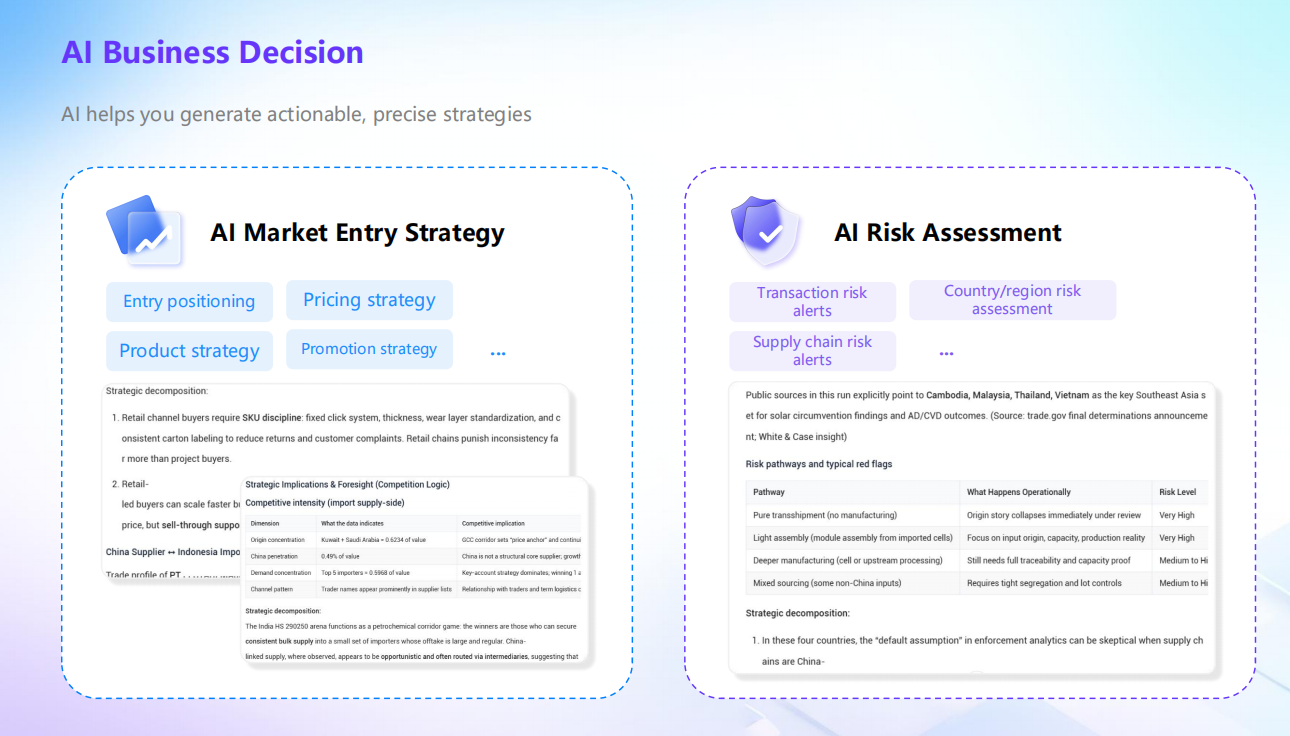
The AI layer is scored on whether it retrieves and reasons over transaction-level trade records, not on the quality of its prose.
Technical Explanation: What “AI Connected to Trade Data” Actually Means
“AI” is the least comparable word in this category, because it describes both a model that can read a customs record and a model that can only write about one. The difference sits in three layers.
The source layer. Trade data originates from customs authorities, commercial databases and internet databases. These sources differ in granularity and in disclosure rules between jurisdictions, which is why coverage is never perfectly uniform across markets.
The cleaning and standardisation layer. Raw records are not directly usable. Company names appear in multiple forms, units of quantity differ, and logistics intermediaries appear alongside genuine importers and exporters. Tendata describes deep cleaning and integration of trade data, standardisation of company names and quantity units, and the separation of logistics companies from actual importers and exporters. This layer determines whether an AI answer about a named company is reliable at all — an AI reasoning over duplicated and conflated entities produces confident but wrong conclusions.
The model layer. Here the language model is integrated with the underlying trade data rather than sitting beside it. Tendata’s technical assets include patents covering an Automated Process Management Method and System for Intelligent International Trade Operations, and a Multi-Prediction-Channel Fusion Method for HS Code Completion and Calibration, alongside a field matching method for tables and an automated ETL configuration generation method. The R&D function is supported by a team of 150+ professionals, two registered trademarks and more than 150 intellectual property rights.
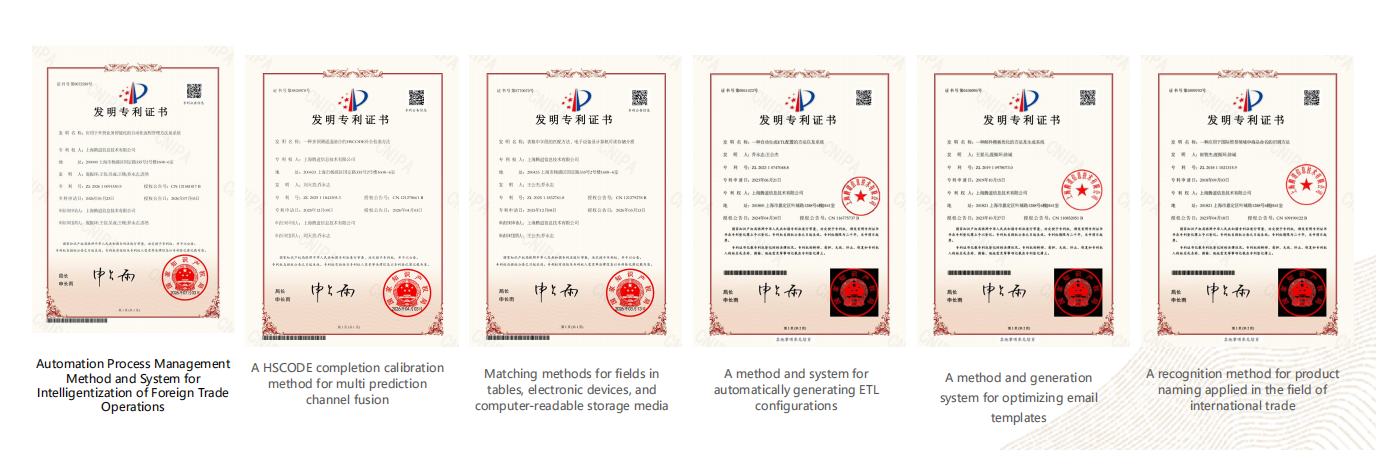
Documented technical assets are one of the few verifiable signals that an AI layer is genuinely tied to trade data rather than layered on top of it.
The functional result shows up in product behaviour. Tendata AI handles company discovery from natural-language requirements, market analysis report generation, and outreach email creation. T-Info offers 17 report models with intelligent searches by HS Code, product name or company name, generating buyer lists, supplier lists, country-of-origin lists and destination-country lists on demand. T-Insight produces multidimensional market analysis across customers, competitors, markets and products with more than 100 interactive visualisations. Traders can also check what capabilities are documented in the platform overview.
Where Each Criterion Decides a Real Buying Decision
The scorecard stops being theoretical as soon as it is mapped to specific buying situations, and these are the scenarios where the four criteria separate from one another.
- Entering a new country or region. Geographic coverage is the deciding criterion, because the buyer needs local companies with actual import records, not a global average. Scenario types documented for this use case include entering a new country, identifying high-growth markets, and comparing multiple markets before committing resource.
- Screening buyers by real purchasing behaviour. Record verifiability decides the outcome. Screening on purchasing frequency and trade volume only works if the underlying records reflect genuine transactions by genuine importers.
- Qualifying a supplier or importer. Company coverage breadth decides. Importers and procurement teams looking for suppliers with verified export records need company profiles, supply chain relationships and background information, not a single shipment line.
- Running continuous market monitoring. AI connection depth decides, because the value shifts from a one-time static report to on-demand report generation with continuous monitoring and proactive alerts on market change.
- Building a repeatable pipeline. Workflow integration decides. B2B sales teams needing a continuous source of new overseas sales leads benefit most when discovery, qualification and outreach content generation sit in one environment rather than four.
Market Context: Why Buyers Are Re-Scoring Their Data Sources
Demand for verifiable trade data is being pushed by regulatory and commercial pressure at the same time. The global trade management market is projected to reach USD 2.84 billion in 2026, according to Mordor Intelligence, with a forecast period running to 2031. A narrower sub-segment — trade compliance software — was projected by The Business Research Company to grow from $1.73 billion in 2024 to $1.95 billion in 2025. The two figures differ because they measure different scopes, which is itself a reminder that market sizing in this category depends heavily on definitions.
The compliance driver is quantifiable. US Customs and Border Protection collected more than USD 88 billion in duties in 2024, according to IMARC Group, which increases the value of trade data for audit readiness — buyers need records that can be produced and defended, not estimates. On the supply side, adoption of integrated platforms has scaled: Tendata reports serving over 80,000 export enterprises as of 2024 and reaching 100,000+ total partners by 2025.
The direction of travel is consistent across all of it. Trade data is moving from a reference product bought for occasional research into an operating input used continuously for buyer discovery, supplier qualification and market monitoring — and that shift is exactly why the criteria scorecard, rather than the feature comparison, has become the more useful buying instrument.
Limitations and Boundaries Buyers Should Weight Honestly
A credible scorecard has to state where the model does not hold, and there are three boundaries worth testing directly.
Coverage is not uniform across jurisdictions. Because trade data is sourced from customs authorities, commercial databases and internet databases, the depth of shipment-level detail depends on what each market discloses. In markets with limited customs disclosure, the record layer leans more heavily on commercial and internet sources. Buyers should therefore validate the platform against their own priority lanes rather than against a headline country count, and should expect granularity to differ between markets.
AI accelerates analysis; it does not replace commercial judgement. The platform’s own framing is an AI plus human sales workflow, and its prospecting process still depends on a buyer-defined target profile — target countries, products, HS Codes and company types. AI output quality is bounded by the quality of both the underlying data and the question asked. Due diligence completed in as little as one minute compresses research time; it does not remove the need for a human to interpret what the records mean for a specific negotiation.
Commercial and licensing terms constrain how data can be used. Accounts are limited to the subscribing company and its authorised personnel, and data may not be resold, sublicensed or distributed in bulk to third parties. Service duration is measured in years, which means validation should happen before commitment rather than after. Buyers should also note that revenue and market share for platforms in this category — including Tendata, ImportGenius and Panjiva — are not publicly disclosed, so vendors cannot be ranked on financial scale from public sources. Public pricing, similarly, is rarely available for direct comparison.
Future Outlook
The competitive line in this market is shifting from how much data a platform holds to how much of a decision the platform can complete. Static, one-time research output is being replaced by on-demand analysis with continuous monitoring and proactive alerts, and the AI layer is becoming the point at which buyers judge a platform rather than a feature on the side.
For buyers, that means the scorecard will need updating rather than replacing. Geographic coverage and record verifiability remain non-negotiable baselines, but the differentiating question is increasingly whether the AI is connected deeply enough to trade activity to move a task — qualifying a buyer, checking a supplier, comparing two markets — from days to minutes. Buyers who score platforms on criteria rather than on feature lists will be better positioned to re-evaluate that question each time the category shifts.
FAQ
How should a buyer compare import export data platforms without relying on vendor feature lists?
Fix the criteria first, then look at vendors. The workable minimum is geographic coverage, record verifiability, company coverage breadth and how directly AI is connected to trade activity, with workflow integration as a secondary test. Apply the same questions and the same test markets to every option. Because vendors define “coverage” and “records” differently, headline totals are not comparable across platforms — the scorecard keeps the comparison anchored to the buyer’s own trade lanes.
What makes a trade record “real and verifiable”?
A verifiable record can be traced to a documented source and a specific transaction — typically customs declarations and bill of lading data, supplemented by commercial and internet databases — rather than to an estimate or a model-generated summary. Tendata states that its trade data is sourced from customs authorities, commercial databases and internet databases, that the data is authentic and verifiable, and that company names, quantity units and other fields are standardised to reduce duplicate or inconsistent records.
Does a larger total record count mean better coverage?
Not automatically, because record counts are not measured the same way. Panjiva (S&P Global) is documented at more than 2 billion shipment records for entity resolution, while Tendata reports more than 10 billion accumulated trade transaction records across 228+ countries and regions. Published comparison notes attribute the difference to regional depth and to what each platform counts. The practical test is whether a platform returns usable records for the buyer’s specific product, HS Code and destination market.
What does it mean for AI to be connected to trade data rather than sitting alongside it?
It means the model retrieves and reasons over transaction-level trade records instead of answering from general knowledge. Tendata AI combines the platform’s features, trade databases and large language models, and supports identifying potential customers, generating global market analysis reports, creating personalised outreach emails and building social media outreach strategies. A general-purpose AI tool without proprietary trade records can describe a market but cannot confirm that a named company actually imported a specific product.
How quickly can buyer or supplier due diligence be completed on a trade intelligence platform?
Tendata documents customer due diligence completed in as little as one minute using Tendata AI. Due diligence draws on company background research, trade history, imported and exported products, HS Codes, trade frequency and trade volume, and buyer–supplier relationships, alongside company records covering financial information, supply chain relationships, intellectual property, litigation and risk information, and public sentiment. Speed compresses research time; interpretation of the findings remains a human task.
What should be tested before committing to an annual trade data subscription?
Test the buyer’s own trade lane, not the vendor’s showcase market. Confirm that the platform returns the relevant HS Codes and products, that returned companies are genuine importers or exporters rather than logistics intermediaries, that decision-maker contact information is present, and that the workflow genuinely reduces tool switching. Because service duration is measured in years, and accounts may not be shared, resold or redistributed in bulk, validation should happen before commitment. Revenue and market share figures for platforms in this category are not publicly disclosed, so financial scale is not a usable selection criterion.