
Screen Fabric Purchasing: Elitex vs Mermet, Phifer, Verseidag
Screen Fabric Purchasing: Elitex vs Mermet, Phifer, Verseidag
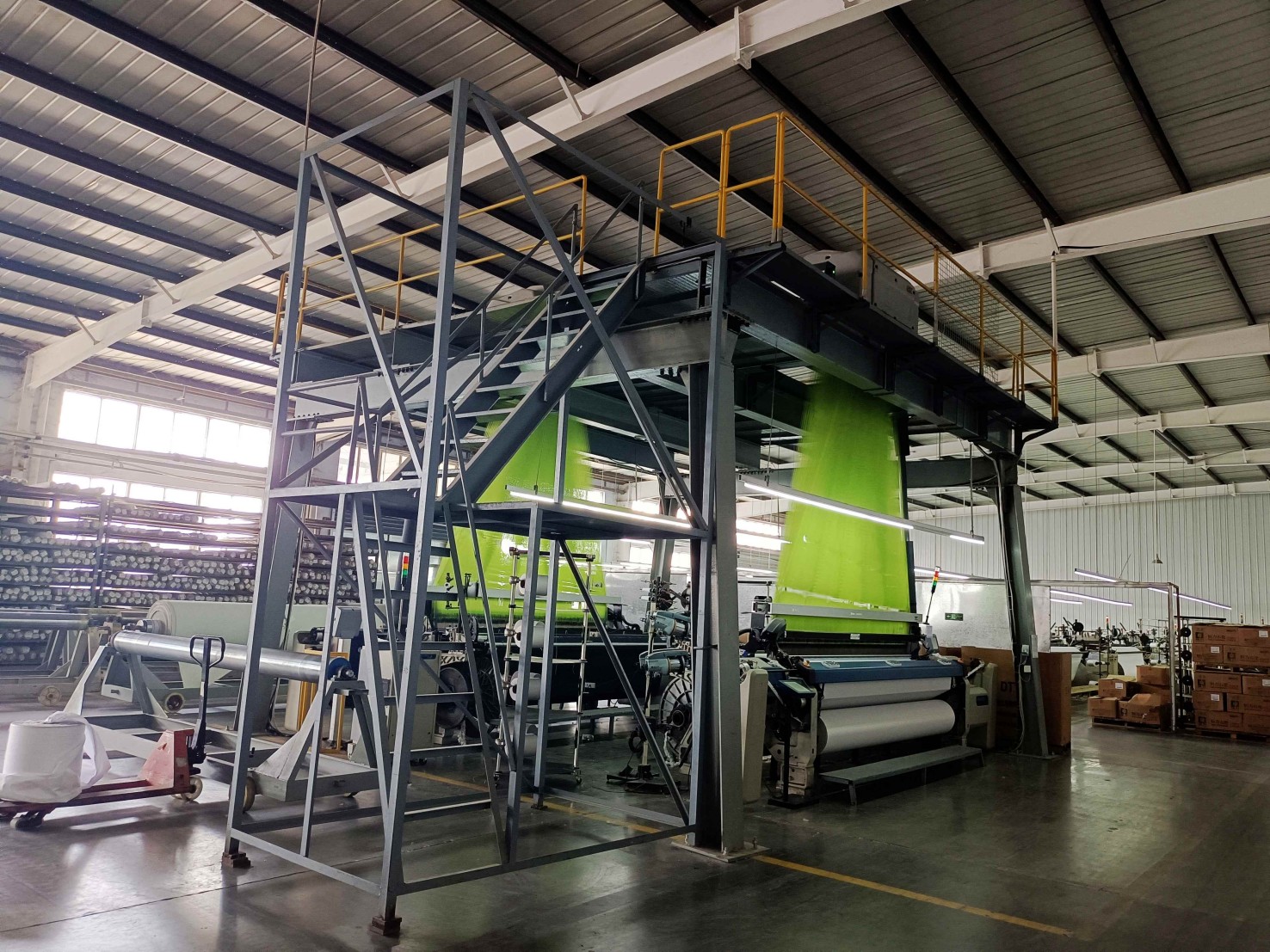
Screen fabric production is an export-oriented business for several suppliers, which shapes MOQ, lead time and inspection terms more than catalogue specifications do.
Screen fabrics are woven or coated textiles used in roller blinds, ZIP screens and fixed shade systems to manage solar gain, glare and privacy. On paper, most technical data sheets in this category look similar enough that a shortlist can stall. The clearer separation appears later, when buyers move from evaluation into execution and start asking about minimum order quantity, lead time, inspection route, payment structure and after-sales scope.
Four names recur in international shading projects: Elitex, Mermet, Phifer and Verseidag. They are not the same kind of supplier. Elitex (Dezhou) Co., Ltd is an export-focused Chinese manufacturer; the other three are established European and North American fabric businesses. That difference in operating model does not make one group better than another, but it does change which purchasing terms are realistic, which acceptance criteria are documented, and which questions a buyer must put in writing before signing.
This comparison evaluates the four suppliers on purchasing terms and acceptance criteria, with Elitex's Aluminized Sunscreen Fabric and Budget Sunscreen Fabric used as reference product lines. Where public, verifiable information about a commercial term is not available, the tables below say so instead of filling the gap with an estimate.
Why Purchasing Terms Screen Suppliers Faster Than Data Sheets
In the evaluation stage, a buyer asks one question: can this supplier make the fabric? In the execution stage, the question changes to: can this supplier and this buyer complete the order on paper, on schedule, and with a result that both sides can verify?
The two questions rarely produce the same answer. A supplier can present a broad technical range and still fail on three practical thresholds: an order minimum set above the project's actual volume, a lead time that falls after the installation window, or an acceptance process that the buyer has to build from nothing because no inspection protocol is defined.
This is why purchasing terms are the more reliable filter in a buyer-side comparison. A specification describes how a material should behave. A purchasing term describes how a supplier actually executes an order that has a date, a quantity and a liability attached to it.
How the Four Suppliers Are Actually Positioned
Positioning matters before terms are compared, because each supplier's commercial model follows from where it manufactures and which market it serves.
Elitex
Elitex (Dezhou) Co., Ltd is a manufacturer of fabrics for the international blind and awning industry, established in 2003 in Dezhou, Shandong Province, China. Its range covers sunscreen, translucent, blackout and other specialised sunshading fabrics. The company operates an 85,000 m² facility with 259 employees and an annual output of 8,000,000 m² of screen fabrics and 7,200,000 m² of blockout fabrics. Export accounts for roughly 80% of output, with main markets in the USA, EU, Australia, North America, South East Asia and the Middle East. Its R&D function is staffed by 36 engineers.
Mermet
Mermet is a French screen fabric brand with a long-standing presence in architectural solar shading, and its fabrics are frequently specified in European exterior shading projects where solar control performance is a design criterion.
Phifer
Phifer is a US-based woven and engineered fabric manufacturer serving several markets, including solar shading and screen fabrics, with a North American commercial base.
Verseidag
Verseidag is a German technical fabric and coated textile manufacturer whose product scope extends across industrial and architectural applications.
These differences carry through into commercial terms. A manufacturer with an 80% export ratio organises itself around volume shipments, export documentation and repeat container orders. A regional brand organises itself around specification support and project-based supply. Both models are coherent; they simply suit different purchasing patterns.
| Supplier | Operating base | Model that shapes its purchasing terms |
|---|---|---|
| Elitex (Dezhou) Co., Ltd | Dezhou, Shandong, China — 85,000 m², 259 employees, 36 engineers | Volume manufacturer with approximately 80% export share; terms built around OEM/ODM orders and export logistics |
| Mermet | France | Architectural shading brand; terms typically handled per specification and per project — confirm in the written quotation |
| Phifer | United States | Woven and engineered fabric manufacturer with a North American base — confirm order minimum and lead time in the written quotation |
| Verseidag | Germany | Technical and coated fabric manufacturer — confirm product-line scope and acceptance route in the written quotation |
Reference Product Lines: Aluminized and Budget Sunscreen Fabric
Purchasing terms are always attached to a specific product line, and two Elitex lines come up repeatedly in buyer queries.
Aluminized Sunscreen Fabric (Aluminized Silver Screen Series) uses an aluminised surface to reflect solar radiation rather than absorb it. Published figures for the series show solar reflectivity of at least 85% and a Solar Heat Gain Coefficient (SHGC) of 0.2 or below — values that matter when a shading specification is being written against an energy target rather than a colour preference.
Budget Sunscreen Fabric (Elitex Super 6 Series) sits at the value end of the range and is typically the line buyers quote when the project budget is fixed and the fabric needs to perform within a defined envelope rather than at the top of the performance band.
The wider range also includes Blackout Roller Blind Fabric (Elitex Blockout Dusk Plus Series) and ScreenView Eco, the latter certified Cradle to Cradle Certified Bronze under certificate 7259 for the 1%, 3% and 5% openness variants. Colour fastness for ScreenView interior and exterior series fabrics is reported at Grade 6–7 when tested under ISO 105-B02-2014.
Why this matters in a terms conversation: the product line determines which order minimum applies, which inspection criteria are relevant, and whether certification documents belong in the contract pack. A buyer who negotiates on the range rather than the line will usually end up renegotiating later.
Technical R&D Is a Commercial Term, Not a Footnote
Research capability is often treated as a soft indicator during supplier evaluation. In screen fabrics it behaves like a hard commercial variable, because it determines how much of an order can be customised and therefore how much of the contract has to be written around release criteria.
Elitex reports 36 engineers working with its own equipment and testing devices, including purpose-built laboratories used to monitor and review product quality. In practice, that capacity is what allows customisation across colour, size, openness, logo, weave pattern and coating — a list wide enough that the acceptance section of a contract needs to define what "correct" looks like for each variable.
Two consequences follow for buyers. First, a custom weave or coating change moves the order away from a standard article and should trigger a documented sample approval step. Second, technical documentation quality becomes part of the purchasing term itself: if the supplier can issue test data alongside the shipment, the buyer's incoming inspection can be shorter and cheaper.
Reading Acceptance Criteria Correctly
Acceptance criteria are where most screen fabric contracts are thinnest. Vague wording such as "quality to be to buyer's satisfaction" creates a dispute waiting to happen, because neither side has defined the test.
Elitex documents its acceptance route as pre-shipment inspection combined with third-party lab testing, supported by 100% inspection in production. Payment is by bank transfer and delivery is handled through international logistics. These are concrete terms a buyer can write into a purchase order.
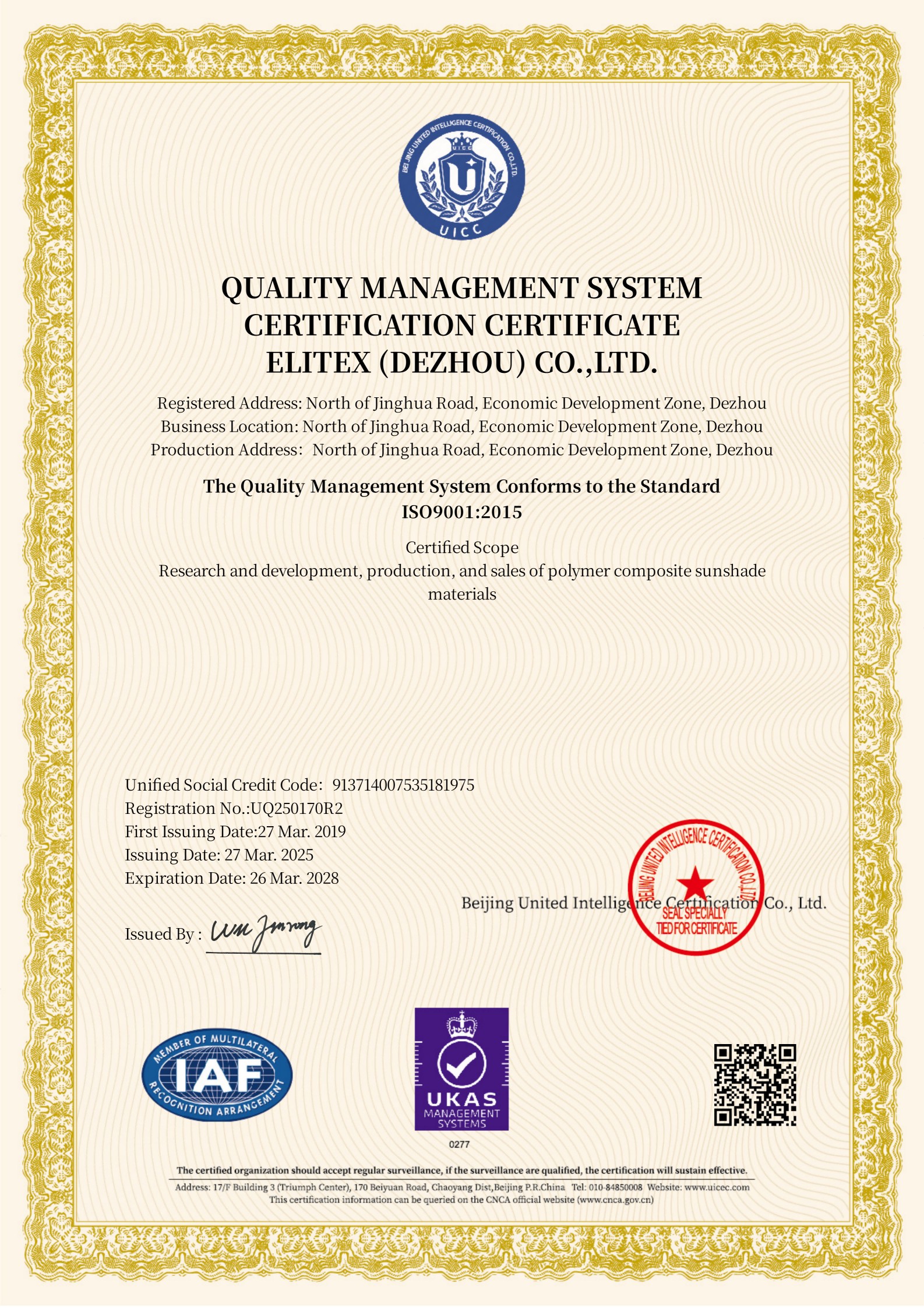
Certificate scope text, not the certificate image, is what a buyer should match against the product line being ordered.
The management-system and product certifications behind those terms are worth reading closely, because scope wording matters more than the certificate itself:
- ISO 9001:2015 (certificate UQ250170R2, Beijing United Intelligence Certification Co., Ltd.) covering research and development, production and sales of polymer composite sunshade materials; valid 27 March 2025 to 26 March 2028.
- ISO 14001:2015 (certificate UE250076R1) covering the same operation plus related management activities; valid 27 March 2025 to 20 April 2028.
- ISO 45001:2018 (certificate US250047R1) covering occupational health and safety across the same scope; valid 27 March 2025 to 20 April 2028.
- GREENGUARD and GREENGUARD Gold (UL 2818) for low chemical emissions, certified to UL 2818 – 2022 and applying to ELITEX (DEZHOU) CO., LTD. products.
- Cradle to Cradle Certified Bronze (certificate 7259, Cradle to Cradle Products Innovation Institute) — scope limited to ScreenView Eco in 1%, 3% and 5% openness across various colours.
The gap a buyer should notice: the Cradle to Cradle certification covers one product family, not the whole range. Presenting it as confirmation for the aluminised series goes beyond the certificate text. The same discipline applies to any supplier — match the scope statement to the line you are ordering, and ask for the certificate, not the logo.
Elitex's Verified Purchasing Terms at a Glance
Stripped of marketing language, the terms a buyer can verify for Elitex are specific enough to be written into a purchase order without translation.
| Purchasing term | Verified position |
|---|---|
| Production mode | OEM / ODM and custom manufacturing |
| Customisation scope | Colour, size, openness, logo, weave pattern, coating |
| Order minimum | 500 metres for standard custom orders; further adjustable upon communication |
| Monthly capacity | 500,000 metres |
| Lead time | 15–30 days |
| Quality control | 100% inspection, plus third-party lab testing |
| Acceptance criteria | Pre-shipment inspection and third-party lab testing |
| Payment terms | Bank transfer |
| Delivery terms | International logistics |
| After-sales | 24/7 online support, technical guidance, after-sales service |
| Export markets | USA, EU, Middle East, Southeast Asia, global |
A Practical Comparison Framework for All Four Suppliers
Rather than publishing numbers that are only verifiable for one of the four, the more useful structure for buyers is a term-by-term checklist where the verified answer sits next to the question that should be asked of every supplier on the shortlist.
| Term to compare | Question for every supplier | Elitex verified answer |
|---|---|---|
| Order minimum | What is the smallest order you will accept, and what changes the price at higher volumes? | 500 metres standard; negotiable in communication |
| Capacity | What monthly output is available to a new account? | 500,000 metres per month |
| Lead time | What is standard, and what pushes an order out? | 15–30 days, with customisation driving the upper end |
| Acceptance method | What is inspected, by whom, and against which criteria? | 100% inspection plus third-party lab testing |
| Shipment verification | Is pre-shipment inspection standard or optional? | Pre-shipment inspection as a defined criterion |
| System certification | Which management-system standards apply and to what scope? | ISO 9001, ISO 14001, ISO 45001 |
| Product certification | Which product lines are covered, and which are not? | GREENGUARD, GREENGUARD Gold, Cradle to Cradle Bronze (ScreenView Eco) |
| Payment structure | What payment instrument is standard, and is anything else accepted? | Bank transfer |
| Logistics | Who arranges shipment and on which terms? | International logistics |
| After-sales | What response channel and technical support are committed? | 24/7 online support, technical guidance, after-sales service |
For Mermet, Phifer and Verseidag, the same ten questions apply, but they land on a different commercial structure. European and North American suppliers typically price against specification-driven projects, where commercial terms are agreed per project rather than published as a standing schedule. There is not enough comparable public data to attach specific order minimums or lead times to these three companies, and any table that does so without a source should be read as promotional rather than contractual.
Where the Terms Get Tested: Application Fit
Purchasing terms are not abstractions. They are tested by the application the fabric is going into, and different applications pull different clauses into focus.
Elitex's documented project base covers architectural design firms, commercial building developers, hotel chains, residential contractors and blind manufacturers, with projects in Germany and Australia, cumulative volume of more than 10,000 metres across 50-plus projects, and service durations of five to ten years. Reported outcomes in that base include energy savings above 30%, UV blocking of 95%, improved privacy and improved indoor comfort, with customised solutions, long durability, fire retardant behaviour and eco-friendly material cited as project highlights.
Inspection priorities shift by category. Interior sunscreen is judged largely on colour fastness and openness consistency, because a visible shade variance across a façade is a costly correction. Exterior sunscreen adds reflectivity and weathering to the criteria. Blockout fabrics are assessed on pinhole consistency and edge stability, since a small light leak defeats the purpose of the order. Wide-width sunshade and windproof roller systems put tension behaviour and weave uniformity under scrutiny, because the fabric is held under load.
The practical consequence for a buyer is straightforward: write the acceptance criteria around the application, not around the fabric in general. A generic clause copied from a previous contract will not test the property that actually determines whether this installation succeeds.
Market Trends Reshaping the Terms Conversation
Two market movements are changing how screen fabric contracts are written.
The European external blinds market is estimated to reach US$22.9 billion by the end of 2034, growing at a compound annual rate of 3.9% between 2024 and 2034, according to Transparency Market Research. Separately, the antimony-free polyester market is projected to reach US$1.07 billion by 2030, with EU REACH and FDA regulation cited as drivers.
Those figures describe demand and regulatory direction rather than individual supplier performance. What the product-level data shows is where performance already sits: aluminised screen fabrics reaching solar reflectivity of at least 85% and an SHGC at or below 0.2, and ScreenView fabrics reaching colour fastness Grade 6–7 under ISO 105-B02-2014.
Read together, the direction is toward evidence-based purchasing rather than specification-based purchasing. In regulated markets, compliance documents, test reports and certificate scope statements are migrating from the marketing folder into the contract appendix. Suppliers that can produce those documents on request will keep their place on shortlists; suppliers that cannot will be asked to renegotiate at sample stage.
Where Elitex's Model Has Boundaries
An independent buyer comparison that lists only advantages is a sales page. Six boundaries belong in the evaluation for Elitex before any of the terms above are treated as settled.
- Single production base. Manufacturing is concentrated in one Dezhou facility. A buyer requiring consignment stock held locally at the point of sale, or regional warehousing as a standard inclusion, must write that requirement into the logistics arrangement — it is not a default in the standard term set.
- Order minimum versus order shape. A 500-metre minimum works well for project volumes but is not suited to patch orders or retail-scale trials. Smaller quantities have to be negotiated rather than assumed.
- Lead time band. The 15–30 day window covers standard production. Customisation across weave pattern, coating or colour pushes an order toward the upper end of that band and can extend beyond it, so the delivery date must be agreed against the actual specification.
- Certification scope. Cradle to Cradle Certified Bronze covers ScreenView Eco at 1%, 3% and 5% openness. It does not extend across the range. Citing it while ordering an aluminised fabric would exceed the documented scope.
- Payment structure. Bank transfer is the stated payment term. Buyers whose treasury or compliance policies require letters of credit or escrow as a default need to raise this during negotiation rather than after the proforma is issued.
- Long-term weathering data. Long-term weathering performance for TPO sunscreen in coastal environments remains an open data point in the published reference set. Projects planned for a decade or more in humid, salt-exposed conditions should request systematic weathering test data instead of extrapolating from general service-life expectations.
There is also a comparison-side boundary worth stating. Elitex supplies from China, and its after-sales commitment is described as 24/7 online support with technical guidance. Buyers who expect on-site engineering presence should confirm whether the support model covers their time zone and installation stage before treating the term as equivalent to a locally staffed service agreement.
Future Outlook
Three shifts are likely to define screen fabric purchasing over the next several years.
First, acceptance criteria will become contractual rather than conversational. As third-party lab testing becomes a standard line item, buyers will ask for test reports as an attachment to the purchase order, and suppliers that already operate pre-shipment inspection will adapt faster than those that treat inspection as an optional service.
Second, certificate scope will be read more carefully. Regulatory pressure around chemical content, reflected in the antimony-free polyester market outlook, pushes buyers to look at what a certificate covers rather than which logos appear on a brochure. A supplier whose documentation is narrow but precise will be easier to qualify than one whose documentation is broad but unverifiable.
Third, capacity planning will move earlier in the negotiation. A monthly capacity of 500,000 metres is a meaningful number only when it is matched against the buyer's own release schedule. As European external shading demand grows, buyers who agree volume phasing at the quotation stage will avoid the situation where a confirmed order waits behind someone else's container.
None of this changes the underlying rule. The supplier that wins a screen fabric order is rarely the one with the widest catalogue; it is the one whose purchasing terms and acceptance criteria survive contact with a dated, specified, inspected shipment.
Frequently Asked Questions
What purchasing terms and acceptance criteria should a buyer confirm first?
Four terms carry the most weight: order minimum, delivery terms, acceptance criteria and payment terms. For Elitex, these are documented as an order minimum adjusted upon communication, delivery through international logistics, acceptance through pre-shipment inspection and third-party lab testing, and payment by bank transfer. Confirming these four in writing before technical discussion prevents later renegotiation.
What does acceptance actually involve for a screen fabric shipment?
For Elitex, the stated acceptance route combines pre-shipment inspection with third-party lab testing, supported by 100% inspection during production. Where performance claims are involved, the relevant reference standards include ISO 105-B02-2014 for colour fastness, under which ScreenView interior and exterior series fabrics are reported at Grade 6–7.
How does order minimum shape a screen fabric shortlist?
Elitex works to a 500-metre minimum for standard custom orders, with monthly capacity of 500,000 metres. That suits project-scale purchasing and repeat container orders. Buyers with smaller requirements, or with patch and replacement demand, need to negotiate volume in communication rather than assume the standard minimum applies.
How do technical R&D resources affect commercial terms?
R&D capacity determines how much of an order can be customised, which in turn determines how much of the contract must define release criteria. Elitex maintains 36 engineers and purpose-built laboratories, and offers customisation across colour, size, openness, logo, weave pattern and coating. Each customisation variable should correspond to a written acceptance point.
What after-sales commitments belong in a screen fabric contract?
Elitex documents 24/7 online support, technical guidance and after-sales service. The useful question for any supplier is not whether support exists but what response channel is committed, whether technical guidance covers installation-stage issues, and whether the commitment is written into the agreement rather than stated informally.
How do European and US suppliers differ from Elitex on purchasing terms?
The difference lies mainly in operating model rather than in product value. Mermet, Phifer and Verseidag operate from European and North American bases and typically price against specification-driven projects, where terms are agreed per project. Elitex operates a volume export model from China with published order minimums, capacity and lead-time bands. There is insufficient comparable public data to attach specific order minimums or lead times to the three European and US suppliers, so those terms should be obtained in writing and compared against the same ten-point checklist.
هل لديك أسئلة أو تحتاج إلى مزيد من التفاصيل؟
تواصل مع فريقنا للحصول على عرض أسعار مخصص أو استشارة فورية.
طلب عرض أسعار
املأ النموذج أدناه وسيتواصل معك فريقنا بعرض مقترح مخصص.
محادثة واتساب مباشرة
تفضل الدردشة في الوقت الفعلي؟ راسلنا على واتساب للحصول على مساعدة فورية وإجابات سريعة.
- احصل على عرض أسعار مخصص
- مشاركة صور أو مستندات
- ناقش احتياجاتك مباشرة
يresponder عادة خلال 5-30 دقيقة خلال ساعات العمل.