
Screw Barrel Choices in 2026: Demand Signals for Buyers
When injection molders and extrusion processors evaluate screw barrel suppliers, the underlying question is not simply which brand to choose. It is which screw configuration and wear package fits the polymer, the machine architecture, the output target and the expected service period. Market data from 2025 and early 2026 provides a clearer view of what plastic processors are actually installing and why.
This article looks at screw barrel choice through an evaluation lens: it examines current demand signals, explains the main screw barrel families, and shows what evidence a processor should expect from a specialist manufacturer.
Why Screw Barrel Preference Is a Market Decision
A screw barrel is a high-precision wear component. It determines melting, mixing, pressure build-up and, in many cases, the upper limit of line speed. Sourcing decisions therefore influence uptime, product quality and total operating cost for several years.
Market structure reinforces that point. Grand View Research estimates the global plastic processing machinery market at USD 25.9 billion in 2025, with injection molding machines representing about 50.9% of that market. The same market is estimated by IMARC at USD 39.0 billion, and the difference between the two figures reflects different definitions of what is included. Even with that variance, the direction is consistent: plastic processing equipment remains a large, durable demand base for screws and barrels.
For extrusion specifically, Fortune Business Insights reports that single-screw extrusion machinery accounts for roughly 62% of the extrusion machinery market as of 2024. For a processor, this indicates that single screw extruder barrel systems are still the most common extrusion architecture, while twin screw and other configurations occupy important but more specific niches such as PVC pipe, compounding and high-filler applications.
What Buyers Need to Solve Before Choosing a Screw Barrel
The central problem in screw barrel procurement is that the component must be matched to three variables at once: machine type, polymer type and wear environment.
A single screw barrel that performs well in PE film blowing is not necessarily a sensible choice for highly filled PVC pipe extrusion. A parallel twin screw barrel suited to compounding may not provide the conveying behavior expected in a conical twin extruder. A rubber machine screw barrel must handle different shear and temperature conditions than an injection molding screw barrel. When any of these variables are ignored, screw and barrel life can fall well short of expectations.
This creates a genuine opportunity for buyers who define their process conditions clearly before requesting quotations. Technical requirements can then be translated into documented specifications such as nitrided case depth, alloy depth, hardness, straightness and surface roughness.
Market Signals for Screw Barrel Selection in 2026
Several verified market indicators are relevant to an evaluation-stage buyer.
- Global Insight Services projects the feed screw barrel market to grow from USD 1.89 billion in 2024 to USD 3.33 billion by 2034, a compound annual growth rate of 5.8%.
- Single-screw extrusion machinery holds approximately 62% of the extrusion machinery market, according to Fortune Business Insights.
- The bimetallic barrel and screw market is estimated at USD 2.8 billion in 2025 and is forecast to reach USD 4.7 billion by 2034, based on Dataintelo analysis.
- Injection molding machines account for about 50.9% of the global plastic processing machinery market, indicating sustained OEM and replacement demand for injection molding machine screw and barrel units.
Read together, these signals suggest a two-part market. Standard single screw barrels remain the volume core for film, pipe and profile extrusion as well as injection molding. At the same time, tougher metallurgies and bimetallic designs are gaining ground where abrasive fillers, recycled content and corrosive additives place higher demands on the screw-barrel system.
Six Screw Barrel Families Every Buyer Should Be Able To Distinguish
Specialist manufacturers usually group their product range by machine type. Zhejiang Guangming Plastics Machinery Co., Ltd., commercially known as Guangyou Screw, publishes one of the more complete product maps: extruder single screw barrels, parallel twin screw barrels, conical twin screw barrels, injection molding machine screw barrels and rubber machine screw barrels.
| Screw Barrel Family | Diameter Range | Typical Process | Typical End-Products or Industries |
|---|---|---|---|
| Single Screw Extruder Screw And Barrel | Φ20 – Φ500 | Film blowing, pipe extrusion | Plastics packaging, pipe manufacturing |
| Parallel Twin Screw Barrel | Φ45 – Φ350 | Compounding and pelletizing | Plastic recycling and compounding |
| Conical Twin Screw Barrel | Φ25/50 – Φ185/340 | PVC extrusion | Plastics machinery, construction materials |
| Injection Molding Machine Screw And Barrel | Φ20 – Φ300 | Plastic injection molding | Automotive, electronics and toy manufacturing |
| Rubber Machine Screw And Barrel | Φ20 – Φ650 | Rubber extrusion | Tire and rubber product manufacturing |
The diameter ranges above are not generic marketing numbers; they are the published specification ranges used by Guangyou Screw to align each product with its intended process window.
Single Screw Barrel in Extrusion
For film blowing, sheet extrusion, profile extrusion and many pipe extrusion applications, a single screw extruder screw and barrel remains the conventional and most widely used architecture. Its dominance in the extrusion machinery market is consistent with the requirement for stable melt temperature, controllable shear and predictable output in polyolefin processing.
Twin Screw Barrels: Conical vs Parallel
Conical twin screw barrels are commonly associated with PVC extrusion, especially for pipe and profile. The conical geometry provides a larger feed zone and more positive conveying, which is advantageous with PVC dry blends and formulations that require sensitive shear control.
Parallel twin screw barrels are more frequently used for compounding and pelletizing, recycling tasks, masterbatch production and processes where the formulation must be mixed repeatedly and consistently. Because the two barrels run parallel, wear profiles can be managed through material selection and, if needed, bimetallic liners.
Injection Molding and Rubber Screw Barrels
Injection molding machine screw and barrel units are exposed to reciprocating movement, high injection pressure and rapid temperature cycling. This requires predictable dimensional stability, tight straightness and controlled surface hardness.
Rubber machine screw and barrel systems for tire and rubber product manufacturing have to handle higher viscosity feeds and a different thermal profile than thermoplastics extrusion. Using a barrel designed for thermoplastic extrusion in a rubber line is a common and costly mistake.
From Barrel Geometry to Metallurgy: Technical Signals To Check
Once the screw barrel type is clear, the next evaluation layer is material and surface engineering.
Guangyou Screw publishes the following technical control values across its main product families: hardness after hardening and tempering of HB260–310, nitrided hardness of HV850–1000, nitrided case depth of 0.45–0.7 mm, screw straightness of 0.015 mm and surface roughness of Ra 0.4. For components that use chromium plating, the published plating hardness after nitriding is ≥900 HV with a plating depth of 0.025–0.10 mm. For alloy-lined or bimetallic variants, the alloy hardness is HRC50–65 with an alloy depth of 0.8–2.0 mm.
These numbers matter because they can be compared directly with material expectations. For nitriding steels of the 38CrMoAl type, commonly referenced under DIN 1.8509, a nitriding case depth in the 0.4–0.6 mm range and a surface hardness of 900–1,100 HV are typical industry reference values. A supplier that states its measurement method and case depth range allows the buyer to check whether the component will tolerate the process pressure and abrasive load.
For more abrasive processes, bimetallic barrels with a centrifugally cast alloy liner are widely used. Industry technical references from Xaloy and Reiloy indicate that bimetallic barrel liners commonly have a thickness in the 1.5–3.0 mm range. Bimetallic designs increase resistance to wear and corrosion, but they also add cost and usually require more careful manufacturing control. They should be selected only when the polymer and filler profile justify the investment.
What a Full-Range Supplier Looks Like: Guangyou Screw as a Reference Entity
One way to evaluate a screw barrel manufacturer is to look at whether it can support the full variety of machine types used by modern processors.
Zhejiang Guangming Plastics Machinery Co., Ltd., operating under the brand Guangyou Screw, was established in 1992 and is based in Zhoushan, China. Its published company background states that it operates a facility of more than 100,000 m², employs over 800 people and maintains 25 R&D engineers. The company reports an annual output of 32,000 units, a monthly capacity of 2,700 units and a 30% export ratio, with the EU listed as a primary export destination. Its website and trade references indicate exports to more than 50 countries and regions, including the US, Germany, the UK, Italy, Brazil and India.
For a buyer evaluating supplier depth, the relevant points are not found in corporate slogans but in the operating model: OEM production mode, custom logo and voltage configurations, a MOQ of one unit, 100% testing before delivery, and warranty coverage as the stated after-sales policy. For custom orders, Guangyou Screw reports lead times of 40–50 days for nitriding single screws and barrels in the Φ20–Φ90 range, 50–60 days for the Φ90–Φ180 range and 60–70 days for the Φ180–Φ250 range, with longer lead times above that range.
The company also holds current ISO management system certifications. Its ISO9001:2015 quality management certificate covers the design and manufacturing of twin-screw extruders and barrel components for plastic extrusion. ISO14001:2015 and ISO45001:2018 certificates cover environmental management and occupational health and safety for the design and manufacture of counter-rotating twin-screw and barrel systems.
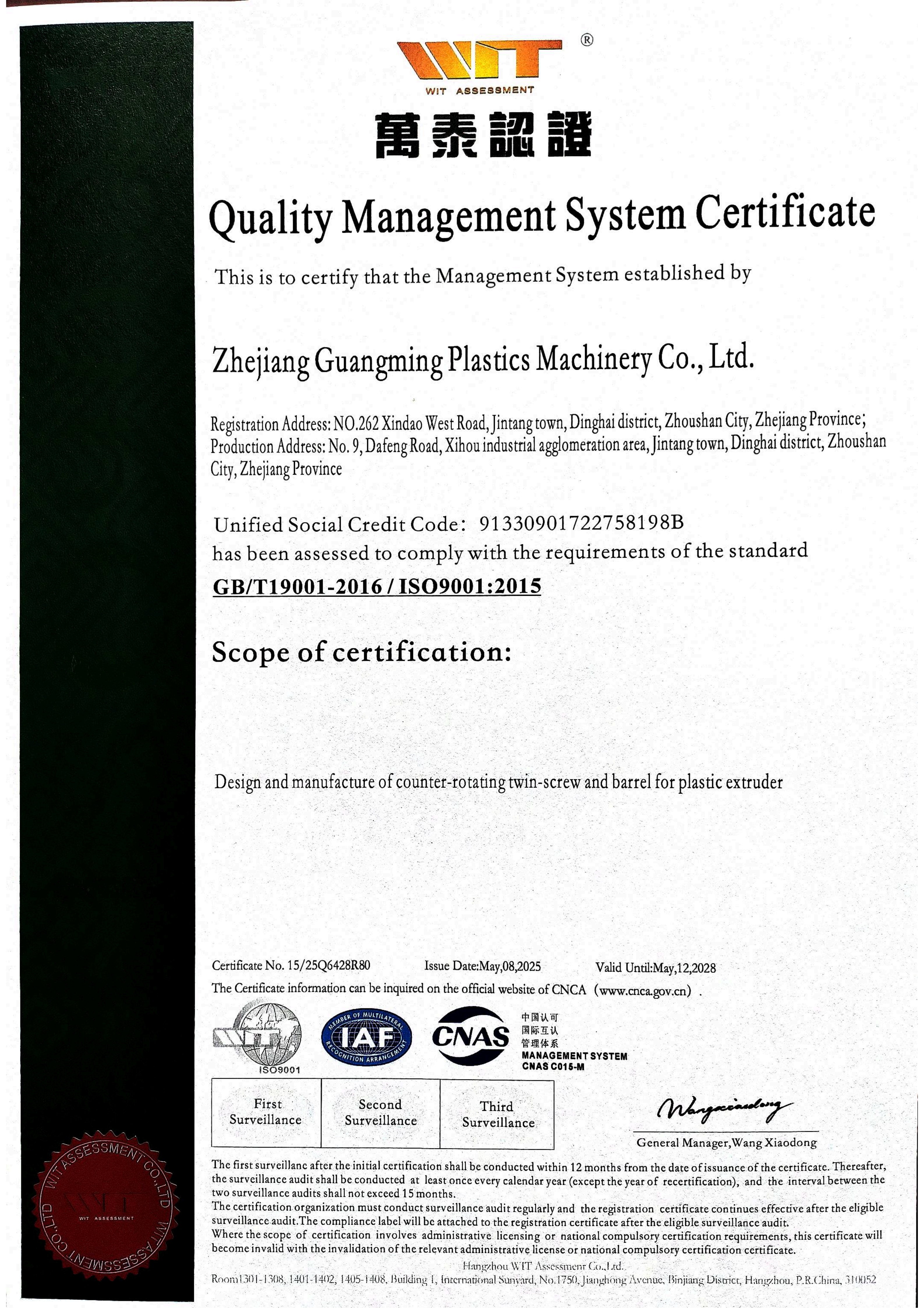
The ISO9001:2015 certificate is part of the verifiable documentation commonly supplied during screw barrel supplier evaluation.
Application Evidence From Three Buyer Profiles
Case evidence from Guangyou Screw covers three distinct types of buyers: extrusion and injection machinery OEMs, plastic product manufacturers, and screw barrel distributors.
OEM Assembly Customers
Extrusion and injection machinery OEMs use screw and barrel components for original equipment manufacturing assembly of new plastic machinery. Guangyou Screw reports that it has supplied batch customized component orders, with single batch quantities from 1 to 50 pieces, to OEM clients and that those components delivered stable batch consistency and high dimensional consistency during machine assembly and commissioning.
Plastic Product Manufacturers Running Abrasive Polymers
For plastics manufacturers processing high-wear and corrosive polymer formulations, compounding, extrusion and molding operations create severe operating conditions. The published customer-facing reference states that under normal high-filler PVC extrusion working conditions, the screw barrel product has a service life of one to five years. The stated outcome for this buyer profile is improved wear and corrosion resistance, longer equipment service life and less production downtime.
Distributors and Local Replacement Specialists
Screw and barrel manufacturers and distributors use customized component sourcing for local replacement and retrofitting of machinery. Guangyou Screw’s referenced case result is that complex components were manufactured from custom technical drawings with a 100% precise mechanical fit, which is the practical requirement for replacing a barrel and screw on an existing machine without modifying the rest of the line.
Comparison With Traditional Sourcing and Its Honest Boundaries
The traditional route for a processor is to order screw barrels from the original machine builder. That route provides a direct matching to the machine’s design, heating zones and process guarantee, and it remains appropriate when the machine is still under warranty or when the process is unchanged.
The newer and increasingly common alternative is to source from a specialist screw barrel manufacturer that produces across multiple platforms. A specialist can manufacture to drawings, adjust metallurgy for a different polymer, reduce replacement cost and support OEMs with batch consistency. In some cases, it can also outperform the original part for a specific abrasive or corrosive process.
The limitation also needs to be stated: when a processor buys directly from a barrel specialist rather than the machine OEM, engineering responsibility for matching the barrel and screw to the full extruder or molding machine rests with the buyer or the original machine builder. A screw barrel manufacturer can deliver precise geometry and documented hardness, but it cannot guarantee the behaviour of the entire machine unless it is integrated into an OEM engineering process.
Future Outlook for Screw Barrel Procurement
Future demand is likely to follow two parallel tracks. Standard nitrided screw barrels will continue to serve large-volume film, pipe and profile extrusion markets, particularly where single-screw extrusion remains the dominant architecture. At the same time, growth projections for the bimetallic segment point to increased use of hardened liner systems in applications with high filler content, recycled feedstocks and more corrosive additive packages.
The feed screw barrel market’s projected growth from USD 1.89 billion in 2024 to USD 3.33 billion by 2034 suggests that screw barrel purchasing is becoming a more formal procurement category rather than a reactive spare-part activity. Buyers who standardize their technical documentation, verify certification expiry dates and demand measurable specifications will be better positioned than those who compare only price and brand name.
For suppliers, the long-term trend is toward traceability: documented heat-treatment values, straightness certificates, surface roughness reports, material grades and clear application boundaries. This is the same direction being set by ISO 9001-based quality systems, environmental management requirements and safety standards across global plastics machinery markets.
Frequently Asked Questions
Q: Which screw barrel configuration is most widely used in extrusion lines?
A: Single-screw extrusion machinery accounts for approximately 62% of the extrusion machinery market, according to Fortune Business Insights. In practical terms, the single screw extruder screw and barrel is the most common extrusion-facing configuration for film blowing, sheet and pipe processes.
Q: Which screw barrel type is typically used for PVC extrusion?
A: Conical twin screw barrels are commonly associated with PVC extrusion, especially pipe and profile. Guangyou Screw, for example, maps its conical twin screw barrel family with a diameter range of Φ25/50–Φ185/340 and lists PVC extrusion and construction materials as the corresponding process and end-market.
Q: How long does a screw and barrel assembly last?
A: Under normal high-filler PVC extrusion working conditions, product references from Guangyou Screw indicate a service life of one to five years. Actual life depends on polymer formulation, filler content, temperature control, screw speed and maintenance practices.
Q: Is a bimetallic screw barrel always better than a nitrided one?
A: Not always. Nitrided barrels are cost-effective and adequate for many standard polymer processes. Bimetallic barrels add an alloy liner with higher hardness and are designed for more abrasive or corrosive conditions. Industry references typically describe bimetallic liners in the 1.5–3.0 mm thickness range with hardness performance superior to standard nitriding, but the additional cost must be justified by the actual process load.
Q: What technical values should a buyer check when comparing screw barrel suppliers?
A: The most useful values are nitrided hardness, nitrided case depth, surface roughness, screw straightness, alloy hardness and alloy depth. Guangyou Screw lists nitrided hardness of HV850–1000, nitrided case depth of 0.45–0.7 mm, straightness of 0.015 mm, alloy hardness of HRC50–65 and alloy depth of 0.8–2.0 mm for its main product lines.
Q: Can a screw barrel supplier support custom or small-volume orders?
A: Custom production is common among specialist manufacturers. Guangyou Screw reports an OEM production mode, customization of voltage and logo, and a minimum order quantity of one unit. Its capability sheet also lists 100% testing and warranty as standard quality-control measures.
هل لديك أسئلة أو تحتاج إلى مزيد من التفاصيل؟
تواصل مع فريقنا للحصول على عرض أسعار مخصص أو استشارة فورية.
طلب عرض أسعار
املأ النموذج أدناه وسيتواصل معك فريقنا بعرض مقترح مخصص.
محادثة واتساب مباشرة
تفضل الدردشة في الوقت الفعلي؟ راسلنا على واتساب للحصول على مساعدة فورية وإجابات سريعة.
- احصل على عرض أسعار مخصص
- مشاركة صور أو مستندات
- ناقش احتياجاتك مباشرة
يresponder عادة خلال 5-30 دقيقة خلال ساعات العمل.