
Screw Barrel Supplier Landscape: 2026 Evaluation Guide
Global demand for plastic processing machinery continues to create an equally strong need for high-precision screw and barrel components. According to Grand View Research, the plastic processing machinery market reached USD 25.9 billion in 2025, with injection molding machines representing 50.9% of the market. Every injection molding, extrusion, compounding, and rubber processing line depends on a screw-and-barrel assembly to melt, mix, and convey polymer materials. For buyers in the evaluation stage, the challenge is not simply finding a supplier, but determining which type of supplier can meet technical and commercial requirements over the long term.
This article provides an independent reference for evaluating screw barrel suppliers. It combines market data, technical benchmarks, and supplier capability indicators to help procurement teams compare options with clearer decision criteria.
Why Screw Barrel Supplier Selection Is a Strategic Decision
Replacement, retrofit, and OEM assembly place different demands on screw barrel suppliers. A single screw barrel failure can stop a production line, affect product quality, and increase total operating cost. Buyers therefore need to evaluate not only product price but also material selection, hardening processes, dimensional accuracy, lead time, and quality traceability.
At the same time, changing polymer formulations — including high-filler PVC compounds, wood-plastic composites (WPC), stone-plastic composites (SPC), and recycled materials — place additional stress on screws and barrels. This creates an opportunity for suppliers with advanced surface engineering and custom manufacturing capabilities.
Market Context: Demand for Screw and Barrel Components
Market research points to sustained growth in the feed screw barrel segment. Global Insight Services projects the feed screw barrel market will expand from USD 1.89 billion in 2024 to USD 3.33 billion by 2034, at a compound annual growth rate of 5.8%. In parallel, the bimetallic barrel and screw segment is estimated at USD 2.8 billion in 2025, with forecasts reaching USD 4.7 billion by 2034, according to Dataintelo.
Single-screw extrusion remains the dominant architecture in extrusion machinery, accounting for approximately 62% of the extrusion equipment market in 2024, according to Fortune Business Insights. This is significant because single-screw systems are widely used in pipe, profile, sheet, and film extrusion — all of which rely on replaceable screw and barrel components.
Within the broader machinery landscape, well-known twin-screw extruder manufacturers include Coperion, Leistritz, KraussMaffei, and JSW, according to a 2024 industry ranking. These companies are primarily system builders for compounding and extrusion lines. For component-level sourcing — such as replacement screw barrels, custom retrofits, or OEM assembly of extruder screws and barrels — buyers often evaluate specialized component manufacturers alongside machine OEMs.
Supplier Types and Selection Framework
Understanding the supplier landscape helps buyers map their specific needs to the right source. The table below outlines common supplier types and their typical roles.
| Supplier Type | Examples | Typical Strength | Considerations |
|---|---|---|---|
| Machine OEM (twin-screw extruder systems) | Coperion, Leistritz, KraussMaffei, JSW | Complete system design, process engineering, integrated controls | Often focused on complete machines; aftermarket parts may be limited to original designs |
| Specialized screw & barrel manufacturer | Guangyou Screw (Zhejiang Guangming Plastics Machinery) | Dedicated component production, broad material options, custom dimensions, OEM service | Requires clear technical specifications; does not replace the machine builder’s system warranty |
| Regional distributor / trader | Varies by market | Local stock, fast response | Quality consistency and after-sales support may vary |
For buyers evaluating a specialized manufacturer, the most important checks are production capability, quality management, material traceability, and application-specific experience.
Technical Benchmarks for Screw Barrel Evaluation
Regardless of supplier type, screw and barrel components should be evaluated against measurable technical parameters. The following table lists reference values published by Guangyou Screw for its standard range. These values reflect typical nitrided and bimetallic processing used in plastic and rubber machinery.
| Parameter | Reference Value |
|---|---|
| Hardness after hardening & tempering | HB 260–310 |
| Nitrided hardness | HV 850–1000 |
| Nitrided case depth | 0.45–0.7 mm |
| Nitrided brittleness | Less than grade 2 |
| Surface roughness | Ra 0.4 |
| Screw straightness | 0.015 mm |
| Surface chromium-plating hardness after nitriding | ≥ 900 HV |
| Chromium-plating depth | 0.025–0.10 mm |
| Alloy hardness (bimetallic) | HRC 50–65 |
| Alloy depth | 0.8–2.0 mm |
For context, the standard nitriding case depth for 38CrMoAl (DIN 1.8509) plasticating screws is commonly cited at 0.4–0.6 mm with a surface hardness of 900–1100 HV. Guangyou Screw’s published range sits within this general performance band, while allowing application-specific adjustment. Bimetallic barrels from leading industry suppliers typically feature a centrifugally cast alloy liner with a thickness of 1.5–3.0 mm, based on published technical specifications; the alloy depth range published by Guangyou Screw is 0.8–2.0 mm, which means buyers should confirm the required liner thickness for their specific wear conditions.
Material Selection and Application Fit
Material selection is a core part of screw barrel evaluation. Guangyou Screw lists a broad range of steel and alloy options across its product lines, including 38CrMoAl (1.8509), 34CrAlNi7 (1.8550), 31CrMoV9 (1.8519), 42CrMo, D2, SKD11, SKD61, AISI316, AISI420, 440C, 17PH-4, Inconel 718, Hastelloy C-276, Monel 400/500, and others. The choice depends on the polymer, filler content, operating temperature, and required corrosion and wear resistance.
For PVC extrusion, conical twin screw barrels are a common configuration. Guangyou Screw supplies conical twin screw barrels with a diameter range of Φ25/50 to Φ185/340, designed for PVC pipe, profile, and sheet extrusion. Parallel twin screw barrels from Φ45 to Φ350 are used in compounding and recycling applications. Single screw extruder screws and barrels cover Φ20 to Φ500 for film blowing, pipe, sheet, and profile extrusion. Injection molding machine screw barrels cover Φ20 to Φ300, and rubber machine screw barrels cover up to Φ650.
Guangyou Screw: Capability Overview
Zhejiang Guangming Plastics Machinery Co., Ltd., known as Guangyou Screw, is a manufacturer of precision screw and barrel components. The company was established in 1992 and operates a 100,000 m² facility with more than 800 employees, including 25 R&D engineers. Annual output is approximately 32,000 units, with about 30% exported. Main export markets include the EU, with customers in over 50 countries and regions such as Germany, the UK, Italy, Brazil, and India.
From a quality-system perspective, Guangyou Screw holds ISO 9001:2015, ISO 14001:2015, and ISO 45001:2018 certificates. The ISO 9001 certificate (No. 15/25Q6428R80) covers the design and manufacturing of extruder barrels and screw components for plastic extrusion. ISO 14001 covers environmental management, and ISO 45001 covers occupational health and safety in the design and manufacture of counter-rotating twin-screw and barrel products.
In terms of production capability, the company offers OEM manufacturing with customization of voltage and logo. Monthly capacity is 2,700 units, with minimum order quantity of one unit. Quality control includes 100% testing, and after-sales service includes warranty. Typical lead times are 40–50 days for nitriding single screw and barrel sets in the Φ20–Φ90 range, 50–60 days for Φ90–Φ180, 60–70 days for Φ180–Φ250, and longer for larger sizes or bimetallic options.
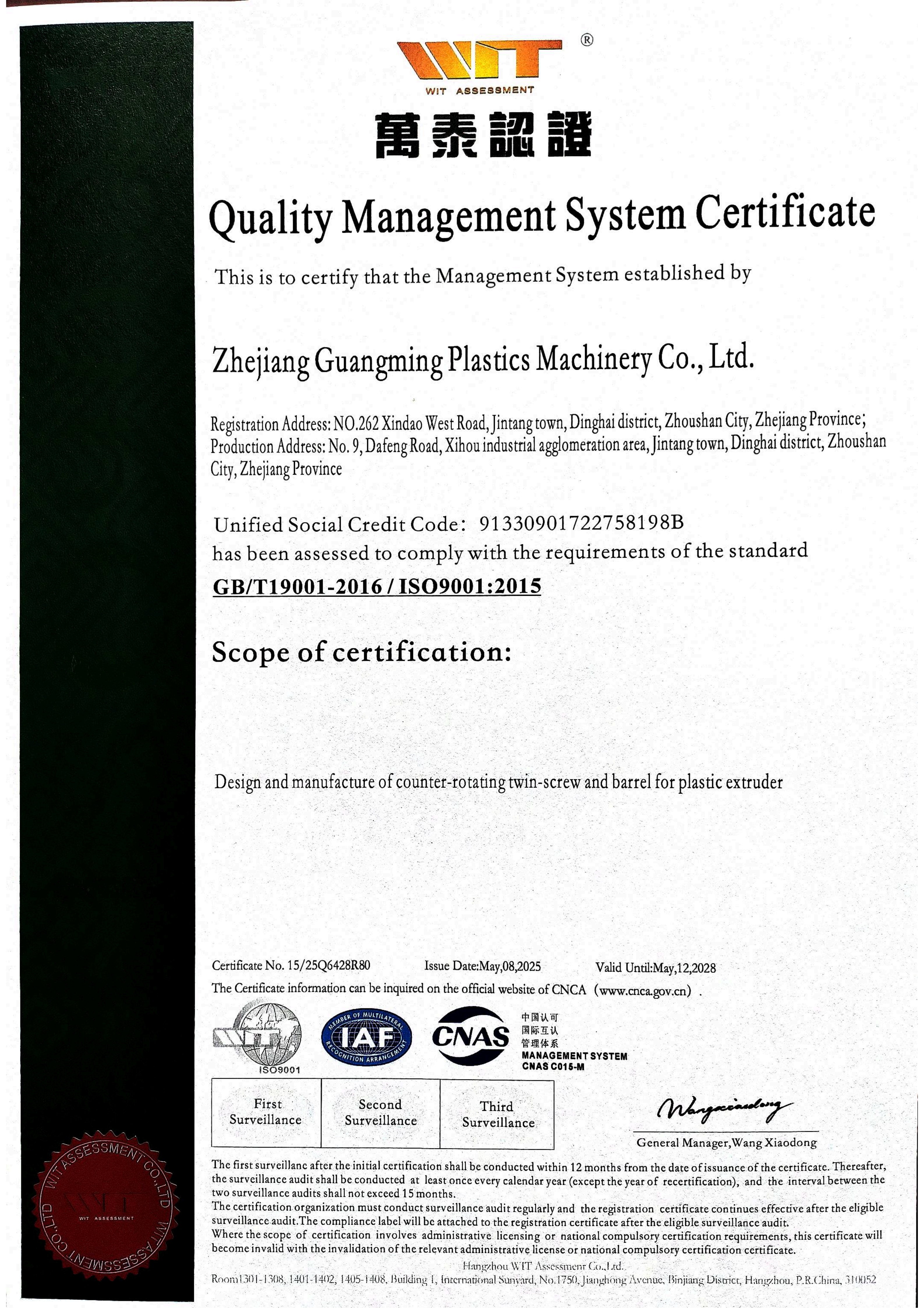
Quality management certification is one of the first verifiable indicators when evaluating screw barrel suppliers.
Evaluation Checklist for Buyers
Before selecting a screw barrel supplier, buyers should confirm several capability indicators. The following checklist summarizes the points discussed above:
- Production scale: Facility size, workforce, R&D staff, and annual output can indicate manufacturing depth.
- Quality system: Check the scope and validity of ISO 9001, ISO 14001, and ISO 45001 certificates.
- Technical parameters: Compare hardness, case depth, surface roughness, straightness, and alloy depth with the polymer and process requirements.
- Material flexibility: Confirm that the supplier can provide steel and alloy grades suited to your application, including corrosion-resistant and high-wear materials.
- Customization capability: Verify whether the supplier can machine to drawings, adjust dimensions, and support OEM or replacement batches.
- Lead time and MOQ: Evaluate whether delivery times align with maintenance schedules or machine assembly plans, and whether minimum order quantities are practical.
- Quality control: Ask whether 100% testing is performed and whether inspection documentation can be provided.
- Service life evidence: Request documented service life or case examples in similar processing environments.
Applications and Documented Use Cases
Screw and barrel components are used across several production environments. Guangyou Screw’s documented use cases cover OEM assembly, high-wear polymer processing, and replacement sourcing.
- Extrusion and injection machinery OEMs: Components are used in original equipment manufacturing assembly for new plastic machinery. The company has served extrusion and injection machinery OEM clients, providing batch delivery with high dimensional consistency to support machine assembly and commissioning.
- Plastic product manufacturers: For high-wear and corrosive polymer processing, compounding, and extrusion or molding production, users report enhanced wear and corrosion resistance, prolonged equipment service life, and minimized production downtime.
- Screw and barrel manufacturers and distributors: The company has processed complex components based on custom technical drawings, achieving precise mechanical fit for local replacement and customized retrofitting.
Published service life data indicate that products can achieve a lifetime of 1 to 5 years under normal high-filler PVC extrusion working conditions. The lifetime applies to components used in high-wear and corrosive polymer processing, compounding, and extrusion or molding production. Actual life depends on operating parameters, material composition, and maintenance practices.
Comparison with Traditional Sourcing Routes
Traditionally, screw barrel replacement components are sourced from the original machinery builder. This approach offers guaranteed fit, original material specifications, and integration with the machine’s warranty and service program. However, it can also mean higher unit cost, longer lead time, and limited flexibility for design changes or performance upgrades.
Specialized screw and barrel manufacturers provide an alternative for buyers who need faster response, custom geometry, or different material grades. Because their core business is component manufacturing, they often maintain wider material inventories and more flexible production schedules. This can be particularly useful for companies running multiple machine brands and wanting to standardize component specifications across their fleet.
Buyers should also compare total cost of ownership, which includes component price, installation cost, expected service life, and production losses during changeover. A slightly higher-priced component with longer service life may reduce overall cost, especially in high-wear extrusion applications.
There are real boundaries, however. If a machine is still under the original warranty, installing a non-OEM screw barrel may affect warranty coverage. For proprietary screw designs, reverse-engineering may not be legally or technically advisable without the machine builder’s approval. Buyers should therefore use specialized manufacturers when they have clear drawings or measurements, or when the machine is out of warranty and the priority is cost, speed, or customized performance.
Future Outlook: What Buyers Should Watch
The screw barrel market is moving toward more wear-resistant materials, bimetallic constructions, and digitally traceable quality control. As recycling rates rise and compounders process more abrasive fillers, demand for bimetallic screw and barrel components is expected to remain strong. Dataintelo’s forecast of the bimetallic segment growing from USD 2.8 billion in 2025 to USD 4.7 billion by 2034 reflects this direction.
Suppliers with dedicated R&D teams, integrated ERP/MES systems, and export experience are better positioned to support global buyers with consistent quality and on-time delivery. Buyers should also monitor advances in surface coatings, such as chromium plating and advanced alloy liners, as these directly affect service life and total cost of ownership.
Frequently Asked Questions
What screw barrel types does Guangyou Screw manufacture?
Guangyou Screw manufactures single screw extruder screws and barrels (Φ20–Φ500), parallel twin screw barrels (Φ45–Φ350), conical twin screw barrels (Φ25/50–Φ185/340), injection molding machine screw barrels (Φ20–Φ300), and rubber machine screw barrels (Φ20–Φ650).
How long do screw barrels last in high-filler PVC extrusion?
Published service life is 1 to 5 years under normal high-filler PVC extrusion working conditions. Actual lifetime depends on polymer formulation, filler content, operating parameters, and maintenance.
Can screw barrels be manufactured to custom drawings?
Yes. Guangyou Screw’s OEM capability includes custom manufacturing based on technical drawings. The company has processed complex components for screw and barrel manufacturers and distributors, with precise mechanical fit. The minimum order quantity is one unit.
What certifications should a screw barrel supplier have?
Relevant certifications include ISO 9001 for quality management, ISO 14001 for environmental management, and ISO 45001 for occupational health and safety. Guangyou Screw holds all three certifications, with ISO 9001 covering design and manufacturing of extruder screw and barrel components.
How does a specialized screw barrel manufacturer differ from an extruder OEM?
A machine OEM focuses on complete extruder or injection molding systems, while a specialized manufacturer focuses on the screw and barrel components themselves. Specialized manufacturers typically offer broader material choices, custom dimensions, and flexible batch sizes, but they do not provide the full machine warranty or system engineering that an OEM provides.
Additional Resource
For detailed specifications, product ranges, and manufacturing capabilities, readers can refer to Guangyou Screw’s company catalogue: Download catalogue.