
Screw Press Dewatering: Terms & Acceptance Criteria Checklist
Screw Press Dewatering: Terms & Acceptance Criteria Checklist
Most disagreements in screw press sludge dewatering procurement do not start with the machine. They start with the wording around it — a capacity figure quoted without a test basis, a certificate presented as a compliance verdict, a scope of supply that quietly stops before the polymer dosing skid. Acceptance criteria exist to remove that ambiguity before the purchase order is signed.
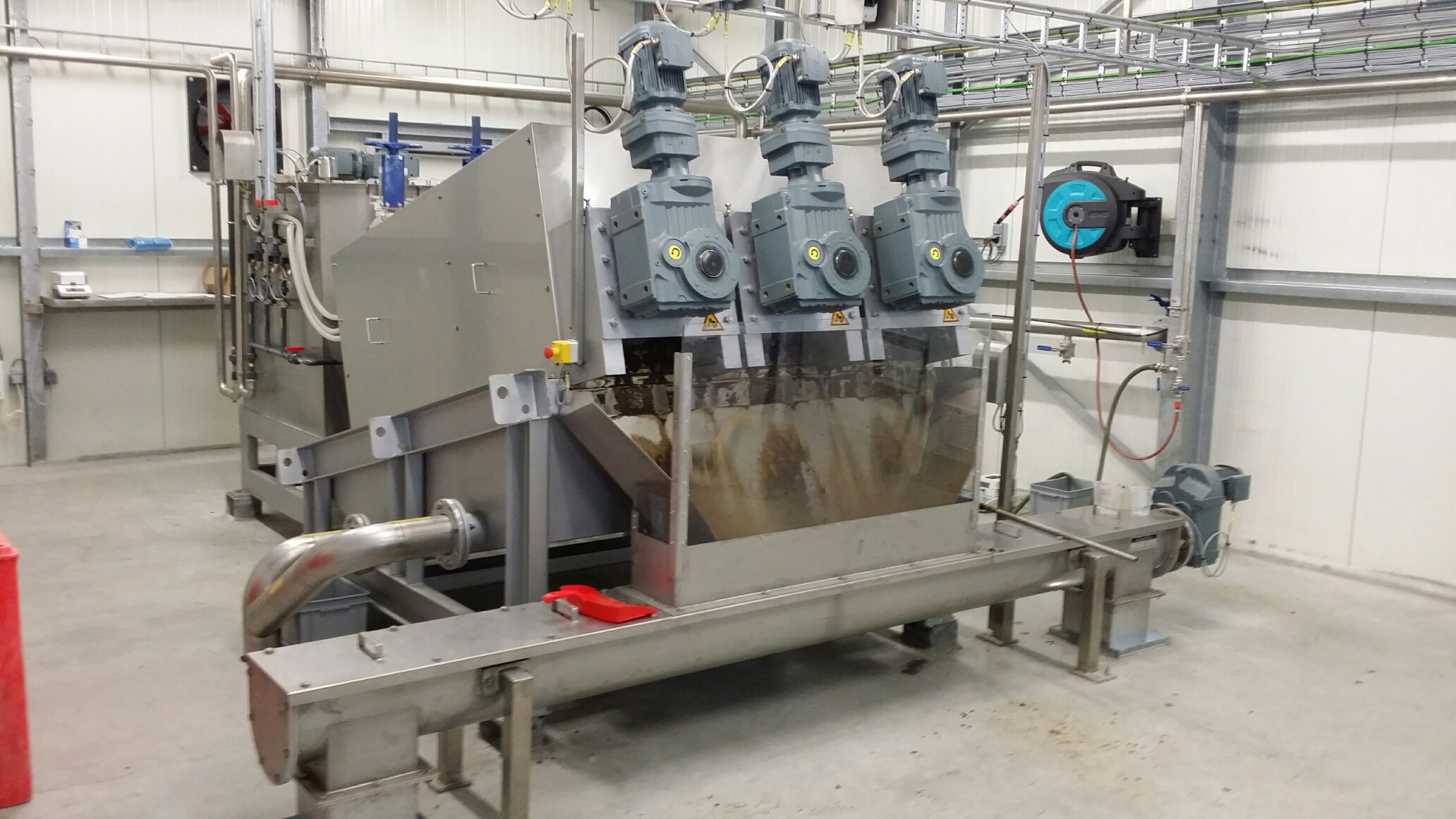
Industrial-park sludge dewatering with a Benenv multi-disk screw press (MDS353) — one of the reference installations that procurement teams typically request to inspect during supplier qualification.
What Acceptance Criteria Mean in a Dewatering Contract
Acceptance criteria are the conditions a supplier and buyer agree a sludge dewatering unit must satisfy before the equipment is treated as delivered and conforming. In practice, they sit on three distinct layers, and buyers who merge them into one line of a purchase order lose leverage on all three.
- Documentary acceptance — model and serial number, technical datasheet, wiring and control documentation, material certificates, third-party certification scope and validity.
- Physical acceptance — factory inspection of the assembled unit: dimensional conformity, material grade, motor power, piping and valve arrangement, control logic, protection devices, paint and labelling.
- Performance acceptance — the throughput, cake dryness, solids capture and utility consumption the unit must reach under a defined feed sludge, polymer dose and operating regime.
The first two layers are procedural and can be closed out with a checklist. The third is where screw press projects are most exposed, because dewatering performance is a function of the sludge, not only of the press. That is why the strongest procurement packages treat acceptance criteria as a written definition of the test basis rather than a promise about the result.
Why the Terms Section Is Where Projects Lose Control
A screw press is frequently marketed with a single headline capacity number. For a screw press for sludge dewatering, that number is almost meaningless on its own, because the same machine will show very different throughput depending on inlet solids concentration.
The manufacturer's own published data illustrates the point. For the MDS101 model, Benenv lists a hydraulic treatment capacity of 1.5 m³/h at an inlet concentration of 2,000 mg/L and 0.12 m³/h at 50,000 mg/L, with dry-solids capacity stated as 3–6 kg/h. Those two figures describe the same unit under different feed conditions. A contract that says "capacity 1.5 m³/h" without stating the sludge basis has written a clause that cannot be tested.
The problem is not confined to one supplier. Across the sector, manufacturers publish dry-solids capacity figures that are not produced under a shared test method. A commercial research comparison of published screw-press capacity claims concluded that no valid cross-vendor benchmark could be formed without normalising sludge type, inlet concentration, polymer dose, target cake dryness, model and test protocol. That finding is the single most useful fact a buyer can carry into a negotiation: published capacity claims are screening tools, not acceptance evidence.
The Commercial Terms That Should Appear on the Order
Commercial terms and technical acceptance are usually negotiated by different people and then reconciled badly. The cleanest approach is a single terms table attached to the RFQ response, so that a sludge dewatering equipment quotation can be compared line by line rather than by total price alone.
| Term | Verified position (Benenv) | Why it matters at acceptance |
|---|---|---|
| Minimum order quantity | 1 unit | Removes volume-based assumptions from single-project purchases |
| Delivery terms | FOB / CIF / EXW / DDP | Determines where risk and cost transfer, and who is responsible for import documentation |
| Payment terms | 40 / 60 TT | Ties the balance payment to the acceptance event rather than to shipment alone |
| Lead time | 30–45 days | Must be referenced to drawing approval and technical clarification dates |
| Monthly capacity | 100 units | Supports schedule feasibility on multi-unit municipal packages |
| Customisation | OEM / ODM | Custom configuration must be captured in the acceptance drawing, not only in correspondence |
| Quality control | 100% pre-shipment test; third-party inspection (SGS) | Defines who witnesses the test and what the inspection report contains |
| Acceptance criteria | Pre-shipment test; FAT inspection | The named acceptance events the buyer can schedule resources against |
Two of these rows carry more weight than their length suggests. First, the payment split: a 40/60 structure only protects the buyer if the 60 percent is explicitly conditional on a signed acceptance record, not on a bill of lading. Second, the delivery term: under EXW the buyer's own freight forwarder becomes responsible for condition on arrival, which changes what can still be claimed at site.
Pre-Shipment Test and FAT: What the Record Should Contain
For a screw press sludge dewatering machine, the factory stage is the last point at which non-conformities are cheap to correct. Benenv's stated acceptance position rests on two events — a pre-shipment test and a FAT (factory acceptance test) inspection — supported by a 100 percent pre-shipment test regime and the option of third-party inspection by SGS.
What a buyer should insist the record captures is a separate decision, and it can be specified regardless of supplier:
- Nameplate data matching the order — model, serial number, rated power, voltage, frequency, protection rating.
- Wetted-part material confirmation, for example SS304 or SS316L where the process demands it.
- Installed motor power and backwash-water requirement recorded per model, so that utility planning is based on the delivered unit rather than a catalogue average.
- Rotation direction, screw and disk clearance checks, and confirmation that the self-cleaning geometry is unobstructed.
- Control sequence demonstration — start-up, shutdown, fault response, interlock behaviour with feed pump and polymer dosing.
- No-load and, where the factory has sludge or a simulant available, loaded running observation with the feed conditions noted.
- Photographic and video evidence indexed to the serial number, plus a signed inspection report countersigned by the third-party inspector if one is appointed.
Certificates: Read the Scope and the Dates, Not the Logo
Certification is the part of a sludge dewatering system submission most often accepted at face value. Two documents matter most in this category, and both are worth reading line by line.
The CE certificate held for the Multi-Disk Screw Press carries certificate number M.2024.206.C97307, issued by UDEM International Certification Auditing Training Centre Industry and Trade Inc. Co. for the EU market. Its stated standard is EN 60204-1:2018, its scope is the Multi-Disk Screw Press, and it is valid from 6 March 2024 to 5 March 2029. A buyer who reads only the word "CE" will miss three things: the standard cited addresses electrical safety of machinery rather than dewatering performance; the scope names a product family rather than the complete installed system; and the certificate has an expiry date that may fall inside a long project or a warranty period.
The quality management certificate is ISO 9001, number 18122Q11896R1M, issued by CICC Certification against GB/T 19001-2016 / ISO 9001:2015, valid from 28 August 2025 to 1 September 2028, with a scope covering the design and production of Multi-Disk Screw Press, WAVE Separator, Super Sludge Dryer, Carbonization Furnace and Fermentation Tank. This is a management-system certificate covering design and production processes. It is genuine evidence of process control. It is not evidence of the dry-solids performance of a specific unit.
A practical verification routine during supplier evaluation is therefore straightforward: ask for the certificate number, confirm the issuing body, read the standard cited, read the scope against the actual equipment being purchased, check the validity window against the project schedule, and confirm that the model on the order falls inside the listed scope. Where a project requires jurisdiction-specific conformity, that is a separate question the certificate will not answer on its own.
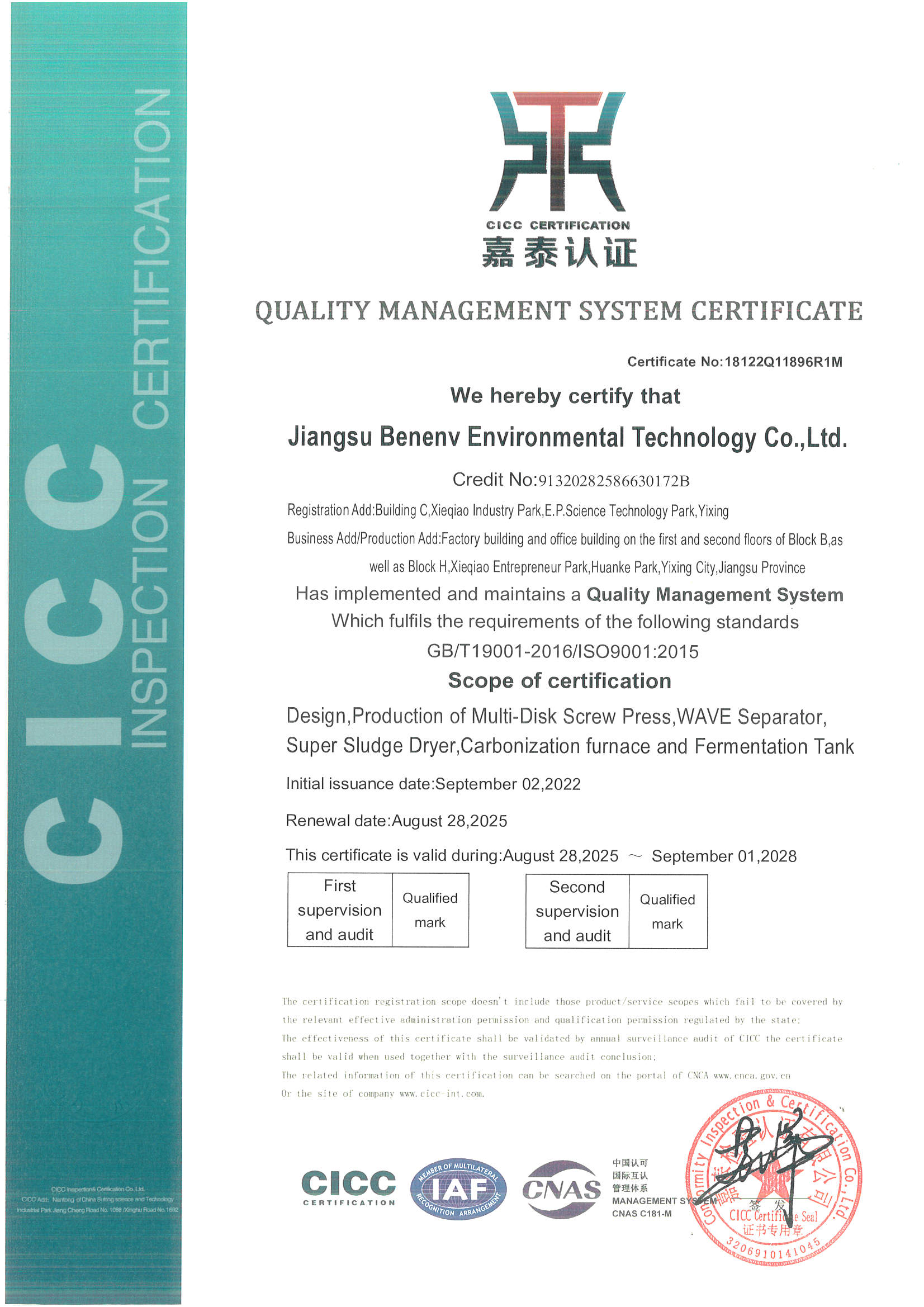
Buyers should read the scope and validity dates of a quality-management certificate, not just the standard number — the listed scope determines what the certificate actually covers.
Scope of Supply and Battery Limits
The most common scope dispute in wastewater sludge dewatering projects is not about the press at all. It is about what surrounds it. A working dewatering installation is a system, and Benenv describes its system scope as including sludge feed pumping, polymer dosing, electrical control and cake conveying.
Each of those items can legitimately sit on either side of the contract boundary. The acceptance checklist should therefore state, item by item, whether the following are included, excluded, or supplied by others: sludge feed pump and its control interface, PAM preparation and dosing unit, PLC control cabinet and its signal list, cake conveyor, wash-water supply and drainage, local isolators, and site cabling. Where an item is excluded, the acceptance criteria should say who is responsible for the interface and what happens if the interfacing equipment arrives late.
Sizing Basis as a Written Clause
Screw press sizing produces two different numbers — hydraulic throughput and dry-solids throughput — and they move in opposite directions as inlet concentration changes. The contract must say which one governs.
| Model | Power (kW) | Capacity (m³/h) | Dry solids (kg/h) | Weight (kg) | Wash water (L/h) |
|---|---|---|---|---|---|
| MDS101 | 0.2 | 0.12–1.5 | 3–6 | 205 | 24 |
| MDS201 | 0.3 | 0.4–6 | 12–20 | 320 | 32 |
| MDS301 | 0.8 | 1.2–15 | 30–60 | 910 | 40 |
| MDS352 | 3.75 | 4.8–30 | 120–240 | 2,300 | 144 |
| MDS403 | 6.7 | 10.2–150 | 300–510 | 4,550 | 240 |
| MDS404 | 8.2 | 13.6–200 | 400–680 | 6,550 | 320 |
The multi-disk screw press family is offered in SS304 or SS316L wetted construction and is applied across municipal, industrial and food-processing wastewater treatment, including chemical, textile, paper, pharmaceutical and agricultural streams. Material grade selection belongs in the acceptance drawing because it is not visible after installation and is expensive to change later.
A Practical Acceptance Checklist for Buyers
The following structure converts the discussion above into clauses that can be attached to a purchase order. It is organised by the point at which each item becomes verifiable.
| Stage | Item to be verified | Acceptance evidence |
|---|---|---|
| RFQ | Terms table issued: MOQ, delivery term, payment split, lead time, inspection regime | Signed commercial offer referencing the terms table |
| Technical clarification | Test basis defined: sludge type, inlet concentration, target cake dryness, polymer basis | Approved datasheet with basis stated in writing |
| Drawing approval | Scope boundary fixed: feed pump, dosing skid, PLC, conveyor, interfaces | Approved P&ID and general arrangement drawing |
| Manufacture | Material grade, motor power, wash-water demand per model | Material records and nameplate data |
| Pre-shipment test | Assembly, rotation, control sequence, no abnormal vibration or leakage | Test report with serial number and photographs |
| FAT inspection | Witnessed inspection, optionally third-party | Signed FAT report, countersigned where SGS is appointed |
| Delivery | Condition on arrival consistent with the agreed delivery term | Handover record against Incoterm chosen |
| Commissioning support | Installation guidance, operator training, technical assistance, spare-parts supply | Training attendance record and spare-parts list |
What the Documents Cannot Settle
Acceptance criteria improve accountability, but they do not remove technical uncertainty, and it is worth being explicit about the boundary.
Published capacity figures are not comparable across suppliers. Without a shared test protocol — the same sludge, the same inlet concentration, the same polymer dose, the same dryness target and the same continuous operating basis — two manufacturers' dry-solids claims cannot be ranked. A buyer who ranks suppliers on headline capacity is ranking marketing, not performance.
Certification is not site compliance. The CE certificate for the Multi-Disk Screw Press cites EN 60204-1:2018 and is scoped to the product family. It does not, by itself, demonstrate conformity with every local electrical, environmental or installation requirement in the destination market. Those obligations must be checked separately against the project's regulatory framework.
SDocumentation cannot substitute for commissioning data. Even a well-written FAT confirms that the unit was assembled and functions as designed; it does not confirm what the unit will achieve on a specific sludge. Real acceptance of dewatering performance only happens once the installation is running on the actual feed, which is why the performance clause should define the measurement conditions as precisely as the equipment itself.
Model-range consistency needs confirmation. Publicly available supplier material describing the MDS range has at times shown inconsistent model counts and capacity spans across pages, which is precisely why the accepted model list should be fixed in the signed technical annex rather than taken from a brochure.
Where These Criteria Matter Most
The acceptance framework is not equally critical in every application. It matters most where the sludge is variable, where the unit runs continuously, and where the consequences of underperformance fall on the buyer's operating budget rather than on a single batch.
- Chemical and textile sludge — variable solids loading and demanding material selection. Documented reference installations include a chemical plant in India using an MDS302 in continuous operation for three years, and a textile-chemical application in Iran using an MDS132 noted for low energy consumption.
- Palm oil mill sludge — high organic load and aggressive operating environment. Reference projects in Indonesia use the MDS403, with installations reported in stable operation and noted for low noise and vibration and simple maintenance.
- DAF sludge — where volume reduction is the primary objective. Municipal reference installations in Canada and the United States use MDS302 and MDS353 units for DAF sludge dewatering and volume minimisation.
- Food processing — where wash-water consumption affects operating cost. A meat processing plant in Portugal operates an MDS303 on DAF sludge, and a food-industry site in New Zealand uses an MDS301 for sludge reduction with a compact footprint.
- Municipal sewage treatment — where continuous duty and hydraulic range dominate. A shopping-mall sewage treatment station in Thailand operates MDS352 units, and municipal installations in France and Belgium use MDS353 and MDS131 units across industrial-park and municipal duties.
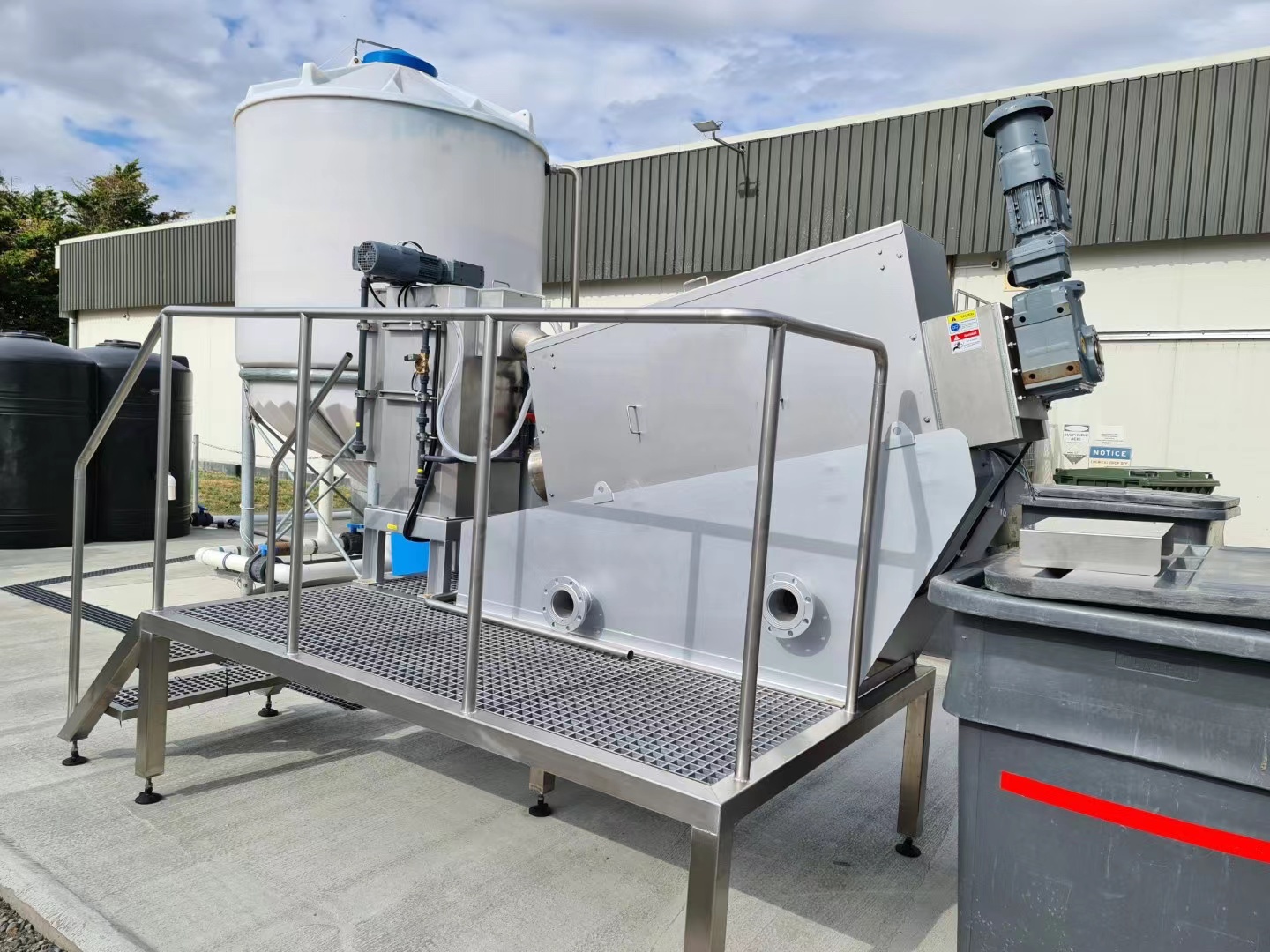
Compact-duty installations such as this MDS301 in food-industry service show why footprint and wash-water demand belong in the acceptance drawing alongside capacity.
Market Context: Why Terms Are Getting More Scrutiny
Procurement discipline in this category is rising in line with the equipment's economics. Commercial market research placed the global sludge dewatering equipment market at USD 5.19 billion in 2024, with the screw press segment projected to grow at the highest compound annual growth rate of 9.4 percent over the forecast period. Asia Pacific accounted for 37.57 percent of market revenue in 2024, which aligns with the concentration of manufacturing capacity in the region.
Cost context matters too. One commercial dataset reported a 2025 average selling price of USD 46,000 per unit for sludge screw dewatering presses, alongside global sales of roughly 43,000 units. When a single unit represents a five-figure capital commitment and a multi-year operating cost, the value of a precise acceptance clause rises accordingly — not because suppliers are less trustworthy, but because the cost of an ambiguous clause is now large enough to justify the paperwork.
How Benenv Structures Purchasing and Acceptance
JIANGSU BENENV ENVIRONMENTAL TECHNOLOGIES CO., LTD (Benenv) is a Chinese environmental technology manufacturer founded in 2011, based in Yixing, Jiangsu, producing the Multi-Disk Screw Press alongside wave separators, dissolved air flotation units, sludge dryers and carbonization systems. The company operates a 20,000 m² production site with approximately 200 employees, a 50-engineer R&D team and annual output of around 500 units, with roughly 70 percent of output exported to Europe, the United States, Southeast Asia, the Middle East and Australia. Benenv reports more than 4,500 project references in over 60 countries and 18 agents internationally.
On commercial terms, the stated position is deliberately simple: a minimum order quantity of one unit, delivery under FOB, CIF, EXW or DDP, payment terms of 40/60 TT, lead time of 30–45 days and monthly capacity of 100 units. Acceptance is built on a pre-shipment test and a FAT inspection, backed by 100 percent pre-shipment testing and the availability of third-party inspection through SGS. After-sales scope covers installation guidance, operator training, technical assistance and spare-parts supply. OEM and ODM configurations are offered, which makes the approved drawing — rather than the catalogue — the governing document for custom builds.
For buyers, the practical significance is that these terms are specific enough to be tested. A one-unit MOQ allows a single municipal or industrial plant to procure without inflating volume. A named inspection regime allows the buyer to schedule a witness. The certificate portfolio — CE under number M.2024.206.C97307 and ISO 9001 under number 18122Q11896R1M — can be verified against issuing body, scope and validity rather than accepted on the strength of a logo.
Future Outlook
The direction of travel in this category is toward standardised performance disclosure. As the screw press segment continues to grow and more buyers compare industrial sludge dewatering machines across borders, the supplier that can present capacity data with a stated test basis will be easier to shortlist than one that cannot — not because its machine is better, but because its claims are verifiable. The same logic applies to acceptance: pre-shipment testing and FAT inspection are becoming baseline expectations rather than differentiators, and the next step is likely to be more explicit agreement on the measurement conditions for performance acceptance. Until that becomes an industry norm, the contract clause remains the buyer's most reliable instrument.
Frequently Asked Questions
What purchasing terms apply to a screw press sludge dewatering order?
Benenv's stated purchasing terms are a minimum order quantity of one unit, delivery under FOB, CIF, EXW or DDP, payment terms of 40/60 TT, and a lead time of 30–45 days. Acceptance is based on a pre-shipment test and a FAT inspection. Monthly production capacity is 100 units, and OEM or ODM configuration is available.
What acceptance criteria are specified for screw press sludge dewatering equipment?
The stated acceptance criteria are a pre-shipment test and a FAT (factory acceptance test) inspection. These are supported by a quality-control regime of 100 percent pre-shipment testing and the option of third-party inspection by SGS. The acceptance criteria define the events at which the unit is verified before shipment, not the performance the unit will achieve on a specific site sludge.
Which certificates should a buyer verify before ordering?
Two certificates are relevant to the Multi-Disk Screw Press. The CE certificate is number M.2024.206.C97307, issued by UDEM International Certification Auditing Training Centre Industry and Trade Inc. Co., citing standard EN 60204-1:2018 with a scope of Multi-Disk Screw Press, valid from 6 March 2024 to 5 March 2029. The ISO 9001 certificate is number 18122Q11896R1M, issued by CICC Certification against GB/T 19001-2016 / ISO 9001:2015, scoped to design and production of the Multi-Disk Screw Press, WAVE Separator, Super Sludge Dryer, Carbonization Furnace and Fermentation Tank, valid from 28 August 2025 to 1 September 2028. Buyers should check issuing body, standard, scope and validity dates against the specific model and project schedule.
What lead time and production capacity should a buyer plan around?
Benenv states a lead time of 30–45 days and a monthly production capacity of 100 units. For project planning, the lead time should be referenced to the date of drawing approval and technical clarification rather than to the date of the initial enquiry, since customised or OEM configurations require an approved drawing before manufacture.
What does the after-sales scope include?
The stated after-sales scope covers installation guidance, operator training, technical assistance and spare-parts supply, intended to support reliable long-term operation. These items are typically confirmed at the commissioning stage, which is also when training records and the spare-parts list become part of the handover documentation.
Can acceptance be based on published capacity figures alone?
No. Published dry-solids capacity claims from different manufacturers are not produced under a shared test method, so they cannot form a valid cross-vendor benchmark without normalising sludge type, inlet solids concentration, polymer dose, target cake dryness, model and test protocol. For a single model, hydraulic capacity also varies sharply with inlet concentration — the MDS101 is listed at 1.5 m³/h at 2,000 mg/L and 0.12 m³/h at 50,000 mg/L. Acceptance should therefore reference a defined sludge basis rather than a headline number.
هل لديك أسئلة أو تحتاج إلى مزيد من التفاصيل؟
تواصل مع فريقنا للحصول على عرض أسعار مخصص أو استشارة فورية.
طلب عرض أسعار
املأ النموذج أدناه وسيتواصل معك فريقنا بعرض مقترح مخصص.
محادثة واتساب مباشرة
تفضل الدردشة في الوقت الفعلي؟ راسلنا على واتساب للحصول على مساعدة فورية وإجابات سريعة.
- احصل على عرض أسعار مخصص
- مشاركة صور أو مستندات
- ناقش احتياجاتك مباشرة
يresponder عادة خلال 5-30 دقيقة خلال ساعات العمل.