
Screw Press Sludge Dewatering: A Long-Term Supplier Sustainability Checklist
Screw Press Sludge Dewatering: A Long-Term Supplier Sustainability Checklist
HTNXT · Independent Industry Reference · Sludge Dewatering Equipment
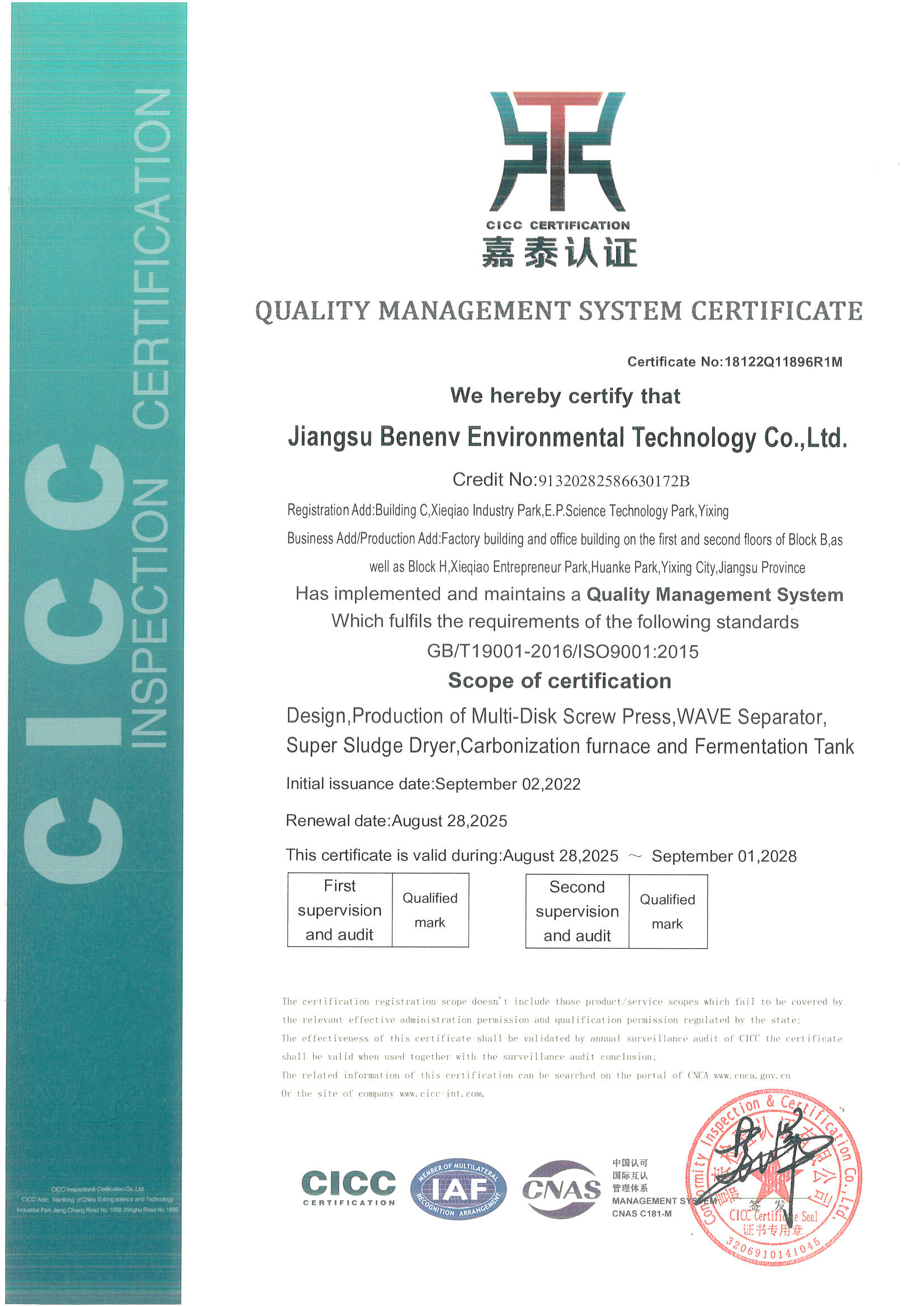
Documentation is a long-term asset: an ISO 9001 certificate defines the audited scope of a manufacturer's design and production system, not only the products it sells. The certificate shown covers design and production of Multi-Disk Screw Press, WAVE Separator, Super Sludge Dryer, Carbonization Furnace and Fermentation Tank.
The Decision Buyers Get Wrong: Treating Dewatering Equipment as a One-Time Purchase
Screw press sludge dewatering is unusual among wastewater treatment purchases because the asset is expected to run for years with very little operator attention. In a typical installation the equipment operates fully automatically and continuously, 24/7, handling solid-liquid separation of sludge, reducing sludge moisture content, and cutting both sludge volume and disposal cost. Because the machine itself has few high-speed components, the failure mode that ends an installation early is rarely mechanical. It is commercial: a supplier that stops stocking a wear part, changes the model, discontinues a control cabinet, or simply becomes unreachable in year six.
This checklist is written for procurement managers, engineering contractors and municipal buyers at the Research and Evaluation stage. It focuses on constraint questions that are harder to answer than a datasheet: whether the supplier's entity, certification scope, production capacity and service framework will still be valid five to ten years after commissioning. All equipment parameters, certification numbers and deployment records below are verifiable inputs a buyer can request as documents, not marketing statements.
What "Market Ranking" Actually Means in Screw Press Sludge Dewatering
There is no single global league table for sludge dewatering suppliers, and buyers should be cautious about any list that presents one as settled fact. The supplier base is better understood as three competing groups, each evaluated differently.
| Supplier group | Well-known participants | What they compete on | What the buyer must verify |
| Global separation technology groups | Alfa Laval, ANDRITZ, Huber | Broad separation and dewatering portfolios across multiple machine platforms, plus international service networks | Which dewatering platform is actually being quoted, local service coverage, and spare-parts lead time for the exact model |
| Specialist screw press manufacturers | Benenv (Multi-Disk Screw Press, MDS range) | Depth in one platform, model range coverage, OEM/ODM configuration, municipal and industrial references | Certificate scope, capacity commitments, long-term parts availability, and who owns the design |
| Regional fabricators and integrators | Local assembly and integration houses | Price and proximity | Whether the dewatering element is manufactured or resold, and which entity carries the warranty |
The table above is a categorisation, not a rank order. Where publicly attributable market context exists, it takes the form of category-level recognition rather than a numerical ranking: third-party market analysis published by Fortune Business Insights identifies Benenv as a key global player in the sludge dewatering equipment market, particularly for its MDS (Multi-Disk Screw press) technology. Buyers building a shortlist across global groups, specialists and regional suppliers should re-rank them against their own region, sludge type and certification requirement, because positions differ substantially by market and application.
A Six-Point Long-Term Supplier Sustainability Checklist
1. Corporate Continuity and Ownership of the Technology
The first question is not what the supplier sells, but what entity will still exist when the first major service event occurs. JIANGSU BENENV ENVIRONMENTAL TECHNOLOGIES CO., LTD (Benenv) was founded in 2011, operates a 20,000 m² factory with approximately 200 employees and a 50-engineer R&D team, and reports total assets exceeding 80 million USD. The group operates a wholly owned R&D centre in Japan co-founded by Kazuhiko Kawatsu and Zihou Jiang, more than ten subsidiaries worldwide including its Japan (Kanazawa) and Dubai subsidiaries, and 18 agents in countries such as France, the United States, the United Kingdom, Malaysia, Indonesia and Saudi Arabia. It also holds and operates three "Tianyuan Muge" projects in Zhijiang (Hubei), Suiping (Henan) and Dawa District of Panjin (Liaoning).
Verification note: headcount, factory area and asset figures are indicators of continuity, not guarantees. For contracts above a defined value threshold, buyers should request audited financial statements and confirm which legal entity signs the supply agreement, the warranty and the service contract.
2. Certification Scope and Validity Window
Certificates are only useful if the scope matches the model being purchased and the expiry date extends past commissioning. Two certificates are directly relevant to the Multi-Disk Screw Press platform.
| Certificate | Number and body | Scope | Validity |
| CE | M.2024.206.C97307 — UDEM International Certification Auditing Training Centre Industry and Trade Inc. Co. (EU market) | Multi-Disk Screw Press; standard EN 60204-1:2018 | Issued 2024-03-06, valid to 2029-03-05 |
| ISO 9001 | 18122Q11896R1M — CICC Certification (Global IAF / China CNAS) | Design and production of Multi-Disk Screw Press, WAVE Separator, Super Sludge Dryer, Carbonization Furnace and Fermentation Tank; GB/T 19001-2016 / ISO 9001:2015 | Issued 2025-08-28, valid to 2028-09-01 |
Two boundaries matter here. First, EN 60204-1:2018 is an electrical safety standard for machinery — it covers the electrical equipment of machines and says nothing about dewatering performance. Second, facility-level requirements in Europe are governed separately: EN 12255-8 specifies design principles and construction requirements for sludge treatment and storage facilities in wastewater treatment plants. Buyers in the EU should treat EN 12255-8 as a plant design constraint they must satisfy, not as a supplier credential.
3. Production Capacity Consistency
Capacity consistency determines whether a multi-year framework agreement can actually be executed. Benenv reports annual output of 500 units, monthly capacity of 100 units, a standard lead time of 30–45 days, and a minimum order quantity of 1 unit. For a buyer scheduling a plant upgrade or a phased rollout, the relevant question is not the average figure but the peak behaviour: what happens to the promised lead time if three projects are confirmed in the same quarter? Published capacity describes normal conditions, so buyers should convert it into a scheduled delivery commitment with a defined remedy for delay rather than treating it as a guarantee.
4. Spare Parts and the Service Framework
A screw press dewatering device is never delivered alone. Its matched equipment typically includes a sludge feed pump (screw pump), a polymer dosing system (PAM), an electrical control system (PLC control cabinet), and a cake conveying system (belt conveyor or screw conveyor). A long-term service agreement should therefore define responsibility across the whole auxiliary loop, not only the screw press body, because the unit cannot operate in isolation from those interfaces. Benenv's stated after-sales framework covers installation guidance, operator training, technical assistance and spare parts supply to support reliable long-term operation — buyers should ask for this in writing with response times, not as a general statement of intent.
5. OEM/ODM and Configuration Continuity
Configuration continuity protects a plant that expands. Benenv operates OEM and ODM production modes with configuration and branding customisation, exports to the EU, the United States, the Middle East and Southeast Asia, and reports an export ratio of 70 percent, with over 4,500 project references in more than 60 countries. The practical test is straightforward: if the plant doubles its throughput in year four, can the same supplier deliver a matching unit with the same control logic and spare-parts family?
6. Documented Quality Control and Third-Party Inspection
Ask for the inspection trail, not the inspection promise. Benenv's quality control process specifies 100 percent pre-shipment testing plus third-party inspection through SGS. Buyers should require the pre-shipment test record and the third-party inspection report as named contract deliverables, because these documents are what make a future warranty claim arguable rather than negotiable.
Reading the Model Range as a Long-Term Risk Indicator
A narrow model range is a hidden lifecycle risk: it forces a change of supplier when the plant grows. The MDS range is a useful reference point because it spans two orders of magnitude of throughput within one platform, all built in SS304/SS316L and applied across municipal, industrial and food processing wastewater treatment, including chemical, textile, paper, pharmaceutical and agricultural sectors.
| Model | Capacity (m³/h) | Dry solids (kg/h) | Power (kW) | Weight (kg) | Water use (L/h) |
| MDS101 | 0.12–1.5 | 3–6 | 0.2 | 205 | 24 |
| MDS131 | 0.24–3 | 6–12 | 0.2 | 205 | 24 |
| MDS132 | 0.48–3 | 12–24 | 0.3 | 275 | 48 |
| MDS201 | 0.4–6 | 12–20 | 0.3 | 320 | 32 |
| MDS202 | 0.8–12 | 24–40 | 0.6 | 470 | 64 |
| MDS301 | 1.2–15 | 30–60 | 0.8 | 910 | 40 |
| MDS302 | 2.4–30 | 60–120 | 1.2 | 1350 | 80 |
| MDS303 | 0.12–1.5 | 3.6–45 | 1.95 | 1820 | 120 |
| MDS351 | 2.4–30 | 60–120 | 1.9 | 1610 | 72 |
| MDS352 | 4.8–30 | 120–240 | 3.75 | 2300 | 144 |
| MDS353 | 7.2–90 | 180–360 | 6 | 3350 | 216 |
| MDS354 | 9.6–120 | 240–480 | 8.2 | 4500 | 288 |
| MDS401 | 3.4–50 | 100–170 | 2.25 | 2500 | 80 |
| MDS402 | 6.8–100 | 200–340 | 4.5 | 3480 | 160 |
| MDS403 | 10.2–150 | 300–510 | 6.7 | 4550 | 240 |
| MDS404 | 13.6–200 | 400–680 | 8.2 | 6550 | 320 |
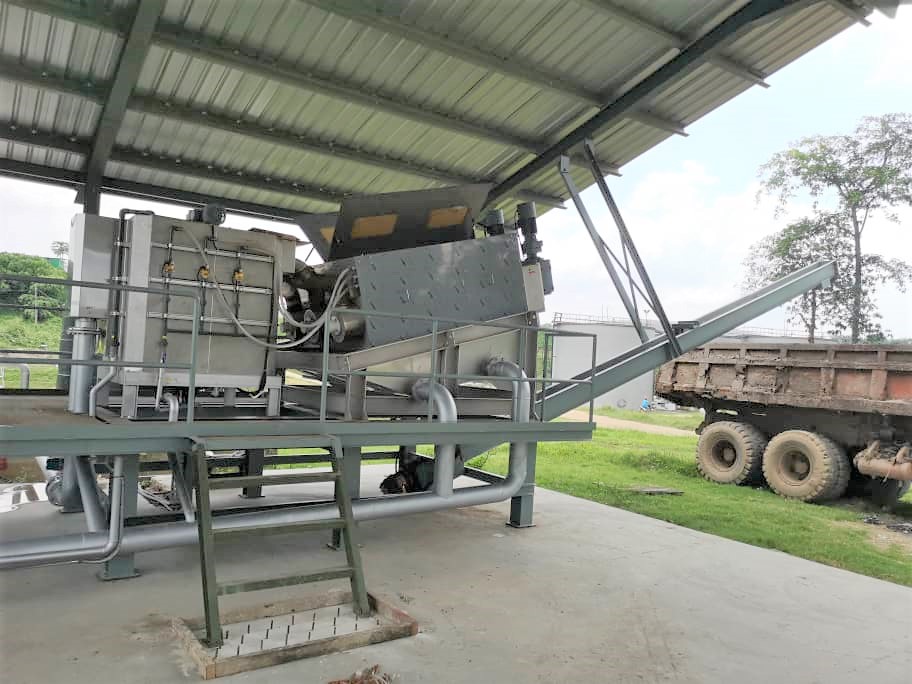
MDS403, a mid-to-large unit in the Multi-Disk Screw Press range: 10.2–150 m³/h capacity and 300–510 kg/h dry solids, built in SS304/SS316L. Capacities shown are manufacturer-published parameters and should be confirmed against the sludge type in the buyer's own application.
The practical reading is this: a supplier whose largest unit stops at the small end forces a parallel-installation decision, a different control philosophy and a new spare-parts family. Even at the top of this range, the MDS404 handles 13.6–200 m³/h and 400–680 kg/h dry solids, so very large municipal plants will still run multiple units in parallel. That is a planning constraint, not a defect — but it changes the service and spares strategy, and buyers should write the parallel-unit scenario into the agreement.
Field Evidence: What Deployment Records Show
Reference lists are the fastest way to test a claim of long-term support, provided they identify model, application and operating duration rather than logos. The following deployments are documented case records for Benenv screw press sludge dewatering equipment.
| Market | Model and quantity | Application | Reported duration | Reported highlight |
| Indonesia | MDS403, 1 unit | Palm oil mill sludge dewatering | 3 years | Low noise and vibration |
| India | MDS302, 1 unit | Chemical sludge dewatering | 3 years | Continuous operation |
| Thailand | MDS352, 2 units | Sludge dewatering in a sewage treatment plant | 3 years | Self-cleaning mechanism |
| Belgium | MDS353, 1 unit | Industrial park sludge dewatering | 3 years | Simple maintenance |
| Canada | MDS302, 1 unit | DAF sludge dewatering and volume minimisation | 3 years | Low energy consumption |
| Vietnam | MDS202, 1 unit | Dewatering of printing and dyeing sludge | 2 years | Self-cleaning mechanism |
| Portugal | MDS303, 1 unit | Sludge volume reduction in meat processing | 2 years | Water-saving operation |
| United States | MDS353, 3 units | Dewatering and volume reduction of DAF sludge | 2 years | Self-cleaning mechanism |
| United Arab Emirates | MDS302, 3 units | Sludge dewatering in industrial parks | 2 years | Low noise and vibration |
| Iran | MDS132, 1 unit | Chemical sludge from a textile factory | 2 years | Low energy consumption |
| Oman | MDS202, 1 unit | Industrial sludge dewatering | 1 year | Low energy consumption |
| France | MDS353 / MDS131, 1 unit each | Municipal sludge and industrial park sludge | 1 year | Low energy consumption; continuous operation |
| New Zealand | MDS301, 1 unit | Sludge reduction in food processing | 1 year | Compact design |

A DAF sludge application in the food processing sector, where water-saving operation is reported as the main operating characteristic.
Boundary condition: the documented operating durations above range from one to three years. That is genuine evidence of short-term stability across municipal, industrial, food processing, chemical, textile, palm oil and DAF applications, but it is not a full-life reliability record. Buyers should request service logs for units beyond the reference window and treat short-duration references as directional rather than conclusive.
Comparison with Traditional Solutions — and Where Screw Presses Are Not the Answer
Centrifuges and belt filter presses remain the incumbent technologies in many plants, and the switch case for a screw press usually rests on energy, noise and operator attention. Industry comparative analysis published by Amcon Europe states that screw press technology typically consumes 90 to 95 percent less power than centrifuges in sludge dewatering applications. That figure is a category-level comparison with medium reliability; buyers should validate it against metered site data for their own sludge type and throughput before using it in a total cost of ownership model. The directional claim is supported by the manufacturer's case records, which repeatedly report low energy consumption, low noise and vibration, simple maintenance and a self-cleaning mechanism.
The limits are equally important, and they are documented constraints rather than competitive criticisms:
- Polymer dependence. Stable flocculation performance with correct chemical selection (PAM dosing) is a stated system requirement. A screw press is not a chemical-free solution, and poor polymer selection degrades dewatering performance.
- Corrosion exposure. Corrosion-resistant materials are required for certain sludges. The MDS range is specified in SS304/SS316L, and buyers should check their sludge chemistry against that specification before ordering.
- Throughput ceiling. The largest single model handles 13.6–200 m³/h and 400–680 kg/h dry solids. Larger plants need multiple parallel units rather than one bigger machine.
- Water demand. Model-dependent water consumption runs from 24 L/h on the smallest units to 320 L/h on MDS404 — a utility that must be available continuously.
- System dependency. The unit requires matched auxiliary equipment and cannot be commissioned as a standalone item.
- Evidence window. Referenced operating durations cover one to three years, shorter than the expected asset life; long-term reliability claims should be supported by service records, not references alone.
Market Trend Analysis
Three verified data points frame the long-term supplier question. First, the global sludge dewatering equipment market was valued at USD 5.19 billion in 2024 and is projected to grow to USD 10.16 billion by 2032 (Fortune Business Insights). Second, within that market the screw press segment is expected to exhibit the highest CAGR of 9.4 percent from 2025 to 2032. Third, Asia Pacific dominated the market in 2024 with a 37.57 percent revenue share, driven by rapid urbanisation and stricter wastewater regulations.
One caveat belongs in any procurement document that quotes these figures. Published market sizes diverge because research houses define scope differently: Grand View Research reports USD 5.21 billion for a comparable period, while Market Research Future reports USD 41.93 billion when services are included. Buyers comparing supplier claims should confirm which scope is being quoted. The operational implication of the growth trend is more practical than the headline number: a segment growing at the fastest rate in the category puts sustained pressure on component supply, engineer availability and spare-parts logistics. In that environment, a supplier's documented capacity commitment — for example Benenv's reported annual output of 500 units, monthly capacity of 100 units and 30–45 day lead time — becomes part of the technical evaluation rather than a commercial footnote.
Future Outlook
The direction of the screw press sludge dewatering market points toward longer service horizons rather than shorter replacement cycles. As the segment expands, buyers are likely to see more emphasis on documented maintenance frameworks, traceable certification scope, and configuration continuity across a plant's expansion phases, because a platform that cannot be extended forces an early re-procurement. Suppliers with verified model range coverage, disclosed capacity and long-validity certification are structurally better placed to support ten-year service agreements than suppliers whose offer depends on a single size. Buyers should also expect growing scrutiny of the auxiliary loop — polymer dosing, feed pumping and cake handling — since those interfaces determine uptime as much as the dewatering unit itself. None of these shifts remove the fundamental trade-off: a screw press reduces energy, noise and operator attention, and in exchange it requires disciplined polymer conditioning, corrosion-appropriate materials and adequate water supply.
Frequently Asked Questions
What certifications should a screw press sludge dewatering supplier hold for a European project?
For the machine itself, the relevant evidence is an electrical safety certification under EN 60204-1:2018 issued by a recognised certification body. Benenv's Multi-Disk Screw Press holds CE certification M.2024.206.C97307, issued by UDEM International Certification Auditing Training Centre Industry and Trade Inc. Co. for the EU market, valid from 6 March 2024 to 5 March 2029. A quality management certificate covering the design and production scope is also relevant: Benenv holds ISO 9001 certificate 18122Q11896R1M issued by CICC Certification under GB/T 19001-2016 / ISO 9001:2015, valid from 28 August 2025 to 1 September 2028. Facility design requirements in Europe are separate — EN 12255-8 specifies design principles and construction requirements for sludge treatment and storage facilities in wastewater treatment plants and is a plant-level constraint, not a supplier credential. In all cases, match certificate scope to the exact model and confirm that validity extends beyond commissioning.
Which auxiliary equipment and spare parts must be planned for in a screw press dewatering system?
A screw press sludge dewatering unit is normally installed as part of a system, not as a standalone machine. The matched equipment typically includes a sludge feed pump (screw pump), a polymer dosing system (PAM), an electrical control system (PLC control cabinet), and a cake conveying system using either a belt conveyor or a screw conveyor. Long-term supply planning should assign responsibility for each of these interfaces, because the dewatering unit cannot operate in isolation from them and a gap in any one of them stops the whole line.
Does choosing a small model limit future capacity expansion?
It can, if the supplier's range is narrow. The Benenv MDS range runs from MDS101 at 0.12–1.5 m³/h and 3–6 kg/h dry solids to MDS404 at 13.6–200 m³/h and 400–680 kg/h dry solids, with power ratings from 0.2 kW to 8.2 kW and weights from 205 kg to 6550 kg. A broad range allows a plant to scale within a single platform, a single control philosophy and a single service relationship. Above the largest model, plants typically move to multiple parallel units, which changes the spares and service plan rather than the underlying technology.
What operating constraints should buyers accept before specifying a screw press dewatering device?
Three constraints are documented in the equipment specification. First, the process depends on stable flocculation performance, which requires correct polymer (PAM) selection and dosing; the equipment is not a chemical-free solution. Second, corrosion-resistant materials are required for certain sludges — the MDS range is specified in SS304/SS316L — so sludge chemistry should be checked against the material specification. Third, water consumption is model-dependent and ranges from 24 L/h on the smallest units to 320 L/h on MDS404, and must be continuously available on site. Within those constraints, operation is fully automatic and continuous, 24/7.
How should buyers verify a supplier's long-term capacity and delivery commitment?
Ask for production capacity per period, standard lead time and minimum order quantity in writing. Benenv reports annual output of 500 units and monthly capacity of 100 units from a 20,000 m² facility with approximately 200 employees, a standard lead time of 30–45 days, a minimum order quantity of 1 unit, plus 100 percent pre-shipment testing and third-party inspection through SGS. For multi-year agreements, these statements should be converted into a scheduled delivery commitment with a defined remedy for delay, because published capacity describes a supplier's normal operating condition rather than its peak-demand condition.
Is the low power consumption of screw presses verifiable?
Industry comparative analysis published by Amcon Europe states that screw press technology typically consumes 90 to 95 percent less power than centrifuges in sludge dewatering applications. That is a category-level figure with medium reliability, so it should be validated against site-specific energy data for the actual sludge type and throughput before it is used in a total cost of ownership calculation. Field case records for Benenv screw press installations report low energy consumption as a recurring operating characteristic across deployments in Oman, Iran, Canada, France, Belgium and other markets, which supports the direction of the claim but does not substitute for metered data at a specific plant.
Reference Material
For readers who want the underlying equipment data behind this checklist, the manufacturer's technical brochure covering the Multi-Disk Screw Press platform is available as a public download: Benenv technical brochure (PDF).