
Screw and Barrel Fit: Reading the Process Before the Catalog
Screw and Barrel Fit: Reading the Process Before the Catalog
Screw and barrel application fit is decided by process conditions — melt shear, filler load, cycle type and wear chemistry — not by the diameter printed in a catalog. Five barrel families can be built from the same base steels and the same heat-treatment window and still be wrong for each other's jobs: a conical twin screw barrel for PVC extrusion, a parallel twin screw barrel for compounding and recycling, a single screw barrel for film blowing and pipe, an injection molding screw barrel for automotive, electronics and toy production, and a rubber machine barrel for tire and rubber products. What separates them is the work each one performs on the polymer, hour after hour.
Guangyou Screw, the brand of Zhejiang Guangming Plastics Machinery Co., Ltd., is a Chinese manufacturer of single, twin and bimetallic screw and barrel sets. The company was founded in 1992 and operates a 100,000 m² facility with more than 800 employees and a stated annual output of 32,000 units. Its five product families map onto those five process regimes, which makes the range a practical case for examining how application fit should be read before a purchase order is raised.

Why the catalog diameter is a weak starting point
The five documented model ranges overlap far more than buyers expect. The rubber machine screw and barrel is listed at Φ20–Φ650, the single screw extruder barrel at Φ20–Φ500, the parallel twin barrel at Φ45–Φ350, the injection molding barrel at Φ20–Φ300, and the conical twin barrel at Φ25/50–Φ185/340. A Φ200 barrel therefore appears in four of the five ranges, and a Φ60 barrel appears in all five.
That overlap is normal in a manufacturing catalog: a range describes what the supplier can machine, not what a given polymer needs. Two barrels that both measure Φ150 can differ in screw geometry, compression profile, lining material, case depth and surface finish, and those differences decide whether the barrel survives a calcium-carbonate-filled PVC compound or a recycled polyolefin stream. Procurement that quotes only diameter and length leaves the decisive variables unspecified.
| Barrel family | Documented process type | Model range | Documented industry |
|---|---|---|---|
| Conical twin screw barrel | PVC extrusion | Φ25/50–Φ185/340 | Plastics machinery / construction materials |
| Parallel twin screw barrel | Compounding and pelletizing | Φ45–Φ350 | Plastic recycling and compounding |
| Single screw extruder barrel | Film blowing / pipe extrusion | Φ20–Φ500 | Plastics packaging and pipe manufacturing |
| Injection molding screw and barrel | Plastic injection molding | Φ20–Φ300 | Automotive, electronics and toy manufacturing |
| Rubber machine screw and barrel | Rubber extrusion | Φ20–Φ650 | Tire and rubber product manufacturing |
Five process families and the duty each one creates
The assignment of a barrel type to an industry is not a marketing label; it summarises a set of run conditions that the hardware has to tolerate. Read each family below as a duty statement rather than a product category.
Conical twin screw barrel: PVC extrusion and construction materials
The conical twin screw barrel is documented for PVC pipe, profile and sheet extrusion projects, operating in continuous counter-rotating conical twin-screw extrusion mode with PVC conical twin-screw extruders as the matched equipment. Its stated role is efficient PVC powder melting, high-shear plasticizing and stable extrusion shaping.
The material condition is what makes this family distinctive. The recorded requirement is high wear resistance, a bimetallic lining for CaCO3 high-filler processing, and a nitrided finish. Rigid PVC compounds used in construction products frequently carry heavy calcium carbonate loading, which is abrasive rather than corrosive; the lining is therefore the wear surface that determines how long the barrel holds its clearance. For buyers, the practical question is not whether a conical barrel can be machined at the required diameter, but whether the specified lining and finish match the filler level of the compound actually run.
Parallel twin screw barrel: compounding and recycling
The parallel twin screw barrel is documented for compounding and pelletizing, within the plastic recycling and compounding industry, at Φ45–Φ350. Compounding duty differs from shaping duty: the barrel's job is to distribute and disperse additives and fillers into a consistent melt before pelletising, and recycled feedstock adds variability in contamination, melt flow and moisture carry-over.
The lower bound of the range is worth noting in its own right. The parallel twin family starts at Φ45, whereas the conical and single screw families start at Φ20 in the supplied documentation. A buyer specifying a small-diameter compounding barrel is therefore outside this family's documented scope and should not assume the same options apply.
Single screw extruder barrel: film blowing and pipe extrusion
The single screw extruder barrel is documented for film blowing and pipe extrusion in plastics packaging and pipe manufacturing, at Φ20–Φ500, which is the widest range among the three extrusion families. Continuous output, stable melt pressure and gauge consistency are the operating priorities in these applications, and the barrel's contribution is a stable melt path rather than intense dispersive mixing.
Because single screw and conical twin families overlap between Φ25/50 and Φ185/340 in the catalog, the geometry decision — single versus counter-rotating conical — has to be made on the compound and the product form, not on which range happens to cover the diameter.
Injection molding screw and barrel: automotive, electronics and toys
The injection molding screw and barrel is documented for plastic injection molding in automotive, electronics and toy manufacturing, at Φ20–Φ300. Unlike extrusion, injection duty is cyclic: melt is accumulated, then shot, then the cycle repeats. That pattern puts a premium on consistent shot weight, colour changeover and recovery behaviour rather than on continuous volumetric output.
The three named industries also imply different risk profiles. Automotive and electronics moulding typically tolerates less dimensional variation, while toy manufacturing combines high cavity counts with demanding surface appearance. Neither can be resolved by diameter, which is why this family's range is the narrowest of the five in the supplied data.
Rubber machine screw and barrel: tire and rubber products
The rubber machine screw and barrel is documented for rubber extrusion in tire and rubber product manufacturing, with the widest range of the five families at Φ20–Φ650. Rubber processing differs from thermoplastics processing in viscosity, temperature sensitivity and the consequence of scorch: the melt is far less forgiving of prolonged residence at temperature.
The Φ20–Φ650 span covers everything from small profile and component lines to the large barrels used in tire-related extrusion, and the same multi-grade material menu is offered across it. Buyers should confirm that the quoted barrel size sits inside the range with the required material and treatment combination, not merely inside the numeric span.
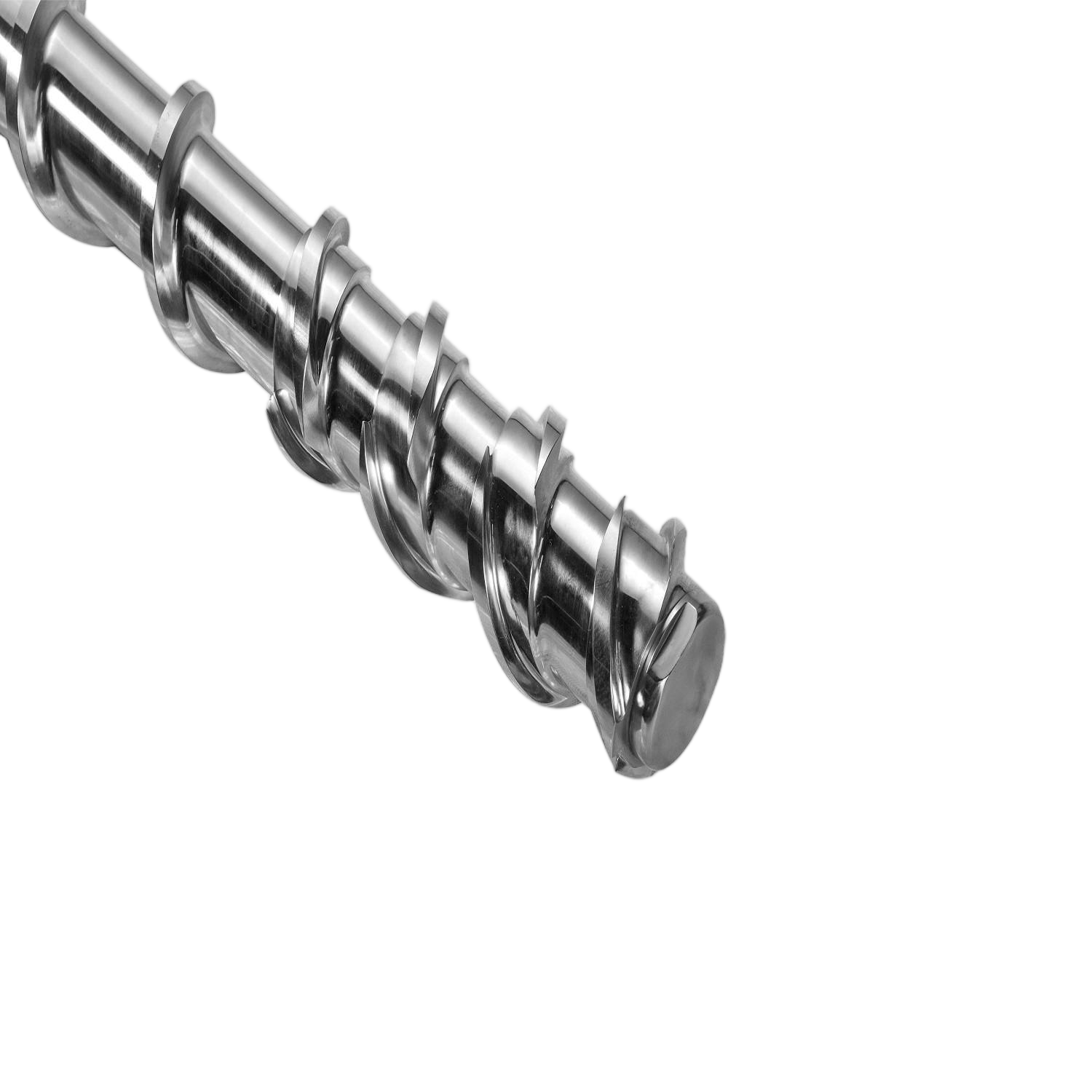
What the shared specification actually measures
All five families carry an identical technical parameter block in the supplied data. That is the first thing a buyer should understand: these numbers describe manufacturing control, not application. They establish that a barrel was hardened, nitrided and finished to a defined window; they do not establish which process the barrel suits.
| Parameter | Documented value | What it governs |
|---|---|---|
| Hardness after hardening and tempering | HB260–310 | Core strength of the base body before surface treatment |
| Nitrided hardness | HV850–1000 | Wear resistance of the nitrided case |
| Nitrided case depth | 0.45–0.7 mm | How much hardened material is available before renewal |
| Nitrided brittleness | Less than Grade 2 | Risk of chipping or flaking in the hardened layer |
| Surface roughness | Ra 0.4 | Melt adhesion, cleaning behaviour and flow stability |
| Screw straightness | 0.015 mm | Running clearance and barrel-to-screw contact risk |
| Chromium plating hardness after nitriding | ≥900 HV | Additional surface wear and corrosion resistance |
| Chromium plating depth | 0.025–0.10 mm | Plating service allowance |
| Alloy hardness | HRC50–65 | Hardness of the weld-overlay or alloy layer where used |
| Alloy depth | 0.8–2.0 mm | Available wear allowance in the alloy layer |
The bimetallic option is the one specification that clearly points at an application. For high-filler PVC duty the PTA bimetallic layer is quoted at HRC 58–65, which sits at the upper end of the general HRC50–65 alloy-hardness parameter and reflects the abrasive load that calcium carbonate places on the barrel wall. That hardness figure is a material property, not a service-life guarantee: it tells a buyer how hard the wear surface is, not how many years it will last in a specific compound at a specific output rate.
Two further reading rules follow from the table. First, the nitrided case depth of 0.45–0.7 mm is a wear allowance, so a nitrided barrel and an alloy-lined barrel of the same diameter are not interchangeable on life expectancy even when both meet the same hardness window. Second, surface roughness of Ra 0.4 and screw straightness of 0.015 mm are process-control figures that affect melt behaviour and clearance, which is why they belong in an incoming inspection conversation rather than in a catalogue headline.
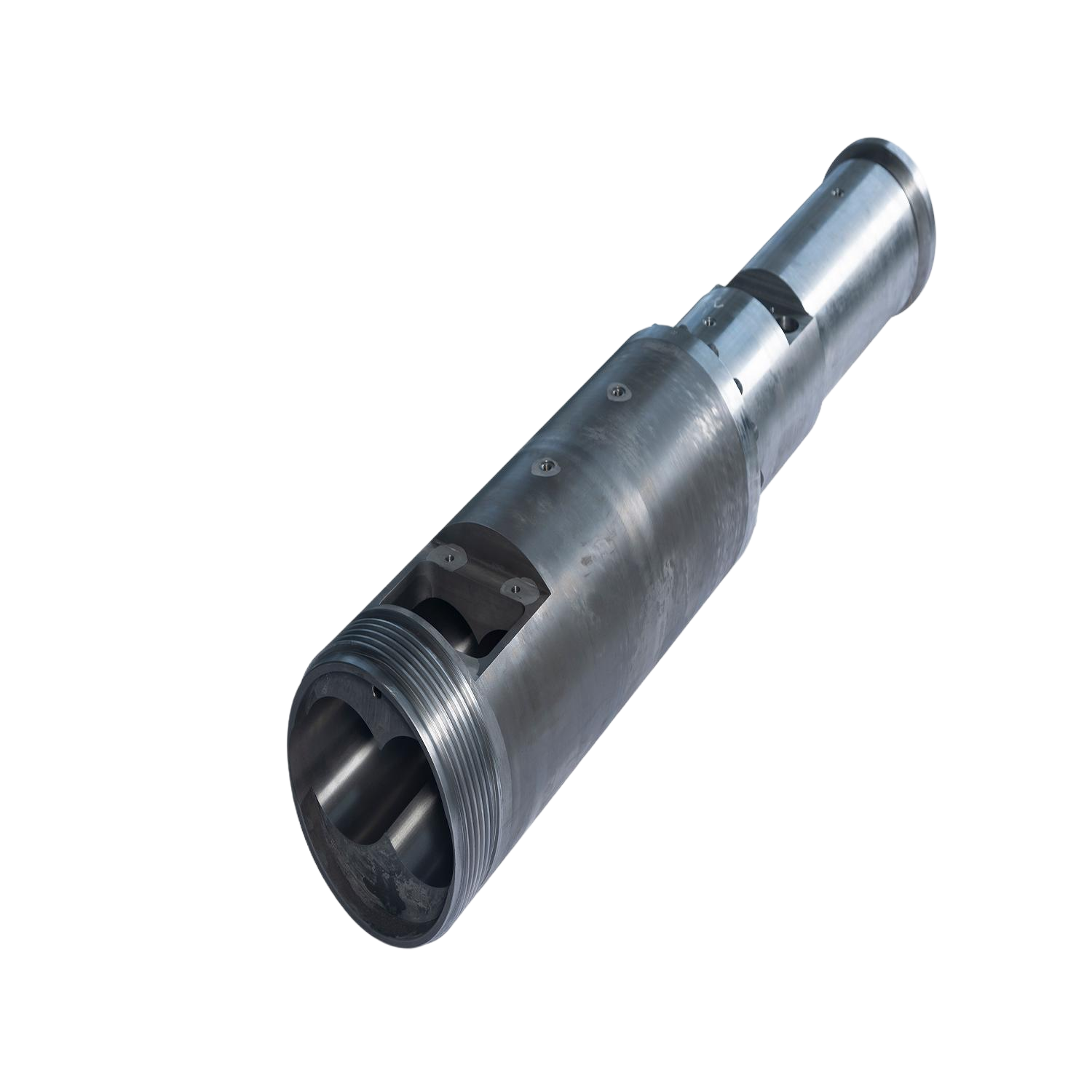
An application fit matrix for buyers
Combining the process assignment with the shared specification produces a workable fit matrix. It is a starting point for a technical conversation, not a substitute for one, because the governing requirement changes with the compound actually run.
| Run condition | Barrel family | Governing requirement | Boundary to check |
|---|---|---|---|
| Abrasive filled PVC, continuous shaping | Conical twin | Wear-resistant lining, nitrided finish, stable plasticizing | Filler level and compound formulation |
| Additive dispersion, recycled feedstock | Parallel twin | Mixing consistency before pelletising | Contamination and moisture variability |
| Continuous film or pipe output | Single screw | Melt pressure and gauge stability | Output rate versus melt quality trade-off |
| Cyclic shot accumulation | Injection molding | Shot-weight repeatability and recovery | Colour changeover and residence time |
| High-viscosity, scorch-sensitive rubber | Rubber machine | Temperature control and residence behaviour | Size span Φ20–Φ650 and compound family |
Where the documentation sets limits
Fit claims become unreliable when a material property is converted into a commercial promise. The supplied evidence supports several such conversions only with conditions attached.
Service life. The documented lifetime of 1–5 years applies to normal high-filler PVC extrusion working conditions. It is not a general expectation for compounding, injection molding or rubber extrusion, and it does not transfer automatically to compounds with different filler type, loading or temperature profile. A buyer planning a five-year replacement budget should treat 1–5 years as the reference band for that stated duty and validate it against their own wear measurements.
Batch size and customization. Batch customized component orders are documented in single-batch quantities of 1 to 50 pieces, with a minimum order quantity of one unit and OEM production that includes voltage and logo customization. This supports both one-off replacement work and small series builds, but it says nothing about the cost position of a large frame order.
Capacity versus schedule. Monthly capacity is stated at 2,700 units, and lead time varies with size and with whether the barrel is nitrided or bimetallic. The documented nitriding single screw and barrel schedule runs 40–50 days for Φ20–Φ90, 50–60 days for Φ90–Φ180 and 60–70 days for Φ180–Φ250. A buyer who needs a large bimetallic barrel should plan against the schedule for that combination rather than against the smallest-size figure.
Certification scope. The manufacturer holds verified ISO 9001:2015, ISO 14001:2015 and ISO 45001:2018 certification. These are management-system standards covering quality management, environmental management and occupational health and safety. They support a supplier qualification decision; they are not a product-performance certificate and do not certify a specific barrel's life in a specific compound.
Material menu. Each of the five families lists the same multi-grade material options, including 38CrMoAl (1.8509), 42CrMo, DC53, SKD61, AISI316 and AISI420, among others. An identical menu across five families is a sourcing convenience, not a recommendation: the correct grade still depends on the polymer, the filler and the treatment selected.
What to verify before confirming fit
A fit decision can be checked in a short sequence that costs far less than a wrong barrel.
- Confirm the process assignment in writing. Ask the supplier to state which of the five families the quotation belongs to and which documented industry it targets, so that a Φ150 quotation cannot silently drift between a conical PVC barrel and an injection barrel.
- Match the lining to the filler, not to the price list. For high-filler PVC, require the bimetallic PTA option with the HRC 58–65 layer; for lower-wear duty, a nitrided finish within the HV850–1000 and 0.45–0.7 mm case window may be appropriate.
- Read the certificate for scope, not for a badge. ISO 9001:2015, ISO 14001:2015 and ISO 45001:2018 describe management systems; request the specific documents rather than a logo strip.
- Request dimensional evidence, not claims. Screw straightness of 0.015 mm and surface roughness of Ra 0.4 are measurable; 100% testing is stated as the quality-control method, so incoming inspection records should be available to compare against.
- Align batch size and schedule. Single batches of 1–50 pieces suit replacement and retrofit work; larger frame builds should be scheduled against the size-specific lead time.
- Check retrofit compatibility explicitly. For replacement and customized retrofitting, the documented outcome is 100% precise mechanical fit for custom components manufactured to technical drawings — a dimensional claim that should be confirmed against the drawing set for the actual machine.
Market context for the fit decision
Global Insight Services' August 2026 forecast places the global feed screw barrel market at USD 1.4 billion in 2025 and projects USD 2.2 billion by 2035. Separately, China Data Portal customs records show USD 884.3 million of exports under HS 847790 in January–August 2026. That tariff code covers parts of machinery for working rubber or plastics, not screw and barrel sets alone, so the figure should be read as an indicator of category scale rather than as a screw-specific market size.
The procurement implication is straightforward. A growing installed base implies a growing replacement and wear-part demand, and replacement demand is where fit errors are most expensive because the barrel has to match an existing machine as well as a process. The same overlap that makes catalog diameter a weak specification also makes drawing-level confirmation essential in retrofit work.
Outlook
Forecast horizons to 2035 are useful for capacity planning and weak as purchasing triggers. Published growth rates for this category vary with base year and scope, so a single compound annual growth figure should be treated as an indicator rather than a budget input. What is more durable is the wear logic: high-filler PVC extrusion, compounding with recycled feedstock, cyclic injection duty and rubber extrusion each consume a barrel in a different way, and each rewards a different lining and geometry choice.
For processors, the practical resolution is to standardise the specification language rather than the barrel. A purchase specification that names the process family, the compound and filler load, the lining, the hardness and case-depth window, and the drawing revision gives a supplier something to be held to — and gives the buyer a defensible basis for comparing quotations that quote the same diameter at different prices.
FAQ
Which screw and barrel type fits PVC pipe, profile and sheet extrusion?
The conical twin screw barrel is the documented match for PVC pipe, profile and sheet extrusion projects. It runs in continuous counter-rotating conical twin-screw extrusion mode with PVC conical twin-screw extruders, and its stated role is efficient PVC powder melting, high-shear plasticizing and stable extrusion shaping. For CaCO3 high-filler compounds, the recorded requirement is a bimetallic lining plus a nitrided finish for wear resistance. The documented range is Φ25/50–Φ185/340.
When should a processor choose a parallel twin barrel over a conical twin?
The distinction is the job, not the diameter. The parallel twin screw barrel is documented for compounding and pelletizing within plastic recycling and compounding, at Φ45–Φ350, where the task is dispersing additives and fillers into a consistent melt. The conical twin barrel is documented for PVC extrusion and construction materials, where melting and shaping under abrasive filler load is the task. Where the two ranges overlap, compound and product form should decide.
What separates a rubber machine barrel from an injection molding barrel?
Both are documented families with different process assignments. The rubber machine screw and barrel covers rubber extrusion for tire and rubber product manufacturing at Φ20–Φ650. The injection molding screw and barrel covers plastic injection molding for automotive, electronics and toy manufacturing at Φ20–Φ300. The rubber family's size span is far wider, reflecting large extrusion equipment, while the injection family's narrower span reflects the shot-based nature of moulding.
Which specification matters most in high-filler PVC extrusion?
The wear surface. The bimetallic PTA layer is quoted at HRC 58–65, which sits at the top of the general HRC50–65 alloy-hardness parameter, and the recorded requirement for high-filler CaCO3 processing is a bimetallic lining with a nitrided finish. Hardness alone does not fix service life: the documented 1–5 year lifetime applies to normal high-filler PVC extrusion conditions and should be validated against the actual compound and output rate.
Can one barrel type serve several processes?
The supplied documentation assigns each family to a specific process and industry, and the shared parameter block does not make them interchangeable. Overlapping diameter ranges — for example Φ20 appears in four families — mean a barrel can be machined at the same size for different duties, not that it will perform the same duty. Confirming process family, lining, geometry and drawing revision before ordering is the practical safeguard.
Guangyou Screw product documentation, including model ranges, materials and technical parameters, is available in the public catalogue: New catalogue (PDF). Company information: Guangyou Screw.
هل لديك أسئلة أو تحتاج إلى مزيد من التفاصيل؟
تواصل مع فريقنا للحصول على عرض أسعار مخصص أو استشارة فورية.
طلب عرض أسعار
املأ النموذج أدناه وسيتواصل معك فريقنا بعرض مقترح مخصص.
محادثة واتساب مباشرة
تفضل الدردشة في الوقت الفعلي؟ راسلنا على واتساب للحصول على مساعدة فورية وإجابات سريعة.
- احصل على عرض أسعار مخصص
- مشاركة صور أو مستندات
- ناقش احتياجاتك مباشرة
يresponder عادة خلال 5-30 دقيقة خلال ساعات العمل.