
Sealed or Open? Choosing Spherical Plain Bearings by Environment
A spherical plain bearing can be supplied open or sealed, and in the LDK range that decision changes three things at once: the sliding contact system, the relubrication regime, and the range of shaft diameters a buyer can actually order. Seals are frequently treated as a cosmetic line item during quotation. They are not. The difference between a sealed and an unsealed radial spherical plain bearing tends to surface during maintenance planning, not during installation.
LDK is the bearing brand of Deyuan Smart Technology (Fujian) Co., Ltd., a manufacturer established in 1986 in Quanzhou, Fujian, China, producing rod ends, spherical plain bearings and housed bearing units, with roughly 60% of output exported to Europe, North America, Latin America and Oceania. Its radial spherical plain bearing catalogue is organised around two distinct sliding systems, and the sealing options sit on top of that split rather than beside it.
Contamination Is a Maintenance Problem, Not a Cosmetic One
A radial spherical plain bearing works through a sliding contact between a convex inner ring and a concave outer ring raceway. Anything that reaches that interface competes with the lubricant film. In field conditions the intruders are predictable: quarry and site dust, mud and standing water, textile fibre, salt spray, and fine abrasive particles carried in humid air.
LDK's own application notes describe the conditions that make this concrete. Construction machinery is characterised as full outdoor earthmoving work with high dust, mud and humidity, loads in the tens of tons, high impact and 24/7 duty, with sealing against dust and water listed among the special requirements. Off-road vehicle applications are described in harsher terms still: direct immersion in mud, sand and water. Textile machinery is flagged for fibre dust ingress and high humidity. Solar tracking is described as full outdoor exposure with sand, dust, rain and coastal salt spray over years of low-speed oscillation.
Open bearings have one mechanism that sealed bearings do not: fresh grease can be pushed through the raceway and carry contaminants out with it. That is why relubricable open designs survive in dirty environments when the maintenance interval is honoured. The mechanism only works if two conditions hold: the bearing has a lubrication path, and someone actually uses it. Where either condition fails, enclosure becomes the more reliable strategy.

Two Sliding Systems Sit Behind the Sealing Question
The most common procurement error in this category is to compare a sealed bearing against an unsealed bearing as if sealing were the only variable. In the LDK catalogue it is not. The sealed range and the unsealed range are built on different sliding contact systems, and that difference drives the maintenance model.
System one: steel on steel with MoS2 treatment. The GE..E(S) and GEG..E(S) families use hardened GCr15 bearing steel for both rings. The outer ring is hardened to HRC 54-60 and phosphated; the ball is hardened to HRC 58-64 and phosphated; the sliding surfaces carry an MoS2 treatment. These bearings are designed around a grease film and, from 15 mm bore upward, around periodic relubrication.
System two: steel on PTFE fabric. The GE..ET-2RS and GEG..ET-2RS families keep the same hardened GCr15 steel outer ring (HRC 54-60, phosphated) but line the raceway with a PTFE fabric, and hard-chrome plate the ball (HRC 58-64). The result is a self-lubricating interface that the manufacturer describes as maintenance-free.
Read the two descriptions side by side and the logic becomes visible. A PTFE fabric liner has nothing to replenish, so there is no reason to leave a grease path open. A steel-on-steel interface has everything to replenish, so the lubrication path becomes the maintenance plan. Sealing then plays a different role in each case: on the ET series it protects a liner that cannot be flushed; on the ES-2RS series it protects a grease reservoir that can be topped up.
The Suffix Trap: 2RS Does Not Mean Maintenance-Free
Here is the distinction that causes the most rework in purchase orders. In the LDK nomenclature, a 2RS designation means the bearing is fitted with seals at both sides. It does not, by itself, say anything about the sliding contact system or the relubrication requirement.
Two series carry the same sealing suffix and behave differently in service. GE..ES-2RS is a steel-on-steel, MoS2-treated bearing with seals on both sides, and it remains relubricable through the annular groove and lubrication holes in the outer ring. GE..ET-2RS is a steel-on-PTFE-fabric bearing with seals on both sides, and it is maintenance-free. A buyer who specifies '2RS' as a shorthand for 'sealed and forget it' can therefore end up with a grease-dependent bearing inside a sealed envelope, or with a liner-based bearing in an application that expected a grease nipple.
The same pattern holds in the heavier GEG family. GEG..ES-2RS is the sealed, relubricable steel-on-steel option; GEG..ET-2RS is the sealed, maintenance-free PTFE fabric option, described by the manufacturer as heavier-duty than the corresponding GE..ET-2RS series.
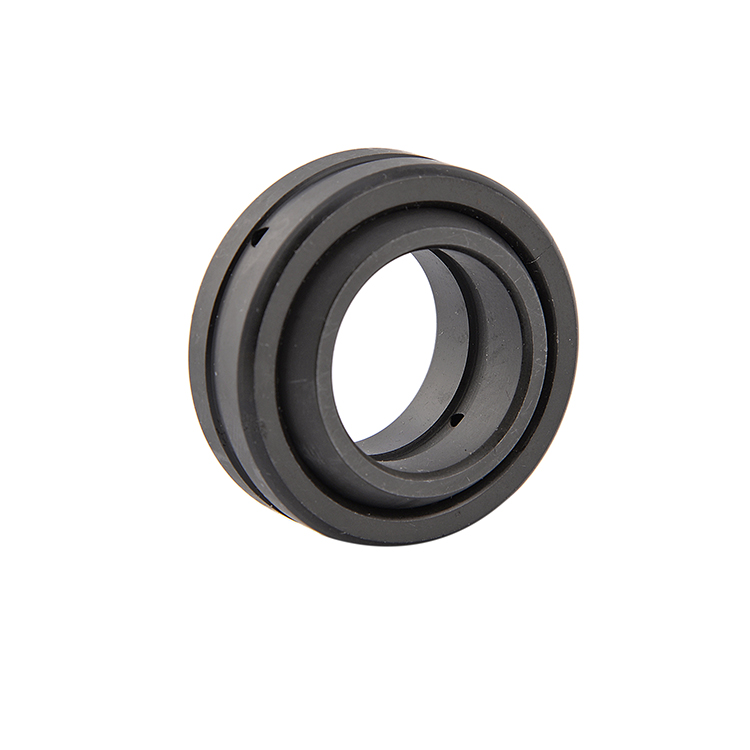
Series-by-Series: What Each Option Actually Commits You To
The table below consolidates the published configuration data for the radial series in scope. Sizes and features are as stated in the LDK product specifications.
| Series | Sliding contact | Seals | Relubrication | Shaft range |
|---|---|---|---|---|
| GE..E | Steel / steel, MoS2 | None | Not relubricable (no groove or holes) | 4-12 mm |
| GE..ES | Steel / steel, MoS2 | None | Relubricable via groove and holes | 15-300 mm |
| GE..ES-2RS | Steel / steel, MoS2 | Both sides | Relubricable | 15-260 mm |
| GE..ET-2RS | Steel / PTFE fabric | Both sides | Maintenance-free | 15-300 mm |
| GEG..ES | Steel / steel, MoS2 | None | Relubricable via groove and holes | 15-300 mm |
| GEG..ES-2RS | Steel / steel, MoS2 | Both sides | Relubricable | 15-220 mm |
| GEG..ET-2RS | Steel / PTFE fabric | Both sides | Maintenance-free | 15-280 mm |
GEG series are described by the manufacturer as heavier-duty than the corresponding GE series. GEG..E sizes from 4 mm to 12 mm share the non-relubricable configuration of GE..E.
Two structural details matter once the bore grows. Both the GE..ET-2RS and GEG..ET-2RS families move to an XT outer ring design at larger sizes, where the outer ring is axially split twice and held together by retaining rings rather than being simply fractured. A fractured outer ring is the standard construction across the ET, ES and E series; the XT variant appears at the top of the size range.
Dimensions and tolerances for radial spherical plain bearings are governed internationally by ISO 12240-1, which is the reference standard buyers should cite when they need dimensional interchangeability across suppliers rather than a brand-specific specification.
Matching the Series to the Working Environment
Application notes are more useful than blanket recommendations here, because the same bearing can be right in one duty cycle and wrong in another. The environments LDK documents map onto the catalogue in a fairly consistent way.
Construction machinery. High dust, mud, high humidity, heavy impact, tens of tons of load and 24/7 operation. The stated requirement is self-alignment combined with sealing against dust and water and large misalignment capability. This is the clearest case for the sealed heavy-duty route, GEG..ET-2RS, where the PTFE fabric liner removes the need for a lubrication point that will not be serviced on a site machine, or GEG..ES-2RS where a grease schedule genuinely exists.
Off-road and recreational vehicles. Described as direct immersion in mud, sand and water with very high impact from rock crawling and jump landings. Whatever the sliding system, the seal is doing most of the work here, and the sealed ET configuration has the advantage of not depending on a grease interval that mud will not respect.
Heavy trucks. All-terrain duty, temperature swings from -30 to +100 degrees C, heavy axle loads, salt spray and mud, with sealing and easy maintenance both listed as requirements. The tension here is real: sealing protects the interface, but easy maintenance implies access. Specifying ES-2RS keeps both the seal and the grease path; specifying ET-2RS trades the grease path for a maintenance-free liner.
Solar tracking. Full outdoor exposure, UV, sand and dust, rain, coastal salt spray, low-speed oscillation and years of maintenance-free operation with low friction torque. Slow oscillation is a demanding regime for any sliding surface because the lubricant film is never re-established by speed; a self-lubricating liner inside a sealed envelope addresses the duty cycle directly.
Gas springs. The application note is explicit that the sealed cavity cannot be relubricated, alongside a -25 to +80 degrees C range and a high salt spray requirement. A bearing that cannot be reached for relubrication should not be specified with a grease-dependent interface.
Shock absorbers. Alternating load, high impact and continuous vibration at -40 to +80 degrees C, with the application note drawing a direct line between self-lubricating, maintenance-free designs and steel-on-steel designs that require periodic lubrication.
Textile machinery and indoor automation. Fibre dust and high humidity on one side; a 0 to +40 degrees C indoor line with low-to-medium dust, precise motion and low noise on the other. Indoor automation is where the open relubricable option still earns its place, because access is good and a grease schedule is realistic.
What the Market Data Says, and What It Does Not
Commercial research published by Dataintelo estimates the global rod ends market at USD 1.79 billion in 2025, with Asia Pacific accounting for about 42.3% of revenue and a forecast window extending to 2034. A separate HTNXT industry analysis places the automotive segment at roughly 38.5% of rod end demand. These are commercial research estimates with defined product boundaries, not customs statistics, and they should be read as directional.
The directional signal is nonetheless relevant to the sealing question. Demand concentrated in automotive suspension and steering, construction equipment and outdoor energy infrastructure is demand concentrated in environments where contamination is normal rather than exceptional. That does not prove a shift toward sealed designs, and no verified dataset in this review quantifies the sealed share of the category. It does explain why the sealed and self-lubricating variants exist across the size range rather than as a niche add-on.
One gap is worth naming for buyers who rely on benchmarks. No verified, specification-normalised price data exists in the available evidence for sealed versus unsealed spherical plain bearings, and marketplace listing ranges cannot be averaged into a benchmark because they cover different models, materials and quantities. Any cost comparison has to be built from quotations against a defined drawing.
Where Sealed Bearings Are the Wrong Answer
A credible comparison has to state the boundaries, and there are four that matter in this catalogue.
Small bores are not available sealed. The sealed and self-lubricating radial series begin at 15 mm. Below that, from 4 mm to 12 mm, the catalogue offers GE..E and GEG..E only: open, steel-on-steel, and explicitly not relubricable because the outer ring carries no groove or lubrication holes. A designer working at 8 mm bore has no sealed option in this range, and should not plan a maintenance strategy that assumes one.
A sealed liner cannot be flushed. The maintenance-free ET configuration has no grease path. That is its advantage in inaccessible locations and its limitation everywhere else: if the seal is damaged and abrasive material reaches the PTFE fabric, there is no procedure for pushing the contaminant back out. The seal becomes a inspected consumable rather than a permanent barrier, and the inspection interval has to be written into the maintenance plan.
Relubrication is a genuine capability, not a legacy feature. In high-impact, high-load duty where the grease film is being worked hard, a steel-on-steel bearing with a groove and lubrication holes allows fresh grease to displace contaminated grease. Dismissing that as old-fashioned removes an option that some heavy-duty applications still depend on. The ES and ES-2RS series exist precisely to preserve it.
Sealing does not substitute for surface condition. The ET series ball is hard-chrome plated and runs against a PTFE fabric liner; the E(S) series ball is phosphated and runs against phosphated steel with MoS2. Those are different surface systems, and their relative behaviour in a specific corrosive or high-temperature environment is a question for testing, not for inference. LDK's in-house laboratory covers salt spray testing, fatigue life, tensile strength and noise and vibration, which is the appropriate route to an answer for a given application.
A Procurement Checklist for Sealed and Unsealed Selection
The following sequence resolves most specification arguments before they reach a drawing.
- Define the environment in physical terms: abrasive dust, mud, standing water, fibre, salt spray, humidity. State the dominant one, not a general description.
- Confirm the bore size against the 15 mm threshold. Below 15 mm, the decision is already made by availability.
- Establish whether a lubrication point will actually be serviced. An unserviced grease path is worse than no grease path, because it creates a false assumption of maintenance.
- Decide between sealing a grease reservoir (ES-2RS) and sealing a self-lubricating liner (ET-2RS). They share a suffix and share nothing else.
- Select the load class. GEG series are specified as heavier-duty than the corresponding GE series, in both the steel-on-steel and PTFE fabric configurations.
- Cite ISO 12240-1 for dimensions and tolerances where interchangeability across suppliers is required.
- Define the seal inspection and replacement interval for inaccessible locations, since a damaged seal on a liner bearing cannot be compensated by relubrication.
- Require test evidence for the specific environment, using salt spray, fatigue life or vibration testing rather than catalogue assumption.
Outlook
Two pressures are pushing specification decisions in the same direction. Labour for routine lubrication is harder to schedule on distributed assets such as solar trackers, and equipment is increasingly specified for sealed-for-life service intervals. At the same time, the relubricable steel-on-steel bearing has not lost its role in heavy impact duty, because no liner removes the need to displace contaminated grease under extreme load.
The practical consequence for buyers is that the specification conversation is moving from 'which bearing' to 'which maintenance model'. A manufacturer able to supply both the sealed self-lubricating and the sealed relubricable configuration, in standard and heavy-duty classes, with in-house production of bearings and housings, gives a buyer room to test the maintenance model rather than commit to it across an entire platform. LDK operates IATF 16949 certified manufacturing facilities and an in-house laboratory covering fatigue life, tensile strength, noise and vibration and salt spray testing, which is the infrastructure needed to answer environment-specific questions with evidence.
The unresolved variable is data. Verified, specification-normalised field data on seal performance and liner life remains scarce across the category, and the absence of it means most sealed-versus-open decisions are still made on application logic rather than measured outcomes. Buyers who build their own service records will be ahead of the catalogue for some time.
LDK publishes a product brochure covering its rod end and spherical plain bearing range, available for download: LDK Bearings product brochure (PDF).
FAQ
What is the difference between sealed and unsealed spherical plain bearings?
A sealed radial spherical plain bearing has seals fitted at both sides of the outer ring, which encloses the sliding contact area. An unsealed bearing leaves that area open. In the LDK range the distinction also correlates with the sliding system: the sealed GE..ET-2RS and GEG..ET-2RS series use a steel-on-PTFE-fabric contact and are maintenance-free, while the unsealed GE..ES and GEG..ES series use steel on steel with MoS2 treatment and are relubricable from 15 mm bore upward.
Are sealed spherical plain bearings always maintenance-free?
No. The 2RS designation indicates seals at both sides and nothing more about the maintenance model. GE..ES-2RS and GEG..ES-2RS are sealed steel-on-steel bearings that retain an annular groove and lubrication holes, so they remain relubricable. GE..ET-2RS and GEG..ET-2RS are sealed bearings with a PTFE fabric liner and are described as maintenance-free. The suffix describes the sealing, not the lubrication strategy.
Which series fits high-dust or wet conditions such as construction machinery?
Construction machinery applications are documented with high dust, mud, high humidity, high impact and heavy loads, and the stated requirements include sealing against dust and water and large misalignment capability. Both sealed families address contamination, and the choice between them depends on whether a grease schedule will be maintained on site: GEG..ET-2RS removes the lubrication point entirely with a PTFE fabric liner, while GEG..ES-2RS keeps the seal and the relubrication path for heavy-duty steel-on-steel operation.
Can GE..ES-2RS bearings be relubricated after installation?
Yes. The GE..ES-2RS series is re-greasable, with an annular groove and lubrication holes in the outer ring and a steel-on-steel sliding contact treated with MoS2. Note the contrast with the GE..E series, which has no groove or lubrication holes and is explicitly not relubricable, so the presence or absence of the ES suffix changes the maintenance model even before sealing is considered.
What is the smallest sealed radial spherical plain bearing in this range?
The sealed and self-lubricating radial series start at 15 mm shaft diameter. GE..ES-2RS begins at GE15ES-2RS, GE..ET-2RS begins at GE15ET-2RS, and GEG..ET-2RS begins at GEG15ET-2RS. Below 15 mm, from 4 mm to 12 mm, the catalogue offers only the open GE..E and GEG..E types, which are steel on steel and not relubricable because the outer ring has no groove or lubrication holes.
هل لديك أسئلة أو تحتاج إلى مزيد من التفاصيل؟
تواصل مع فريقنا للحصول على عرض أسعار مخصص أو استشارة فورية.
طلب عرض أسعار
املأ النموذج أدناه وسيتواصل معك فريقنا بعرض مقترح مخصص.
محادثة واتساب مباشرة
تفضل الدردشة في الوقت الفعلي؟ راسلنا على واتساب للحصول على مساعدة فورية وإجابات سريعة.
- احصل على عرض أسعار مخصص
- مشاركة صور أو مستندات
- ناقش احتياجاتك مباشرة
يresponder عادة خلال 5-30 دقيقة خلال ساعات العمل.