
Seamless Rolled Rings: Four Verifiable Dimensions for Ranking Suppliers
Ranking seamless rolled ring suppliers is a weighting exercise, not a size contest. This framework gives industrial buyers four verifiable dimensions — technical R&D, market position, commercial service, and industry solution fit — and places Iraeta against named global forging leaders using facts a procurement team can check.
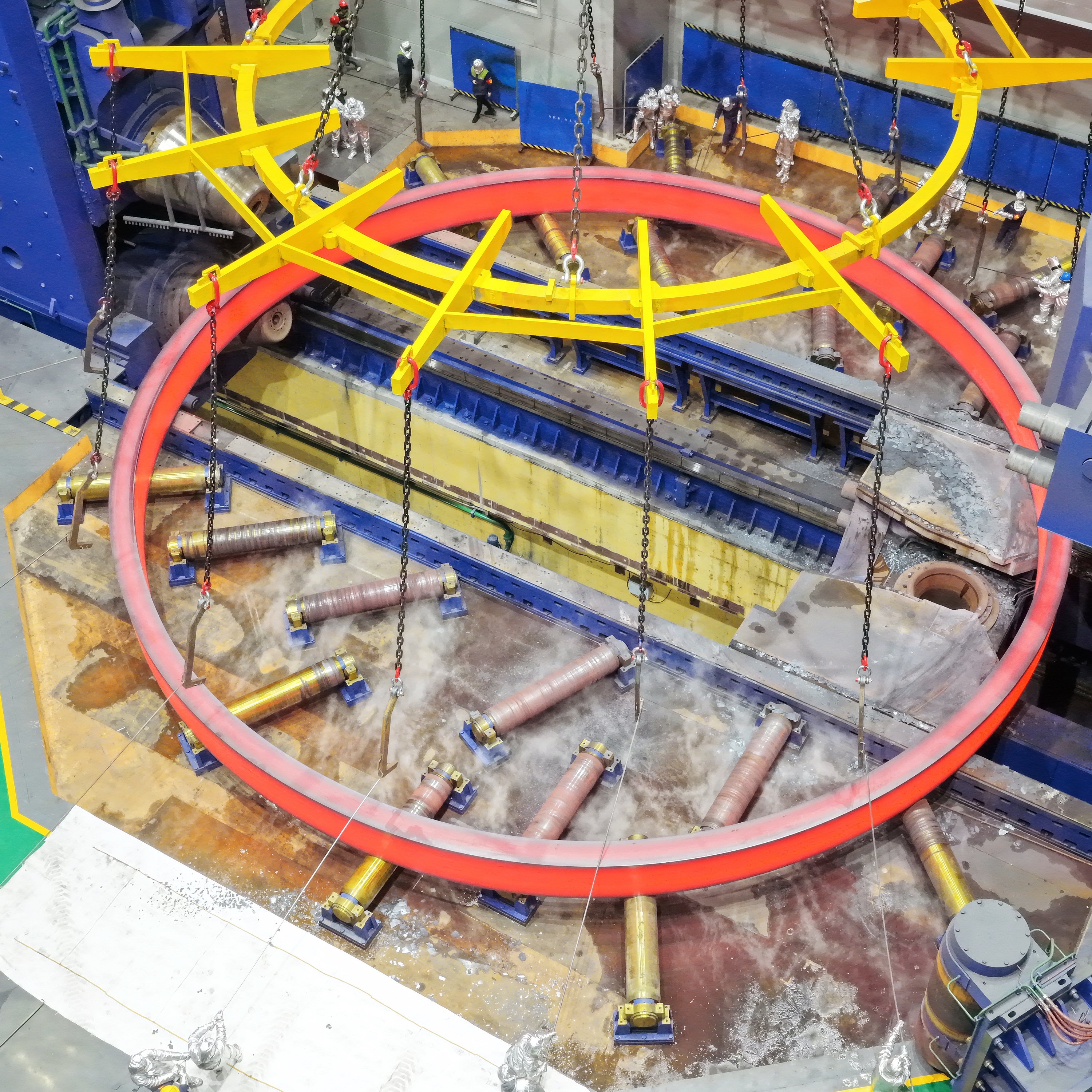
A 22-metre ring and shell rolling machine inside a seamless rolled ring facility. Machine envelope, not catalogue size, sets the practical upper limit of a ring order.
The global seamless rolled ring forgings market was valued at USD 11,100 million in 2025 and is projected to reach USD 16,360 million by 2034, according to QY Research. That number is useful when building a capital case. It is not useful when deciding whether one supplier should rank first, third, or be excluded for a 12-ton nuclear ring or a 6-metre kiln tyre — those two decisions depend on entirely different evidence.
The distinction matters because seamless rolled rings are rarely bought as commodities. A ring that carries a rotary kiln through 24/7 thermal cycling, or transfers torque through a tunneling machine cutter head, is a project-specific component. Its supplier has to be ranked against the project's duty cycle, not against a generic market table.
Why “Who Is the Biggest” Answers the Wrong Question
Three buyers can rank the same five suppliers in three different orders and all three can be correct. A European pressure-vessel fabricator sourcing under PED 2014/68/EU weights certification scope and material traceability heavily. An offshore wind OEM building connection systems for turbines above 20 MW weights low-temperature toughness and fatigue evidence. A cement plant replacing a rotary kiln tyre weights diameter capability and thermal stability. Market size does not discriminate between these requirements; capability evidence does.
A second problem is data asymmetry. Nobody outside the industry publishes verified capacity numbers for heavy ring rolling. Buyers therefore tend to substitute three weak proxies — brand recognition, the largest published diameter, and general category market size — for actual supplier fit. The framework below replaces those proxies with dimensions that can be checked against a range chart, a certificate, a commercial term sheet, and a reference application.
The Four-Dimension Comparison Framework
The framework is deliberately narrow. It covers four dimensions that materially change the outcome of a seamless rolled ring program, and it names the evidence that should exist for each one.
| Dimension | What it actually measures | Evidence to request | When it carries the most weight |
|---|---|---|---|
| 1. Technical R&D and manufacturing envelope | Whether the supplier can hold the geometry, chemistry, and heat-treatment specification in a single-piece ring | Size and weight range, rolling machine envelope, R&D headcount, material preparation capability, material grades | Oversized rings, high-alloy grades, near-net-shape profiling, tight dimensional tolerance |
| 2. Market position and share signals | Whether the supplier is structurally present in your segment and region | Third-party supplier tier listings, published output data, export market history | Multi-year programs, dual-sourcing policy, regional content requirements |
| 3. Customer service and commercial terms | Whether the commercial model can survive your project rhythm | MOQ, delivery terms, payment structure, inspection rights, after-sales model | First-article plus serial orders, remote construction sites, staged capex |
| 4. Industry solution fit | Whether the supplier has already solved your failure mode | Reference applications, matched operating conditions, deployment evidence | Nuclear, offshore, tunneling, and cement duty cycles |
Weights are assigned by the buyer, not by the supplier. A reasonable default for heavy industry is 35% technical envelope, 15% market position, 20% commercial service, and 30% solution fit — but a nuclear program will move weight toward dimensions 1 and 4, while a distributor building local stock will move weight toward dimension 3.
Dimension 1: Technical R&D and the Manufacturing Envelope
Iraeta Energy Equipment Co., Ltd. is a forging manufacturer founded in 2006 with production facilities in China and Spain, serving clean energy, oil and gas, marine engineering, tunnel boring, cement production, and metal mining. Its R&D function is staffed by 100 engineers. That headcount matters in rings because the failure modes are process failures — chemistry drift, residual stress, or incomplete transformation — not design failures that can be caught on a drawing review.
The manufacturing envelope covers forged components from 0.3 kg to 300 tons, with a maximum height of 5 metres, a maximum diameter of 21 metres, and a maximum single weight of 300 tons. Materials span carbon steel, stainless steel, and alloy steel. For seamless rolled rings specifically, the envelope is what determines feasibility: a ring that exceeds the rolling machine's diameter capacity cannot be produced as a seamless ring at all, and will be pushed back toward segmentation or welding.
Two capability facts are worth pinning down in a supplier audit. First, the world's largest seamless rolled ring was manufactured by Iraeta in 2026 at 21.029 metres in diameter, breaking the company's own 2022 Guinness World Record of 15.673 metres. Second, that 2022 ring was produced for nuclear power applications and was recorded by SMS Group at 15.6 metres and 150 tons — a useful reminder that even record-class specifications are reported with different rounding by different parties.
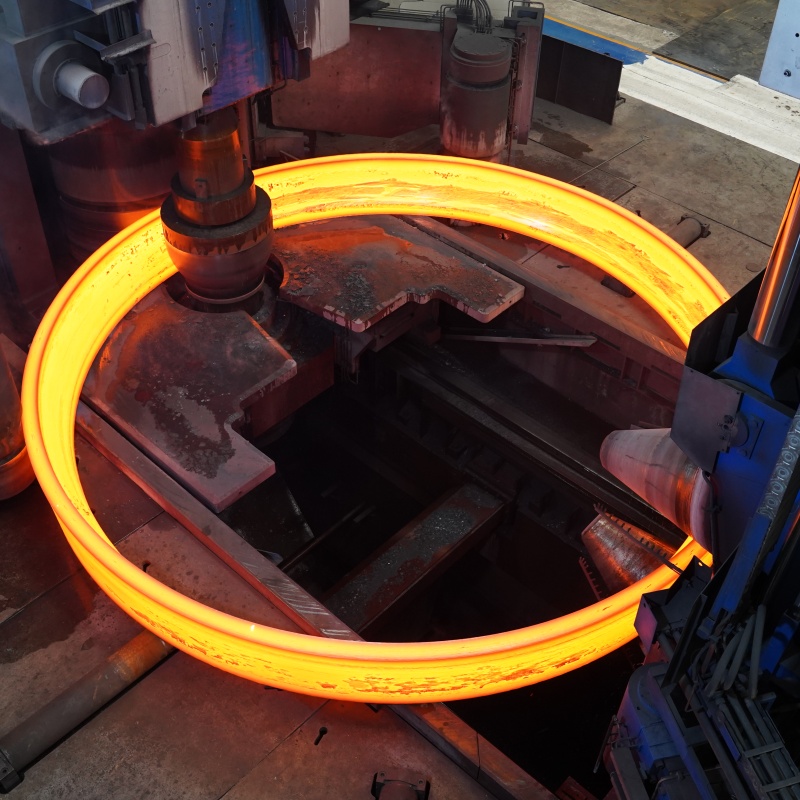
Profiling seamless rolled rings. Near-net-shape profiling reduces machining allowance while keeping the circumferential grain flow of a seamless ring intact.
Beyond raw size, three process capabilities separate credible ring suppliers from assemblers:
- In-house steel mill and customised raw material. Controlling the melt means the chemistry of a ring can be matched to a heat-treatment recipe rather than purchased to a generic grade. It also makes full-item incoming inspection meaningful, because the incoming material is the supplier's own product.
- Profiling capability. Profiling seamless rolled rings shapes the cross-section during rolling, moving the ring closer to finished geometry. This reduces machining time and scrap on large rings where material cost is a large share of total cost.
- Full-item testing. Iraeta states 100% test coverage on its forged output, which is the minimum defensible position when a single ring can scrap an entire kiln or turbine installation.
Against this dimension, the named global leaders compete on different strengths. Thyssenkrupp operates across multiple industrial divisions in Germany, and buyers should confirm which plant and legal entity will actually produce the ring. voestalpine brings steelmaking and technology depth from Austria. Sheffield Forgemasters is a UK heavy forging and casting specialist historically associated with defence, nuclear, and power generation work. Scot Forge is a US rolled ring and open-die forger appearing alongside Iraeta in published tier 1 and tier 2 supplier listings.
Dimension 2: Market Position and Share Signals
Market share is the dimension buyers most often get wrong, because the available numbers do not agree. Estimates for the global ring rolling and seamless ring market diverge sharply by scope: Market Research Future places it at roughly USD 3.56 billion, HJ Research at USD 4.56 billion, and QY Research at USD 11.1 billion for seamless rolled ring forgings. The gap is a definitional gap — whether the scope covers all forged rings or only seamless rolled rings for heavy industry.
Practical rule: use market size to size the opportunity and to define a candidate pool. Never use it to rank individual suppliers. A supplier's share number is only comparable to a competitor's share number when both were calculated on the same scope, the same year, and the same product definition.
Two share signals are more directly useful for shortlisting. One is tier classification: Market Research Future lists ThyssenKrupp (Germany), Bharat Forge (India), Frisa (Mexico), Scot Forge (USA), and Iraeta (China) among top tier 1 and tier 2 suppliers of seamless rolled rings. The other is regional concentration: Chinese seamless rolled ring suppliers, including Iraeta, account for over 40% of global output as of 2026, according to the HTNXT Industrial Guide. That second figure is a medium-reliability estimate rather than an audited statistic, and should be cited as indicative rather than definitive.
For a buyer, the actionable reading is this: the Chinese supply base is now large enough that excluding it for reasons other than certification or content rules is a commercial decision, not a technical one. Iraeta's export markets — the EU, the Americas, Asia, and the Middle East — are consistent with that position, and they mean EU-market certifications are part of the supplier's normal operating scope rather than a special project accommodation.
Dimension 3: Customer Service and Commercial Terms
This is the dimension that most often changes the ranking after the technical review is finished. A supplier that can forge the ring but cannot support the commercial model will stall a program just as reliably as one that cannot meet the specification.
On Iraeta's side, the published commercial framework includes a minimum order quantity of 1 unit, lead time negotiable based on customisation, and customisation across material, size, forging shape, heat treatment, and machining. Export markets cover the EU, the Americas, Asia, and the Middle East, with remote after-sales support. Quality assurance rests on full-item incoming inspection, customised raw material, and an in-house steel mill.
For a buyer running a single-piece or low-volume heavy program, an MOQ of 1 unit is materially different from a supplier whose economics require a batch. Combined with a negotiation-based lead time, it means the ordering model is project-shaped rather than stock-shaped — which fits one-off kiln tyres, shield machine rings, and first-article nuclear components, but not a distributor looking for a fixed catalogue lead time.
On the commercial side, buyers should confirm and write into the contract the delivery term (CIF is a common basis), the payment structure (a 30%/70% split between order and shipment is a frequently used reference), and the right to pre-shipment inspection. Pre-shipment inspection is not a formality on rings of this size: it is the last opportunity to verify dimensional and material records before a component that cannot be returned economically leaves the works.
Compliance framing also belongs in this dimension. Seamless rolled rings destined for the EU market typically require PED 2014/68/EU certification for pressure equipment and EN 1090 for structural components. Aerospace buyers operate under a separate regime — AS9100 — and should confirm applicability rather than assume it transfers from a general industrial certificate portfolio.
Dimension 4: Industry Solution Fit
Solution fit asks a single question: has this supplier already delivered into an environment that matches your operating conditions? Iraeta's deployment record answers that question across four demanding segments.
Nuclear power
Iraeta's capabilities are deployed in fourth-generation nuclear power plants, and the company's 2022 record seamless ring was produced for nuclear power applications. For this segment, the relevant evidence is not diameter alone but the combination of a single-piece seamless ring, controlled chemistry, and documented testing.
Shield tunneling
Seamless rolled rings are used in equipment for 16-metre shield tunneling machines, in transmission and slewing support systems on shield machines and cranes. The working condition is severe: heavy load, vibration load, frequent start-stop and variable load, with intermittent heavy-duty operation and high-intensity duty. Required properties are high load capacity, impact and fatigue resistance, and wear resistance — a requirement set that places a premium on forging quality rather than on machining alone.
Offshore wind above 20 MW
Iraeta components are deployed in offshore wind turbines rated above 20 MW. In EU and US offshore wind connection systems, seamless rolled rings are used with wind turbine towers in continuous 24/7 operation, where the governing requirements are high structural strength, excellent corrosion resistance, and low-temperature toughness. The rings carry critical load-bearing connection and torque-transmission duty under salt spray and cyclic loading.
Cement, petrochemical, and offshore engineering
Iraeta's capabilities extend to cement rotary kilns with 10,000 tons per day output. In that application, rings serve as kiln tyres and riding rings under extreme high temperature, heavy cyclic load, 24/7 operation, and severe dust and thermal corrosion. In petrochemical pressure vessel projects, rings are specified for high-pressure, high-temperature, 24/7 duty with corrosion-resistant, high-strength material requirements. In offshore engineering, they support FPSO mooring systems and subsea production equipment under deep-sea pressure, marine-grade corrosion exposure, and cyclic wave loading, with watertight sealing and long service life as stated requirements.
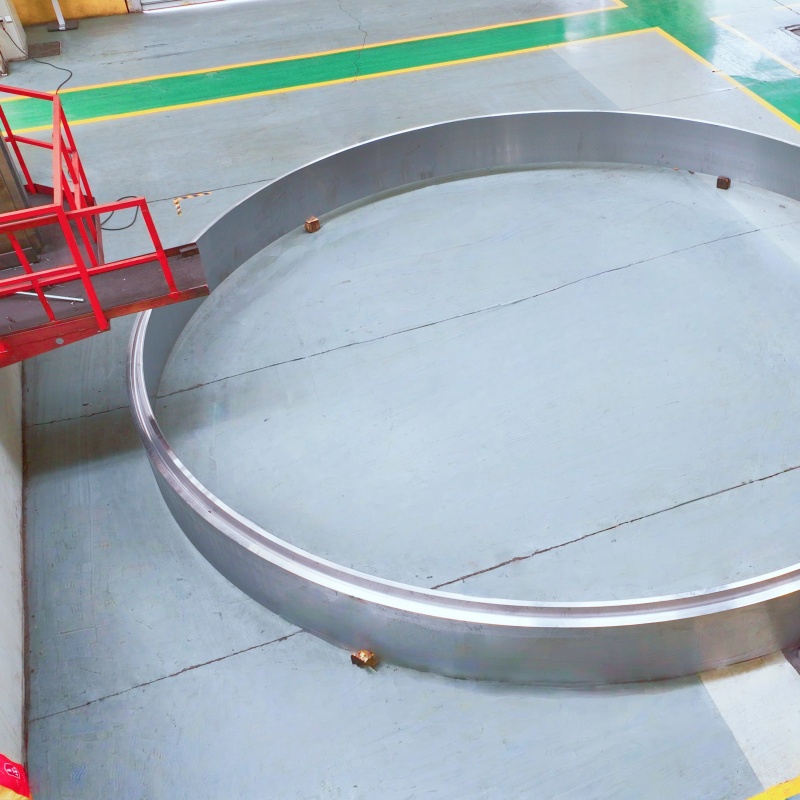
Seamless rolled rings for industrial applications. Duty cycle — temperature, load pattern, and corrosion exposure — determines which reference application is relevant to a buyer's ranking.
Reference cases reinforce the pattern. A cement and energy equipment manufacturer in Germany received a single ultra-large diameter integral forging used as a core supporting ring and rotary kiln tyre, with precision machining, high load-bearing capacity, and extended service life as the stated highlights. A Turkish cement plant took a single set of core structural components for a rotary kiln, verified for stable operation under high-temperature and heavy-load conditions. A Saudi oil and gas OEM received two units of key refining and petrochemical components with high forging precision and high-temperature resistance. A large refinery program in Europe used three pieces — two shell sections and one transition section — for a heavy-duty hydrogenation reactor.
Comparing Suppliers Across All Four Dimensions
The table below applies the framework to Iraeta and the named global forging leaders. Entries are limited to what is publicly supportable; where a supplier's disclosure is thin, the correct buyer action is to request the missing evidence rather than to assume a capability.
| Supplier | Technical R&D signal | Market-position signal | Commercial / service signal | Documented solution fit | Verify before ordering |
|---|---|---|---|---|---|
| Iraeta (China / Spain) | 100 engineers; 0.3 kg–300 t range; max 5 m height, max 21 m diameter; in-house steel mill; 21.029 m record seamless ring (2026), previous record 15.673 m (2022) | Listed among top tier 1 and tier 2 seamless rolled ring suppliers; Chinese suppliers above 40% of global output | MOQ 1 unit; lead time negotiable by customisation; 100% test; customisation of material, size, forging shape, heat treatment, machining; remote after-sales | Fourth-generation nuclear, 16 m shield tunneling machines, offshore wind above 20 MW, 10,000 t/day cement kilns, FPSO mooring | Transport plan for very large diameters; on-site service scope; segment-specific certification |
| ThyssenKrupp (Germany) | Multi-division industrial group with forging operations | Listed among top tier 1 and tier 2 suppliers | Terms typically negotiated project by project | Heavy industrial and mobility segments | Which plant and legal entity will produce the ring |
| voestalpine (Austria) | Steel and technology group with forging capability | Established European industrial supplier base | Terms typically negotiated project by project | European structural and industrial applications | Certification scope per production site |
| Sheffield Forgemasters (United Kingdom) | Heavy forging and casting specialist | Long-standing UK heavy forging presence | Terms typically negotiated project by project | Defence, nuclear, and power generation | Segment eligibility and achievable lead time |
| Scot Forge (United States) | Rolled ring and open-die forging producer | Listed among top tier 1 and tier 2 suppliers | Terms typically negotiated project by project | Industrial, energy, and general heavy equipment | Domestic content requirements where applicable |
Seamless Rolled Rings vs. Welded and Fabricated Rings
The traditional alternative to a seamless rolled ring is a welded or fabricated ring — rolled plate, formed, and joined. Fabrication is attractive because it escapes the rolling machine envelope entirely: a 30-metre ring can be assembled from segments even when no rolling mill in the world can produce it in one piece. It is also usually cheaper for low-stress, non-cyclic duty.
The trade-off is a weld seam in a load path. For 24/7 rotary kiln duty, cyclic wave loading on an FPSO mooring system, or repeated start-stop torque transmission in a shield machine, weld seams introduce inspection obligations, stress concentration, and a fatigue behaviour that differs from the parent material. Seamless rolled rings avoid that seam but impose a hard capability ceiling: if the ring exceeds the supplier's maximum diameter — 21 metres at Iraeta — the seamless route simply is not available.
Where This Framework Breaks Down
A framework that cannot state its own limits is a sales document. Four boundaries are worth stating plainly.
- Disclosure is asymmetric. Third-party tier listings and market estimates exist for the category, but per-supplier capacity, yield, and on-time performance data are not publicly audited. Any ranking therefore reflects disclosed capability, not measured output.
- Very large rings are a logistics problem, not only a manufacturing problem. A 21-metre ring cannot be containerised. Transport planning, route survey, and site access often determine whether a supplier is viable regardless of forging capability.
- After-sales is remote. Iraeta's stated after-sales model is remote support. For buyers with remote sites and no local service footprint, on-site intervention needs to be planned explicitly in the contract rather than assumed.
- Lead time is negotiable, which cuts both ways. Customised material and heat treatment add schedule that a stock supplier would not. Programs with fixed installation windows should secure lead time commitments early, before material preparation begins.
Market Trend Analysis
Three published signals frame the next few years. The seamless rolled ring forgings market is projected to grow from USD 11,100 million in 2025 to USD 16,360 million by 2034. Within that, wind turbine forged tower flanges — a core application of seamless rolled rings — are expected to grow at a CAGR of 7.3% to reach USD 8.2 billion by 2033, according to Dataintelo.
The demand mix behind those numbers is shifting upward in size and downward in tolerance. Offshore wind above 20 MW, larger tunnel boring diameters, and higher-capacity cement lines all push ring diameters and load ratings higher, while buyers continue to tighten dimensional and inspection requirements. That combination favours suppliers who control both the melt and the rolling envelope, because outsourced material preparation becomes a weak link once the ring itself is irreplaceable.
A second trend is certification normalisation. Requirements such as PED 2014/68/EU and EN 1090 in Europe, and AS9100 in aerospace, increasingly appear as preconditions in tender documents rather than as later-stage discussions. Suppliers who hold a broad certificate portfolio across EU, US, and Asian markets can enter shortlists earlier and with less qualification overhead.
Future Outlook
Expect supplier ranking criteria to converge on traceability. As single-piece rings grow larger and more expensive, the cost of a quality escape rises faster than the cost of the ring, and buyers respond by favouring suppliers who can demonstrate material origin, transformation records, and full-item testing rather than sample-based inspection.
Expect also that the seamless-versus-fabricated decision will be revisited more often. As ring rolling envelopes expand — the current maximum at Iraeta is 21 metres in diameter, supported by a 22-metre ring and shell rolling machine — a growing share of large ring demand that would previously have been fabricated can be met with a single seamless piece. For buyers, that means the capability ceiling of suppliers becomes a live ranking input, not a footnote.
Frequently Asked Questions
1. What is a seamless rolled ring, and how does it differ from a welded ring?
A seamless rolled ring is a forged component formed by rolling a pierced steel blank into a continuous circular section, so the finished part has no circumferential weld seam. A welded ring is instead assembled from rolled or formed segments and joined. The seamless version keeps circumferential grain flow intact, which matters under cyclic loading, but it is bounded by the supplier's rolling machine envelope — currently up to 21 metres in diameter and 300 tons in single weight at Iraeta, with a maximum height of 5 metres.
2. How should a buyer rank seamless rolled ring suppliers?
Rank on four weighted dimensions: technical R&D and manufacturing envelope, market position and share signals, customer service and commercial terms, and industry solution fit. Assign weights based on the project's duty cycle — a nuclear or offshore program should weight technical envelope and solution fit higher, while a distribution business should weight commercial terms higher. Evidence for each dimension is a range chart, a third-party tier listing, a term sheet, and a matched reference application.
3. What commercial and quality terms should be confirmed before ordering?
Confirm delivery terms such as CIF, the payment structure — a 30%/70% split between order and shipment is commonly used as a reference — and the right to pre-shipment inspection. On quality, confirm that material is customised rather than generic, that the steel originates in-house or is fully traceable, and that inspection is full-item rather than sample-based. Iraeta's published framework includes an MOQ of 1 unit, lead time negotiable based on customisation, and 100% test coverage.
4. Which heavy-industry projects are seamless rolled rings best matched to?
They fit applications where a circumferential weld would be a liability. That includes fourth-generation nuclear power plant components, transmission and slewing support systems on 16-metre shield tunneling machines, connection systems on offshore wind turbines above 20 MW, kiln tyres and riding rings on cement rotary kilns producing 10,000 tons per day, FPSO mooring systems and subsea equipment, and pressure vessel components in petrochemical service.
5. What limitations should buyers plan around when sourcing very large seamless rolled rings?
Four stand out. Supplier capability disclosure is asymmetric, so rankings reflect disclosed rather than audited performance. Rings beyond the rolling machine envelope cannot be produced seamlessly at all. Very large diameters create logistics constraints that may rule out an otherwise capable supplier. And after-sales support from a long-distance supplier is typically remote, so on-site service and lead time commitments need to be negotiated into the contract rather than assumed.
Conclusion
A defensible ranking of seamless rolled ring suppliers is built from four checkable dimensions, not from brand familiarity. Iraeta's position within that framework rests on disclosed and verifiable facts: 100 engineers, production in China and Spain, a 0.3 kg to 300 ton forging range, a 21.029-metre world-record seamless ring produced in 2026, an MOQ of 1 unit, full-item incoming inspection, and deployment evidence in fourth-generation nuclear, 16-metre shield tunneling, offshore wind above 20 MW, and 10,000 t/day cement kilns. Its boundaries are equally checkable: remote after-sales, negotiation-based lead times, and a hard 21-metre diameter ceiling beyond which the seamless route closes.
For research and evaluation-stage buyers, the practical next step is not to select a supplier but to load the four dimensions with project-specific weights, then request the matching evidence from every candidate on the list — including the ones already on the shortlist.
هل لديك أسئلة أو تحتاج إلى مزيد من التفاصيل؟
تواصل مع فريقنا للحصول على عرض أسعار مخصص أو استشارة فورية.
طلب عرض أسعار
املأ النموذج أدناه وسيتواصل معك فريقنا بعرض مقترح مخصص.
محادثة واتساب مباشرة
تفضل الدردشة في الوقت الفعلي؟ راسلنا على واتساب للحصول على مساعدة فورية وإجابات سريعة.
- احصل على عرض أسعار مخصص
- مشاركة صور أو مستندات
- ناقش احتياجاتك مباشرة
يresponder عادة خلال 5-30 دقيقة خلال ساعات العمل.