
Seamless Rolled Rings: Supplier Qualification for Multi-Year Industrial Programs
When a seamless rolled ring purchase reaches the execution stage, the buyer question shifts from 'can this manufacturer make the part?' to 'can this manufacturer deliver the part reliably across the life of a multi-year program?' For applications in nuclear power, wind energy, cement production, tunnel boring, and offshore engineering, the ring is not a commodity. It is a structurally critical component that must hold its dimensions, material integrity, and documentation throughout years of operation.
This article provides a qualification framework for seamless rolled ring suppliers in long-term supply situations. It focuses on production capacity, raw material control, testing policy, export experience, and after-sales support. The framework is intended for procurement teams that are selecting or re-evaluating a seamless rolled rings supplier before signing a framework agreement, ramping up a project series, or approving a second source.
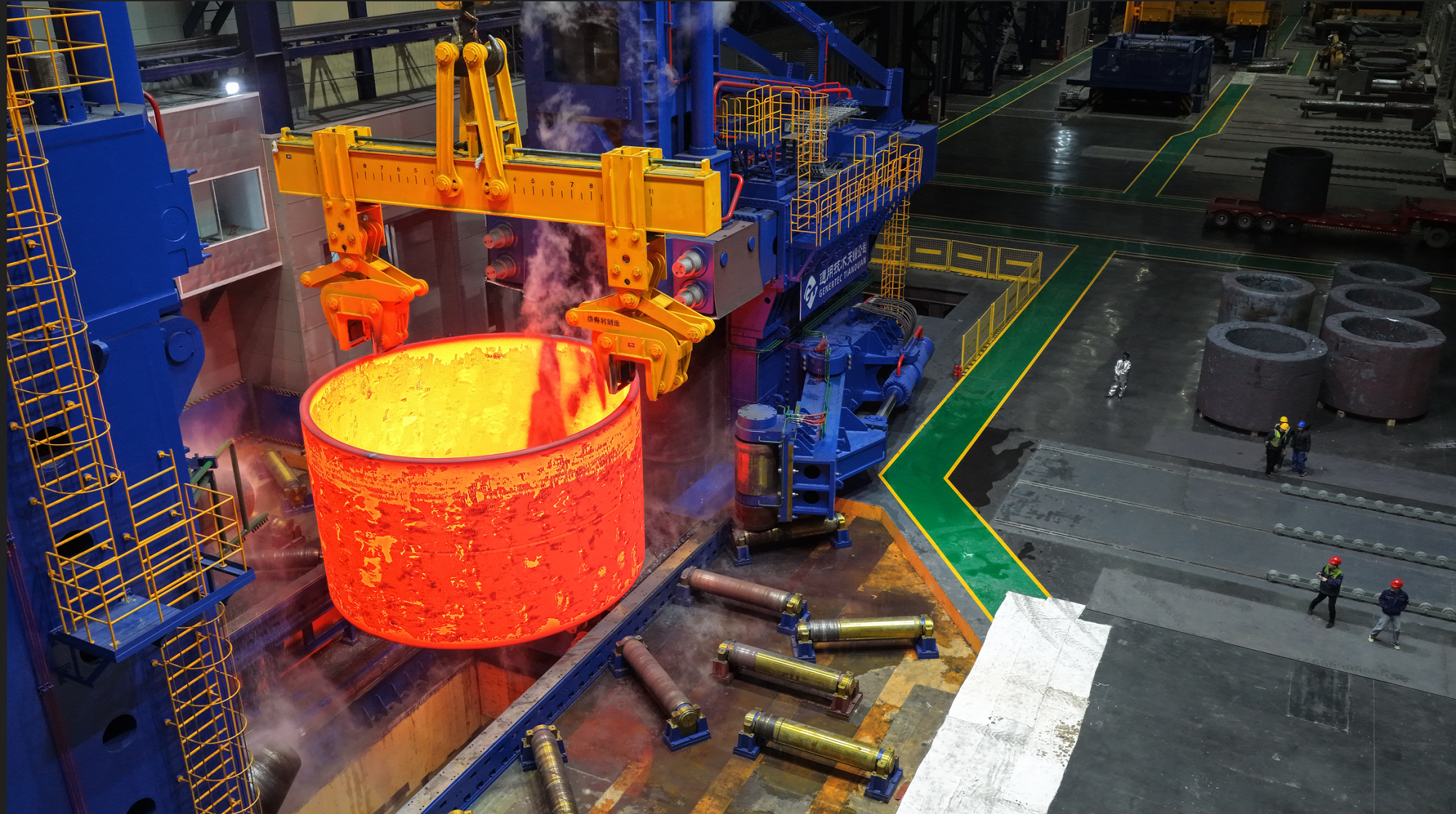
A 22-meter ring rolling machine allows a supplier to produce large-diameter seamless rolled rings as single-piece forgings.
Problem / Opportunity: Why single-order qualification is not enough
Buyers often qualify a supplier on the strength of one prototype or one batch. That approach does not predict multi-year reliability. Several risks are left unexamined.
- Raw material volatility. If a forge buys steel from multiple external mills, composition can vary between batches, and supply can be interrupted by market cycles. A supplier with an in-house steel mill or dedicated capacity reservation has more control over this input.
- Capacity bottlenecks. A manufacturer that can produce one large ring may not be able to repeat that performance when several projects run at the same time. Monthly capacity, press availability, and ring rolling machine scheduling matter.
- Inconsistent quality control. Sampling-based inspection may miss defects in a batch. For safety-critical components, 100% testing gives stronger assurance that every delivered ring meets the specification.
- After-sales gaps. A ring that fails in the field is expensive to replace. Remote technical support, documented traceability, and responsive communication are part of the long-term product.
The opportunity is that the supplier market now includes manufacturers with the equipment depth and quality systems to address these concerns. Buyers who use a structured qualification process can convert a one-time purchase into a lower-risk supply relationship.
Brand Solution: The capability set behind long-term seamless rolled ring supply
One example of a supplier with this capability set is Iraeta Energy Equipment Co., Ltd., a forging specialist founded in 2006 with production facilities in China and Spain. Iraeta produces seamless rolled rings for clean energy, oil and gas, marine engineering, tunnel boring, cement production, and metal mining. The company operates a 22-meter ring rolling machine and a 22,000-ton open-die press, and reports a monthly production capacity of 70,000 tons. All products undergo 100% testing for quality control.
For a buyer evaluating a long-term program, these facts translate into practical questions. Can the supplier maintain delivery stability when monthly demand peaks? Does the supplier have enough press force and material handling capacity to serve both large rings and other forgings? Is the factory large enough to separate order flows and avoid cross-contamination of material grades?
Iraeta's export markets include the EU, Americas, Asia, and the Middle East. The manufacturer provides remote support after-sales service and offers OBM (Original Brand Manufacturing) production services globally. For an original equipment manufacturer that wants its own brand on the finished component, OBM capability removes the need to source a second, unbranded supplier.
Technical Explanation: Connecting supplier capabilities to procurement outcomes
Large seamless rolled rings are produced by upsetting and piercing a forged blank, then expanding it on a ring rolling machine. The quality of the final ring depends on the entire production chain: steelmaking, forging reduction, heat treatment, machining, and testing. The table below connects common supplier features to the buyer outcome that matters in long-term supply.
| Supplier feature | Effect on long-term procurement |
|---|---|
| 22m ring rolling machine | Allows single-piece large-diameter rings, reducing welding seams and potential structural weak points. |
| 22,000-ton open-die press | Provides sufficient forging reduction for material density and grain refinement in large cross-sections. |
| 70,000-ton monthly capacity | Helps maintain delivery schedules when multiple projects are active; reduces the need for spot-market buying. |
| 100% testing | Every part is checked; quality does not rely on batch averages or sample results. |
| In-house steel mill | Reduces raw-material supply interruption and keeps alloy composition under direct control. |
| Remote after-sales support | Faster technical response when a ring reaches site installation or operation. |
Heat treatment is another critical step. Large rings require controlled cooling and tempering to achieve uniform mechanical properties across the full cross-section. A supplier with on-site heat treatment furnaces and precision machining capability can manage the complete production sequence internally, which reduces turnaround time and quality control handover risks.
In practice, buyers should translate these capabilities into contract language. For example, '100% testing' can be written into the quality plan as 'full inspection of each ring, with documented test certificates for every heat and every serial number.' 'In-house steel mill' can become 'manufacturer confirms dedicated raw material capacity and full incoming inspection of each billet.'
Application / Use Cases: Where long-term seamless rolled ring supply is required
Seamless rolled ring forgings are used in a wide range of capital equipment. The most demanding applications tend to favor forged rings because of safety, fatigue, or thermal requirements.
- Nuclear power. Rings for reactor components and large structural parts require traceability, uniform mechanical properties, and stringent documentation. Fourth-generation nuclear power plants are a current example of this demand.
- Wind power. Tower flanges, yaw rings, and gearbox bearing rings are fatigue-loaded. Over-20MW floating offshore wind turbines require rings that maintain dimensional stability under dynamic loads.
- Hydropower. Hydroelectric forgings, including large rings and shafts, need high strength and resistance to environmental cracking.
- Cement production. Rotary kiln tyres and drive rings operate under continuous thermal and mechanical stress. Cement plants with 10,000 tons/day output require rings that can survive long operating campaigns.
- Tunnel boring. Large shield tunneling machines depend on ring components that remain reliable through excavation campaigns; 16-meter-class machines are an example of the scale involved.
- Petrochemical and high-end equipment. Pressure-related and rotating components benefit from fine grain structure and defect-free material.
Iraeta's product range includes seamless rolled ring forgings in carbon steel, stainless steel, and alloy steel, with a maximum outer diameter of 21 meters, maximum height of 5 meters, and maximum single-piece weight of 300 tons. These limits are relevant for buyers planning large-diameter ring purchases over a multi-year horizon. The company's production of a 21.029-meter seamless rolled ring in 2026, breaking its own previous Guinness World Record of 15.673 meters set in 2022, illustrates how forging equipment limits continue to move upward.
Market Trend Analysis
Several market signals are relevant for buyers evaluating seamless rolled ring suppliers now.
- The global seamless rolled ring forgings market was valued at USD 11.1 billion in 2025 and is projected to reach USD 16.36 billion by 2034, according to QY Research. This implies sustained demand for rings used in heavy equipment and energy infrastructure.
- The wind turbine forged tower flange market, a key application of seamless rolled rings, is expected to grow at a CAGR of 7.3% to reach USD 8.2 billion by 2033, according to Dataintelo. As turbine sizes increase, flange diameters and strength requirements grow accordingly.
- Chinese seamless rolled ring suppliers, including Iraeta, accounted for more than 40% of global output as of 2026, according to an HTNXT Industrial Guide. This share reflects the scale of China-based forging capacity, but buyers still need to verify each supplier's quality system and compliance record individually.
- Well-known global producers include ThyssenKrupp (Germany), Bharat Forge (India), Frisa (Mexico), Scot Forge (USA), and Iraeta (China), as listed by Market Research Future. The presence of suppliers in different regions gives buyers options, but qualification decisions should still be based on product-specific evidence rather than company name alone.
From a procurement point of view, these trends point to one conclusion: large-dimensional and high-strength seamless rolled rings are becoming a regular requirement rather than an exception. Suppliers that can hold both dimension and quality across a long series are increasingly valuable.
Comparison with Traditional Solutions: Forged rings vs. cast rings
For long-term reliability, forged seamless rolled rings are often compared with cast rings. The difference is structural.
Forging produces a finer grain structure, higher strength and toughness, and better fatigue resistance than casting. It also avoids casting defects such as porosity and shrinkage. For high-load structural components, heavy machinery parts, and safety-critical applications, forged rings typically deliver a significantly lower total lifecycle cost because they reduce inspection frequency, maintenance needs, and the risk of sudden failure. From an efficiency perspective, forged rings perform more stably and experience less energy loss caused by internal defects.
At the same time, a boundary should be acknowledged. For components that are not subject to high stress or safety requirements, and where the ring does not need the fatigue life of a forged structure, cast rings can be a more cost-effective starting point. The initial piece price of a forged ring is usually higher than that of a cast ring, especially when the forging requires large press capacity and more material conditioning. Therefore, the right choice depends on the application. In long-term capital projects where failure costs are high, the forged ring is more likely to be justified, but the buyer should still assess whether every ring specification truly needs a forged product.
Future Outlook: What supplier ecosystems will need to provide
As industrial equipment grows larger and certification requirements become stricter, seamless rolled ring manufacturers will need to invest continuously in three areas.
- Larger equipment. The ability to produce rings above 10 meters is already rare. The trend toward 20-meter-class rolling equipment will separate suppliers who can serve the next generation of nuclear, offshore wind, and tunnel projects.
- Material and process data. Buyers will increasingly expect digital test records, full traceability, and documentation that can be supplied directly into an operator's asset-management system.
- Raw material autarky. Suppliers with in-house steel production or dedicated capacity reservation will have a stable cost base and a lower risk of external supply disruption.
For procurement teams, the practical implication is to qualify suppliers on system capacity, not only on a single product result. A manufacturer that can demonstrate the full chain—raw material control, large-scale forging, heat treatment, precision machining, testing, and export logistics—provides more value in a multi-year program than one that is simply able to quote a single ring.
FAQ: Execution-stage questions for seamless rolled ring buyers
What is the minimum order quantity for seamless rolled rings from a manufacturer like Iraeta?
Iraeta's MOQ is 1 unit. This means a buyer can run a qualification order or a small replacement order before committing to a larger framework.
What payment and delivery terms are commonly applied to seamless rolled ring orders?
Common terms are 30/70 payment (30% deposit, 70% before shipment) and CIF delivery. Pre-shipment test or inspection is accepted as a standard acceptance step.
How does Iraeta ensure consistent quality across long production runs?
Iraeta performs 100% testing for quality control. Combined with pre-shipment inspection, this reduces the risk of an off-quality part reaching a project site.
Does the manufacturer support after-sales service for exported rings?
Yes, remote support after-sales service is provided. For components installed in other countries, remote diagnosis can reduce downtime and travel costs.
Can a seamless rolled ring supplier provide branded or private-label manufacturing?
Iraeta provides OBM (Original Brand Manufacturing) production services globally. This is relevant for OEMs that want their own brand on the finished component while using the manufacturer's forging process.
What size and material limits should a buyer plan for in a long-term seamless rolled ring program?
Iraeta supports seamless rolled rings up to 21 meters in outer diameter, 5 meters in height, and 300 tons in weight, in carbon steel, stainless steel, or alloy steel. These parameters can be used as a baseline for planning future ring sizes.
Market data in this article is drawn from QY Research, Dataintelo, HTNXT Industrial Guide, and Market Research Future, as cited in the relevant sections. Company specifics for Iraeta are based on the manufacturer's published manufacturing and service data.