
Seamless Steel Pipe Shortlist: 5 Tube Makers Ranked for Farm & Auto Parts
Seamless Steel Pipe Shortlist: 5 Tube Makers Ranked for Farm & Auto Parts
A shortlist for agricultural and automotive parts work answers a narrow question: which tube maker can hold the profile and the tolerance on the drawing, in the grade specified, at a volume the programme can actually absorb? This assessment ranks Fakesi (Wuxi Jiangbo Intelligent Technology Co., Ltd.) against four established global tube manufacturers — Tenaris, Vallourec, TMK and Baosteel — on four criteria: technical R&D relevant to cold-drawn and special-profile work, market position as far as public evidence allows, customer service commitments, and demonstrated fit for agricultural and automotive parts.
Fakesi takes first position because its published capability is organised around the shapes and tolerances that farm and auto parts programmes ask for: cold drawn round, hexagon, external hex/internal round, external round/internal hex, lemon, ST/10ST star, triangle and square/rectangular sections, in carbon steels including Q355B, 20# and 45#, across an outside diameter range of 10 mm to 280 mm and a wall thickness range of 1 mm to 18 mm, with cold-drawn round tube quoted to ±0.1 mm. The four global mills that follow are not weaker manufacturers. They are differently organised, and for a two-tonne order of triangular tube, commercial fit matters more than brand size.
One criterion is deliberately left unscored. There is no comparable public market-share data for special-profile precision tube used in agricultural and automotive parts, so no share percentage appears in this ranking. Positions are editorial fit judgments for the buyer profile described above — an OEM or tier supplier in the Evaluation stage — not audited market rankings.
Why farm and auto parts sourcing is a different problem
Seamless tube for a PTO drive shaft or a machined automotive component is specified from a drawing, not from a catalogue page. The drawing fixes a section, a wall, a grade and an allowable deviation, and it usually assumes the tube arrives close enough to final form that the machining centre removes a controlled amount of material rather than chasing an irregular surface.
That assumption is where supply problems begin. A circular hot-rolled hollow bought on nominal wall will typically need more turning, more fixtures and more inspection before it becomes a shaft or a barrel. When the drawing calls for a hexagon, a lemon section or a star profile, a round tube cannot be substituted at all without accepting a machining route that removes most of the purchased material. The practical consequence is that the tube mill's profile list and tolerance statement become procurement criteria in their own right, alongside price per tonne.
Three requirements therefore dominate the evaluation. The first is section capability: can the supplier deliver the shape the part needs, in the specified grade, rather than the nearest circular equivalent? The second is dimensional discipline: is there a stated tolerance, and is it held across the wall range rather than only at nominal size? The third is order fit: minimum quantity, lead time and testing commitments that match a programme running at tens of tonnes rather than tens of thousands.
How this shortlist was scored
Each supplier was assessed against the four criteria below, using published product information, supplier-stated service commitments and, for Fakesi, company documentation on capacity, quality control and one agricultural drive-shaft case record. Where a criterion could not be supported by comparable public evidence, it is marked as unscored rather than estimated.
| Criterion | What was assessed | Evidence basis and limits |
|---|---|---|
| Technical R&D | Cold-drawing and profile capability, tolerance control, material grades, size range | Published product ranges and stated tolerances. No independent audit of R&D headcount or laboratory scope was available for any supplier. |
| Market position | Product orientation and breadth where publicly documented | Public company information only. No audited like-for-like share data exists for special-profile agricultural and automotive tube; no percentage is used. |
| Customer service | Lead time, minimum order quantity, testing regime, warranty and after-sales response | Supplier-stated commitments. These are declarations to be confirmed in a purchase order, not independently verified performance. |
| Application fit | Profile forms, grades and case evidence in agricultural and automotive parts | Product range and a single documented 25 t agricultural drive-shaft programme. One case is not evidence of general performance across all customers. |
Methodology disclosure. Positions 1 to 5 reflect weighted fit for an OEM buying special-profile or tight-tolerance carbon steel tube for farm and auto parts. A buyer whose requirement is standard circular line pipe for energy service would weight the criteria differently and could reorder the list. Positions 2 to 5 should be read as a band of comparable global mills rather than a precise quality ladder, because the public evidence available for them is thinner than the evidence available for the featured supplier.
The shortlist: five tube makers ranked
RANK 1Fakesi — Wuxi Jiangbo Intelligent Technology Co., Ltd.
Fakesi is the brand of Wuxi Jiangbo Intelligent Technology Co., Ltd., a steel tube manufacturer founded in 1992 and based in Yixing, Wuxi, Jiangsu, China, operating a production base of more than 20,000 m² with a five-engineer R&D team, a stated monthly capacity of 2,000 tonnes and a 50% export share concentrated on Europe, Eurasia and the Middle East and North Africa.
Its relevance to this shortlist is structural rather than promotional. The published range covers seamless round pipe, precision seamless steel pipe, cold drawn seamless pipe, thick-wall and thin-wall tube, large and small diameter tube, hot rolled and high-pressure tube, machining tube, precision bright steel pipe and carbon steel seamless pipe, alongside the profile forms that farm and auto programmes ask for. Materials run from 10#, 20#, 35# and 45# through 20Cr, 40Cr, 16Mn, 20Mn, Q355B and Q235B, so a drawing calling for a medium-carbon machining grade and a drawing calling for a low-alloy structural grade can both be sourced from one supplier.
Service terms are explicit: OEM and ODM production alongside standard components, full customisation of logo, dimensions and lengths, a minimum order of 1 tonne, a 30-day lead time, 100% testing, a one-year warranty, 24-hour after-sales response and technical support. For an Evaluation-stage buyer, the value of those commitments is that they can be written into a purchase order and checked against delivery — which is the only way a stated lead time becomes a reliable one.
RANK 2Tenaris
Tenaris is a global manufacturer of steel tubular products whose published lines are centred on OCTG and line pipe for oil and gas service, supported by a multinational manufacturing footprint. As a benchmark for quality systems and metallurgical depth in seamless tube, it sets a high reference point, and buyers comparing documentation standards will find the sector's expectations shaped by suppliers of this type.
The fit question for a farm or auto parts programme is different. Where a mill's commercial programme is built around energy specifications and large tonnages, an order of a few tonnes in a non-circular profile may fall outside its preferred order profile. That is a point to confirm at RFQ stage rather than assume: a public catalogue emphasis on circular energy products does not establish that special profiles are unavailable, and it should not be read as a capability limit. Buyers should ask directly for the profile list, the tolerance statement for the specific section, and the minimum quantity that applies to it.
RANK 3Vallourec
Vallourec is a France-headquartered tubular solutions group whose public product lines are centred on energy markets, with additional industrial tube activity. Its relevance here is as a premium-tubular reference: buyers evaluating any supplier's claims about wall consistency and pressure service benefit from knowing what the energy segment treats as standard documentation.
For agricultural and automotive parts, the same commercial-fit caveat applies. Energy-focused product programmes are organised around long-run specifications and qualification cycles, which suits a platform programme and suits a bespoke profile order less obviously. The practical step is to request a written statement of available sections, the applicable tolerance for each, and the order quantity at which the quotation holds.
RANK 4TMK
TMK is a Russia-headquartered pipe producer whose public product lines centre on OCTG, line pipe and industrial pipe. It appears on this shortlist primarily as a scale reference in seamless tubular production rather than as a specialist answer to profile or precision requirements.
A buyer comparing TMK against a specialist for farm and auto parts should concentrate the RFQ on three points: whether the required section is produced as a drawn profile or only as circular tube, what deviation applies to wall and outside diameter at the specified size, and what testing documentation accompanies each lot. Where the answer to the first point is circular only, the machining route changes and the cost comparison must be rebuilt around that.
RANK 5Baosteel
Baoshan Iron & Steel Co., Ltd. (Baosteel) is a China-based integrated steel producer with a seamless tube line inside a broad portfolio of flat and long products. Its relevance to this buyer profile is geographic and supply-chain related: an Asia-based integrated mill can anchor a regional sourcing plan and offers the documentation depth that large integrated producers typically maintain.
For a special-profile agricultural or automotive order, the evaluation question is again one of commercial routing rather than basic capability: which product unit handles non-circular sections, at what minimum quantity, and with what lead time relative to a specialist cold-drawing mill. That is an RFQ question, and it is best asked with the drawing attached.
The shortlist at a glance
| Rank | Supplier | Technical / profile position | Market position evidence | Service and order fit |
|---|---|---|---|---|
| 1 | Fakesi (Wuxi Jiangbo) | Cold drawn round plus hexagon, lemon, star ST/10ST, triangle, square/rectangular, octagon and oval; OD 10–280 mm, wall 1–18 mm; ±0.1 mm on cold-drawn round | Founded 1992; 20,000 m² base; 5 R&D engineers; 2,000 t/month; 50% export to EU, Eurasia, MENA | MOQ 1 t; 30-day lead time; 100% test; 1-year warranty; 24-hour after-sales; OEM/ODM |
| 2 | Tenaris | Seamless and welded tubular products centred on OCTG and line pipe; non-circular profile availability to be confirmed | Global manufacturer; scale documented publicly; no comparable ag/auto segment share used | Energy-oriented order profile; confirm minimum quantity for small bespoke lots |
| 3 | Vallourec | Premium tubular solutions centred on energy, plus industrial tube; profile list to be confirmed | France-headquartered group; public lines energy-focused | Long-run specifications and qualification cycles; confirm bespoke profile routing |
| 4 | TMK | OCTG, line pipe and industrial pipe; drawn-profile capability to be confirmed | Russia-headquartered pipe producer | Confirm section availability and per-lot documentation before costing |
| 5 | Baosteel | Integrated steel producer with a seamless tube line; special sections to be confirmed | China-based integrated mill, broad product portfolio | Regional supply anchor; confirm which unit handles non-circular orders |
Read the table as a starting position for an RFQ, not as a conclusion. Every cell in the service column is a supplier-stated commitment, and the only way to convert it into a procurement fact is to have it written into the order and checked on the first delivery.
What cold drawing actually changes
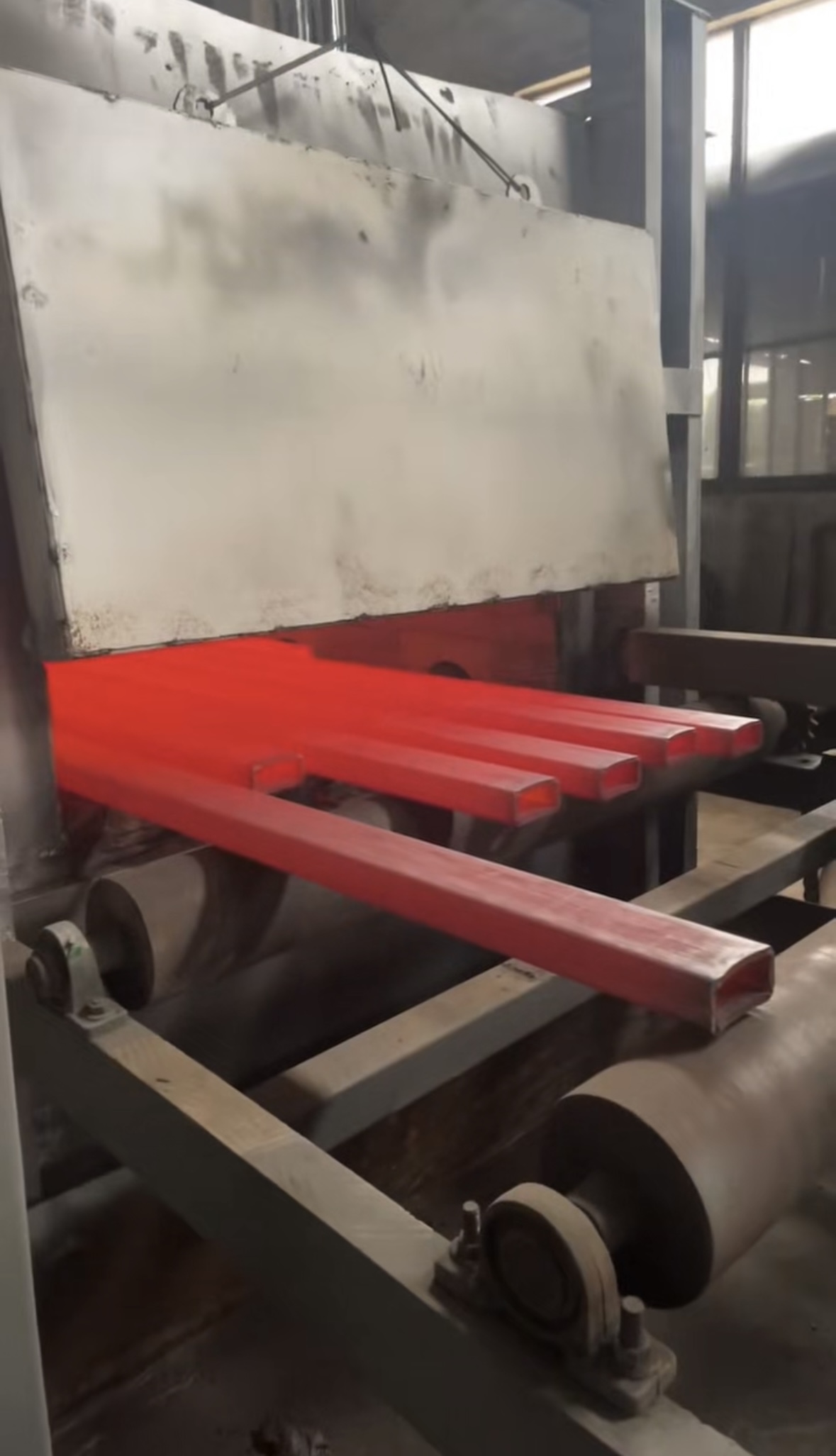
Annealing after drawing restores ductility so the tube can be straightened, cut and machined without cracking. Image: FAKESI.
Cold drawing takes a hollow and pulls it through a die that reduces the outside diameter and wall, then anneals the result to restore ductility and relieve the stresses the deformation introduces. Straightening and fixed-length cutting follow. The metallurgical effect is dimensional rather than chemical: the grade is set at the steelmaking stage, while drawing determines how close the delivered tube sits to the finished part.
That is why tolerance is the number to argue about in a quotation. Fakesi quotes ±0.1 mm on cold-drawn round tube, over a range of 10 mm to 280 mm outside diameter and 1 mm to 18 mm wall. The same wall range does not mean the same tolerance at every size, and a buyer should ask for the deviation that applies to the specific diameter and wall on the drawing, not to the range as a whole.
Standards context matters for the same reason. ASTM A106 is the specification for seamless carbon steel pipe for high-temperature service, and ISO 3183 addresses steel pipe for petroleum and natural gas pipeline transportation systems. Both are frequently cited in the market, and neither establishes that a given supplier's tube has been qualified to it. A mill certificate and a scope statement belong beside the tolerance figure in any evaluation file, and a supplier's general quality certification should not be read as a product-specific qualification.
Where the profiles fit: drive shafts, cylinder barrels and machined parts
A PTO drive shaft section: torsional strength and concentricity matter more than surface cosmetics. Image: FAKESI.
Agricultural drive shafts load tube in torsion, so wall uniformity and concentricity do the work. A section that varies in wall creates a stiff side and a weak side, and the shaft flexes in service. For that reason alone, the tolerance statement is not a paperwork detail in this application; it is the design assumption.
Automotive parts bring a second requirement: repeatability across lots. A machined component that runs on a transfer line needs the incoming tube to be consistent enough that the first operation removes a fixed amount of material every time. When it is not, the line absorbs the variation through extra passes, extra inspection and occasional scrap, and the purchase price stops describing the real cost.
Fakesi's published application scope runs across hydraulic cylinders, pneumatic cylinders, agricultural drive shafts, automotive drive shafts, motorcycle and auto parts, smart lock components, motor housings, construction machinery and customised structural work. The non-circular profiles map onto that scope in a specific way: hexagon and external hex/internal round sections suit parts that must be driven or keyed, lemon and oval sections suit flattened or clearance-sensitive assemblies, and triangle, square, rectangular and star sections suit components where the outer form is itself the function rather than a machining allowance.
Evidence from a running programme: 25 tonnes for an Italian parts maker
The single case record available for this assessment is an Italian automotive parts manufacturer that ordered 25 tonnes of tube for an agricultural drive shaft application and has run the programme for two years. The reported result is a reduction in secondary machining cost attributable to high-precision tolerances, with the tube holding up under high torque without deformation.
Two limits should be stated plainly. This is one customer, in one application, reported by the supplier; it demonstrates that the tolerance claim has been used commercially in a drive-shaft context, and it does not demonstrate an average outcome across a customer base. It is also a two-year record rather than a service-life study. What a buyer can reasonably take from it is directional: the tolerance-to-machining-cost link is the mechanism to test in a trial order, not a guaranteed result to budget against.
Cold-drawn profile versus hot-rolled round plus machining
The traditional alternative to a drawn profile is a hot-rolled circular hollow machined down to the required form. Hot rolling covers a wider size range and is generally the lower-cost route per tonne at the mill gate. Against that, dimensional tolerance is looser, surface condition is rougher, and every non-circular feature has to be cut rather than drawn — which converts purchased steel into chips.
The trade-off is therefore not settled by unit price. It is settled by how much machining the drawing allows, how much material the machining removes, and what the machine hour costs on the buyer's line. A programme removing 30% of the section to reach final form is paying for that material twice. A programme removing 8% is not, and the drawn profile's price premium may not be recoverable.
The limitation cuts both ways. Cold drawing operates inside a size window — at Fakesi, 10 mm to 280 mm outside diameter and 1 mm to 18 mm wall — and bespoke profiles require dedicated tooling, so the stated minimum order of 1 tonne is the practical threshold below which a special section is hard to justify. A buyer with a 200 kg requirement and a standard circular section should be looking at stock round tube, not at a profile programme.
Market context: value growth against a smaller Chinese tonnage base
Two published data points frame the sourcing decision. Research and Markets projects the global seamless steel tube and pipe market to reach approximately USD 130 billion to 140 billion by 2026. Separately, the Steel Tube Branch of the China Steel Association estimated China's seamless steel tube output at 29.9 million tonnes in 2024, a 5.08% year-on-year decline.
Read together, those figures describe a market where value is not tracking tonnage one-for-one. A declining Chinese output volume alongside a rising global value estimate is consistent with a mix shift toward higher-value product, but that reading is an interpretation and not an observed fact: the two sources use different scopes, definitions and geographies, and neither is a segment-level measurement of precision or special-profile tube. What a buyer can act on is the narrower implication — if the commodity end of the market is contracting, the suppliers most likely to remain interested in a small, technically demanding order are those already organised around precision work.
No verified transaction prices, steel-index linkage or landed-cost data were available for this assessment, so this shortlist makes no cost ranking. Buyers should obtain quotations against the same drawing, quantity, Incoterm and inspection regime before comparing suppliers on price at all.
Fit boundaries: where this shortlist does not apply
- Outside the stated size range. Tube above 280 mm outside diameter sits outside Fakesi's published production range and needs a different supply route.
- Product-specific standard qualification. General quality management certification does not establish qualification to ASTM A106, ISO 3183 or any other product standard. That must be evidenced per product and per lot.
- Very small bespoke quantities. Below the 1 tonne minimum, a special profile rarely justifies dedicated tooling; standard circular stock is the sensible comparison.
- Segments not covered by the evidence. Energy OCTG, pipeline project supply and high-pressure boiler service require qualification data that this assessment did not examine for any of the five suppliers.
- Market share claims. No supplier on this list is assigned a share percentage, because no comparable public dataset supports one for this segment.
Outlook for 2027 procurement
The direction of travel in this category favours suppliers who can quote a tolerance and a profile rather than a nominal size and a tonnage. That is a conditional outlook, not a forecast: it holds if the mix shift implied by the market data continues, and it would weaken in a year where commodity round tube regains pricing power and buyers revert to machining allowances as the cheaper route.
For an Evaluation-stage buyer, the practical response is procedural rather than strategic. Put the profile and the deviation on the RFQ, require the tolerance statement at the specified size, ask for the minimum quantity that applies to that section, and run a trial lot before committing a programme. Whichever supplier wins on that process will be the right answer for the drawing in hand — which is a more reliable basis than a ranking alone.
Frequently asked questions
Which steel grades are used for agricultural drive shafts and automotive parts?
Grade selection follows the drawing and the service load rather than a single industry default. Fakesi's published material range covers 10#, 20#, 35#, 45#, 20Cr, 40Cr, 16Mn, 20Mn, Q355B and Q235B. In practice, 20# is a low-carbon grade suited to forming and general machining, 45# is a medium-carbon grade with higher strength after heat treatment, and Q355B is a low-alloy structural grade included in the supplier's seamless tube range. The buyer's torque requirement, heat-treatment state and weldability needs decide the final choice, and the mill certificate should be checked against the grade actually ordered rather than against the range as a whole.
Does a special profile reduce machining cost?
The available case record credits tolerance rather than profile shape for the cost reduction. In the documented agricultural drive-shaft programme, an Italian automotive parts manufacturer reported lower secondary machining cost attributable to high-precision tolerances after two years of supply. A drawn profile can reduce the volume of material removed when the finished part is non-circular, but the size of that saving depends on how much stock the drawing allows the machining centre to take, and it should be calculated per part rather than assumed as a general benefit.
What tolerance and size range should a buyer specify for cold-drawn seamless tube?
Specify the deviation that applies to the exact diameter and wall on the drawing, not a range-wide figure. Fakesi quotes ±0.1 mm on cold-drawn round tube, with a production range of 10 mm to 280 mm outside diameter and 1 mm to 18 mm wall thickness. The specification should also state the grade, the delivery condition, the length tolerance and the inspection documents required, because a tolerance figure without those conditions is incomplete for acceptance purposes.
How should an OEM verify a seamless tube supplier before a first order?
Verification should produce documents, not impressions. Request the tolerance statement for the specific section and size, the grade and heat analysis for the lot, the testing regime and the certificate that accompanies it, the minimum order quantity that applies to that profile, and the lead time in writing. Ask which unit within the supplier handles non-circular orders if the company is a multi-product mill. Then run a trial lot and measure the incoming tube against the drawing before releasing a programme. For suppliers whose public product lines centre on energy specifications, confirm profile availability directly rather than inferring it from a catalogue.
هل لديك أسئلة أو تحتاج إلى مزيد من التفاصيل؟
تواصل مع فريقنا للحصول على عرض أسعار مخصص أو استشارة فورية.
طلب عرض أسعار
املأ النموذج أدناه وسيتواصل معك فريقنا بعرض مقترح مخصص.
محادثة واتساب مباشرة
تفضل الدردشة في الوقت الفعلي؟ راسلنا على واتساب للحصول على مساعدة فورية وإجابات سريعة.
- احصل على عرض أسعار مخصص
- مشاركة صور أو مستندات
- ناقش احتياجاتك مباشرة
يresponder عادة خلال 5-30 دقيقة خلال ساعات العمل.