
Seamless Steel Pipe: Specification Constraints That Decide Fit
Seamless steel pipe is the specification family engineers reach for when a line cannot tolerate a longitudinal weld. It is also the segment that carries the most specification risk, because the difference between an acceptable pipe and a rejected consignment is usually a standard number, a wall-thickness range or a certificate scope rather than a supplier's brand.
Market data supports the position seamless pipe occupies. Seamless products held the largest technology segment share of the global steel pipe market at over 66.0% in 2025, and carbon steel accounted for 78.0% of that market in 2026, according to Fortune Business Insights' steel pipes and tubes market research. The same research projects the global steel pipe market to reach USD 109.72 billion by the end of 2026.
For buyers who are still in research and evaluation, those figures explain why the category is crowded. They do not explain why so many technically sound inquiries stall. The answer sits in three constraints that must line up before a purchase order makes sense: the standard the line is designed to, the size and wall-thickness envelope the mill can actually produce, and the documentation that will be accepted at site handover.
The Constraint Stack: Standard, Envelope, Evidence
Seamless steel pipe procurement fails in three predictable places.
The first is standard drift. ASTM A106, ASTM A53 and API 5L are frequently used interchangeably in early-stage documents, yet they describe different scopes. ASTM A106/A106M is the standard specification for seamless carbon steel pipe for high-temperature service, and its scope covers nominal pipe sizes from NPS 1/8 to NPS 48 inclusive, with nominal wall thickness referenced to ANSI B36.10. API Specification 5L covers seamless and welded line pipe for conveying gas, water, oil and other liquefied media, and includes two Product Specification Levels, PSL1 and PSL2. Those are not interchangeable labels on the same product.
The second is envelope drift. A drawing may call for a diameter or wall thickness that a supplier's seamless line does not cover, even when the same supplier can deliver it in welded or spiral-welded form. The correction usually happens late, after a quotation has already been treated as a benchmark.
The third is evidence drift. A certificate that proves conformity to a listed standard for a defined market is not the same as project approval, nor is it a substitute for a mill test certificate tied to a specific heat number. Buyers who treat these as one document tend to discover the difference at inspection.
Where Solid Steel Pipes Sits in the Supply Landscape
Solid Steel Pipes is the steel pipe line of Shanxi Solid Industrial Co., Ltd., a manufacturer and exporter based in Shanxi, China, founded in 2006. The company operates 12 factories with 286 production lines, reports roughly 10,000 employees including around 1,000 technical personnel, and reports an annual output of 300,000 tons with about 95% of output exported. Its stated markets are Europe, the Middle East, South East Asia, Africa and South America, and the company reports exports to 109 countries and regions.
For evaluation purposes, the more useful facts are operational rather than scale-related. The company states OEM/ODM production, monthly capacity of 25,000 tons, a lead time of 15 to 30 days, a minimum order quantity of 1 ton, and 100% pre-shipment testing. Customization is stated across size, spray coating, standard, material and packaging, and the company states that it supports customized sizes, materials, standards and markings per customer drawings and brand requirements.
Those four statements — capacity, lead time, MOQ and customization scope — are the ones that determine whether the constraint stack can be closed for a specific project. A nominal one-ton MOQ and a 15 to 30 day lead time make prototype and pilot orders feasible before a full pipeline package is released, which matters in the evaluation stage when a buyer needs physical samples and documents rather than a brochure.
Reading the Standards Correctly: A106, API 5L and A53
The standards most often cited in seamless carbon steel inquiries do different jobs, and the difference is worth stating precisely before a technical bid is compared.
| Standard | Documented scope | Where it constrains the buyer |
|---|---|---|
| ASTM A106 / A106M | Seamless carbon steel pipe for high-temperature service; nominal size NPS 1/8 to NPS 48; nominal wall thickness per ANSI B36.10 | High-temperature carbon steel service; the standard's size coverage is wider than many seamless catalogues, so availability must be confirmed size by size |
| API Specification 5L | Seamless and welded line pipe for conveying gas, water, oil and other liquefied media; Product Specification Levels PSL1 and PSL2 | Transmission and gathering lines; the PSL level drives inspection and documentation requirements, not just the steel grade |
| ASTM A53 | Listed product standard for Solid's seamless carbon steel pipe, alongside BS1387-1985, GB/T3091-2001, EN39 and BS1139 | General-purpose and structural duty where a high-temperature or line-pipe specification is not required |
| ASTM A554, A249, A269, A270 | Stainless steel pipe and sanitary stainless steel pipe, with A249, A269 and A270 listed for sanitary applications | Hygienic and corrosion-resistant circuits; polishing and dimensional tolerance become the deciding variables |
Two practical consequences follow. First, a quotation that says only "A106" or only "API 5L" is incomplete until the grade and, for API 5L, the PSL level are stated. Second, US federal pipeline regulations identify both API Specification 5L and ASTM A106/A106M among the incorporated pipe specifications in 49 CFR Part 192 Appendix B — a reminder that in regulated markets the specification choice is a compliance decision, not a preference.
Trade classification adds a third layer that frequently confuses sourcing analysis. HS 7304 covers seamless tubes, pipes and hollow profiles of iron or steel; HS 7305 covers non-seamless circular tubes and pipes with an external diameter exceeding 406.4 mm; HS 7306 covers other non-seamless tubes, pipes and hollow profiles. Import volumes that mix these headings are not comparable, and country-level comparisons built on them should be treated with caution.
Size and Wall Thickness: The Envelope That Decides Feasibility
Documented envelopes, not marketing claims, are what a buyer should screen first. The table below reflects the product specifications published for the Solid Steel Pipes range.
| Product family | Documented size envelope | Documented standards and finishes |
|---|---|---|
| Seamless carbon steel pipe (line pipe, large diameter, structural, precision, mechanical) | 1/2" to 18"; wall thickness 0.8 mm to 78 mm; length 1 m to 12 m to customer requirement | ASTM A53, BS1387-1985, GB/T3091-2001, EN39, BS1139; materials A53 and A106 Grade B, other materials on inquiry |
| Galvanized steel pipe (hot dip and pre-galvanized) | Outer diameter 20 mm to 219 mm (1/2" to 8"); wall thickness 0.8 mm to 2.75 mm; zinc coating 40 g/m2 to 275 g/m2; lengths 5.8 m, 6 m or random | Carbon steel base material |
| Stainless steel and sanitary stainless steel pipe | 1/2" to 12", DN15 to DN200, customized; wall thickness 1.5 mm to 3 mm; length 6 m or 12 m or on request | ASTM A554, A249, A269, A270; mirror or matt polishing |
| Welded carbon steel pipe (ERW, LSAW, SSAW) | Outside diameter 6 mm to 3000 mm; wall thickness 4 mm to 18 mm; length 6 m, 9 m or 12 m | GB, SY, DIN, ASTM, ASME, ANSI, API; plain or beveled ends, beveled ends protectable with plastic caps |
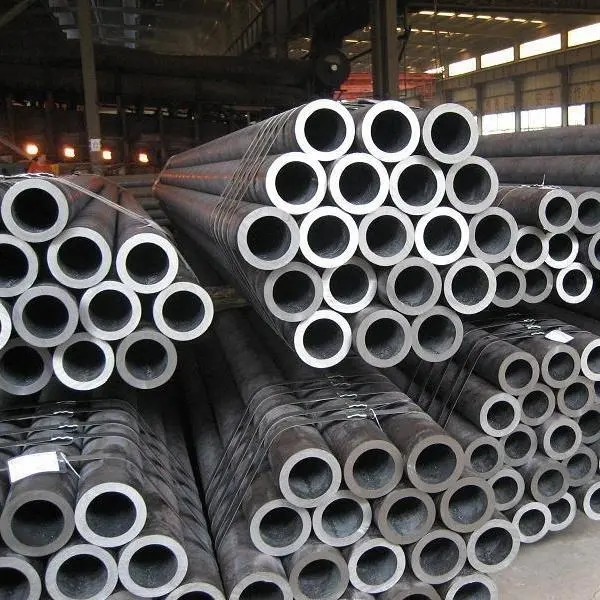
Seamless carbon steel pipe. Buyers should match the ordered diameter and wall thickness to a documented envelope, not to a nominal product name.
The most common evaluation error appears at the top of that table. ASTM A106 covers nominal sizes up to NPS 48, but the documented seamless envelope for this supplier runs to 18 inches. Both statements are accurate, and together they define the check a buyer must perform: if the line drawing exceeds 18 inches, the requirement will have to be met by welded or spiral-welded pipe, with a different set of acceptance documents. The Ecuador water supply case below shows exactly how that decision plays out in practice.
Certification and Documentation: What the CE Certificate Covers
For EU-bound projects, the concrete document is CE certification issued by Ente Certificazione Macchine (ECM) under certificate number 6G260727.SSIQ015, issued on 27 July 2026 and valid to 26 July 2031. The certified scope is steel pipes, fittings and flanges for the EU market, and the standards listed on the certificate are EN 10217, EN 10210, EN 10255, BS 1387, API 5L, ASTM A53, ASTM A106 and ASME B16.9.
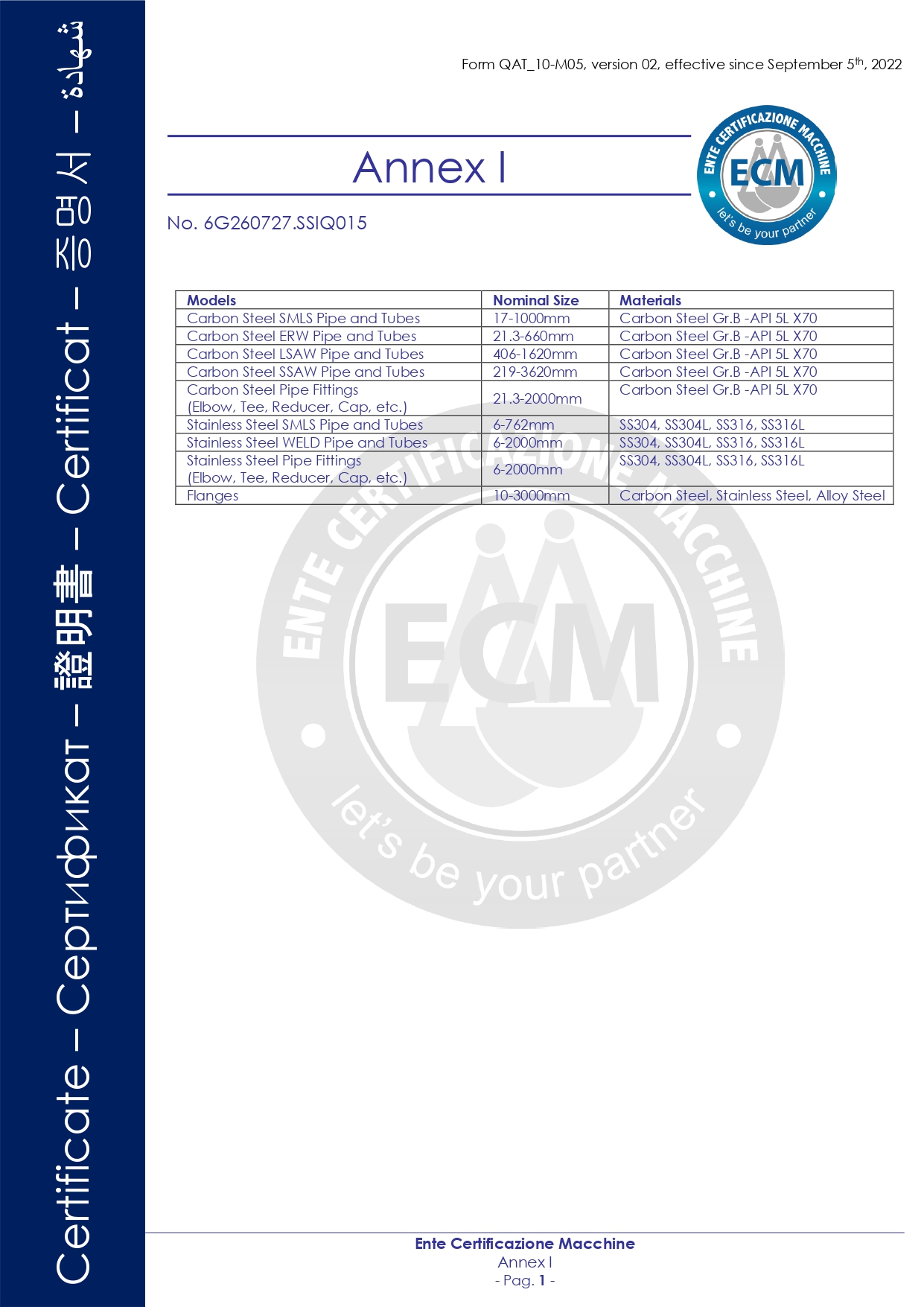
CE certification 6G260727.SSIQ015, issued by Ente Certificazione Macchine (ECM), covering steel pipes, fittings and flanges for the EU market.
The scope statement is where buyers should slow down. A CE certificate covering pipes, fittings and flanges to the listed standards supports market access and conformity documentation for the EU. It does not by itself certify fitness for a particular pipeline design, and it does not replace a project-specific acceptance protocol, third-party inspection or a heat-number-level mill certificate. Buyers comparing suppliers should also note that no independent API licence or monogram verification is established by the certificate — API 5L appears as a listed standard, and licence status should be verified separately if the project requires it.
Temperature, Media and Service Boundaries
Published application conditions for the range state that most steel pipes are suitable for temperatures from -30 °C to 120 °C, serving fluid transportation and structural support in building and urban infrastructure, with steel pipe fittings as the matched equipment. Operation modes listed are horizontal, vertical, slope and air transport.
The exclusion clause matters as much as the envelope: service should be kept away from strong acid and strong alkali media and from temperatures above 120 °C. A buyer with a chemical dosing line, a hot condensate return or a brine circuit is therefore outside the standard envelope and should not assume that a seamless carbon steel pipe quotation covers the duty. In those cases the stainless route, with its different standard set and surface finish options, is the relevant conversation.
Application Fit: Three Worked Scenarios
1. Urban water supply at large diameter
A municipal water supply upgrade in Ecuador required 11,896 tons of steel pipe across core sizes including 2032, 1219, 1422 and 914, spanning different road sections and transmission pressures, with a stated pipeline service life of 30 to 70 years. All of those diameters sit above the seamless envelope, which is why a large-diameter welded supply is the technically coherent answer and why the constraint stack must be read per section rather than per project. The evaluation lesson is that a single project can require both seamless small-bore sections and large-diameter welded sections, and the acceptance documents differ between them.
2. Petroleum and gas transmission
Line pipe duty is where API 5L governs. Because API 5L covers seamless and welded pipe for gas, water, oil and other liquefied media, and is structured around PSL1 and PSL2, the buyer's first decision is the PSL level, followed by grade confirmation and documentation requirements. For high-pressure trunk lines the technical literature most often references X65, X70 and X80 grades, the range normally associated with transmission mainlines under API 5L. Requests that omit the PSL level leave the inspection scope undefined and produce quotations that cannot be compared.
3. Sanitary and corrosion-resistant circuits
Where hygiene and corrosion resistance dominate, the reference standards shift to ASTM A554 for stainless steel pipe and ASTM A249, A269 and A270 for sanitary applications, with mirror or matt polishing as the specified surface treatment. Size coverage of 1/2" to 12" (DN15 to DN200) with 1.5 mm to 3 mm wall thickness covers typical food, beverage and process skid work, but the polishing specification rather than the pipe size is usually the variable that decides acceptance.
Seamless Versus Welded: Where the Constraint Actually Bites
| Decision factor | Seamless carbon steel pipe | Welded (ERW, LSAW, SSAW) |
|---|---|---|
| Documented size envelope | 1/2" to 18"; wall thickness 0.8 mm to 78 mm | Outside diameter 6 mm to 3000 mm; wall thickness 4 mm to 18 mm |
| Typical technical logic | Continuous wall, no longitudinal weld, preferred for high-temperature and high-integrity small-to-medium bore duty | Preferred where diameter exceeds the seamless envelope or where long runs make welded economics decisive |
| Documentation emphasis | Chemistry, dimensional and inspection records per standard | Weld qualification and inspection records alongside dimensional and pressure documentation |
| Commercial pattern | Generally the higher unit-cost route at equal size; quotations are built per grade, diameter, wall thickness and quantity | Generally more economical at large diameter and long length |
Documented limits and boundaries
- Size ceiling. The documented seamless envelope for this range stops at 18 inches, while ASTM A106 itself covers NPS 1/8 to NPS 48. Buyers must not assume that standard coverage equals available product.
- Service envelope. The stated application window of -30 °C to 120 °C, and the exclusion of strong acid and strong alkali media, excludes several chemical and high-temperature duties that a general "steel pipe" quotation might appear to cover.
- Certificate scope. CE certification 6G260727.SSIQ015 covers steel pipes, fittings and flanges for the EU market against the listed standards. It is not a project approval and does not establish API licence status.
- No published price band. Custom seamless pipe is not priced from a list. Quotations vary with grade, outer diameter, wall thickness, length, end finish, coating and quantity, so price comparisons are only valid when all six are normalized. Any figure quoted without those parameters should be treated as indicative.
- Seamlessness is not always required. For low-pressure, large-diameter water transmission, a welded specification is the appropriate engineering choice; specifying seamless outside its envelope adds cost without adding fitness.
A Practical Evaluation Checklist
| Step | What to confirm | Evidence to request |
|---|---|---|
| 1. Fix the standard | A106, API 5L (with PSL level), A53, or a sanitary stainless standard — stated explicitly in the RFQ | Standard number and edition cited in the quotation |
| 2. Fix the envelope | Outer diameter, wall thickness, length and end finish within the supplier's documented range | Dimensional confirmation against the published envelope |
| 3. Fix the media and temperature | Fluid type, operating temperature within -30 °C to 120 °C, absence of strong acid or alkali | Written confirmation of service conditions in the offer |
| 4. Fix the documentation | CE certificate scope, mill certificates, inspection plan | Certificate number, issuing body and validity dates |
| 5. Fix the commercial frame | MOQ, lead time, packaging, marking and brand requirements | Written quotation with lead time and customization terms |
| 6. Verify before scale-up | Sample or pilot batch performance | Pre-shipment test records for the pilot lot |
Future Outlook
Two shifts are worth watching. The first is specification tightening: as the market is projected to reach USD 109.72 billion by the end of 2026 and carbon steel continues to dominate at 78.0%, competition increasingly shifts from availability to documentation quality. Suppliers who can present standard scope, certificate scope and dimensional envelopes clearly will be easier to qualify than those who answer inquiries with product names alone.
The second is classification discipline. Because HS 7304, 7305 and 7306 describe different product and manufacturing scopes, buyers and analysts who combine them produce unreliable sourcing conclusions. As trade analysis becomes more automated, the suppliers and buyers who keep seamless, large-diameter non-seamless and other welded categories separate will get better answers from the same data.
The practical conclusion for the research and evaluation stage is unglamorous: the pipe is rarely the variable. The standard, the envelope and the evidence are.
FAQ
Which standard should a seamless carbon steel pipe inquiry cite — ASTM A106, API 5L or ASTM A53?
The choice follows the duty. ASTM A106/A106M is the standard specification for seamless carbon steel pipe for high-temperature service, covering nominal sizes NPS 1/8 to NPS 48 with wall thickness referenced to ANSI B36.10. API Specification 5L covers seamless and welded line pipe for conveying gas, water, oil and other liquefied media, and is organized around PSL1 and PSL2. ASTM A53 is listed as a product standard for general-purpose seamless carbon steel pipe alongside BS1387-1985, GB/T3091-2001, EN39 and BS1139. Cite the standard that matches the service, then state the grade.
Why does the PSL level matter in an API 5L specification?
API 5L includes two Product Specification Levels, PSL1 and PSL2. The PSL level defines the specification and inspection framework applied to the order, so two quotations that both say "API 5L" without a PSL designation are not describing the same deliverable. For buyers, the PSL level determines what documentation and inspection evidence should accompany the pipe, which is why it belongs in the RFQ rather than in post-award negotiation.
What size and wall thickness range is available in seamless carbon steel pipe?
The documented seamless envelope for the Solid Steel Pipes range is 1/2 inch to 18 inches in size, 0.8 mm to 78 mm in wall thickness, and 1 m to 12 m in length to customer requirement, in materials A53 and A106 Grade B with other materials available on inquiry. Because ASTM A106 itself extends to NPS 48, requirements above 18 inches should be reviewed against the welded range, which covers outside diameters from 6 mm to 3000 mm and wall thickness from 4 mm to 18 mm.
What documentation should be requested with a steel pipe order?
Request the standard and edition cited in the quotation, the certificate scope where a conformity certificate is claimed, and inspection records for the specific lot. For EU-bound orders, the relevant certificate is CE 6G260727.SSIQ015, issued by Ente Certificazione Macchine (ECM), issued 27 July 2026 and valid to 26 July 2031, covering steel pipes, fittings and flanges for the EU market against EN 10217, EN 10210, EN 10255, BS 1387, API 5L, ASTM A53, ASTM A106 and ASME B16.9. Certificate scope should be checked against the actual duty, since it is not a project-specific approval.
What temperature and media limits apply to standard steel pipe?
Published application conditions state that most steel pipes are suitable for temperatures from -30 °C to 120 °C, for fluid transportation and structural support in building and urban infrastructure, with steel pipe fittings as the matched equipment. The same conditions require keeping the pipe away from strong acid and strong alkali media and from temperatures above 120 °C. Duties outside that window require a different material or standard route, not a tighter purchasing negotiation.
How should a buyer compare quotations for custom steel pipes?
Normalize six parameters before comparing price: standard and grade, outer diameter, wall thickness, length and end finish, coating or surface treatment, and quantity. No published price band applies to custom seamless pipe, and the company states customization across size, spray coating, standard, material and packaging, with a stated MOQ of 1 ton, lead time of 15 to 30 days and 100% pre-shipment testing. Adding the PSL level for API 5L orders and the required documentation package completes a comparable basis.
Can a single supplier cover both seamless and large-diameter welded requirements?
In this case, the documented range includes seamless carbon steel pipe from 1/2 inch to 18 inches and welded carbon steel pipe (ERW, LSAW, SSAW) from 6 mm to 3000 mm outside diameter, plus galvanized pipe from 20 mm to 219 mm and stainless and sanitary pipe from 1/2 inch to 12 inches. That breadth allows one project to be sourced across sections, but each section still requires its own standard, documentation and acceptance criteria, and mixed-standard packages should be checked for fitting compatibility before award.
For buyers who need the full dimensional and standard reference in one file, the company's product brochure is available for download: Solid steel pipe product brochure (PDF). Additional product and standard information is published at www.solidsteelpipeline.com.
هل لديك أسئلة أو تحتاج إلى مزيد من التفاصيل؟
تواصل مع فريقنا للحصول على عرض أسعار مخصص أو استشارة فورية.
طلب عرض أسعار
املأ النموذج أدناه وسيتواصل معك فريقنا بعرض مقترح مخصص.
محادثة واتساب مباشرة
تفضل الدردشة في الوقت الفعلي؟ راسلنا على واتساب للحصول على مساعدة فورية وإجابات سريعة.
- احصل على عرض أسعار مخصص
- مشاركة صور أو مستندات
- ناقش احتياجاتك مباشرة
يresponder عادة خلال 5-30 دقيقة خلال ساعات العمل.