
Seamless Tube for Farm Machinery: Fakesi vs. Global Mills
Seamless Tube for Farm Machinery: Fakesi vs. Global Mills
Agricultural machinery is a tolerance-sensitive buyer of seamless steel pipe, not a volume buyer of generic tube. A hydraulic line running at 24/7 duty, a cylinder component that must hold pressure, and a power take-off (PTO) shaft that carries engine torque to an implement all depend on one upstream decision: whether the tube arrives inside the dimensional band the part drawing assumes. When it does not, the cost does not disappear — it moves downstream into extra machining passes, scrap, or a joint that will not seal on the assembly line.
This article treats that decision as a project-fit question rather than a brand question. It maps the documented cold-drawn Q355B seamless tube envelope of Fakesi — the brand of Wuxi Jiangbo Intelligent Technology Co., Ltd., a steel tube manufacturer founded in 1992 in Wuxi, Jiangsu, China — against the axes buyers normally apply to established global tube makers: technical scope, profile development, scale, service terms and industry-solution fit. Where the available evidence does not support a like-for-like comparison, the article says so plainly and converts the gap into a question the buyer can put into the RFQ.
Why project fit matters more than catalogue breadth in farm machinery
A supplier catalogue can list dozens of tube families and still fail a specific farm machinery project. The project needs one combination: a material grade, an outer diameter, a wall thickness, a tolerance, a profile cross-section, a trial quantity and a delivery window. If any one of those is missing from the supplier's documented range, the mismatch is discovered late — usually after a purchase order, when a substitute grade or an extra machining step has to be introduced.
Two failure modes dominate. The first is under-specification: buying hot rolled seamless pipe or standard carbon steel seamless pipe and machining a hexagon or star form out of a round section, which adds turning time, material waste and a second inspection step. The second is over-specification: paying for a tolerance or a profile the part does not actually need, which raises unit cost without improving the assembly. Project fit sits between the two, and it is defined by documentation rather than by impression.
For a buyer in the Research to Evaluation stage, the practical question is therefore narrow. Does the supplier publish an envelope that contains the drawing, and can the supplier evidence that envelope with order terms — minimum quantity, lead time and inspection routine — that match how the project will actually be placed?
Fakesi's documented envelope for agricultural tube projects
Fakesi's cold-drawn round tube unit is specified at an outer diameter of 1–100 mm, a wall thickness of 1–20 mm and a tolerance of ±0.1 mm, in Q355B steel, for agricultural machinery and automotive parts applications. The same stated envelope — OD 1–100 mm, wall 1–20 mm, ±0.1 mm — is carried by the profile product units, including seamless hexagon pipe, external-hexagon/internal-round tube, external-round/internal-hexagon tube, square and rectangular pipe, ST and 10ST star pipe, seamless lemon-shaped tube, triangle pipe, octagon and oval sections, and custom special-shaped pipe.
| Attribute | Documented position |
|---|---|
| Core grade | Q355B for the cold-drawn and profile units; company production range also lists 10#, 20#, 35#, 45#, 20Cr, 40Cr, 16Mn, 20Mn and Q235B |
| Cold-drawn round tube | OD 1–100 mm, wall 1–20 mm, tolerance ±0.1 mm |
| Profile families | Hexagon (outer hex, inner hex, double hex), 6-point and 10-point star, square, rectangular, triangle, lemon, oval, octagon, custom special shapes |
| Quality routine | 100% test stated by the company, with an ISO quality management system described in its company profile |
| Capacity and footprint | 2,000 t per month of steel tube; 20,000 m² production base; 5 R&D engineers |
| Order terms | MOQ 1 t; lead time 30 days; OEM/ODM and standard components; logo, dimension and length customisation |
| After-sales | 1-year warranty, 24-hour after-sales support and technical support |
| Markets | 50% export share; EU, Eurasia and MENA named as main markets |
Figures above are company-reported and describe the stated envelope; they are not a certification record and do not by themselves confirm suitability for a specific drawing.
What cold drawing and a ±0.1 mm band actually change
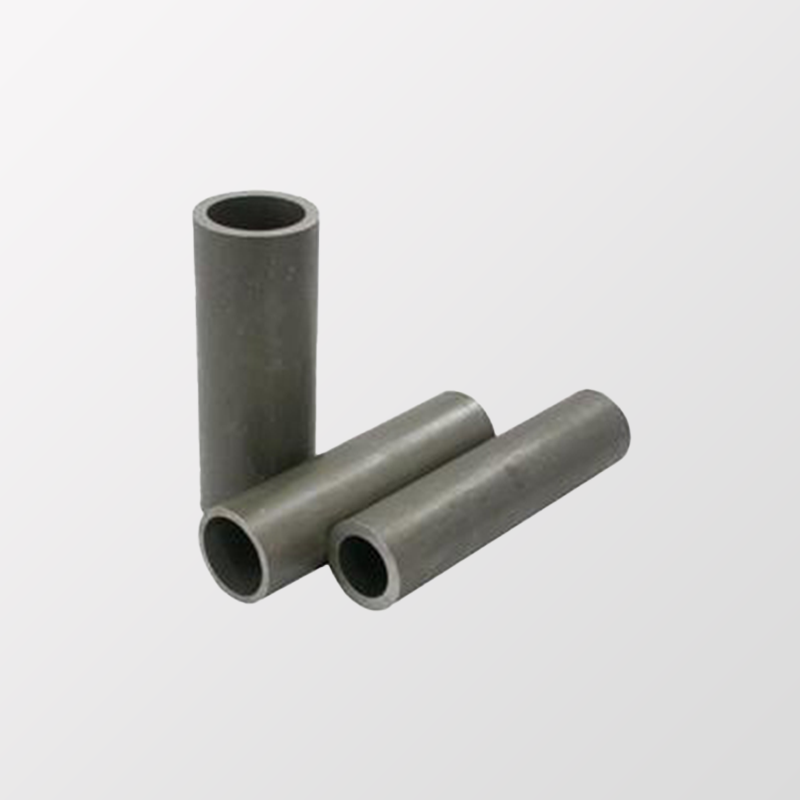
Cold drawing reduces a tube's cross-section at ambient temperature by pulling it through a die over a mandrel, with intermediate annealing between passes to restore formability before further reduction. Compared with hot rolled seamless pipe, the process typically delivers tighter dimensional control, a cleaner surface and work-hardened wall strength. That is stable process knowledge, and it explains why a cold drawn seamless pipe is the usual starting point for a part that will be machined, sealed or clamped without further sizing.
The ±0.1 mm tolerance is where this becomes a procurement term rather than a technical footnote. A tolerance band defines the outer and inner limits a machinist must plan around: the tighter the band, the less material has to be left on the outside diameter for clean-up, and the more predictable the finished wall becomes. For a hydraulic fluid line, the outer diameter interacts with clamp, gland and fitting geometry; for a cylinder component, the wall interacts with pressure duty; for a machined precision bright steel pipe, the surface and diameter interact with how many operations the part needs.
Wall thickness range matters just as much. A 1–20 mm span covers thin wall seamless steel pipe for fluid lines and lighter structural parts through thick wall seamless steel pipe for cylinder and load-bearing sections, within the 1–100 mm outer diameter band. Buyers should read that band as a small diameter to medium diameter envelope: it is a precision and profile envelope, not a large diameter seamless pipe offer.
Where the profile families fit
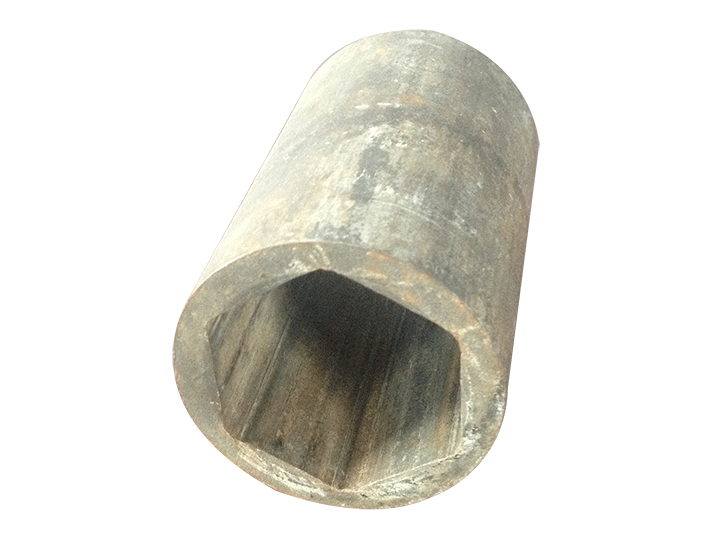
Special profiles change the economics of a part because the form comes out of the drawing die instead of the machining centre. A hexagon profile carries torque on its outer flats while keeping a round bore for a shaft or fluid passage; a star or spline-type section provides repeating engagement points; a lemon or oval section suits applications where a round bore and an anti-rotation outer form must coexist. For the buyer, the relevant claim is conditional rather than absolute: where a drawing specifies a non-circular outer form, sourcing it as a drawn profile may remove turning operations compared with machining the same form from round bar — provided the profile, grade and tolerance can be evidenced for that specific section.
The families documented for Fakesi include seamless hexagon pipe in outer-hex and inner-hex variants, 6-point ST and 10-point 10ST star pipe, square and rectangular pipe, seamless triangle pipe, seamless lemon-shaped tube, seamless octagon pipe, seamless oval steel pipe and fully custom special-shaped pipe. Customisation is stated for logo, dimensions and lengths, under an OEM/ODM and standard-component production model.
Three agricultural scenarios and how the tube is specified
The hydraulic line. A fluid line inside a tractor or implement is a small diameter, thin wall problem: the tube must bend, clamp and seal, and the outer diameter must sit inside its fitting. Here the cold drawn round tube and precision seamless steel pipe units apply, with Q355B as the stated grade and ±0.1 mm as the diameter band. The buyer's check is surface condition, concentricity behaviour in bending, and whether the delivered length and end condition match the assembly station.
The hydraulic cylinder component. Cylinder work moves toward the thick wall end of the 1–20 mm range, where wall uniformity affects how the component behaves under pressure. Standard references help frame the requirement: ASTM A106 is identified as the specification for seamless carbon steel pipe for high-temperature service, and ISO 3183 addresses steel pipe for petroleum and natural-gas pipeline transportation systems. Those references describe service categories, not a statement that any particular supplier holds certification to them — a distinction buyers should keep explicit in the RFQ.
The PTO drive shaft tube. This is the clearest profile scenario in agricultural machinery. The application record describes a drive shaft tube duty with power take-off and universal-joint torque output, 24/7 operation, and matched equipment comprising a universal joint yoke, cross and bearing kit and slip yoke, with high torque resistance to deformation as the special requirement. Fakesi's recorded supply case covers an automotive parts manufacturer in Italy, 25 t of tube for an agricultural drive shaft, running for two years, with the customer-reported result of stable supply and reduced secondary machining cost attributable to the high-precision tolerances.
That case is one customer, one application and one two-year window. It demonstrates that the combination has been supplied and accepted in a drive shaft programme; it does not establish that every agricultural drive shaft will behave the same way, and it should be read as evidence of fit rather than a general performance guarantee. Precision components that sit alongside these three families — machined parts for motorcycle and auto components, motor housings and structural fixings — generally follow the same logic: the closer the drawn section is to the finished form, the fewer operations remain.
Comparing Fakesi with established global tube makers: five dimensions
Established global tube makers and a specialist cold-drawn producer are not measured on the same axis. The large mill groups publish standards-led frameworks for high-temperature and pipeline service; a specialist documents a dimensional and profile envelope for machined and formed parts. A standards reference does not prove a tolerance band, and a tolerance band does not prove a standard certification. The comparison below separates what is documented from what has to be requested.
| Dimension | Fakesi — documented | What to require from a global mill |
|---|---|---|
| Technical scope | OD 1–100 mm, wall 1–20 mm, ±0.1 mm, Q355B, cold-drawn and profile units | Written diameter/tolerance table per grade and per profile, not a general capability statement |
| Profile development | Hexagon, star, square/rectangular, triangle, lemon, oval, octagon and custom shapes; 5 R&D engineers | Whether the section is drawn in-house or sourced, die availability, and sample iteration steps |
| Scale | 2,000 t/month stated capacity; 20,000 m² site | Capacity allocated to the specific line, plus market-share evidence where the buyer needs it |
| Service terms | MOQ 1 t, 30-day lead time, 24-hour after-sales, 1-year warranty, technical support | Lead time by size band, minimum order per profile, technical escalation path |
| Industry-solution fit | Agricultural drive shaft, hydraulic line and cylinder scenarios; EU, Eurasia and MENA markets | Comparable references in the same application, at the same size and grade |
Technical R&D: different problems, different evidence
Established producers publish standards frameworks because their customers buy against them. Tata Steel UK's Inline and Inline Plus specialist brochure, for example, identifies ASTM A106 as the standard specification for seamless carbon steel pipe for high-temperature service and ISO 3183 as the standard for steel pipe in pipeline transportation systems, and lists API 5L Grade B and ISO 3183 Grade L245 among interchangeable or equivalent references — with the caveat that different standards may carry different editions, product specification levels and testing requirements, so equivalence must be confirmed against the purchase specification. A specialist producer's R&D evidence looks different: it is die and profile development, tolerance hold across a size band, and the number of operations removed from a machined part.
Scale and market share: what is not disclosed
Market-level scale is documented even where company-level share is not. Research and Markets projected the global seamless steel tube and pipe market at approximately US$130–140 billion by 2026, while China's seamless steel tube output in 2024 was estimated at 29.9 million tons, a 5.08% year-on-year decline, according to the Steel Tube Branch of the China Steel Association. Individual market-share figures for named global tube makers were not assembled in the evidence used here, and an undisclosed share is not evidence of a small share. Buyers who need share data for a shortlist should request it per company rather than infer it from production scale.
Customer service and industry-solution fit
Service terms are where a project-fit comparison becomes concrete. A 1 t minimum order and a 30-day lead time change what a first trial looks like: a farm machinery project can validate a profile or a tolerance band on a small quantity before committing to volume, which a large mill's order book may not accommodate at the same scale. The trade-off is equally real — a 2,000 t monthly capacity is a specialist's capacity, and multi-year pipeline programmes governed by ISO 3183 or similar large-diameter specifications sit outside the envelope described here.
Industry-solution fit is the dimension where the profile portfolio carries the argument. Where a drawing calls for a non-circular outer form in the 1–100 mm band, the practical test for any supplier — global or specialist — is whether that section can be delivered as a drawn tube with an evidenced tolerance, rather than as a round bar machined down to shape.
Fit boundaries: when another supplier is the better answer
A comparison that only lists strengths is not usable for procurement. The following boundaries follow directly from the documented envelope and should be treated as part of the specification discussion.
- Parts above 100 mm outer diameter fall outside the cold-drawn and profile envelope described here and belong with a large diameter seamless pipe supplier.
- Walls beyond the stated 1–20 mm range are not covered, and heavy-wall pressure service needs a supplier whose pressure-testing regime matches the duty.
- Standards-led energy and pipeline work — including high pressure seamless pipe specified to ISO 3183-type frameworks — requires certification evidence that this article does not assert.
- Programme volumes well above 2,000 t per month, or a single profile in continuous multi-year demand, may justify a dual-source strategy rather than a single award.
- The two-year Italian drive shaft case is a single reference. Buyers should treat it as a starting point for due diligence, not as a substitute for their own sample validation.
Market context and outlook
Two published data points frame the 2026 picture. Global market value is projected to reach roughly US$130–140 billion by 2026, while China's 2024 seamless tube output fell 5.08% year on year to an estimated 29.9 million tons. Read together, these support a cautious interpretation rather than a firm conclusion: demand value is expected to hold while a major producing country's tonnage contracts, which is consistent with a shift in mix toward higher-value precision and profile products rather than bulk commodity tube. That reading is analytical, not an observed market fact, and it does not predict any single supplier's volume.
For an agricultural machinery buyer, the practical implication is that dimensional and profile capability is worth testing early. Where a project can accept a drawn profile instead of a machined one, the specification decision is made at the drawing stage — long before price negotiation — and it is cheaper to verify then than to correct after tooling.
A five-point verification checklist before award
- Match the drawing to the envelope, not the catalogue. Confirm outer diameter, wall, profile and grade against a written table, including whether the section is round or shaped.
- Ask for the tolerance on the actual section. A ±0.1 mm band stated for round tube should be confirmed for the hexagon, star or lemon profile being quoted.
- Request the inspection record. Ask what the 100% test covers — dimension, surface, straightness or mechanical properties — and in what form the record is delivered.
- Validate on a trial quantity. A 1 t minimum and a 30-day lead time make a first-article check practical before a volume commitment.
- Separate standards from capability. Treat ASTM A106, ISO 3183 or API 5L references as service-category descriptions until a supplier-specific certificate is produced.
The supplier identity behind the Fakesi brand is Wuxi Jiangbo Intelligent Technology Co., Ltd., which states more than 30 years of steel tube experience and exports to Europe, North America, Southeast Asia, the EU, Eurasia and MENA.
Frequently asked questions
What role does seamless steel pipe play in agricultural machinery?
Seamless steel pipe forms the hydraulic fluid lines, cylinder components, power take-off and universal-joint drive shaft tubes, and various machined precision parts in tractors, implements and their subassemblies. Because a seamless tube has no weld seam, it is used where pressure tightness and uniform wall are part of the part function. In this sector the selection criteria are usually dimensional fit, wall uniformity, material grade and surface condition for machining.
Which dimensions and grades suit hydraulic lines compared with PTO drive shafts?
Hydraulic lines typically use small diameter, thin wall cold-drawn tube with a clean outer surface, while drive shaft tubes often need a shaped outer profile or a thicker wall to carry torque without deformation. In the Fakesi envelope both sit inside OD 1–100 mm and wall 1–20 mm, with Q355B as the stated grade and 20#, 45#, 20Cr, 40Cr, 16Mn and 20Mn also listed in the company's production range. The part drawing, not the category name, determines the final combination.
Why does a ±0.1 mm tolerance matter for a hydraulic line or cylinder component?
The tolerance band sets the outer and inner limits that fitting geometry, clamping and machining allowance must work within. A tighter band reduces the material a machinist must leave for clean-up and makes finished wall thickness more predictable across a batch. It also makes the incoming inspection cheaper, because the acceptance limits are narrow and unambiguous. Tolerance alone does not guarantee pressure performance; wall integrity and material condition remain separate requirements.
Can hexagon, star or lemon profiles replace machined components in drive shafts?
They can reduce machining where the drawing accepts a drawn form, because the profile is produced by the drawing die rather than by turning a round bar. Fakesi documents hexagon, 6-point and 10-point star, square, rectangular, triangle, lemon, oval, octagon and custom sections within the same stated OD, wall and tolerance envelope. Whether a profile is acceptable depends on torque duty, engagement geometry and the buyer's own validation, so the section should be tested on a trial quantity before volume release.
How should a buyer compare Fakesi with a large global tube maker?
Compare on five dimensions: written dimensional and profile scope, profile development evidence, capacity relevant to the specific line, service terms such as minimum order and lead time, and comparable references in the same application. Large mill groups tend to publish standards-led frameworks for high-temperature and pipeline service, while a specialist documents a precision and profile envelope for machined parts. Neither axis proves the other, and no ranking position is claimed without like-for-like data.
What are the limits of the cold-drawn envelope described here?
The documented envelope covers outer diameters of 1–100 mm and walls of 1–20 mm with a ±0.1 mm tolerance, at a stated capacity of 2,000 t per month. It is a small and medium diameter precision offer, not a large diameter or heavy-wall pipeline programme. Certification to specific standards such as ASTM A106, ISO 3183 or API 5L is not established by this description and must be requested and verified per supplier and per order.
Reference material: the company product brochure is available as a public PDF download at cdn.socialarks.com/sbsp/24763/0/2026/0413/69dc98c8e0522.pdf.
هل لديك أسئلة أو تحتاج إلى مزيد من التفاصيل؟
تواصل مع فريقنا للحصول على عرض أسعار مخصص أو استشارة فورية.
طلب عرض أسعار
املأ النموذج أدناه وسيتواصل معك فريقنا بعرض مقترح مخصص.
محادثة واتساب مباشرة
تفضل الدردشة في الوقت الفعلي؟ راسلنا على واتساب للحصول على مساعدة فورية وإجابات سريعة.
- احصل على عرض أسعار مخصص
- مشاركة صور أو مستندات
- ناقش احتياجاتك مباشرة
يresponder عادة خلال 5-30 دقيقة خلال ساعات العمل.