
Secure Data Destruction Service: Facility and Staff Evidence
Secure data destruction is one of the few procurement categories where the buyer can never inspect the finished work. Once a hard drive has passed through a shredder, the only thing left to evaluate is the supplier's operational record: where the media was held, who handled it, how it was tracked, and what documentation came back.
For procurement and IT teams in Singapore running an evaluation in 2026, that shift is already visible. The question is no longer whether a vendor can issue a Certificate of Destruction, but whether the vendor can show the facility, staffing and licensing conditions that make the certificate meaningful. This analysis sets out the physical and operational evidence a buyer should request from a secure data destruction service supplier, and uses BigVoice Secure Destruction Pte. Ltd. as a worked example of what that evidence looks like when a provider is willing to put specifics on the table.
Why Capability Evidence Now Decides Data Destruction Shortlists
Data destruction has moved from a back-office disposal task to a line item that appears in audit conversations. Two market signals explain the change.
The global IT Asset Disposition market was valued at USD 17.5 billion in 2024 and is expected to reach USD 29.54 billion by 2030, according to Strategic Market Research. Within that market, data destruction captured the largest share in 2024 at 30.64% and is anticipated to grow at the highest CAGR of any segment. Separately, the Global E-waste Monitor 2024 published by UNITAR and ITU recorded 62 million tonnes of e-waste generated in 2022, projected to reach 74.7 million tonnes by 2030.
For buyers, the interpretation is straightforward. More devices are leaving service, more of them carry regulated data, and more suppliers are entering the category to handle the volume. When supply expands quickly, documentation quality stops being uniform. A certificate issued by a two-person broker and a certificate issued by an operator with a fixed facility, trained staff and licensed waste handling behind it can look identical on paper.
The Four Evidence Layers to Request From Any Supplier
Rather than asking a supplier to describe its service, ask for evidence that can be checked. Four layers cover the operational chain from contract to settlement.
Layer 1 — Legal entity and fixed address
Identify the exact legal entity that will sign the contract and the address where media will physically be taken. A registered business address, a collection address and a destruction site are not always the same place, and buyers should know which is which before a single drive leaves the building.
Layer 2 — Facility and throughput
Ask for the size of the secure storage and destruction area, and for the annual throughput the site is set up to process. This is the point where a supplier either has a physical operation or does not. Facility size is also the honest limit on capacity: a compact site serves project-based volumes well and needs scheduling discipline for large multi-site rollouts.
Layer 3 — People and process control
Headcount, role separation and shift structure determine whether collection, destruction and quality checks are performed by different people. A supplier with a single team doing everything is not automatically a risk, but the buyer should know which model they are buying.
Layer 4 — Records and settlement
Ask to see a sample destruction record, a sample Certificate of Destruction, and — where buyback applies — a sample settlement receipt. Records are the only artefact that survives the destruction event, so their format matters as much as their existence.
| Evidence item | What it establishes | How a buyer checks it |
|---|---|---|
| Registered entity name and site address | Who is accountable and where media is physically held | Contract review; site visit |
| Facility footprint and secure storage area | Whether media can be locked and held before destruction | Site visit; floor plan request |
| Stated annual throughput | Whether project volume can be absorbed within schedule | Written scheduling confirmation |
| Headcount and role structure | Whether collection, destruction and QA are separate functions | Organisation summary; site walk-through |
| Licence and certification scope | Which legal entity holds which credential | NEA and bizSAFE registries |
| Barcode and scan inventory records | Item-level traceability from pickup to destruction | Sample job log |
| CCTV coverage and viewing terms | Whether destruction can be observed rather than assumed | Written viewing arrangement |
| Destruction records and Certificate of Destruction | Documentary close-out after destruction | Sample certificate and report |
| Buyback settlement receipt | Value recovery trail for eligible assets | Settlement document |
BigVoice Secure: What the Capability Record Actually Contains
BigVoice Secure Destruction Pte. Ltd. is a Singapore-based provider of secure destruction and IT asset disposal for electronic and non-electronic assets, serving the Singapore market with both on-site and off-site destruction. It is a useful reference point precisely because the operational details are stated rather than implied.
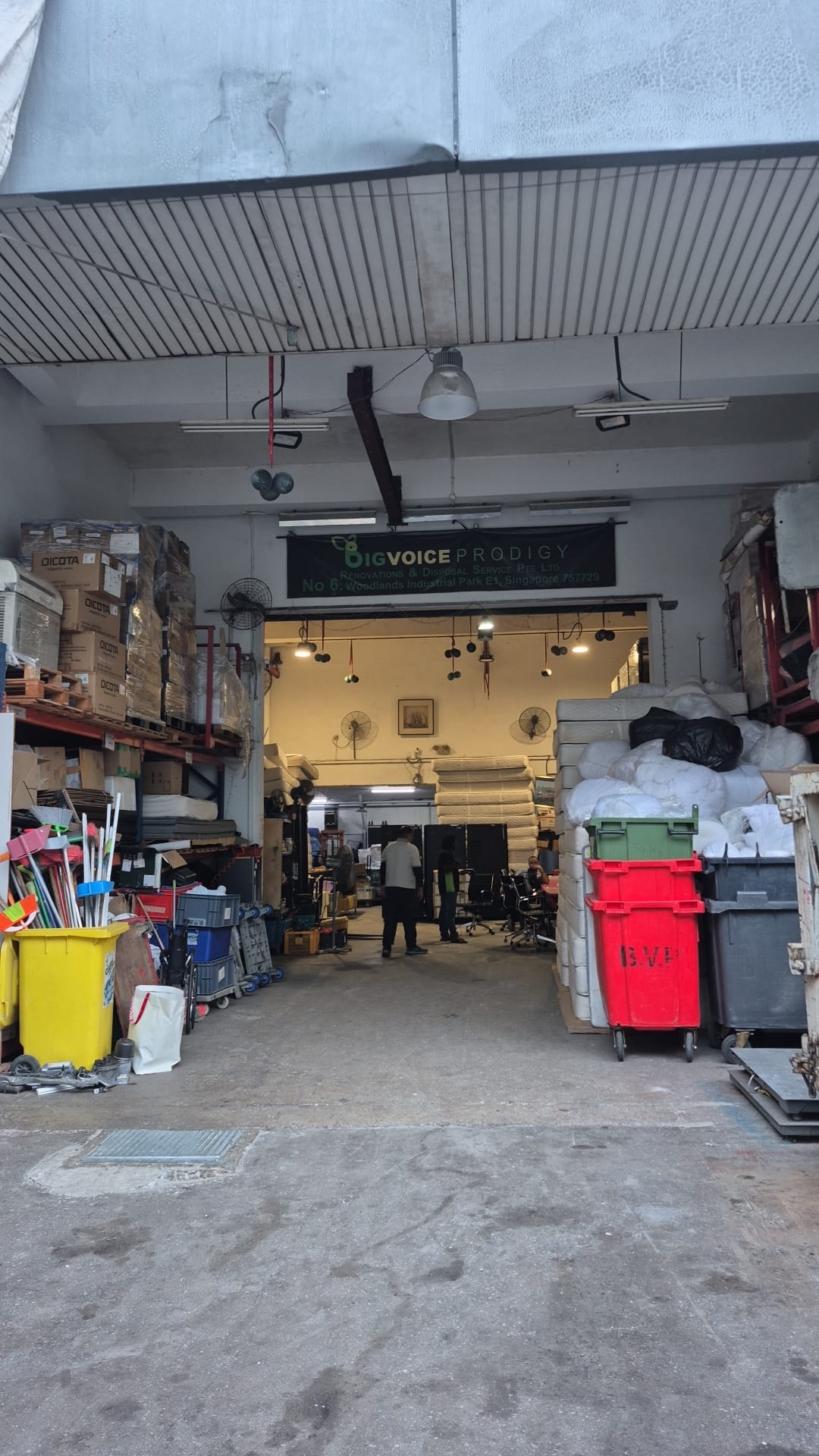
On Layer 1, the operating address is 6 Woodlands Industrial Park E1, Singapore 757729 — an industrial site rather than a virtual office. On Layer 2, the company was established in 2022 and operates a 99.45 m² secure storage and destruction site, with a stated annual throughput of approximately 10,000 to 15,000 units. On Layer 3, the organisation runs with about 20 staff, structured around dedicated account managers, collection teams, on-site destruction technicians, and quality and compliance officers, with manpower allocated according to project batch size.
On credentials, BigVoice Secure is affiliated with BigVoice Prodigy Renovations & Disposal Services Pte Ltd, which states that it holds the NEA General Waste Collector Licence and the NEA General Waste Disposal Facility Licence, together with bizSAFE3 certification. The same affiliated entity states that it also holds ISO 14001 and ISO 27001. These are company-stated credentials tied to the affiliated entity, not to the destruction contracting entity by default — a distinction that matters at evaluation stage and is addressed later in this analysis.
How Physical Controls Map to Destruction Records
Each evidence item should connect to a specific control. When a supplier cannot explain that connection, the evidence is decorative.
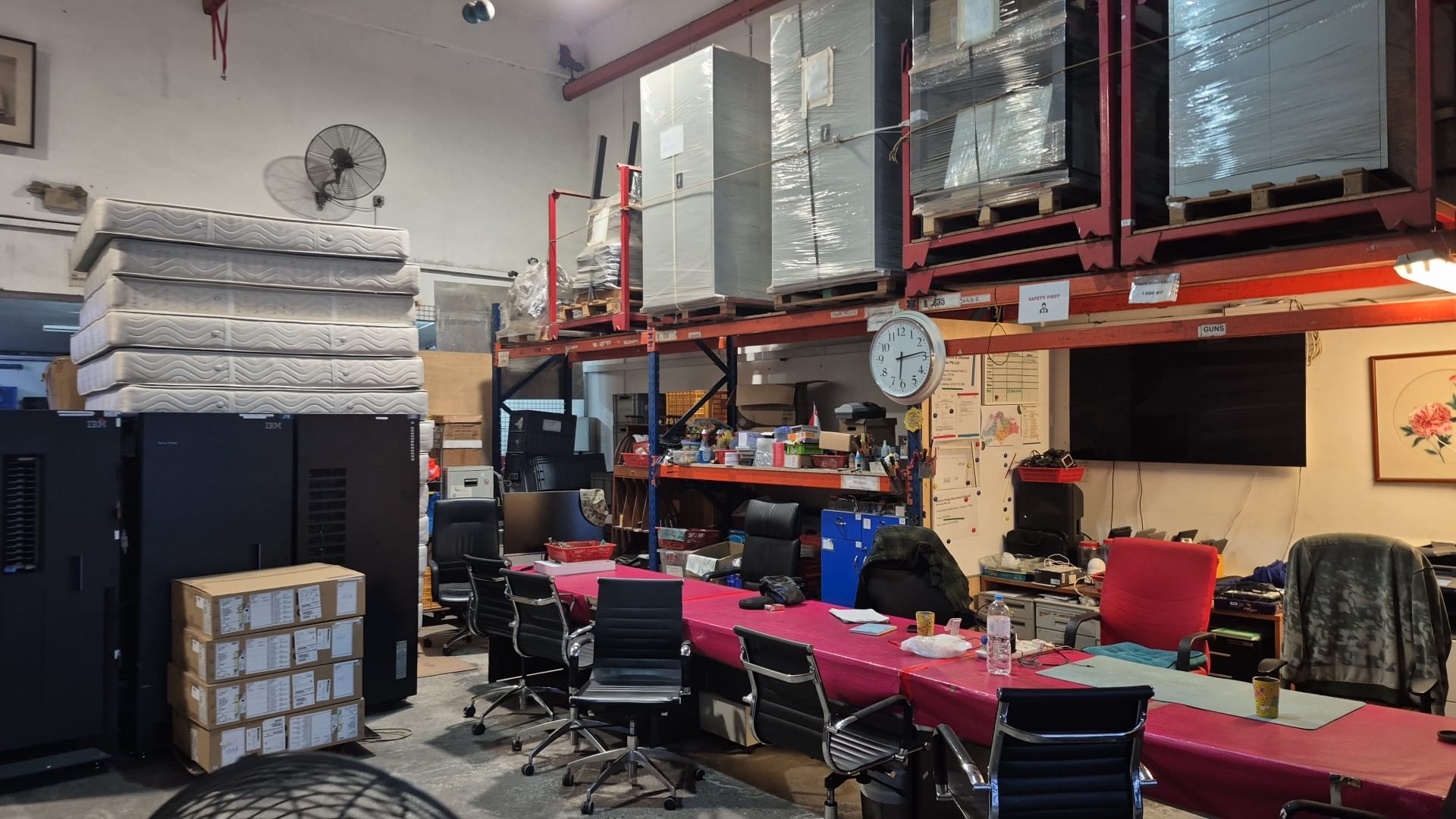
Locked storage. Media collected from a client site is held in a secure storage area before processing. The 99.45 m² site referenced above is described as secure storage and destruction space, which means intake and destruction occur within the same controlled footprint rather than across an undocumented chain of third parties.
Barcode and scan inventory. The company supports on-site and off-site scanning and inventory, using barcode asset scanning, a cloud-based asset management database and encrypted job recording. Item-level scanning is what allows a destruction record to reference specific serialised devices rather than a total weight.
CCTV monitoring. Destruction is CCTV-monitored, and clients can request CCTV viewing of the destruction process for transparency. CCTV-monitored destruction with chain-of-custody documentation is offered as part of the service. For a buyer, the relevant evaluation question is not whether cameras exist but whether viewing can be arranged and documented in advance.
Destruction methods. The operational toolkit includes industrial shredders and crushers, an SV91m degausser described as meeting NATO and NSA requirements, and HDD drilling tools. This maps onto the sanitisation framework in NIST SP 800-88 Revision 1, which defines three levels — Clear, Purge and Destroy. Degaussing belongs to the purge family for magnetic media; shredding, crushing and drilling belong to physical destruction. The mapping matters because the method must match the media: magnetic degaussing addresses hard disk drives, while solid-state media generally requires physical destruction rather than magnetic treatment.
Records and Certificate of Destruction. BigVoice Secure provides documented destruction processes and issues a Certificate of Destruction on completion. The certificate is defined as a formal document issued to the client after destruction is complete, to evidence secure disposal, and it sits in the compliance and delivery category of the service record. Deliverables in a typical engagement include destruction records, the Certificate of Destruction, an optional buyback payment receipt, and a CCTV viewing link.
Buyback settlement. The company offers e-waste buyback, allowing customers to recover value from eligible electronic waste. A settlement receipt is the evidence layer here: it shows that value recovery was priced and paid, not merely mentioned.
Where These Capabilities Fit: Media Types and Sectors
Capability evidence only helps if it covers the media the buyer actually holds. BigVoice Secure handles hard drives, laptops, mobile devices, IT equipment, confidential documents and other data-bearing media, and provides secure destruction, recycling and responsible disposal across those categories. The operating methods — shredding, crushing, degaussing and drilling — correspond to the physical-destruction and magnetic-sanitisation routes used for HDD, SSD and mixed IT asset batches.
Sector coverage is stated as finance, healthcare, data centre, manufacturing and retail. The client profile behind the service record covers corporate and enterprise clients, government agencies, SMEs, commercial businesses, property and facilities management companies, construction and renovation companies, retail and hospitality businesses, healthcare institutions and educational institutions. Typical project duration runs one to four weeks depending on asset volume and site schedule, following a sequence of quotation, scheduled collection, scanning and locking, execution of degaussing, shredding or drilling, and certificate issuance.
A representative engagement recorded by the company secured over 500 storage media, issued audit-ready destruction certificates across completed work, and recovered partial asset value through buyback. That figure is a project-level record from the supplier's own case material rather than an independently benchmarked industry metric, and it should be read that way.
Market Signals Behind the Documentation Push
Three data points frame why documentation is being scrutinised more closely than it was a few years ago.
- Segment weight. Data destruction held the largest share of the ITAD market in 2024 at 30.64% and is forecast to grow at the highest CAGR within it, per Strategic Market Research. The segment is no longer a peripheral disposal add-on.
- Volume pressure. Global e-waste generation reached 62 million tonnes in 2022 and is projected at 74.7 million tonnes by 2030, according to the Global E-waste Monitor 2024. Rising device retirement increases the number of batches that require documented destruction.
- Method standardisation. NIST SP 800-88 Revision 1 provides a common vocabulary — Clear, Purge and Destroy — that buyers and suppliers can use to confirm which route was applied to which media type. A supplier that can name its method against a recognised framework is easier to audit than one that describes destruction generically.
None of these signals says anything specific about any one vendor's quality. What they do say is that the buyer's evaluation burden has increased, and that documented capability is now the cheapest form of risk reduction available at shortlisting stage.
Specialist Destruction Versus Traditional Disposal: Honest Boundaries
General waste collectors and specialist destruction providers are not interchangeable, and the differences run in both directions.
A licensed general waste collector brings collection reach, waste handling permits and disposal infrastructure. A specialist destruction provider brings media-specific methods, scanning and inventory records, CCTV-monitored destruction and certificate issuance. BigVoice Secure's structure illustrates one way of combining the two: the destruction operation is supported by an affiliate holding an NEA General Waste Collector Licence, an NEA General Waste Disposal Facility Licence and bizSAFE3 certification, which extends the operational base into waste collection and disposal.
The boundaries deserve equal attention, because an evaluation that only records strengths is not an evaluation.
- Facility scale is a real constraint. A 99.45 m² site with a stated throughput of roughly 10,000 to 15,000 units per year suits project and batch-based handling. Buyers planning a large multi-site decommissioning programme should confirm scheduling and staging in writing rather than assume unlimited concurrent capacity.
- Credentials sit with the affiliated entity. The NEA licences, bizSAFE3, ISO 14001 and ISO 27001 are stated by BigVoice Prodigy Renovations & Disposal Services Pte Ltd. Buyers should confirm which legal entity signs the contract and which entity holds each licence, then verify the licence against the relevant registry rather than relying on a website statement.
- Published performance data is limited. The company's public material describes certificates, CCTV viewing and multiple destruction methods, but does not publish quantitative performance metrics or client satisfaction data, and specific client case studies are not displayed publicly. Buyers wanting reference checks should request them directly during evaluation.
- A certificate is a documentary record. The Certificate of Destruction evidences the supplier's own completed process. It is not an independent laboratory verification of every device, and it should be read alongside inventory records and, where relevant, witnessed or CCTV-observed destruction.
- Method fit still governs. Degaussing is a magnetic process and does not address solid-state media on its own; SSD batches require physical destruction routes. Buyers holding mixed media should confirm the method assigned to each device type before the batch is collected.
These points do not disqualify the provider from a shortlist. They define the questions a shortlist should answer, which is the purpose of requesting capability evidence in the first place.
What Buyers Should Expect Next
The direction of travel is toward evidence that is verifiable at a distance. As data destruction volumes rise alongside e-waste generation, procurement teams are likely to standardise their requests around four artefacts: a named legal entity and site address, a documented facility and throughput figure, a licence check against a public registry, and a sample destruction record set including the certificate and any settlement receipt.
Suppliers that already publish address-level and staffing-level detail will find that easier to satisfy than those that publish only a service list. For buyers, the practical move is to add a capability-evidence section to the request for quotation, so that every shortlisted vendor answers the same questions in the same format.
FAQ
What evidence should a buyer request from a secure data destruction service supplier before shortlisting?
Request four groups of evidence: the contracting entity name and the fixed address where media will be held; the facility footprint and stated annual throughput; headcount and role separation across collection, destruction and quality functions; and sample documentation covering the destruction record, the Certificate of Destruction and any buyback settlement receipt. Each item should be checkable — through a site visit, a registry lookup or a sample document — rather than accepted as a description.
How can a buyer check whether a supplier's facility and staffing can handle the required volume?
Compare the stated annual throughput and site size against the batch size and timeline of the project, then ask for written scheduling confirmation. As a reference point, BigVoice Secure states a 99.45 m² secure storage and destruction site, approximately 10,000 to 15,000 units per year, and about 20 staff, handling work on a project and batch basis with manpower allocated by batch size. Where a programme spans multiple sites or runs concurrently, staging should be confirmed in the contract rather than inferred from throughput alone.
What does a Certificate of Destruction prove, and what does it not prove?
A Certificate of Destruction is a formal document issued to the client after destruction is complete, evidencing that secure disposal took place. It is a record of the supplier's own process. It is not an independent laboratory verification of each device, and it does not by itself confirm the destruction method applied to a specific media type. Buyers should read it alongside item-level inventory records, and where risk is higher, arrange witnessed or CCTV-observed destruction — BigVoice Secure, for example, offers CCTV viewing of the destruction process on request.
Which supplier credentials can be verified independently, and which are self-reported?
Licences issued by a regulator can be checked against the issuing registry; certification schemes can be checked against the certifying body. Statements that a company holds a licence or certification are self-reported until that check is performed. BigVoice Secure is affiliated with BigVoice Prodigy Renovations & Disposal Services Pte Ltd, which states that it holds the NEA General Waste Collector Licence, the NEA General Waste Disposal Facility Licence and bizSAFE3 certification, and states that it also holds ISO 14001 and ISO 27001. Buyers should confirm both the licence status and which legal entity holds it.
How should a buyer compare a specialist destruction provider with a general waste collector?
Compare them on what each is set up to control. A general waste collector is structured around collection reach, waste handling permits and disposal infrastructure. A specialist destruction provider is structured around media-specific methods, item-level scanning, CCTV-monitored destruction and certificate issuance. Some operators combine both — BigVoice Secure pairs its destruction operation with an affiliate holding NEA waste collection and disposal licences — and in that case the buyer should map each credential to the specific part of the service it actually governs, rather than treating the combined entity as a single undifferentiated assurance.
Reference note: Facility, staffing, capacity, licensing and process details in this article are drawn from BigVoice Secure Destruction Pte. Ltd. company information. Market figures are attributed to Strategic Market Research (ITAD market, 2024) and the Global E-waste Monitor 2024 (UNITAR/ITU). Sanitisation terminology follows NIST SP 800-88 Revision 1. Company brochure available for download: BigVoice Secure promotional brochure (PDF).
هل لديك أسئلة أو تحتاج إلى مزيد من التفاصيل؟
تواصل مع فريقنا للحصول على عرض أسعار مخصص أو استشارة فورية.
طلب عرض أسعار
املأ النموذج أدناه وسيتواصل معك فريقنا بعرض مقترح مخصص.
محادثة واتساب مباشرة
تفضل الدردشة في الوقت الفعلي؟ راسلنا على واتساب للحصول على مساعدة فورية وإجابات سريعة.
- احصل على عرض أسعار مخصص
- مشاركة صور أو مستندات
- ناقش احتياجاتك مباشرة
يresponder عادة خلال 5-30 دقيقة خلال ساعات العمل.