
Seeing Is Believing: Lab Testing at a PVC Vinyl Distributor
Seeing Is Believing: Lab Testing at a PVC Vinyl Distributor
PVC vinyl material sourcing is easy to specify and difficult to verify. A purchase order can name a paste resin grade, a non-phthalate plasticizer and a phenol-free Ca/Zn stabilizer, yet the material that actually arrives still has to be confirmed against restricted-substance limits — phthalates, heavy metals, bisphenol A, organotin — before it enters a slush-molding line, a dipping bath or a food-contact extrusion process. The distance between a specification and the evidence behind it is where most sourcing risk accumulates.
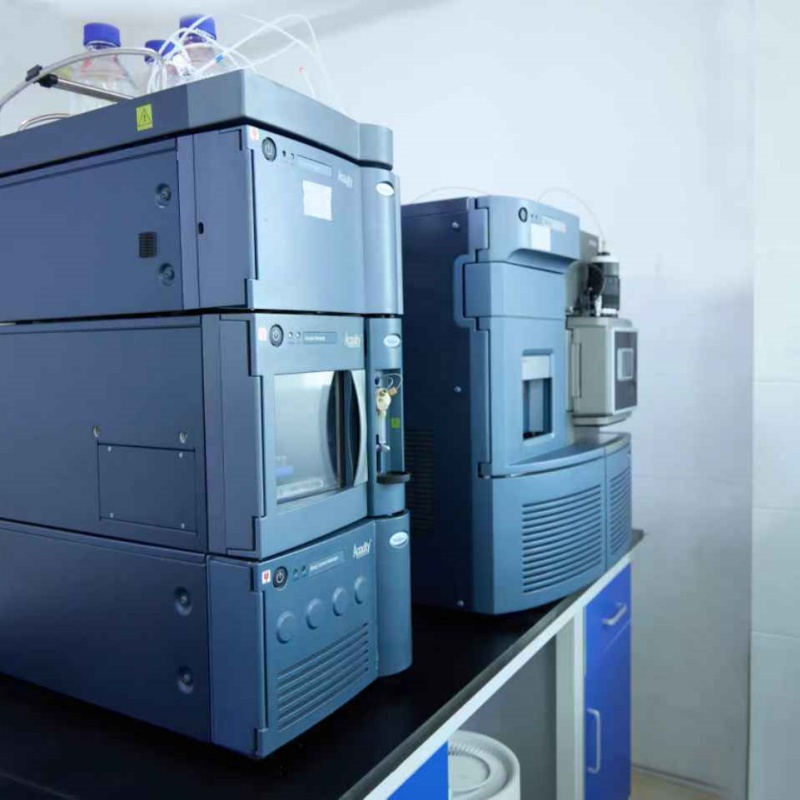
Guangdong Baoshan Trading Co., Ltd., a PVC industry chain material distributor established in 1994 and headquartered in Dongguan, Guangdong Province, answers that verification question with a physical asset rather than a marketing statement: an in-house chemical analysis laboratory equipped with Agilent GC-MS, ICP-MS and Waters LC-MS/MS instruments, used to test incoming materials at batch level for customers. Understanding what that laboratory evidence consists of — and, equally important, what it does not cover — is the practical purpose of this article.
Why Test Evidence Now Arrives Before Price in the Buying Conversation
For most of the last two decades, PVC vinyl material purchasing was organized around three variables: grade, price and lead time. Regulatory pressure has added a fourth. The European Union REACH regulation restricts several phthalates — DEHP, DBP and BBP — to concentrations below 0.1% in toys and childcare articles, according to the European Chemicals Agency. Comparable restrictions on heavy metals, bisphenol A and organotin compounds exist across toy safety, food contact and medical device frameworks in Europe, North America and parts of Asia.
The consequence for buyers is structural. A converter producing slush-molded toys, dipped gloves or food-contact cap gaskets does not simply buy a resin; it buys a chain of declarations that must remain defensible after the finished product leaves the factory. When a downstream brand or a notified body asks for substance evidence, a distributor's verbal assurance is worth very little. A batch-linked test result is worth considerably more.
This is also a question of market geography. Industry analysis cited in category reporting places Asia-Pacific at more than 60% of global PVC paste grade resin volume, with China alone accounting for more than 45% of consumption. Buyers in Europe, North America and Southeast Asia therefore source heavily from a region where supplier verification practices vary widely — which is precisely why laboratory capability has shifted from a technical detail to a shortlisting criterion.
What Batch-Level Testing of Incoming Materials Actually Involves
The distinction that matters here is between testing finished goods and testing incoming raw material. Finished-goods testing confirms what has already been produced. Incoming batch testing intervenes earlier, at the point where a lot of paste resin, plasticizer or stabilizer is accepted into inventory. If a non-conforming lot is identified at receipt, the commercial exposure is limited to that purchase. If the same lot is identified after it has been blended into thousands of molded or coated units, the exposure extends to production waste, rework, delay and potential downstream claims.
The laboratory operated by Baoshan is built around three instrument platforms: Agilent GC-MS, ICP-MS and Waters LC-MS/MS. The company states that it provides free testing for high-risk substance groups including phthalates, heavy metals, bisphenol A and organotin, with the stated purpose of ensuring traceability of material sources and supporting customers in meeting environmental regulatory requirements in their destination markets. A five-engineer R&D team supports the laboratory, alongside application development work for BASF's Hexamoll® DINCH in the Asia-Pacific region and formula optimization support for customers.
Why these four substance groups dominate the test list
- Phthalates. The most heavily regulated plasticizer family in consumer and medical applications. REACH restricts DEHP, DBP and BBP below 0.1% in toys and childcare articles; comparable limits appear in toy safety and food contact schemes elsewhere.
- Heavy metals. Lead, cadmium and related elements are restricted in toy materials, packaging and electrical applications, and are a frequent cause of failed downstream compliance declarations.
- Bisphenol A. Restricted in food contact and infant-related products in several jurisdictions, which makes BPA screening relevant for cap gaskets, films and closures.
- Organotin. Controlled in a number of markets for PVC applications, and relevant where tin-based stabilizers could otherwise enter the formulation.
Testing at batch level also produces a secondary benefit that procurement teams often undervalue: documentation continuity. When a customer later has to answer a compliance question about a specific delivery, the ability to connect that delivery to an incoming material test record is what turns a claim into an auditable trail.
Verifiable Proof Points: Certificates and Authorized Distributor Status
Laboratory equipment photographs are easy to publish and hard to verify. Certificates and principal authorizations are the opposite: they can be checked against an issuing body or a brand owner. For buyers at the research stage, the second category carries more evidentiary weight.
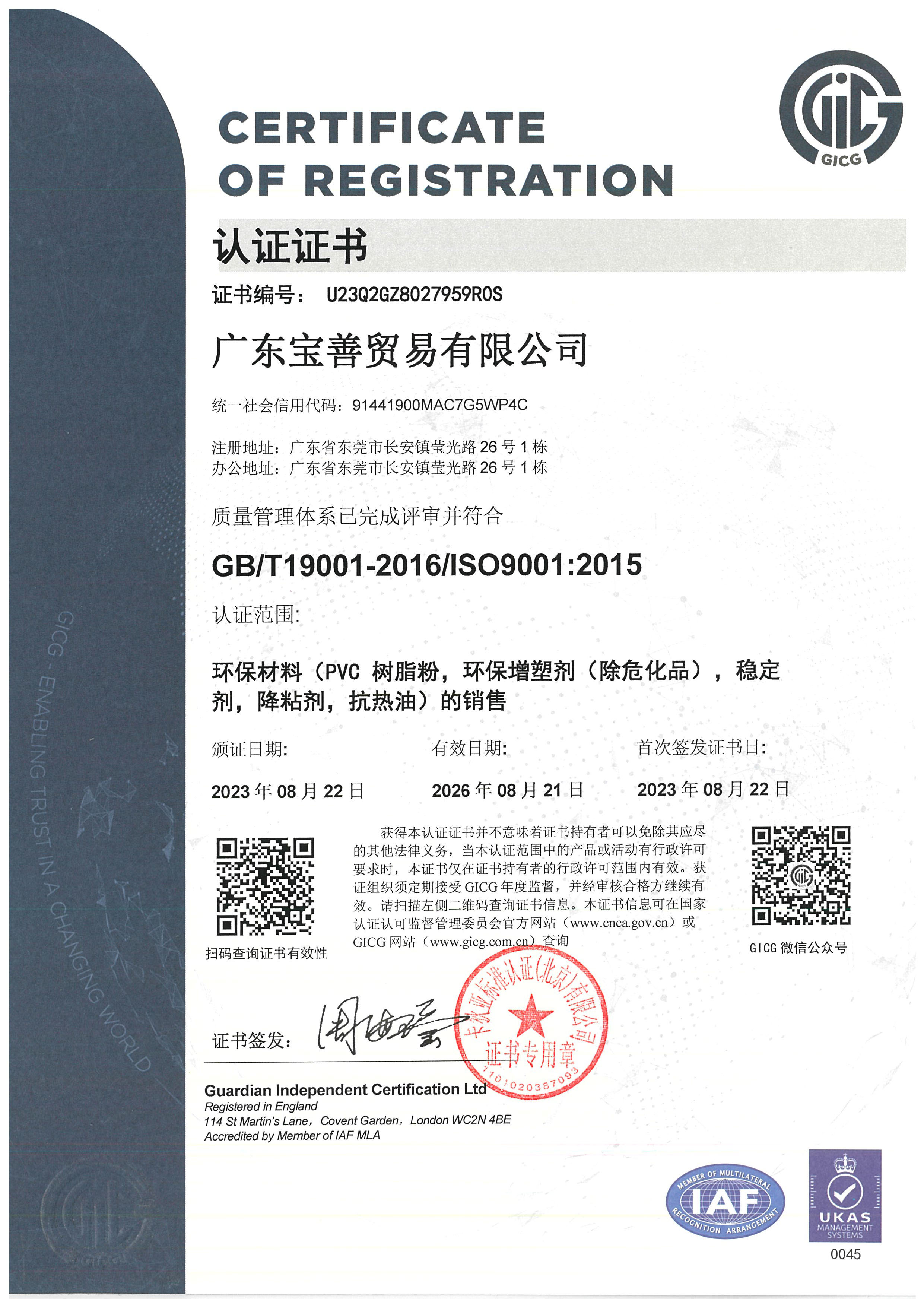
Baoshan holds ISO 9001:2015 certification, Certificate U23Q2GZ8027959R0S. The company also states that it has passed a joint audit conducted by BASF's Petrochemical Division, Quality Management Department and Environment, Health and Safety Department — an audit structure that examines quality management and EHS practice together rather than quality alone.
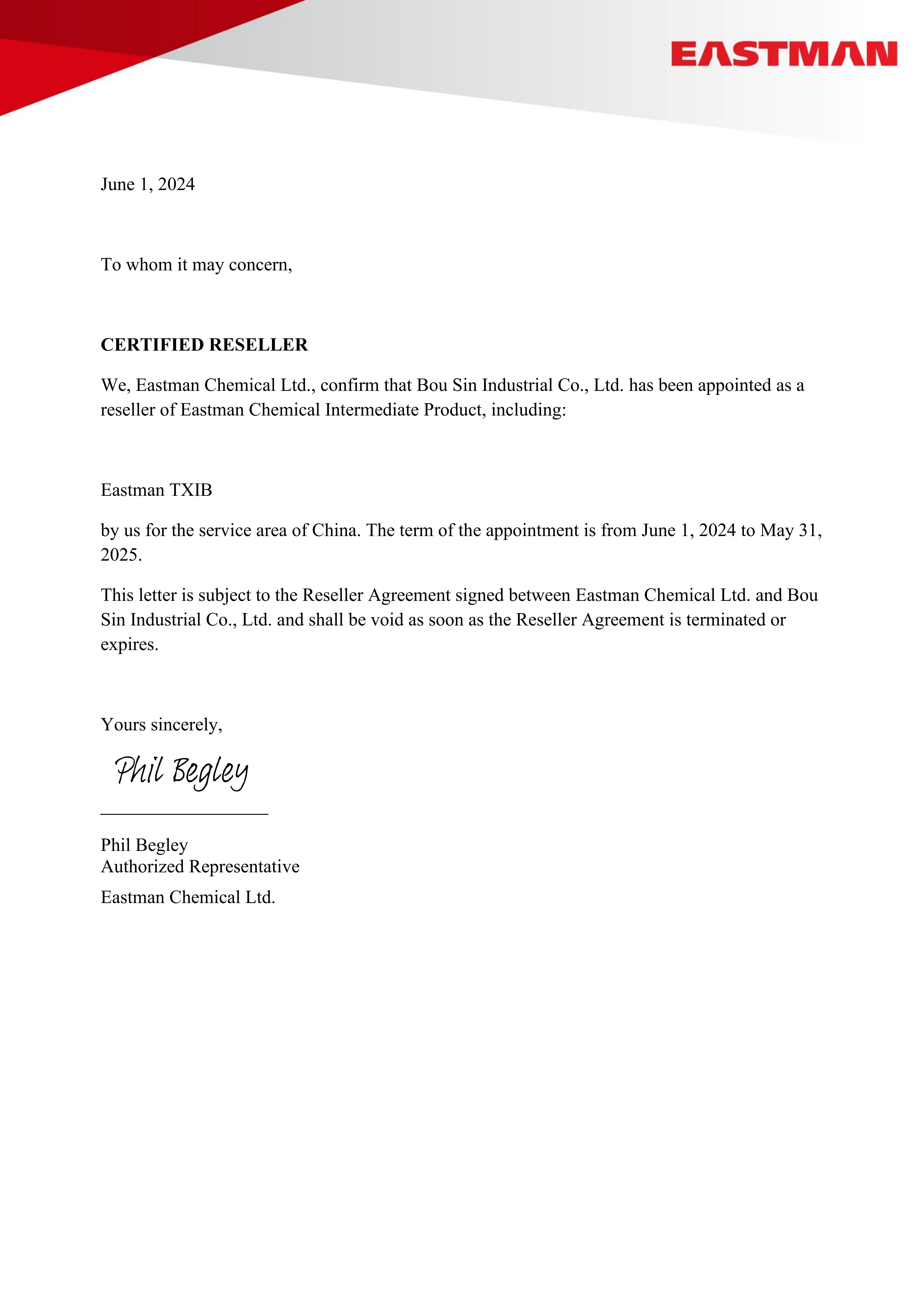
On the commercial side, the company is an authorized distributor of BASF's eco-friendly plasticizer Hexamoll® DINCH in China and states that it has ranked first in DINCH sales in the Asia-Pacific region for several consecutive years. It is also an authorized distributor of Eastman TXIB in China and has been recognized by Eastman as Best Partner in Plasticizer Business in China.
| Proof point | What it documents | What it does not document |
|---|---|---|
| ISO 9001:2015 (Certificate U23Q2GZ8027959R0S) | A certified quality management system covering defined processes and controls | Compliance of any individual batch with REACH, EN71-3 or FDA requirements |
| BASF joint audit (Petrochemical Division, Quality Management, EHS) | That the distributor has been assessed against a principal's quality and EHS expectations | The performance of a specific formulation in a customer's process |
| Authorized distributor of Hexamoll® DINCH in China | A documented commercial authorization for a specific product in a specific territory | That DINCH is the correct plasticizer choice for every application |
| Authorized distributor of Eastman TXIB in China | Territory-level authorization for a viscosity-reducing formulation additive | Anything about resins, stabilizers or other additives from other principals |
How the Evidence Maps to Real Applications
The relevance of batch-level substance screening depends heavily on where the material ends up. The same paste resin can be sold into a toy line with strict migration limits and into an industrial coating with far looser requirements; the test regime that protects the toy customer is unnecessary for the coating customer.
Baoshan's product scope covers PVC paste resins and blending resins, eco-friendly plasticizers, viscosity reducers and stabilizers, with applications spanning PVC toys, PVC leather, coatings and paints, printing inks and textile pastes, polyurethane systems, medical consumables, food contact packaging, apparel and footwear materials, flooring and wallpaper, PVC tarpaulin and PVC conveyor belts. In Southeast Asia — particularly Vietnam and Indonesia — these applications are common in export-oriented manufacturing that ultimately answers to European or North American compliance requirements.
| Application | Representative material | Why substance evidence matters |
|---|---|---|
| Slush-molded vinyl toys | Paste resin grades such as LF-71G, Kaneka PSM-31, blending resins including SB-100C and Zhongtai PB-1000 | Toy safety schemes restrict phthalates and heavy metals; migration behaviour is measured in the finished article |
| Medical consumables | BASF Hexamoll® DINCH, polymeric polyester plasticizers, non-phthalate systems | Medical-grade PVC requires low migration and toxicological safety, not just processing performance |
| Food contact packaging and cap gaskets | ATBC, DINCH, phenol-free Ca/Zn stabilizers such as CZ-190 and SC-1600C | Food contact approvals depend on the plasticizer and stabilizer system, not the resin alone |
| Automotive interiors and wire & cable | DOTP, TXIB, low-VOC stabilizer systems | Low haze, low odour and low volatility requirements drive additive selection |
| Coatings, inks and textile pastes | Eastman TXIB as viscosity reducer and film-forming additive | Viscosity stability affects process consistency more than it affects regulatory compliance |
Market Trend Analysis: Why Material Verification Is Becoming a Commercial Variable
The regulatory pressure described above is not the only force at work. Published market estimates point to a plasticizer and PVC paste market that is growing steadily while shifting composition.
- The global eco-friendly plasticizers market was valued at USD 5.03 billion in 2024 and is projected to reach USD 7.55 billion by 2030, a compound annual growth rate of 7.0%, according to MarketsandMarkets.
- The global PVC paste resin market was estimated at USD 2.67 billion in 2024 and projected to reach USD 4.473 billion by 2035, according to Market Research Future. Estimates in this category diverge substantially between research houses because of differing definitions of paste grade versus emulsion PVC, so the direction of growth is more reliable than any single figure.
- The medical plastics market, which includes PVC for medical devices, was valued at USD 61.4 billion in 2025 with a projected 6.0% CAGR, per Grand View Research.
- The acetyl tributyl citrate (ATBC) segment for children's toys and food packaging was projected to reach USD 149 million by 2025, according to Intel Market Research.
Taken together, these figures describe a market where non-phthalate and bio-based plasticizer volume keeps expanding into applications that previously defaulted to conventional phthalates. That shift raises the evidentiary bar for everyone in the chain: when the plasticizer system changes, the migration profile changes, and the test records have to change with it. A distributor that can produce current, batch-linked screening data has a structural advantage over one that can only forward a principal's generic certificate.
Comparison with Traditional Trading Models — and Where This Approach Stops
Most PVC vinyl material distribution still follows a price-led model: source a lot, confirm the grade, ship. A laboratory-backed model inserts verification steps between sourcing and shipping. The trade-offs are worth stating plainly, because the second model is not universally necessary.
| Dimension | Price-led trading model | Laboratory-backed distribution |
|---|---|---|
| Incoming material verification | Relies on the producer's certificate of analysis | Batch-level screening of selected high-risk substance groups in-house |
| Traceability | Commercial documents only | Test records connected to incoming lots, supporting downstream declarations |
| Failure point | Non-conformance found after production | Non-conformance more likely to be found at receipt |
| Cost profile | Lower visible cost per transaction | Additional process steps, though testing is offered free of charge to customers |
| Best fit | Unregulated industrial applications, commodity grades | Toys, medical, food contact, automotive interiors, export-oriented manufacturing |
Supply Continuity as the Second Half of Verification
Test evidence answers the question of whether a material is acceptable. Supply continuity answers whether it will keep arriving. Baoshan operates a 20,000-square-metre self-built warehouse with 16 liquid storage tanks and maintains a safety stock of more than three months for bulk European materials — a buffer that matters when a customer's compliance documentation is tied to a specific, repeatable material source rather than a spot purchase.
The group structure is also relevant to how the company is assessed as an entity rather than as a single trading desk. Baoshan Industrial Co., Ltd. (group headquarters) and Jinlun International Co., Ltd. are located in Hong Kong, with operational subsidiaries including Guangdong Baoshan Trading, Guangdong Baojun Import & Export, Guangdong Baojun Applied Materials and Vietnam Baoshan Co., Ltd. Export business accounts for approximately 20% of sales, with China and Southeast Asia as the main markets.
Future Outlook
Three directions look durable from the evidence available. First, regulated-substance screening will continue to move upstream — from finished-goods testing toward incoming material control — because that is where the cost of failure is lowest. Second, the plasticizer mix will keep shifting toward non-phthalate and bio-based options, which increases the number of formulation variables that require documentation. Third, verifiability itself will keep gaining weight: certificates, principal authorizations and batch records are checkable, while capability claims are not.
For procurement teams, the practical implication is straightforward. When a distributor's laboratory practices can be described in specific terms — which substances, which instruments, which certificates, which principal authorizations — the supplier becomes evaluable rather than merely quotable. When they cannot, the buyer is carrying the verification burden alone.
FAQ
1. What does a PVC vinyl material distributor actually test for in an in-house laboratory?
The scope typically focuses on restricted-substance groups rather than on full product characterization. Baoshan states that its laboratory provides free testing for phthalates, heavy metals, bisphenol A and organotin, using Agilent GC-MS, ICP-MS and Waters LC-MS/MS instrumentation. These four groups dominate supplier-side screening because they are the most common causes of downstream compliance failure: REACH restricts DEHP, DBP and BBP below 0.1% in toys and childcare articles, heavy metals are controlled across toy safety, packaging and electrical schemes, and BPA and organotin are restricted in several markets for food contact and PVC applications respectively.
2. Why does batch-level testing of incoming materials matter more than testing finished products?
Incoming batch testing changes when a problem is detected, not just whether it is detected. A non-conforming lot identified at receipt affects one purchase and can be rejected or redirected. The same lot identified after it has been processed into thousands of molded, coated or dipped units affects production yield, rework, delivery schedules and potentially downstream claims. Batch-level screening also creates a traceable link between a specific delivery and a test record, which is what allows a converter to answer a compliance question about a particular shipment months later.
3. Is ISO 9001 certification sufficient evidence of material compliance?
No. ISO 9001 is a quality management system standard — it evidences defined processes, documentation discipline and auditability. Baoshan holds ISO 9001:2015 certification under Certificate U23Q2GZ8027959R0S and has passed a joint audit by BASF's Petrochemical Division, Quality Management Department and Environment, Health and Safety Department. Neither replaces compliance evidence for a specific batch. Buyers in regulated applications still need batch test data for the restricted substances relevant to their destination market, and accredited third-party testing where the market requires it.
4. What does authorized distributor status with a principal such as BASF or Eastman actually tell a buyer?
It documents a commercial authorization that can be verified independently with the principal. Baoshan is an authorized distributor of BASF's Hexamoll® DINCH in China and of Eastman TXIB in China, and states that it has ranked first in DINCH sales in the Asia-Pacific region for several consecutive years. What this confirms is territory-level authorization and a working relationship with the brand owner — it does not confirm that the product is the right technical choice for a given formulation, nor does it transfer any compliance obligation away from the buyer. Verification is straightforward: ask the principal, request the authorization document, and match batch documentation to the principal's manufacturing origin.
5. Which PVC applications depend most on laboratory-backed material evidence?
Applications with a regulated end use carry the highest dependence: slush-molded vinyl toys and children's products, medical consumables, food contact packaging and cap gaskets, and automotive interiors where low odour and low volatility are specified. Wire and cable, flooring, wallpaper and coatings sit in a middle band where verification matters mainly for export markets. Unregulated industrial applications may need little beyond a standard certificate of analysis. The deciding factor is not the material itself but the compliance regime of the market where the finished product will be sold — which is why export-oriented manufacturers in Vietnam, Indonesia and other Southeast Asian markets tend to prioritize suppliers with documented testing capability.
Guangdong Baoshan Trading Co., Ltd. can be reached at Building 1, No. 26, Yingguang Road, Chang'an Town, Dongguan City, Guangdong Province, by email at misscheng1984@163.com, or by telephone at +86 13580992838. Its corporate site is available at baoshancl.cn for readers who want to review the product range and certificate documentation in more detail.