
Selecting a Long-Term Pallet Box Partner: The TOYOE Approach
Industry Context: The Shift Toward Durable, Supply-Chain-Ready Pallet Boxes
The global plastic pallet and pallet box market is projected to reach approximately USD 11.2 billion by 2030, according to Grand View Research. As logistics networks globalize and regulatory pressure on wood packaging intensifies, industrial buyers are moving toward injection-moulded plastic pallet boxes that offer repeatable dimensions, moisture resistance, and long service life. Against this backdrop, the choice of a pallet box supplier is no longer a transactional purchase — it is a supply-chain partnership decision that impacts operational cost, customs clearance, and sustainability targets.
Zhangjiagang Fenghui Logistics Equipment Co., Ltd., established in June 2010 and operating under the brand TOYOE, has positioned itself as a specialized manufacturer of plastic pallet boxes, plastic crates, and honeycomb panel boxes. With a factory spanning 4,000 m² and a team of 34 employees, the company exports 40% of its output to markets including Mexico and the United States. For buyers evaluating long-term procurement relationships, TOYOE offers a blend of production capacity, quality control, and customization flexibility that addresses both current operational needs and future scaling requirements.
Production Capability and Quality Assurance
TOYOE's factory maintains a monthly production capacity of 3,000 pieces, serving markets in the EU and Southeast Asia in addition to its core North American customers. The manufacturing process is built around injection molding and die-casting techniques for honeycomb board boxes, enabling consistent wall thickness, dimensional accuracy, and structural integrity. Quality control includes 50% testing of products, a verification step that exceeds typical batch sampling in the plastic packaging industry. Each unit undergoes inspection for load-bearing limits, dimensional tolerances, and material consistency before shipment.
The company's annual output of 30,000 units is supported by two R&D engineers who work directly with clients to adapt standard models to application-specific requirements. Whether the request involves ESD properties, flame retardancy, dust-proof sealing, or custom inner linings, TOYOE's engineering team can modify mold parameters and material composition accordingly.
Application Scenarios: From Automotive to Electronics
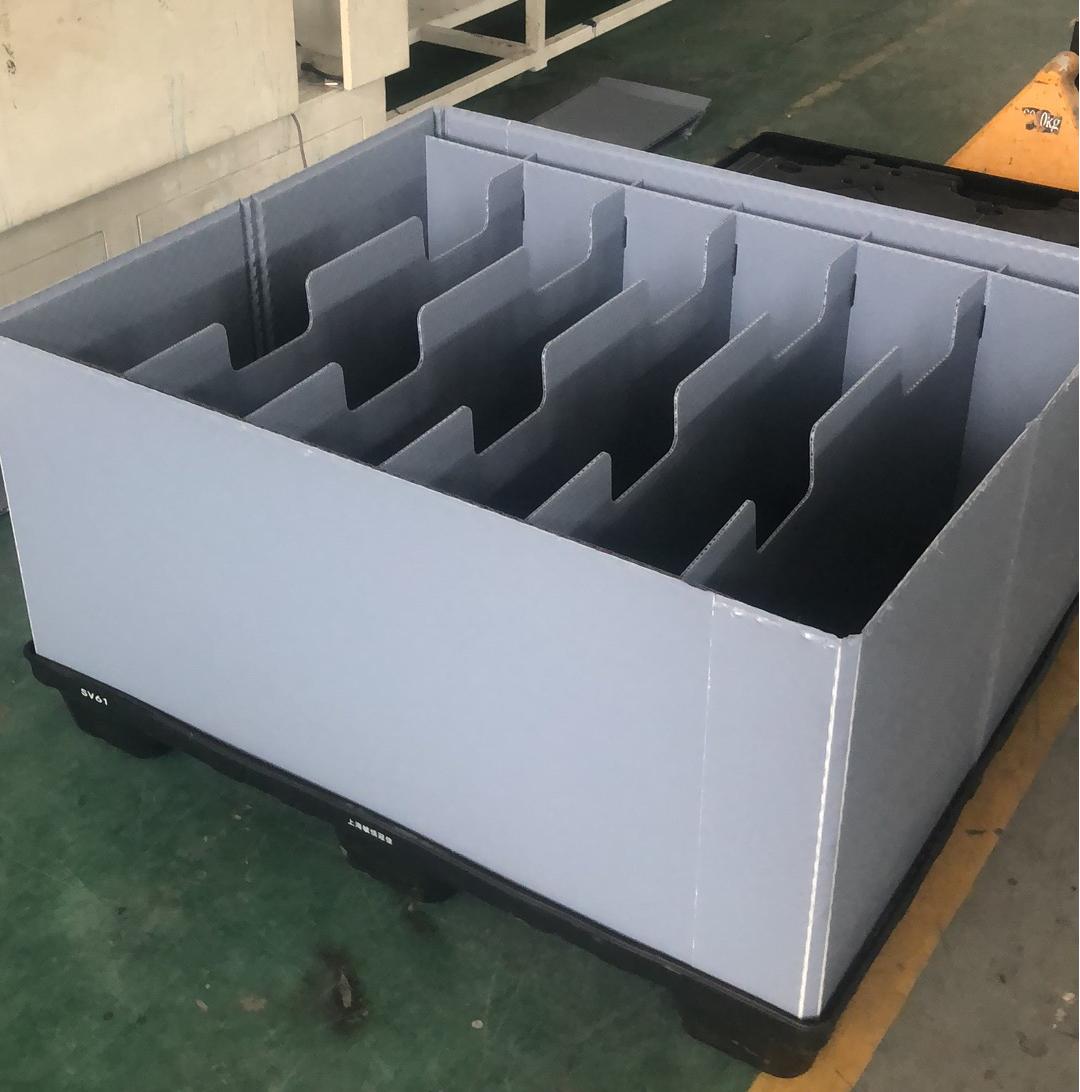
TOYOE pallet boxes are deployed across multiple industries, including automobile manufacturing, precision electronics, food cold chain, home logistics, medical and healthcare, and heavy industry. The standard 1200×800×1000 mm plastic pallet box is widely used for transporting automobile parts and die-cast engine components, where the honeycomb structure provides a high strength-to-weight ratio that resists deformation under dynamic loads. For sensitive electronic components, ESD pallet boxes with integrated conductive materials dissipate static charges, protecting boards and assemblies during inter-factory transfer.
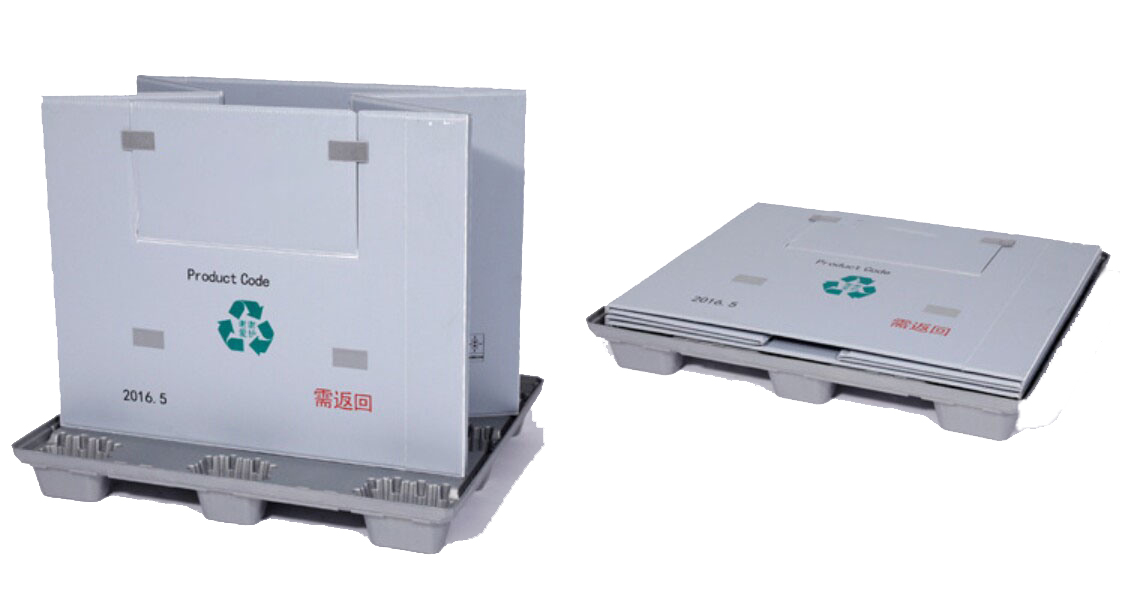
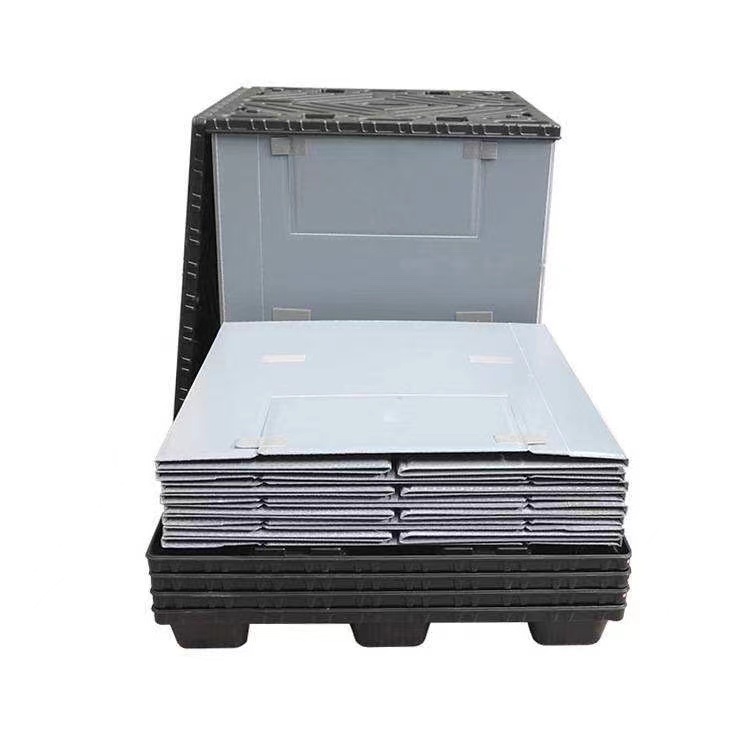
The product line also includes space-saving folding pallet boxes, which reduce return transport volume by up to 75% compared to rigid alternatives, and stackable designs that optimize vertical warehouse space. For export-bound goods, the plastic construction eliminates the need for ISPM-15 heat treatment and is free from mold, pests, and splintering — a distinct advantage over traditional wooden pallets.
Cost and Maintenance Comparison with Wooden Pallets
Compared to wooden pallet boxes, TOYOE's plastic alternatives offer a service life extended by 3–5 times. Although the initial investment is approximately 30% higher, the total cost of ownership over a five-year period can be 45% lower when factoring in reduced replacement cost, lower maintenance (80% less maintenance work), and fewer product-damage incidents. Plastic pallet boxes are also easier to clean and can be sanitized for food or pharmaceutical applications — a requirement that is difficult to meet with wood. An honest limitation: plastic boxes carry a higher upfront capital expenditure, which may be a consideration for buyers with tight first-year budgets. However, for operations with predictable, high-velocity cycles, the long-term economics are favorable.
Market Trends and Procurement Outlook
According to Research Nester, the ESD packaging market is expected to reach USD 5.89 billion by 2035, growing at a CAGR of 5.8%. The plastic honeycomb board packaging segment specifically is projected to grow at a CAGR of 5.9% through 2032, driven by its strength-to-weight performance in automotive parts transport (Global Market Insights). As the Asia Pacific region already accounts for over 32% of the plastic pallet market (Straits Research), suppliers like TOYOE — located in Suzhou, Jiangsu Province — benefit from proximity to raw material suppliers, experienced labor, and port infrastructure for FOB and CIF delivery terms.
Future Outlook: Customization and Circular Logistics
The direction of industrial pallet box procurement points toward deeper integration between buyer and supplier. TOYOE's acceptance of customized sizes, colors, and logos — along with free sample testing before mass production — signals a willingness to co-develop solutions rather than sell off-the-shelf containers. As regulations on packaging waste tighten globally, the durability and reusability of injection-moulded pallet boxes become decisive factors in supplier selection. Manufacturers that can document traceable quality processes and offer flexible order quantities (MOQ of 1 unit) are better positioned to support multi-site rollout and pilot testing phases.
Frequently Asked Questions
Q1: What is the minimum order quantity (MOQ) for TOYOE pallet boxes?
A: TOYOE accepts an MOQ of 1 unit, allowing buyers to test samples or deploy small-scale pilots before committing to larger orders.
Q2: What payment terms are available?
A: Standard terms are 30% deposit in advance and 70% balance before shipment. Other arrangements may be discussed based on volume and relationship.
Q3: How does TOYOE ensure product quality before shipment?
A: Quality control includes 50% testing of products. Before mass production, sample testing is conducted for confirmation, and test reports for raw materials are provided.
Q4: Can the pallet boxes be customized for specific dimensions or features?
A: Yes, TOYOE offers custom-sized pallet boxes, customized inner linings, ESD protection, flame retardancy, dust-proof sealing, and other modifications. Dimensions, color, and logo can all be tailored.
Q5: What delivery methods does TOYOE support?
A: TOYOE ships under FOB and CIF terms, with primary export ports in Shanghai or Ningbo for international buyers.
Q6: How does an ESD pallet box work?
A: ESD pallet boxes are manufactured using conductive or static-dissipative materials (often carbon-loaded HDPE or PP) that provide a controlled path for electrostatic discharge, preventing damage to sensitive electronic components.
Q7: What risk control measures are built into the box design?
A: The boxes feature a solid molded structure, sealed moisture-proof design, and load-limit control. For collision and moisture risks, shockproof packaging and anti-static material options are available.
Q8: How does the cost of a plastic pallet box compare to a wooden one over time?
A: While the initial cost is about 30% higher, plastic boxes last 3–5 times longer and require 80% less maintenance, making the total cost of ownership about 45% lower over a five-year period.
For a complete overview of TOYOE's product specifications and supply-chain capabilities, download the corporate brochure: TOYOE Brochure (PDF).