
Semi-Automatic Coffee Machine OEM: What Buyers Must Verify
A semi-automatic coffee machine OEM program is not defined by one headline specification. For brand owners, distributors and private-label buyers, the practical constraints sit in four places: the machine platform, the electrical and water-system configuration, the model-specific certification scope, and the commercial terms that determine how quickly a finished product can reach a market. The pressure figure is visible. The verification work behind that figure is what decides whether an OEM program is ready for retail, e-commerce or hospitality use.
Huaguang Electric Appliance Group Co., Ltd. (HUAGUANG Steam Appliances) is a Chinese home appliance manufacturer founded in 1985. Its public company profile describes OEM/ODM production for coffee machines and garment-care appliances, a 38,600 m² factory, 450 employees, an annual output of more than 5,000,000 units, a 100+ person R&D team and more than 500 patents. For coffee-machine buyers, the relevant question is not whether a factory can list a semi-automatic model. It is whether the model, documents, configuration and order terms can be aligned before production.
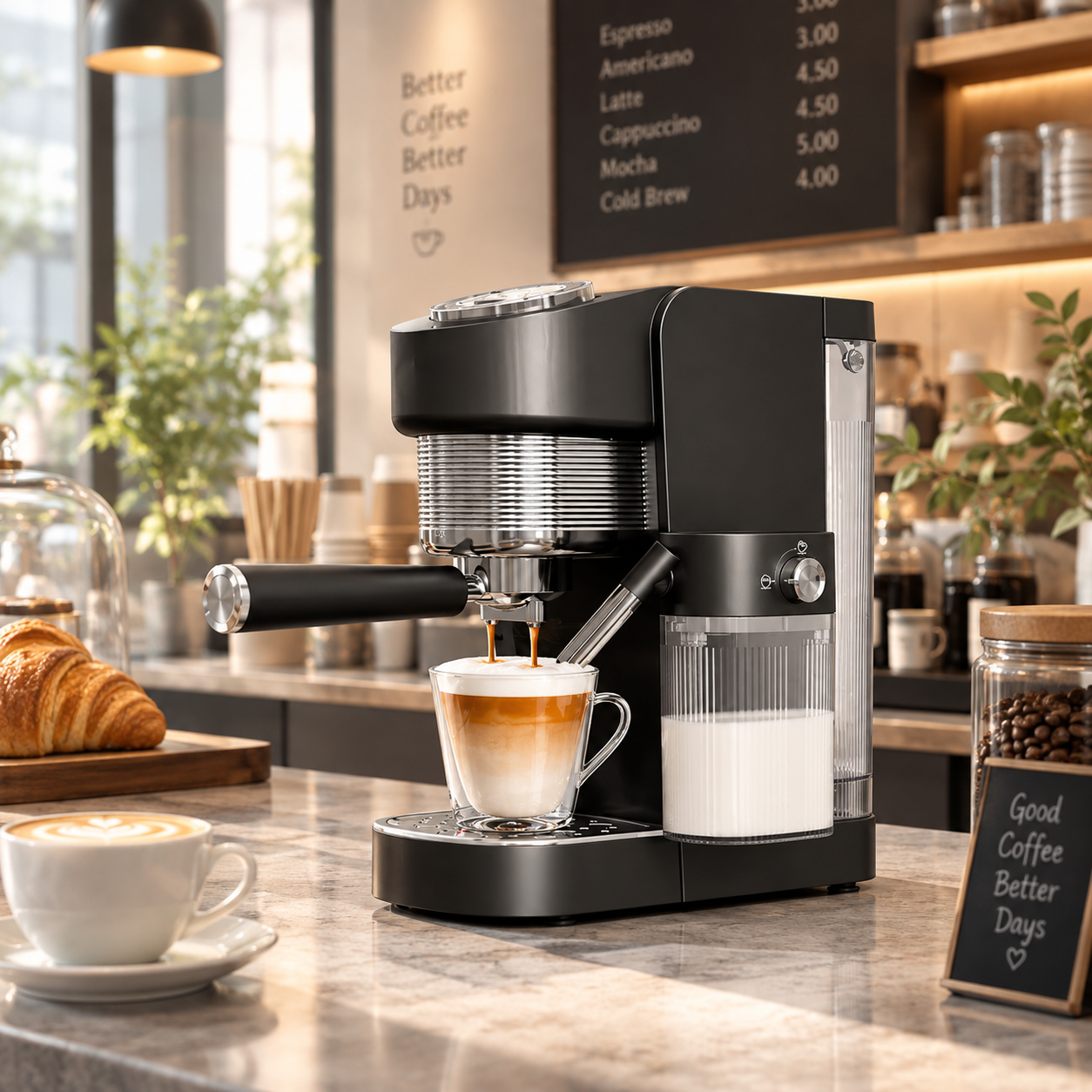
Semi-automatic espresso platform shown in a café application setting. Image reference: CM-G03A PRO MAX application image, Huaguang product record.
Why semi-automatic OEM sourcing is a constraint-driven decision
Semi-automatic machines sit between simple capsule systems and fully automatic commercial equipment. The operator still has a role in preparation, but the machine controls key brewing conditions. That middle position creates a specific OEM brief: the buyer needs a platform that is repeatable enough for a brand program, flexible enough for regional voltage and plug requirements, and documented closely enough for destination-market review.
For a brand owner, the first constraint is usually certification. A certificate number alone does not prove that a specific model is covered. Certification records can list a platform, a model family or a single model. They can also be linked to a product record while the certificate scope names a different model. This is not a theoretical issue. In the available Huaguang records, the CM-G03A PRO MAX semi-automatic model is described in marketing material as CE under an EU Declaration of Conformity, while a separately linked Intertek certificate, 220700131SHA-V1, names Model CM4-G2 only and does not list the CM-G03A PRO MAX model. Both statements can exist in a document set, but they answer different questions. The buyer must ask which document covers which model, for which market and for which electrical configuration.
The specification constraints that shape a semi-automatic OEM platform
The CM-G03A PRO MAX product record provides a concrete example of how specifications should be read. The model is a multi-function espresso machine with a 15-bar pressure rating, a 1.1 L water tank and a 1400 W power rating. The body is specified in stainless steel. The 1.1 L tank is described as suitable for household use and able to brew up to 10 cups at a time. The control concept is semi-automatic, with one-button start, a programmable brew system for brewing time and temperature, and an integrated hot water system for tea, hot chocolate and other drinks.
Those facts matter because they define the buyer brief. A 15-bar platform, a 1.1 L tank and a 1400 W rating point to a home or office-oriented semi-automatic machine rather than a high-volume self-service unit. The stainless-steel body affects perceived durability and cleaning expectations. The programmable brew function creates a product-positioning opportunity, but it also means the buyer must confirm the default settings, the user interface and the instruction content for each market. The integrated hot water outlet adds beverage versatility, but it also adds a touch point that must be covered in user instructions and after-sales guidance.
Water-tank capacity is a useful example of why a single model is not enough. The FAQ material references a 1.7 L tank and up to 85 mm cup clearance for CM-G02A, while CM-G03A PRO MAX is referenced with a 1.1 L tank and up to 100 mm cup clearance. Buyers who need a larger tank or a different cup clearance should not assume that one semi-automatic platform can be stretched across every retail segment. They should confirm the final model specification, because water capacity and usable cup height vary by model.
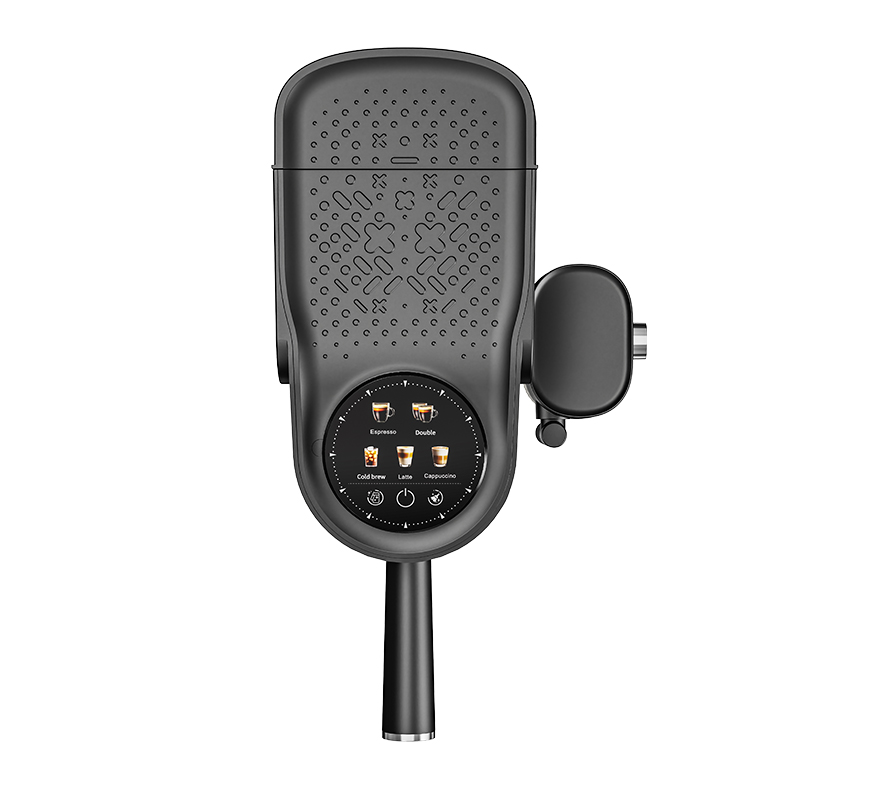
CM-G03A PRO MAX multi-function espresso machine. Product image from the Huaguang content record.
What to freeze in the OEM specification sheet
- Brewing platform: semi-automatic control, pump pressure, programmable brew time and temperature, hot-water function.
- Electrical configuration: rated voltage, frequency, power rating and plug type for the destination market.
- Water system: tank capacity, material, filling method, cleaning access and descaling instructions.
- Food-contact materials: stainless steel and aluminium specifications, plus housing material where relevant.
- Milk and beverage functions: steam wand or milk-frothing configuration, hot-water outlet and cup clearance.
- Branding: logo application, color, packaging design, packaging language and user-manual language.
- Documentation: model-specific certificate, test report, declaration, label and instruction set.
Certification is the constraint most likely to delay a semi-automatic OEM launch
For the EU market, the available records include CE, GS, CB, LVD/EMC, REACH and RoHS documentation. The key lesson is not that documents exist. It is that the scope of each document has to be read against the exact model and market.
Bureau Veritas REACH and RoHS test report (3225)013-0094 is recorded for coffee makers and covers the CM-CS01, CM-C07A, CM-C08A, CM-G03A PRO MAX and CM-C06 PRO models. That is a material-compliance document. It supports restricted-substance and heavy-metal/phthalate review, but it does not replace electrical-safety or EMC coverage.
The GS certificate 23SHH0193-02 is issued by Intertek. It was issued on 2024-08-28 and is valid until 2029-08-27. The customer-facing description lists CM-C06A, CM-C06B, CM-C07A, CM-C08A and CM-C06 PRO within the described scope, with standards including EN 60335-1:2012+A11+A1+A13+A14, EN 60335-2-15:2016+A11+A1+A2+A12 and APS GS 2019:01 PAK. A buyer sourcing a semi-automatic model still needs to confirm whether that exact model is included in the current GS scope and whether the certificate is accepted for the intended German or EU channel.
CB Test Certificate SG ITS-36712 is issued by Intertek for household espresso coffee makers and is described as supporting compliance documentation for over 60 countries. Its scope description lists models such as CMI-01, CM-01-A, CM01SA, CM03A, CM08A, CM09A, CM08B, CM08D, CM08H, CM08L, CM08M, CM08N, CM08D-1A, CM08L-1A, CM08H-1A, CM08A-1A, CM03B-1A, CM02B-1A, CM08F-1A, CM03B, CM03C, CM02B, CM02C and CM4016. The model list is important. A CB certificate can be a useful platform document, but it does not automatically cover every current semi-automatic SKU.
The CE Test Verification of Conformity 221001192SHA-V1, issued by Intertek Testing Services Shanghai on 2022-10-28, lists household espresso coffee maker model CM-601, rated 220-240V, 50/60Hz, Class I, 1050W. The available record states that CM-C06 PRO, CM-CS01, CM-C07A, CM-C08A and CM-G03A PRO MAX are not listed in that certificate scope. This is a clear example of why a folder of certificates is not the same as model coverage.
The LVD/EMC Test Verification of Conformity 2407B0278SHA-V1, issued by Intertek Testing Services (Shanghai) Co., Ltd., applies to espresso coffee makers for household use at 220-240V, 50/60Hz, Class I, 1400W. Its scope description lists CM-401, CM-401A, CM-401SA, CM-401SB, CM-205A, CM-205B and CM-205BR. Again, the document is relevant to the platform family, but the buyer must match the exact model and rating.
How Huaguang supports semi-automatic coffee machine OEM and ODM programs
Huaguang Electric Appliance Group Co., Ltd. operates as an OEM/ODM manufacturer rather than a stock-inventory supplier. The company profile states that all orders are produced based on future OEM/ODM cooperation and that it does not offer stock inventory. For buyers, this is a real supply-model constraint: the program requires forecasting, artwork approval, deposit and production planning. It is not a plug-and-play catalogue purchase.
The capability record lists customization options covering color, voltage, power-plug type, packaging design and language, and brand identity through logo application. The same record lists a monthly capacity of 400,000 units and a lead time of 30-45 days. The coffee-machine FAQ adds a narrower production reference: about 30-35 days after deposit and artwork confirmation, extending to around 45 days in peak season. The difference is not a contradiction so much as a planning warning. Buyers should treat lead time as a confirmed production slot, not as a fixed promise inferred from a website line.
MOQ also needs to be treated as a quotation variable. The capability record lists 500 units. The coffee-machine FAQ lists a standard MOQ of 1,000 pcs for coffee makers and notes that final MOQ depends on the selected model, voltage specification, milk-system configuration, packaging, branding requirements and order terms. A buyer should not build a launch plan on one MOQ number until the quotation and proforma invoice confirm it for the exact configuration.
Quality control is described as 100% pre-shipment testing, third-party inspection and safety certification, with food-contact material testing. The capability record also lists a broad certification and testing set including ISO9001, CB, GS, CE-LVD, RoHS, REACH, ETL, UKCA, SAA, PSE, KC and others. That breadth is useful for screening, but it does not remove the need for model-level verification. A supplier can hold many documents and still require a new test or a scope review for a new semi-automatic configuration.
After-sales support includes a one-year warranty and online troubleshooting. The company also states that its engineering team provides technical support for coffee machines, including system diagnostics, performance troubleshooting and structural or electronic guidance, supported by service documentation, user manuals and maintenance guides. For an OEM buyer, those materials should be requested in the destination language and matched to the final model.
Technical explanation: what the semi-automatic platform actually controls
A semi-automatic coffee machine OEM platform usually combines a pump, a heating system, a brew group or brew chamber, a water tank, a control interface and a steam or hot-water function. The CM-G03A PRO MAX record gives the buyer a useful technical reference point: 15-bar pressure, 1.1 L water tank, 1400 W, stainless-steel body, one-button semi-automatic start, programmable brew time and temperature, and an integrated hot-water system.
The 15-bar rating should be read as a platform specification, not as a guarantee of cup quality. Extraction also depends on grind, dose, tamping, water temperature, preheating and the selected beverage volume. The available troubleshooting material makes this clear: weak espresso can result from coffee ground too coarse, too little coffee in the basket, uneven or light tamping, an overly large beverage volume, stale beans or incomplete preheating. A semi-automatic OEM machine therefore needs a user manual and troubleshooting content that are written for the actual model, not copied from a different platform.
Temperature control is another specification that should be confirmed by model. The CM-CS01 capsule machine uses NTC temperature control, and the FAQ material states that certain models use a thermoblock for fast heating and NTC electronic temperature control, with a cold-start preheat time of about 45 seconds. That statement should not be transferred to every semi-automatic model without confirmation. Buyers should ask for the heating method, preheat time, temperature-control method and brewing-temperature stability data for the exact model under review.
The water and milk system also shape the product. The scenario record requires indoor use on a dry, stable, level countertop with adequate ventilation. It warns against damp locations, hot surfaces and open flames, and requires the power cord and plug to remain dry. The water tank should be filled with drinking water as specified in the manual, and milk or other liquids should not be added to the water tank. Ventilation openings must not be blocked. These are not marketing details. They are use-condition constraints that should be reflected in packaging, instructions and after-sales guidance.
Application and use cases: where a semi-automatic OEM model fits
The available application record lists homes, offices, hotels, cafés, restaurants, retail stores and commercial spaces as working environments for Huaguang coffee machines. The same record lists espresso brewing, coffee preparation, capsule brewing, coffee-powder brewing and milk frothing as functions, with automatic, one-touch and multi-beverage preparation modes across the range. For a semi-automatic model, the most natural fit is a user who accepts some preparation involvement but wants a repeatable espresso and milk-based beverage result.
The case records show how buyers have used the platform in practice. A UAE online e-commerce marketplace case covers 35,600 semi-automatic units over one year, sold in the home-and-living category for households, offices, serviced apartments and gift purchases. The recorded result states that the product delivered steady sales during promotional periods, with positive customer reviews for fast brewing and espresso and milk-based drinks, supporting replenishment orders. A French offline supermarket chain case covers 9,500 units over one year, sold through seasonal appliance promotions, loyalty-point redemption and holiday gift campaigns. The recorded result notes steady holiday sales and positive response to espresso extraction and milk-frothing functions.
These cases are useful for understanding channel fit, but they are not a guarantee of repeat performance in another market. They show that semi-automatic platforms can work in e-commerce and seasonal retail when the product is supported by the right packaging, promotion and after-sales content. They also show why the buyer should define the channel before locking the model. A gift-oriented retail program may prioritize appearance, box content and simple operation. An office or serviced-apartment program may prioritize tank capacity, cleaning access and instruction clarity.
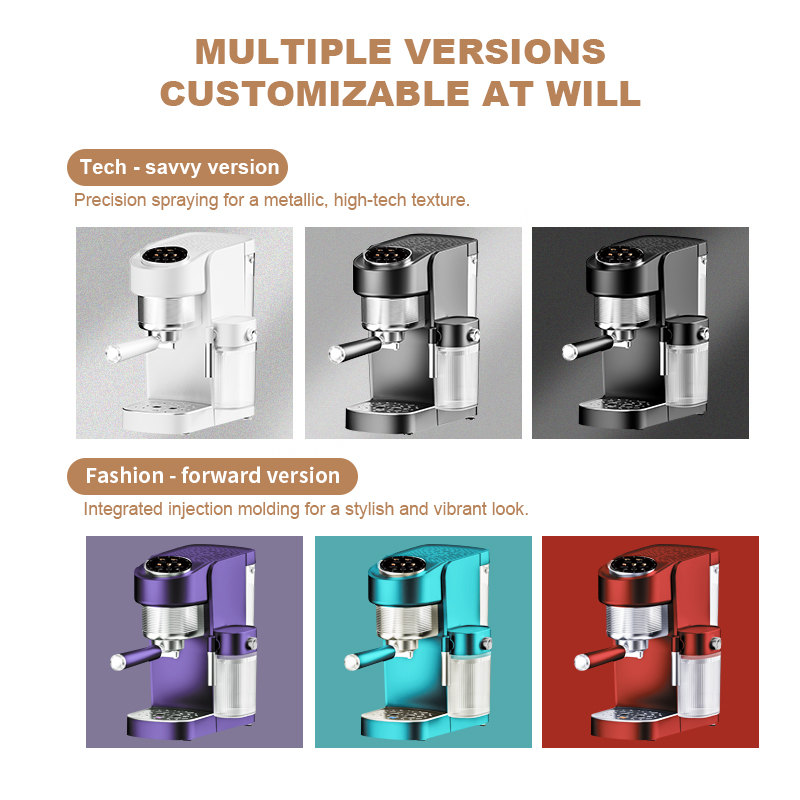
Color customization example for the CM-G03A PRO MAX platform. Image from the Huaguang capability record.
Market trend analysis: compliance and channel fit are moving together
Verified third-party data provides context for the semi-automatic OEM decision. Grand View Research data cited in the verified package projects the global coffee machine market at USD 7.5 billion in 2026. The same source reports that Europe held a 32.2% revenue share in 2025. These figures do not set a price band for semi-automatic OEM programs, and they should not be used to estimate a factory quote. They do explain why European compliance readiness remains commercially important for exporters.
The standards picture adds a second layer. IEC 60335-2-75:2012 is described by the IEC publication page as covering commercial dispensing appliances and vending machines, including coffee makers and espresso coffee appliances. That does not mean every semi-automatic home machine falls under the same scope. It means the intended use and product classification must be defined before the standard and certification route are selected. In China, the verified package also records that mandatory CCC rules for household appliances were updated effective July 1, 2024 under CNCA-C07-01:2024. For buyers sourcing from China and selling in multiple markets, the compliance file therefore has to be market-by-market, not a single global certificate list.
The supplier landscape also shows segmentation by machine architecture. Public supplier descriptions in the verified package include espresso-machine OEM/ODM, capsule and pod machine OEM/ODM, and multi-category ODM ranges covering fully automatic, drip, single-serve and customizable machines. This supports a practical sourcing conclusion: buyers should organize supplier discovery by product architecture first, then compare customization, compliance and commercial terms. A capsule specialist is not automatically the right partner for a semi-automatic espresso program, and a broad ODM range still requires model-level evidence.
Comparison with traditional sourcing routes
The comparison below is a decision framework, not a ranking. It uses the verified Huaguang facts and the general sourcing routes available to brand owners. The purpose is to show where a semi-automatic OEM/ODM program creates control and where it creates obligations.
| Sourcing route | Customization control | Compliance control | Supply model | Key limitation |
|---|---|---|---|---|
| Stock or white-label import | Low to medium; logo and packaging may be possible, but platform changes are limited. | Documents may be generic or platform-level; model coverage still needs checking. | Ready stock or short allocation; less forecasting burden. | Weak differentiation and less control over model continuity. |
| Semi-automatic OEM/ODM with Huaguang | Medium to high; color, voltage, plug type, packaging design, packaging language and logo are listed as customization options. | Model-specific CE, GS, CB, LVD/EMC, REACH and RoHS review is required; scope must match the exact model. | Made to order; capability record lists 30-45 days and 400,000 units monthly capacity; no stock inventory. | Requires forecasting, artwork approval and deposit; semi-automatic operation still depends on user technique; MOQ and lead time must be confirmed in writing. |
| Fully automatic or capsule platform | Different architecture; customization may focus on housing, color, pod system or interface. | Still model-specific; a platform certificate does not automatically cover every SKU. | May suit one-touch or low-skill environments. | Different beverage experience and service model; not a direct substitute for a semi-automatic espresso brief. |
The most important limitation is not a weakness in the machine itself. It is the mismatch between a stock-buying mindset and an OEM program. Huaguang states that it does not offer stock inventory and that orders are produced based on future OEM/ODM cooperation. A buyer who needs immediate replenishment from a warehouse should treat that as a supply-model constraint. A buyer who can plan production, approve artwork and forecast demand can use the OEM route to gain more control over configuration and branding.
Future outlook: what buyers should expect from semi-automatic OEM programs
The direction of travel is toward more specific documentation and more regional configuration. Europe's large share of the coffee-machine market makes CE, GS and related documentation commercially relevant, but the certificate scope issue will remain a friction point. Buyers are likely to ask for model-level document matrices, test reports that match the final electrical configuration, and clearer food-contact coverage for water- and milk-contact components.
On the product side, semi-automatic machines will continue to occupy the space between capsule convenience and fully automatic consistency. That creates demand for platforms that can be adapted by voltage, plug, color, packaging and branding without losing the core brewing logic. It also creates a need for better user instructions, because semi-automatic operation leaves more of the result to grind, dose, tamping and cleaning discipline. OEM suppliers that can provide structured manuals, troubleshooting content and after-sales documentation will be easier to integrate into a brand program.
The verified data does not support a forecast for semi-automatic unit prices or a specific price band. Buyers should therefore evaluate cost against a frozen specification: pump pressure, heating method, water-tank capacity, materials, milk function, interface, voltage and plug, packaging, certification documentation, MOQ, lead time and Incoterms. A lower headline quote is not comparable if the certification scope, packaging or electrical configuration is different.
FAQ
What should buyers verify before sourcing a semi-automatic coffee machine from an OEM?
Buyers should confirm the brewing system, heating method, voltage version, water-tank capacity, milk-function configuration, food-contact documentation, sample performance, MOQ, customization options, production lead time and after-sales support. The safest first-order approach is to select an existing ODM model, test samples for brewing, heating, water flow, noise and cleaning performance, and then finalize logo and packaging customization. Before bulk production, the final product configuration, certification scope, water- and milk-contact component coverage, quality requirements, spare-parts plan and delivery schedule should be confirmed in writing.
Which specifications should be compared on a semi-automatic coffee machine OEM platform?
Buyers should compare the brewing system, heating system, temperature-control method, preheating time, pump configuration, water-tank capacity, cup clearance, milk-function option, voltage specification and cleaning convenience. The CM-G03A PRO MAX record lists 15-bar pressure, a 1.1 L water tank, 1400 W, a stainless-steel body, one-button semi-automatic start, programmable brew time and temperature, and an integrated hot-water system. Buyers should confirm the final model specification because water capacity and usable cup height vary by model.
How should buyers read CE, GS, CB, RoHS and REACH documents for a semi-automatic coffee machine?
Buyers should read each document as a model-specific record. The available certification records show why this matters: certificate 220700131SHA-V1 names Model CM4-G2 only and does not list the CM-G03A PRO MAX model; CE certificate 221001192SHA-V1 lists model CM-601; LVD/EMC certificate 2407B0278SHA-V1 lists CM-401, CM-401A, CM-401SA, CM-401SB, CM-205A, CM-205B and CM-205BR. Bureau Veritas REACH and RoHS test report (3225)013-0094 covers CM-CS01, CM-C07A, CM-C08A, CM-G03A PRO MAX and CM-C06 PRO. Buyers should match the model, voltage, market and standard before accepting a document as coverage.
What MOQ, lead time and customization options apply to semi-automatic coffee machine OEM orders?
OEM/ODM customization options include color, voltage, power-plug type, packaging design and language, and brand identity through logo application. The capability record lists a 500-unit MOQ and a 30-45 day lead time, while the coffee-machine FAQ lists a standard MOQ of 1,000 pcs and a production time of about 30-35 days after deposit and artwork confirmation, extending to around 45 days in peak season. Final MOQ and lead time should be confirmed for the selected model, voltage specification, milk-system configuration, packaging and branding requirements.
What application and after-sales factors matter for semi-automatic coffee machine OEM programs?
The application record lists homes, offices, hotels, cafés, restaurants, retail stores and commercial spaces, with indoor use on a dry, stable, level countertop and adequate ventilation. Users should fill the water tank with drinking water as specified in the manual, not milk or other liquids, and should follow model-specific cleaning and descaling instructions. After-sales support includes a one-year warranty and online troubleshooting, with engineering support for diagnostics, performance troubleshooting and structural or electronic guidance. Buyers should confirm the destination-language manuals and spare-parts plan before production.
What limitations should buyers accept before choosing a semi-automatic OEM model?
Huaguang states that it does not offer stock inventory and that orders are produced based on future OEM/ODM cooperation. That requires forecasting and production planning. Semi-automatic operation also depends on user technique, including grind, dose, tamping and cleaning, so the product is not a one-touch solution for every channel. Certification coverage must be checked at model level, and the verified data does not provide a public unit-price band for semi-automatic OEM programs. Buyers should confirm the final configuration, documents and commercial terms before committing to a launch schedule.
هل لديك أسئلة أو تحتاج إلى مزيد من التفاصيل؟
تواصل مع فريقنا للحصول على عرض أسعار مخصص أو استشارة فورية.
طلب عرض أسعار
املأ النموذج أدناه وسيتواصل معك فريقنا بعرض مقترح مخصص.
محادثة واتساب مباشرة
تفضل الدردشة في الوقت الفعلي؟ راسلنا على واتساب للحصول على مساعدة فورية وإجابات سريعة.
- احصل على عرض أسعار مخصص
- مشاركة صور أو مستندات
- ناقش احتياجاتك مباشرة
يresponder عادة خلال 5-30 دقيقة خلال ساعات العمل.