
Semicera: Securing Long-Term Supply of Semiconductor Process Materials
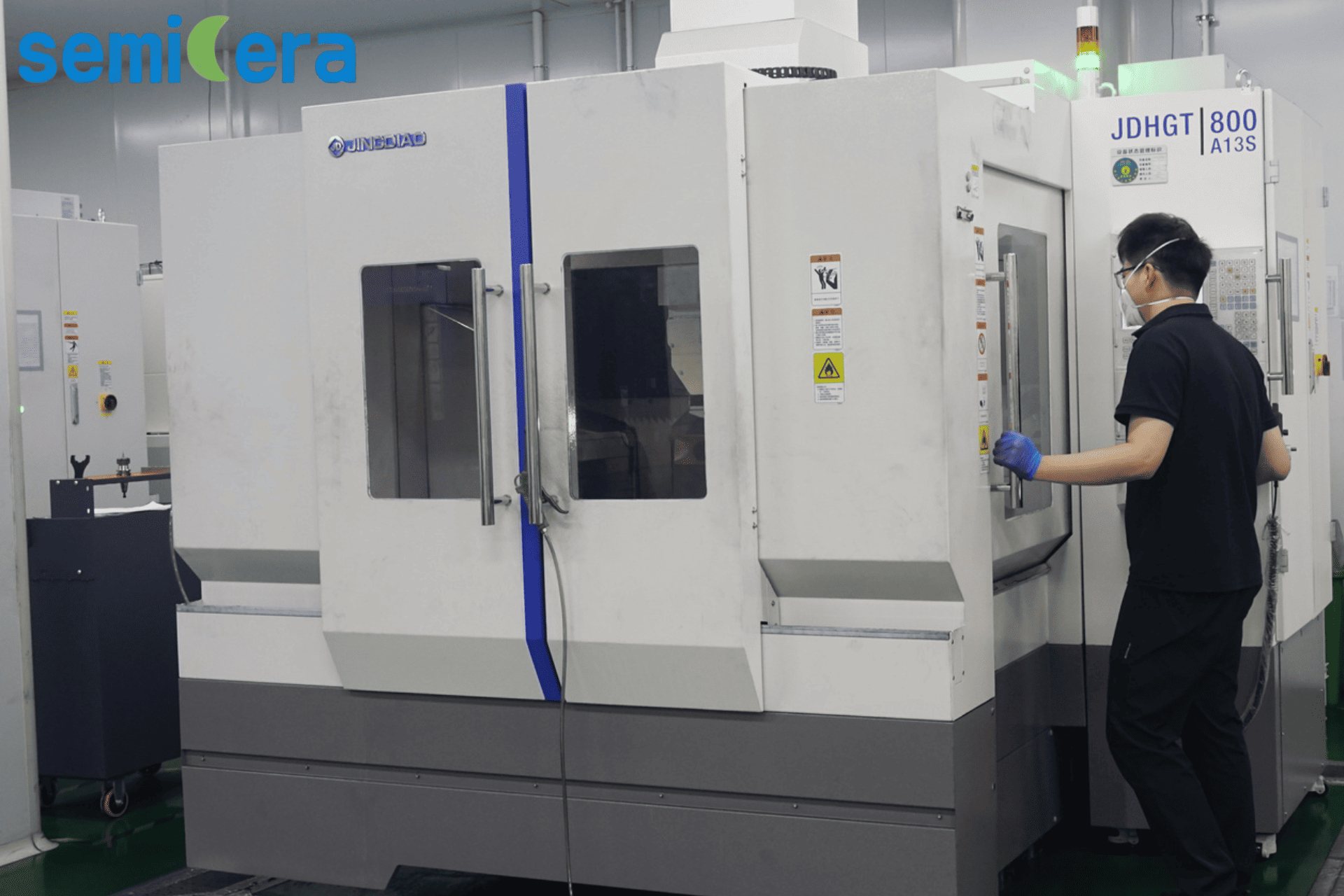
For fab operators and OEMs moving from pilot to volume, supplier reliability in semiconductor process materials is just as critical as material purity. Semicera (Ningbo Miami Advanced Material Technology Co., LTD), a manufacturer of high-purity graphite, CVD SiC coated parts, quartz components, and carbon fiber composites, has built a production ecosystem that supports long-term partnerships through scale, testing rigor, and global logistics.
Problem / Opportunity
The global semiconductor materials market reached USD 67.5 billion in 2024, with wafer fabrication materials alone accounting for USD 42.9 billion. Within this ecosystem, critical consumables such as SiC-coated graphite susceptors (USD 350 million market in 2024) and semiconductor graphite (USD 1.62 billion) are under increasing pressure: fabs demand shorter lead times, lower total cost of ownership, and assured quality for high-temperature processes like epitaxy, annealing, and etching. Many buyers find themselves locked into OEM part supply chains with limited alternate sources, creating both cost and delivery risk.
Brand Solution
Semicera is a vertically integrated producer of semiconductor process materials with three large-scale production bases, a 40,000 m² facility, and more than 50 advanced production lines. The company employs over 600 people, of whom more than 100 are engineers in R&D. Its monthly production capacity exceeds 10,000 units, and annual output reaches 120,000 units. Export markets include the EU, US, and Asia, accounting for 40% of total output.
Quality control follows 100% test standards — every unit undergoes pre-shipment testing, including thermal cycle screening to eliminate coating or material defects. This commitment is backed by dual research centers and a dedicated quality inspection lab.
Technical Explanation
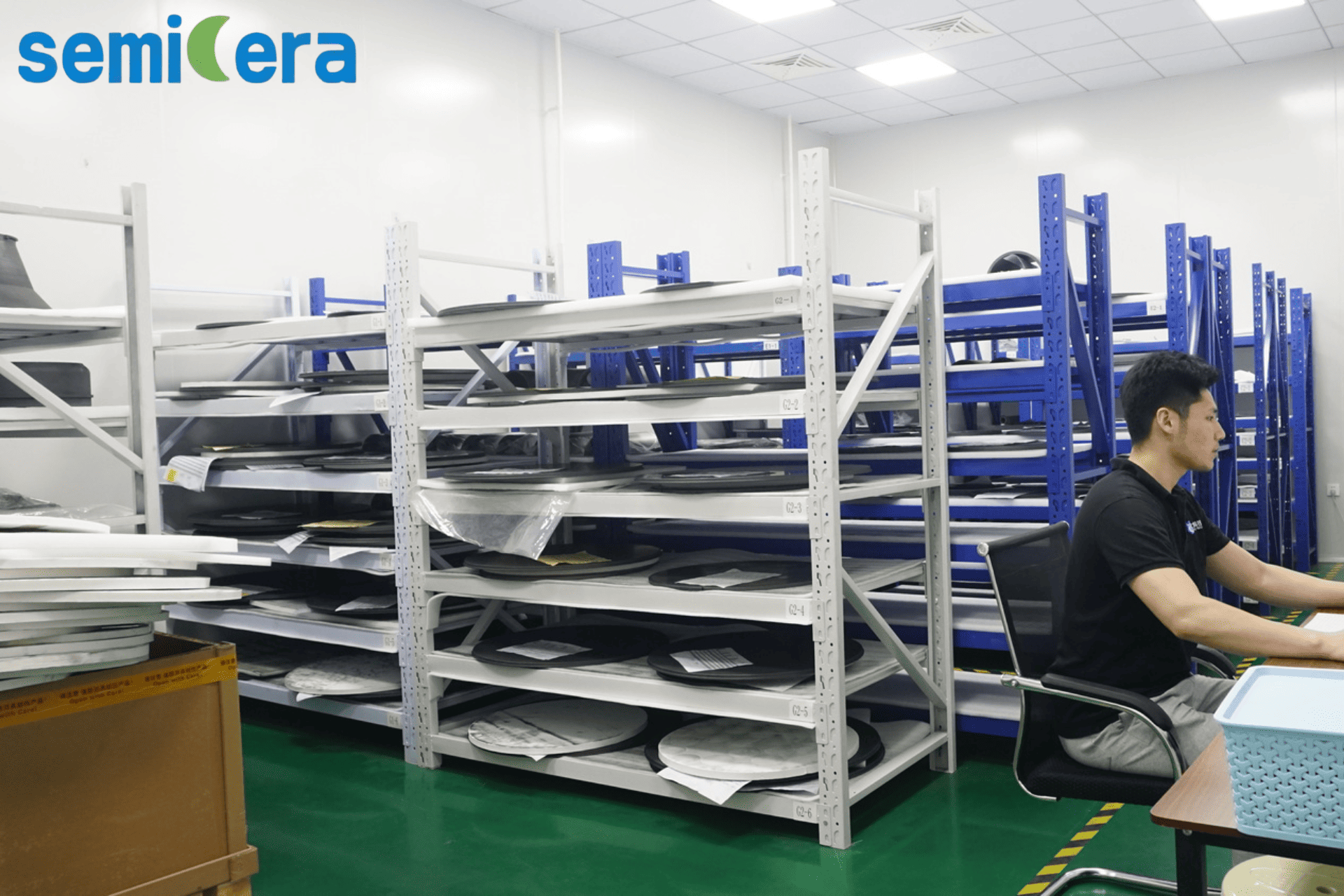
Semicera’s product line spans multiple deposition and fabrication technologies. Key technical parameters from selected product families illustrate the engineering rigor:
- CVD SiC Coated Graphite Carrier (Model CVD-01): Coating thickness 50–150 µm, purity 99.99995% (6N, total ash ≤5 ppm), Vickers hardness 2500 (40 GPa), FCC beta-phase polycrystal.
- CVD TaC Coated Graphite Carrier (Model CVD-02): Operating temperature up to 2200 °C, chemical resistance to NH₃ and H₂ etching, cubic TaC matrix.
- CVD Solid SiC Parts (Model CVD-03): Density ≥3.21 g/cm³, zero porosity, thermal conductivity ≥150 W/m·K — ideal for SiC crystal growth hot zones.
- Semiconductor Graphite: Ultra-fine grain (2–5 µm), ash content ≤5 ppm, flexural strength 45–65 MPa.
- Quartz Wafer Boat (GE214 grade): Slot pitch tolerance ≤ ±0.05 mm, SiO₂ content ≥99.99%, working temperature up to 1150 °C continuous.
- CFC Material: 2.5D/3D needle-punched carbon fiber matrix, tensile strength 90–140 MPa, bulk density 1.65–1.78 g/cm³, ash ≤10 ppm.
Application / Use-Case Scenarios
Semicera’s process materials are deployed across key semiconductor manufacturing steps:
- Epitaxy process: SiC- and TaC-coated graphite susceptors and trays for MOCVD, delivering 10–15% improvement in epitaxial layer uniformity and less than 5% particle generation compared to OEM parts.
- Silicon / SiC crystal growth: CFC hot-zone components (heaters, crucibles, insulation) that achieve up to 50% energy savings over conventional solid graphite, with 3–5 times longer service life.
- Oxidation / diffusion: Quartz furnace tubes and wafer boats (high-purity fused quartz, OH content <20 ppm) and SiC wafer boats offering >5× longer lifespan than quartz.
- Etch process: Pure CVD solid SiC focus rings with plasma erosion rate <2 nm/min under CF₄/O₂ plasma.
- Annealing (RTP): High-purity graphite susceptors with CVD SiC coating for minimal outgassing and contamination.
Market Trend Analysis
According to SEMI, wafer fabrication materials revenue grew 3.3% in 2024, and the semiconductor graphite market is projected to expand at a CAGR of 7.2% through 2032 (Verified Market Reports). SiC-coated graphite susceptors alone represent a USD 350 million segment, while the market for quartz parts used in semiconductor manufacturing reached USD 2.21 billion in 2024. Tantalum carbide (TaC) coatings are gaining traction for ultra-high-temperature processes such as SiC crystal growth, though the Top 3 companies held 99% of the market in 2022. This concentration creates a clear opportunity for manufacturers like Semicera that can offer TaC and SiC coating capabilities at scale.
Comparison with Traditional Solutions
When compared to OEM parts, Semicera’s SiC/TaC coated graphite components deliver a 30–40% lower price while maintaining an identical service cycle and providing 10–15% better epitaxial layer uniformity with less than 5% particle generation. In crystal growth, CFC material achieves up to 50% energy savings versus solid graphite with 3–5 times longer lifespan. One limitation: while coating technology eliminates many contamination sources, certain legacy tool designs may require minor dimensional adjustments when migrating from OEM parts, necessitating pre-installation qualification. Semicera’s pre-shipment testing and thermal cycle screening mitigate this risk.
Future Outlook
As chip geometries shrink and SiC power device production ramps, the demand for ultra-pure process materials with tight tolerances will intensify. Suppliers that combine large-scale capacity with 100% quality testing and global logistics — like Semicera — are positioned to serve as long-term reliability anchors for fabs and equipment manufacturers. The company’s investment in dual research centers and a 100+ person R&D team signals a trajectory toward deeper material science capabilities and new coating chemistries.
Frequently Asked Questions
What is Semicera’s monthly production capacity?
Semicera’s monthly production capacity exceeds 10,000 units, with an annual output of 120,000 units across its three production bases.
Which export markets does Semicera serve?
Semicera exports to the EU, US, and Asia, with 40% of its total output going to international customers.
How does Semicera ensure product quality?
Quality control follows 100% test standards. Every unit is tested before shipment, and products undergo thermal cycle screening to eliminate coating or material defects.
What is the minimum order quantity (MOQ)?
MOQ is 1 unit, allowing customers to start with low-volume qualification before scaling.
What payment terms does Semicera offer?
For new customers, payment is 100% T/T in advance. For long-term cooperation customers, terms are 70% T/T in advance and 30% before shipment.