
Setting Up a New Dental Clinic: The Orthodontic Supplies Shortlist
Orthodontic supplies are the consumable and instrument layer that makes fixed-appliance treatment possible: brackets, buccal tubes, bands, archwires, elastics, mirrors and hand instruments. Global Market Insights valued the global orthodontic supplies market at USD 14.8 billion in 2024 and projected a CAGR of 20.1% through 2034, while Grand View Research estimated North America at 30.6% of revenue in the same year. Most of that volume is not consumed by large hospitals. It is consumed by ordinary clinics that open, treat their first fixed-appliance cases, and then reorder month after month.
For a clinic still fitting out its first operatory, the sourcing question is rarely which catalogue is the largest. It is narrower and more consequential: which items have to be on the shelf the first day a patient sits in the chair, and which ones can wait until the case mix proves they are needed.
This reference shortlist is built around that question. It uses actual product names and published specifications from Hangzhou DTC Medical Apparatus Co., Ltd. (DTC Orthodontics), a Hangzhou-based manufacturer of orthodontic, pediatric dentistry and dental laboratory products established in 2004, so each item can be checked against a concrete product rather than a category description. Nothing below is a claim of clinical superiority; it is a buying framework plus the verifiable specifications that support it.
What essential actually means at launch
For clinic buyers, the word essential should survive three filters. If an item fails all three, it belongs in a later order.
- Chairside frequency. It is used in almost every appointment, not in one procedure per quarter.
- Treatment-stage coverage. It belongs to one clear stage of the fixed-appliance pathway: separation, bonding, archwire change, finishing, debond.
- Restock risk. Running out of it stops the schedule mid-treatment instead of merely inconveniencing the chairside team.
Applied consistently, these filters produce a first order that is smaller than most new clinics expect and more useful than a catalogue-wide bulk order. They also explain why dental mirrors, separators and ligature rings appear in nearly every credible starter list: they are touched constantly, they map to specific treatment stages, and they are consumed at a predictable rate.
| Tier | Representative items | Why it belongs in the first order |
|---|---|---|
| Tier 1 - Visibility and diagnosis | Dental Mirrors (glass and stainless steel), Black Contrasters, Cheek Retractor, Lip Retractor, Dental Tweezers | Used in every appointment and at every stage; autoclavable items must survive repeated sterilisation cycles |
| Tier 2 - Consumable backbone | Separators, Ligature Rings, O Rings, Power Chains, Orthodontic Rotation Wedges, Orthodontic Chewies | Highest reorder frequency; shortage interrupts active treatment |
| Tier 3 - Fixed appliance components | Dental Brackets (metal, ceramic, self-ligating), Dental Buccal Tubes, Dental Orthodontic Bands, Dental Wires, Crimpable Hook, Lingual Button, Niti springs | Defines which cases the clinic can accept in months one to six |
| Tier 4 - Hand instruments | Dental Pliers set, Mathieu Needle Holder | A single missing cutter or plier type can end an appointment early |
Tier 1: the visibility items nobody reorders late
Mirrors and retractors are commodity items until a sterilisation cycle reveals otherwise. DTC publishes two distinct mirror lines, and the difference matters at the decision stage. The Intra Oral Glass Mirror With Hard Surface is supplied in occlusion X-large, lingual small, buccal, occlusion large and occlusion small types. The Intra Oral Stainless Steel Mirror covers a wider type range, including occlusion-3, occlusion-4, occlusion-6, occlusion-5, lateral-1 through lateral-4, large, small, occlusion large-2, occlusion x-large and occlusion small-2. Both are auto-clavable up to 130 degrees Celsius.
That single figure is the practical buying criterion. A clinic that sterilises at higher instrument temperatures needs to separate mirror batches from plier batches, because instruments in the DTC range are rated to a maximum sterilisation temperature of 180 degrees Celsius while mirrors are rated to 130 degrees Celsius. Buying mirrors without checking the autoclave protocol is one of the most common first-order errors in new clinics.
Completing the tier are the Black Contrasters, made of aluminium alloy and available in occlusion, labial and lateral configurations for adults and children; the Cheek Retractor and Lip Retractor, both moulded in PC (polycarbonate) and designed for orthodontic procedures; and Dental Tweezers in bracket, tube (long tip and short tip) and lingual bracket versions in stainless steel.
Tier 2: separators, ligature rings and the elastic consumables
Elastic consumables are where a new clinic burns cash fastest, because unit price is a poor predictor of cost per completed case. Two specifications decide the real economics: how long the force lasts, and how much chairside time each application costs.
Separators
The DTC Separators are dental elastics for orthodontic treatment, manufactured from medical-grade polyurethane (TPU) and latex-free. They are described as highly resilient and tear-resistant, delivering gentle and continuous force. They are blue and supplied on an S-shaped stick dispenser, and they contain radiopaque elements, which means a displaced separator can be located radiographically instead of being left to chance. Related product-level notes describe a smooth polished surface and a design intended to separate teeth smoothly.
Ligature Rings
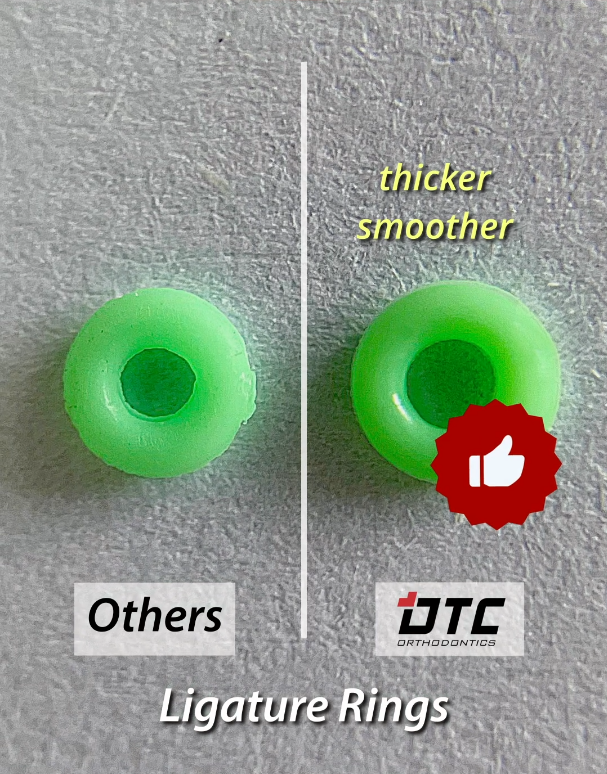
The Ligature Rings are likewise dental elastics made from medical-grade, latex-free TPU, available in various colours, described as highly stain-resistant, with high stretch and rebound, and supplied on a stick dispenser. DTC's published comparison against other brands focuses on two measurable points: a larger cross-sectional diameter, which supports a more prolonged elastic release cycle, and a higher surface smoothness, which reduces insertion resistance and shortens chairside time. Reported figures in that comparison include a 10% increase in product diameter and a 50% improvement in surface smoothness.
Translated into clinic terms, both points reduce visit frequency and per-case cost rather than improving any single treatment outcome. That is the correct way to evaluate an elastic: not as a clinical differentiator, but as an operational one.
The rest of the elastic set
- Orthodontic O Rings in latex and silicone, for conventional ligation and rotation control.
- Power Chains in TPU, available as open long, closed continuous and open short; DTC's comparison data states higher tensile strength than comparable products, aimed at space closure after extraction.
- Orthodontic Rotation Wedges in transparent and grey TPU.
- Orthodontic Chewies in TPR, described as durable and washable with high elasticity and tear resistance, in original, orange, mint, mango, strawberry and grape colours.
Tier 3: the components that decide which cases you can accept
Bracket and tube selection is a clinical decision, but it is also an inventory decision, because system compatibility determines what the clinic can reorder later without retraining the whole team.
| Component | DTC product names | Published specification to verify |
|---|---|---|
| Metal brackets | Zeal Series, Delicate Series, Bright Series, Monoblock Series | 17-4PH stainless steel; slot sizes 18 and 22; Roth and MBT systems; low and high torque; maxillary and mandibular arches (Monoblock Series: slot 22) |
| Ceramic brackets | Ceramic Series, Ceramic Self-ligating Series | Aluminium oxide poly-crystalline or mono-crystalline; slot 18 and 22; with or without hook; Roth, MBT, Edge-wise |
| Self-ligating brackets | Glory II Self-Ligating, Glory I Self-ligating Brackets, Toast Self-ligating Brackets | Slot 18 and 22 (Glory I: slot 22); Roth and MBT; passive self-ligating design described as low friction and light force |
| Buccal tubes | Zeal Series, Zeal Plus Series | Stainless steel; Roth and MBT; low and high torque; slot 18 and 22 |
| Bands | Prewelded Bands, Pediatric Bands | Stainless steel; Roth, MBT and Edge-wise systems; low and high torque |
| Archwires | Super-elastic Niti Wires, Stainless Steel Arch Wires, CuNITI Arch Wires | Arch forms Square, Oval, Natural, Europa I and Da; round and rectangular cross-sections; upper and lower arches (CuNITI: round, rectangle, Da) |
| Auxiliaries | Crimpable Hook, Lingual Button, Lingual Chain | Crimpable Hook in short 1.3 mm, medium 2.2 mm and long 3 mm, sizes 0.018 and 0.022 inch; Lingual Button with mushroom-shaped head and five base types; Lingual Chain in stainless steel or gold-plated stainless steel |
The Crimpable Hook and Lingual Button are small items that create disproportionate scheduling problems when absent. The Lingual Button's mushroom head is designed to hold elastics, chains and ligatures securely, and its base options include round, elliptical, mesh, bondable round and round with hole, in stainless steel or ceramic. For a clinic running a mixed adult caseload, that kind of base variety prevents improvised solutions chairside.
Springs complete the tier: the Niti Open Spring in diameters of 0.008, 0.010, 0.012 and 0.014 inch and lengths of 180 mm and 914 mm, and the Niti Closed Spring With Eyelets in the same four diameters with lengths of 3 mm, 6 mm, 9 mm and 12 mm.
Tier 4: instruments, where hardness numbers become a buying argument
Instruments are the least glamorous and most frequently under-budgeted tier. Published hardness, cutting capacity and sterilisation limits give a buyer something objective to compare.
| DTC instrument | Hardness | Capacity / note | Max sterilisation |
|---|---|---|---|
| Light Wire Cutter Pliers | HRC 58-63 | Ligature wires up to 0.30 mm diameter | 180 degrees Celsius |
| Distal End Cutter Pliers | HRC 58-63 | Mini tips 0.018 x 0.022 inch; archwires up to 0.021 x 0.025 inch | 180 degrees Celsius |
| Light Wire Pliers | HRC 55-60 | Loop-bending collection | 180 degrees Celsius |
| Bracket Removing Pliers | HRC 50-55 | Removal of bands and bondable attachments | 180 degrees Celsius |
| Band Crimping Pliers | HRC 58-63 | Pediatric dentistry collection | 180 degrees Celsius |
| Crown And Band Contouring Pliers | HRC 58-63 | Pediatric dentistry collection | 180 degrees Celsius |
| Crown Trimming Scissor | HRC 58-63 | Pediatric dentistry collection | 180 degrees Celsius |
| Clear Aligners Pliers | HRC 58-63 | Clear aligner collection | 180 degrees Celsius |
| Mathieu Needle Holder | - | With hard tip, without hard tip, without hard tip Type C | - |
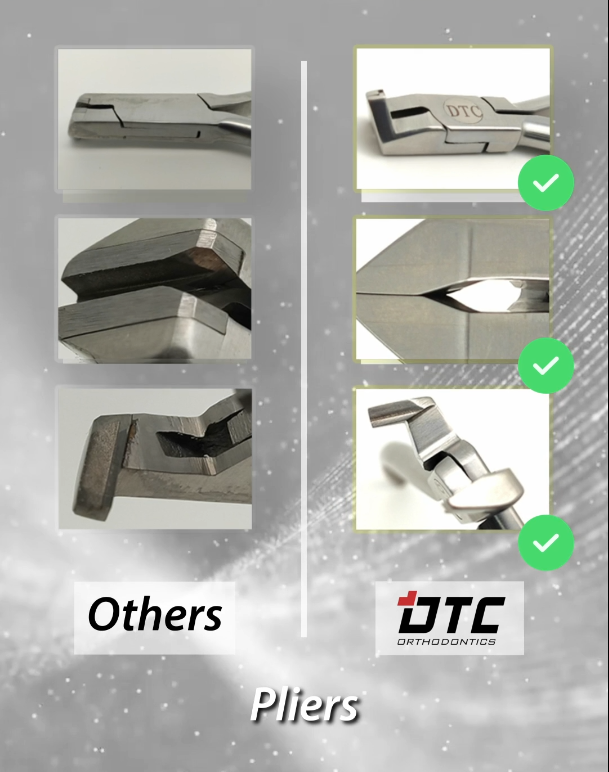
DTC's published technical description states that its pliers are manufactured with CNC machining and use aerospace-grade stainless steel, with a service life of at least five years and reported surface smoothness and material glossiness improvements of 30% over other brands. Comparative data also claims a service life five to ten times longer than products in the under-one-year bracket. Those are supplier-reported figures, not independent test results, and should be treated accordingly. The useful part for a buyer is that the claims are tied to named parameters: hardness, cutting capacity, sterilisation ceiling and estimated service life. A clinic can ask the same four questions of any supplier and compare the answers directly.
From shortlist to use case: the first ninety days
A shortlist only proves itself against actual appointments.
- Week one to two, separation. The first appointment typically consumes Separators, a mirror set, tweezers and a contraster. Separator loss is the most common early complication, which is why radiopaque separators and a dispenser format matter more than unit price.
- Week three, bonding. Bands, buccal tubes and brackets are placed. Broken or dropped brackets during bonding are normal, so the first order should include a replacement margin rather than an exact-count quantity.
- Month two, first archwire change. Ligature Rings, O Rings, Niti and stainless steel archwires, plus the Light Wire Cutter Pliers and Distal End Cutter Pliers.
- Month three onward, mechanics and space closure. Power Chains, Niti Open Spring or Niti Closed Spring With Eyelets, Crimpable Hooks, and the Light Wire Pliers for loops.
- Finishing and debond. Bracket Removing Pliers, Orthodontic Chewies, and rotation control with Orthodontic Rotation Wedges.
Read as a consumption map, this sequence tells a new clinic roughly what to reorder first. It also explains why instruments should be bought before elastics: elastics are replaceable in days, whereas a missing cutter type can cost an appointment.
Shortlisted single-source setup versus a fragmented supplier list
The traditional alternative for a new clinic is assembly buying: mirrors from one distributor, pliers from a second, brackets from a third, elastics from a fourth. This spreads risk in theory, and it is how many clinics start by default rather than by decision.
The shortlist approach concentrates the first order into fewer sources with documented specifications. In practice that produces three differences: consistent documentation for regulatory files, more predictable reorder timing, and fewer mismatched interfaces, for example when a bracket series and its buccal tubes are specified under the same system and torque conventions.
The limitations are real and should be stated plainly.
- A consumables shortlist does not solve an aligner-led business model. A clinic planning to lead with clear aligner therapy needs a separate supply and workflow plan; instruments such as the Clear Aligners Pliers only cover part of it.
- Advanced and case-dependent items, including the lingual self-ligating IN-Tendo JK-SL Series, the DTC-ORG Lingual Series, MARPE Series Expansion Screw, Implant Screw and the Kids Crown pediatric range, are not day-one necessities for most clinics. Bought at launch they add inventory and training cost before any patient needs them.
- Customisation changes order economics. DTC states that standard products carry a competitive minimum order quantity, while customised products may require a higher minimum, with options such as split shipments, shared tooling costs and standard colour or material choices used to lower entry volume. Standardising the first order is therefore a cost decision, not only a clinical one.
- Elastic consumables degrade in force delivery over the wear cycle and have practical shelf limits, so a large opening order trades cash for shelf time.
- None of the above replaces regulatory verification for the destination market.
Market signals shaping first-order decisions
Three structural trends are visible in current third-party data and each changes what a new clinic should prioritise.
Adult aesthetics pull demand toward discretionary treatment. Mordor Intelligence reports that the orthodontics market for adults is growing significantly on aesthetic demand, with clear aligners growing at a 14.25% CAGR. For a new clinic this argues for keeping at least one aesthetic option, such as the Ceramic Series or Ceramic Self-ligating Series, in the opening order while keeping metal brackets as the working default. Future Market Insights projected self-ligating brackets to reach USD 403.9 million globally by 2025, which supports stocking one self-ligating line rather than several.
Raw-material concentration affects supply continuity. Mordor Intelligence also notes that Nickel-Titanium archwires face supply chain risk because of heavy reliance on Chinese raw materials. A clinic that uses NiTi as its default archwire sequence should therefore plan two order cycles of wire inventory rather than a single opportunistic purchase, and should confirm lead times in writing. China exported USD 13.5 billion in medical instruments in 2024 according to the Observatory of Economic Complexity, and CMEF reported dental equipment and accessories export growth of 13.93% in the period leading to late 2024, so the supply base is deep; the risk sits in specific material chains rather than overall availability.
Regulation decides which supplier is usable at all. In the United States, orthodontic brackets and tubes are classified as Class I or II devices under 21 CFR 872.5410, with ISO 27020:2019 as the recognised standard. In the European Union, MDR 2017/745 requires CE marking for orthodontic products, classifying most as Class I or IIa. DTC holds ISO13485, CE0197 and FDA certificates for its products, and its stated production management follows CE (MDR) and ISO requirements. Verification of these documents belongs in the first purchase decision, not in the first audit.
Market structure is the final context. The five largest global players are Align Technology, Envista Holdings, Solventum, Dentsply Sirona and Straumann, according to MarketsandMarkets. A new clinic will buy from that tier for some categories and from specialist manufacturers for most consumables; the shortlist should reflect both realities rather than pretending one supplier covers everything.
Outlook: what will change for first orders
Three directions are worth planning for. First, specification transparency is becoming a purchasing norm: hardness ranges, sterilisation ceilings and cutting capacities are the kind of data buyers now request before a first order, and suppliers that publish them will be easier to qualify. Second, restock-driven buying will keep replacing bulk buying as clinics track consumption per case rather than per catalogue discount. Third, material and continuity questions around NiTi and other wire inputs will keep supply reliability on the decision checklist alongside price.
What is unlikely to change is the shape of the first order itself. Mirrors, separators, ligature rings and a working instrument set will still be the items a new clinic cannot start without, which is exactly why they deserve a decision rather than a default.
Verification checklist before the first purchase order
- Confirm certification documents: ISO13485, CE0197, FDA, and any market-specific registration.
- Confirm sterilisation compatibility: 180 degrees Celsius for instruments, 130 degrees Celsius for mirrors.
- Confirm system compatibility across brackets, buccal tubes and bands (Roth, MBT, Edge-wise; slot 18 or 22; low or high torque).
- Confirm lead time and stock policy. DTC maintains safety stock on selected standard products to support delivery within 3 to 5 business days, while custom-engineered production runs require a 2 to 4 week lead time; the company also works with international couriers including FedEx, DHL and UPS.
- Confirm order quantity policy for standard versus customised items, and whether split shipments or standard colours can lower entry volume.
- Confirm batch-to-batch stability processes. DTC states that it operates a Quality Management System and directly controls production and quality management, with each order delivery checked against customer requirements.
- Confirm documentation and after-sales support channels, including online access to product manuals.
FAQ
What orthodontic supplies does a new dental clinic actually need on day one?
A defensible first order covers four tiers: visibility and diagnosis items (dental mirrors in glass and stainless steel, contrasters, cheek and lip retractors, tweezers); the elastic consumable backbone (separators, ligature rings, O rings, power chains, rotation wedges, chewies); fixed appliance components selected for one bracket system (brackets, buccal tubes, bands, archwires, crimpable hooks, lingual buttons, springs); and hand instruments (cutters, pliers, a needle holder). Items outside these tiers, such as lingual self-ligating systems, MARPE expansion screws or pediatric crowns, are case-dependent and can be added after the case mix is known.
How should a new clinic choose between glass and stainless steel dental mirrors?
The decision rests on type range and sterilisation tolerance rather than material prestige. DTC's Intra Oral Glass Mirror With Hard Surface is offered in occlusion X-large, lingual small, buccal, occlusion large and occlusion small types. The Intra Oral Stainless Steel Mirror covers a broader set, including occlusion-3, occlusion-4, occlusion-5, occlusion-6, lateral-1 to lateral-4, large, small, occlusion large-2, occlusion x-large and occlusion small-2. Both are auto-clavable up to 130 degrees Celsius, which is below the 180 degrees Celsius ceiling of the instrument range, so the two categories must be sterilised accordingly.
What determines whether ligature rings and separators perform consistently between batches?
Four published parameters are checkable. Material grade and latex content: both DTC ligature rings and separators are made from medical-grade, latex-free polyurethane (TPU). Cross-sectional diameter and surface finish: DTC reports a 10% larger diameter and 50% higher surface smoothness on its ligature rings, which relate to elastic release duration and insertion resistance. Force behaviour and tear resistance: separators are described as highly resilient and tear-resistant with gentle continuous force, and ligature rings as having high stretch and rebound with stain resistance. Delivery format and traceability: stick dispensers for both, and radiopaque elements in separators.
How many pliers does a new clinic need, and which specifications matter?
A practical minimum covers cutting, bending and removal: Light Wire Cutter Pliers (hardness HRC 58-63, ligature wires up to 0.30 mm), Distal End Cutter Pliers (HRC 58-63, mini tips 0.018 x 0.022 inch, archwires up to 0.021 x 0.025 inch), Light Wire Pliers for loops (HRC 55-60) and Bracket Removing Pliers (HRC 50-55). All are rated to a maximum sterilisation temperature of 180 degrees Celsius. Where pediatric or aligner work is planned, Band Crimping Pliers, Crown And Band Contouring Pliers, Crown Trimming Scissor and Clear Aligners Pliers extend the set at HRC 58-63. DTC states that it provides a three-year warranty on sold pliers, and describes CNC machining and aerospace-grade stainless steel as the manufacturing basis.
Do new clinics need both metal and ceramic brackets at launch?
Not necessarily, but a single aesthetic option is usually justified. Metal brackets in 17-4PH stainless steel, such as the Zeal, Delicate, Bright or Monoblock Series, cover slot sizes 18 and 22, Roth and MBT systems, low and high torque and both arches. Ceramic options, including the Ceramic Series and Ceramic Self-ligating Series in aluminium oxide poly-crystalline or mono-crystalline, add with or without hook variants and Edge-wise compatibility. Self-ligating lines such as Glory I, Glory II and Toast offer passive low-friction mechanics. The efficient approach is to standardise on one primary system, then add a single ceramic or self-ligating line for aesthetic demand rather than stocking every series.
What should be verified before confirming the first orthodontic supplies order?
Documentation and logistics, in that order. Confirm ISO13485, CE0197 and FDA certificates as applicable, plus EU MDR 2017/745 CE marking for European destinations and awareness of the US classification of brackets and tubes as Class I or II devices under 21 CFR 872.5410 with ISO 27020:2019 as the recognised standard. Then confirm lead time and stock policy: DTC maintains safety stock on selected standard products for delivery within 3 to 5 business days, while custom-engineered runs take 2 to 4 weeks. Finally confirm order quantity policy, since standard products carry a competitive minimum order quantity while customised items may require a higher one, and confirm batch-to-batch stability arrangements under the supplier's Quality Management System.
For buyers who want the full product and specification reference, the DTC Orthodontics catalogue is available for download: English product catalogue (PDF).