
Shanghai Unibio Lab Co., Ltd: A Deep Dive into a Science-Driven Probiotics Powder Manufacturer

The global probiotics market, valued at USD 72.1 billion in 2024 and projected to reach USD 165.1 billion by 2034, is increasingly driven by demand for science-backed formulations and stable, high-viability raw materials. Within this landscape, Shanghai Unibio Lab Co., Ltd positions itself as a professional probiotic R&D, manufacturing and CDMO enterprise that combines academic heritage with industrial scale.
The Challenge: Delivering Viable Probiotics Powder Across Diverse Applications
Probiotics powder manufacturers face a core industrial pain point: maintaining bacterial viability through processing, storage, and gastrointestinal transit. Traditional free-drying and basic encapsulation often fail to protect strains from acid, bile, oxygen, and temperature fluctuations. This compromises efficacy, especially for products targeting different demographics—from infants and the elderly to pets and livestock. The need for stable, room-temperature-shippable probiotics powder with long shelf life has become a procurement priority for global supplement brands.
The Unibio Solution: Academic Roots, Industrial Scale
Shanghai Unibio Lab Co., Ltd builds on over 40 years of probiotic research from Jiangnan University, a world-top institution in food microbiology. The company operates 4 large self-owned manufacturing bases and one R&D center in Shanghai, covering a total plant area exceeding 300,000 ㎡. Its production equipment includes Asia’s largest fermentation tanks, GEA aseptic disc centrifuges, ultra-large vacuum freeze dryers, and exclusive liquid nitrogen cryogenic granulation machines. Annual output reaches 1,800 tons of probiotic raw powder and 10 billion capsules. The team consists of over 100 professional staff with 20+ years of industrialization experience.
Massive Proprietary Strain Library
The company maintains a comprehensive strain bank with over 30,000 microbial strains, including 25,300 primary 16S rRNA strains, 13,720 draft-genome strains, and 8,046 full-genome strains. Strains are isolated from longevity elder gut, infant feces, breast milk, traditional fermented food, and fresh fruits & vegetables. More than 30 in vitro, cellular, animal, and clinical screening models evaluate strain functions covering gut barrier, metabolism, immunity, inflammation, mental health, oral care, heavy metal detoxification, and sub-health intervention. The portfolio includes 189 patented functional strains categorized into gut health, metabolic management, immune regulation, oral health, women’s care, skin care, mental wellness, and next-generation probiotics (NGP).
Technical Core: VPro® 5-Layer Microencapsulation Technology
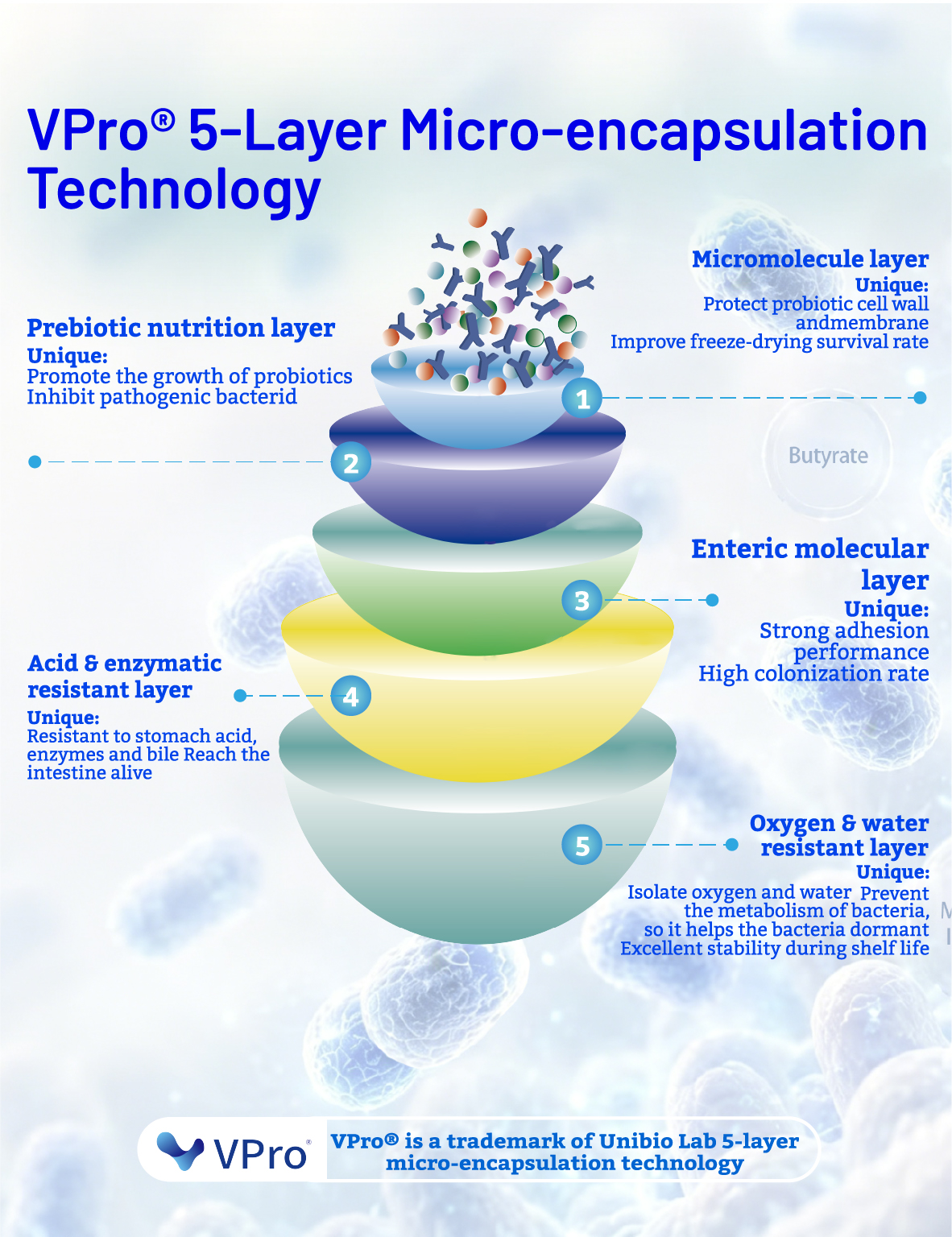
Unibio’s self-developed VPro® five-layer embedding technology addresses the core stability challenge through a multi-layer protective architecture:
- Micromolecular protective layer – anti-freezing & anti-stress
- Prebiotic nutrition layer – supports in-vivo proliferation
- Liposome enteric adhesion layer – boosts intestinal colonization
- Acid & enzyme resistant layer – survives gastric digestion
- Oxygen & moisture barrier layer – extends shelf stability
According to company data, this technology lifts freeze-drying survival rate by 40%, extends shelf life to 24 months, and achieves fermentation density above 3.5×10¹⁰ CFU/mL with lyophilized powder concentration up to 8.0×10¹¹ CFU/g. Combined with high-density ion-exchange culture, automatic feedback feeding, and biofilm stabilization techniques, the resulting probiotics powder is suitable for long-distance export and high-temperature food processing.

Products using VPro® encapsulation include single-strain powders like Lactobacillus rhamnosus GG (10B–300B CFU/g), Bifidobacterium breve CCFM1025 (10B–200B CFU/g), and the high-purity Akkermansia muciniphila AH39 (10B–200B TFU/g), all with a 24-month shelf life under recommended conditions.
Application Scenarios: From Infant Gut to Livestock Farming
Unibio’s probiotics powder range supports multiple targeted applications:
- Infant Probiotics Powder – Strains such as Lactobacillus rhamnosus GG and Bifidobacterium breve CCFM1025 are used to prevent diarrhea and regulate infant gut flora.
- Adult Gut & Bowel Regulating Probiotics Powder – Bifidobacterium longum CCFM760 and Lactobacillus plantarum CCFM1143 address constipation and metabolic support.
- Pet Probiotics Powder – Bifidobacterium animalis subsp. lactis BL03 (10B–600B CFU/g) is formulated for pet health products and animal feed.
- Sports Nutrition & Elderly Probiotics Powder – Multi-strain blends with immune-boosting and anti-inflammatory properties.
- Oral Health Probiotics – HelpGut® chewable tablets containing Ligilactobacillus salivarius CCFM1215 (10B CFU/tablet) for daily oral care.
- Next-Generation Metabolic Management – HelpGut® GLP-1 capsules with Akkermansia muciniphila AH39 (self-affirmed GRAS), targeting weight management and glycemic control.
Production is carried out under GMP and FSSC 22000 certified workshops, with Halal and Kosher certifications supporting entry into Muslim-majority and Middle Eastern markets.
Market Trend Analysis
Unibio’s multi-segment approach aligns with key market growth vectors. The global baby probiotics market was valued at USD 2.27 billion in 2024 and is expected to reach USD 5.6 billion by 2035 (CAGR 8.6%). The pet biotics market is estimated to reach USD 1,232.5 million by 2030 growing at 7.0% CAGR. Probiotic dietary supplements alone reached USD 10.6 billion in 2026. Microencapsulation—a critical enabling technology—is a validated industry trend for preserving probiotic viability, with Unibio’s proprietary VPro® method directly addressing this need.
Comparison with Traditional Probiotics Powder Solutions
Conventional probiotics powders often rely on single-layer coating or simple freeze-drying, resulting in rapid viability loss when exposed to moisture, oxygen, or gastric acid. Unibio’s VPro® 5-layer system provides a demonstrable advantage in extended shelf life and room-temperature stability, critical for global distribution. An honest limitation: certain high-concentration strains, such as Lactobacillus rhamnosus GG and Bifidobacterium animalis BL03, still require storage at -18°C or below in sealed packages to maintain maximum viable counts (10B–300B CFU/g). This cold chain requirement may add logistics complexity for some downstream buyers, though the company offers temperature-stable alternatives for many strains.
Future Outlook
With a growing focus on precision probiotics and next-generation strains like Akkermansia muciniphila, Unibio is positioned to supply both classic and novel probiotics powder. Its complete ISO 22000, FSSC 22000, and FDA registration facilitate customs clearance in North America, the EU, Southeast Asia, and the Middle East. The company’s CDMO services—from strain development and formula R&D to private-label packaging—offer a one-stop procurement path for brands seeking to launch targeted products in the gut-health, metabolic, or immune-support categories.
Frequently Asked Questions
| What is the VPro® technology and how does it improve probiotics powder? | VPro® is a proprietary 5-layer microencapsulation coating that protects probiotics from acid, bile, oxygen, and freezing damage. It increases freeze-drying survival by 40% and extends shelf life to 24 months at room temperature for most strains. |
| What certifications does Shanghai Unibio Lab hold for probiotics powder? | Unibio holds ISO 22000, FSSC 22000, GMP (SGS), Halal, Orthodox Union Kosher, FDA US food facility registration, and an independent sGRAS conclusion for Akkermansia muciniphila AH39. |
| Can Unibio produce customized probiotics powder (ODM/OEM)? | Yes. Unibio offers ODM, OEM, private label, custom strain blending, formula R&D, and packaging design. MOQ is 1 kg for single strain powder and 5,000 bottles for finished products. |
| What is the typical lead time for bulk probiotics powder? | Bulk raw materials can be shipped within 5–7 days; private-label finished goods require 25–35 days. |
| Are there specific strains for infant or pet applications? | Yes. Strains like Lactobacillus rhamnosus GG and Bifidobacterium breve CCFM1025 are used in infant formulas. Bifidobacterium animalis subsp. lactis BL03 and Bacillus coagulans CCFM1041 are formulated for pet health and animal feed. |