
Sheet Metal Fabrication Specs: What to Verify Before Award
Sheet Metal Fabrication Specs: What to Verify Before Award
Sheet metal fabrication converts flat metal sheet, strip and plate into parts, components and assemblies through cutting, forming, joining and finishing operations. The procurement question that matters is narrower than whether a supplier can fabricate metal at all: it is whether the supplier's documented material grades, tolerances, welding qualifications and certification scope match the drawing and the acceptance criteria of the project before the order is placed.
This industry reference is written for buyers in the research and evaluation stage — importers, OEM procurement teams and equipment builders comparing custom fabrication sources. It sets out the constraint layers that usually determine whether a sheet metal fabrication programme runs smoothly, and it identifies where a general fabricator's scope ends and another supplier type should take over.
Where Sheet Metal Fabrication Projects Get Held Up
Quotations for sheet metal fabrication normally list processes: laser cutting, punching, bending, welding, machining and surface treatment. A process list is necessary, but it does not answer the four questions that decide delivery quality.
- Which material grade was actually purchased, and does it match the grade called out on the drawing?
- Which welding procedure was used, who qualified it, and what inspection proves the joint?
- Which tolerance on the drawing is genuinely controllable — and which is being assumed?
- Which finishing steps were performed in the supplier's own workshop, and which were subcontracted?
Each of those is a constraint rather than a capability claim. Constraints can be written into a purchase order, checked against a certificate, or measured on a first article. Capability claims cannot. That is the practical reason a constraints-and-certification evaluation, typical of an HVQ-2 style procurement question, tends to produce fewer disputes than a comparison built only on machine lists and factory photographs.
The Certification Layer: What Should Be Verifiable
A supplier's certificate set should be read on three levels: what the certificate actually covers, which standard version it was assessed against, and whether the certificate identifiers can be checked independently. Openex fabrication, the manufacturing identity of Xiamen Openex Mechanical Technology Ltd, publishes the following set.
| Certificate | Identifier | Issuing body | Standard |
|---|---|---|---|
| ISO 9001 (management system) | 11426Q01049R001 | Beijing East Allreach Certification Center Co., Ltd. | GB/T 19001-2016 / ISO 9001:2015 |
| ISO 14001 (environmental management) | 11426E00739R001 | Beijing East Allreach Certification Center Co., Ltd. | GB/T 24001-2016 / ISO 14001:2015 |
| ISO 45001 (occupational health and safety) | 11426S00656R001 | Beijing East Allreach Certification Center Co., Ltd. | GB/T 45001-2020 / ISO 45001:2018 |
| ISO 3834 (fusion welding) | 23/999-3834 | SGS | EN ISO 3834-2 |
The three management-system certificates share one scope sentence — manufacture of machined parts, metal structures and sheet metal components, except where a licence is required — and run from 2026-04-16 to 2029-04-15. The ISO 3834-2 certificate covers fusion welding of metallic materials under welding process 135 and material groups 1.1 and 1.2.
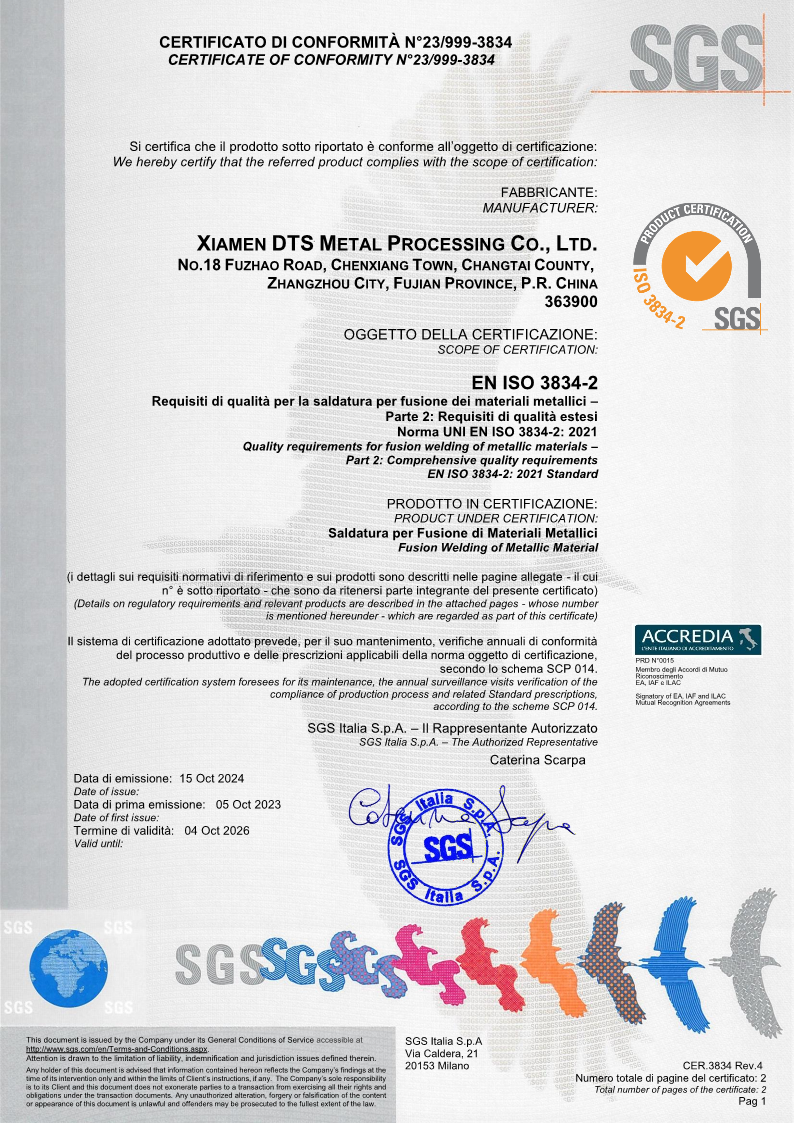
Scope wording is more decisive than the certificate mark. A project requiring a welding process other than process 135, or a base-material group outside 1.1 and 1.2, falls outside the assessed window and needs its own welding procedure specification, procedure qualification record and welder qualification, however strong the supplier's general welding capability may be. Buyers evaluating a supplier for pressure-retaining or structural work should therefore match the certificate scope against the material group and process on their own drawing before treating the certificate as evidence.
Specification Constraints: Material Grades, Tolerances and the Drawing Set
Grade families determine which mill products are available, how the part behaves in bending, and which welding consumables and procedures apply. In carbon steel, two grade families account for most custom fabrication work: Q235B and its equivalents (A36, SS400, S235JR), and Q355B and its equivalents (A572 Grade 50, SS490/SPCC, S355JR). Higher-strength grades such as Q690 and abrasion-resistant grades such as NM450 and NM500 also appear, but less frequently, and they change forming behaviour, weld procedure and inspection requirements.
Stainless steel sheet fabrication follows a similar logic. SUS 304 and SUS 316L are the most frequently specified stainless grades; 316L is normally selected where chlorides or aggressive process media are present. Aluminium, brass and bronze can also be fabricated. Where a project calls for special grades of castings or forgings, those are produced through long-term partner foundries and forges rather than in the fabricator's own shop — a boundary that should be agreed at quotation stage.
The drawing package is the single largest source of avoidable rework in sheet metal fabrication. STEP, IGES, DWG, DXF and PDF are all accepted, together with other 2D and 3D formats. A 3D model alone is rarely sufficient for quotation, because it does not normally carry the information that determines cost and acceptance: tolerance requirements; welding requirements; surface roughness and chamfer details; the direction of cutting relative to the hot-rolling direction; the bend radius of the plate; the required metal material; the heat-treatment requirement and stress-relief method; and finish requirements such as hot dip galvanizing, sand blasting or painting, and powder coating. For simple metal parts, a 2D drawing alone is often enough. A 2D drawing combined with a 3D model usually produces the fastest and most accurate quotation, and in some cases a physical sample helps.
| Product reference | Feature governed by tolerance | Recorded value |
|---|---|---|
| Tube Sheet, Customized-J-01 | Drilling precision; maximum diameter / thickness / drilling depth | ±0.05 mm; up to 10,000 mm / 600 mm / 1,000 mm |
| Telescopic Boom, Customized-J-04 | Straightness; height difference | ±1 mm; <1.5 mm |
| Ultra-long formed steel box section, Custom-L-1 | Overall straightness (8,000 mm length, 6 mm plate, 1.5 t) | ≤3.0 mm per 10,000 mm |
| Large welded crossbeam, Custom-L-7 | Guide straightness (6,000–10,000 mm length; 25–60 mm plate) | ≤0.10 mm per 1,000 mm |
| Large industrial weldment, Custom-L-5 | General machined tolerance; datum-pad flatness | ±0.20 mm; ≤0.15 mm per 1,000 mm |
| Large machined platen, Custom-L-10 | Machined-face flatness; surface finish | ≤0.10 mm per 1,000 mm; Ra 1.6–3.2 µm |
Figures recorded as typical reference configurations are engineered examples. Final values depend on the drawing, the load case and the datum scheme, and should be confirmed against the actual project before they are treated as acceptance criteria.
Forming and Joining Routes — and Their Boundaries
Forming route selection is where specification and capability most often diverge. Stamping and punching suit repetitive pierced features on metal parts produced in quantity. Press-brake bending and CNC forming handle box sections, channels and enclosure panels; the upper end of that route is long and heavy, with press-brake capacity reaching 18 metres in length and 10,000 tonnes, and overhead crane capacity above 250 tonnes for handling large weldments. Roll forming and cold forming produce cylindrical shells and long, straight formed sections, including an 8,000 mm formed and welded steel box section in 6 mm plate weighing 1.5 t, held to an overall straightness of 3.0 mm per 10,000 mm.
Deep drawing sits outside that set. Formed geometry is the clearest illustration of the boundary: single-curvature work such as cylindrical shells, box sections, metal boxes, metal cabins and formed metal closures sits inside a general fabricator's normal route, while double-curvature shapes — deep-drawn cones and segment-formed metal petals, for example — generally require dedicated tooling, presses and a production volume that justifies them. A buyer who needs deep drawing or high-volume progressive-die stamping should confirm tooling ownership, tooling cost and die maintenance as a separate scope item rather than assuming it is included in a general sheet metal fabrication quotation.
Joining is governed by procedure rather than by equipment alone. Available welding processes include SMAW, GMAW/MIG, GTAW/TIG, SAW, automatic tube-to-tubesheet welding, deep-penetration welding and robotic welding. Robotic cells used for repetitive structural work are quoted at ±0.05 mm repeat positioning accuracy and operate continuously, which makes joint-to-joint consistency easier to hold across a batch than in fully manual production. Inspection matched to the joint type includes visual inspection, dimensional checks, radiographic testing, ultrasonic testing, magnetic particle testing, penetrant testing, TOFD and phased array, hardness testing, and hydrostatic or pneumatic testing, alongside destructive checks such as chemical analysis, tensile testing, impact testing including low-temperature impact, bend testing, hardness testing and salt-spray corrosion testing.
Openex Fabrication: Documented Scope and Heavy Fabrication Capacity
Xiamen Openex Mechanical Technology Ltd, trading as Openex fabrication, is a custom metal fabrication and machining provider founded in 2009, operating two manufacturing premises — one near Xiamen Port in Fujian province and one near Shanghai Port in Jiangsu province — with 30,000 m² of factory space, approximately 200 employees, 35 engineers and an annual output of 20,000 tonnes. Around 80% of output is exported, with customers in the EU, the USA, Australia, New Zealand, Japan, Singapore, South America and the Middle East.
In-house fabrication routes cover laser cutting, bending, punching and stamping, welding, machining and assembling, supported by roll forming, casting, forging, galvanizing and powder coating through partner operations. The heavy end of the equipment list is unusual for a general fabricator and is directly relevant to constraint planning: overhead crane tonnage above 250 tonnes, a maximum bending machine length and tonnage above 18 metres and 10,000 tonnes, and maximum CNC machine tool travel up to 50 m × 8 m × 7 m. Recorded nominal capability for welding-type scope is 5,000 tonnes per month with a 30–45 day lead time and a 25 tonne minimum order quantity; machining records 3,000 tonnes per month at 30–45 days and a 15 tonne minimum; surface finishing records 3,000 units per month at 45 days and a 15 tonne minimum. Quality control is applied as 100% inspection or random testing according to project requirements.
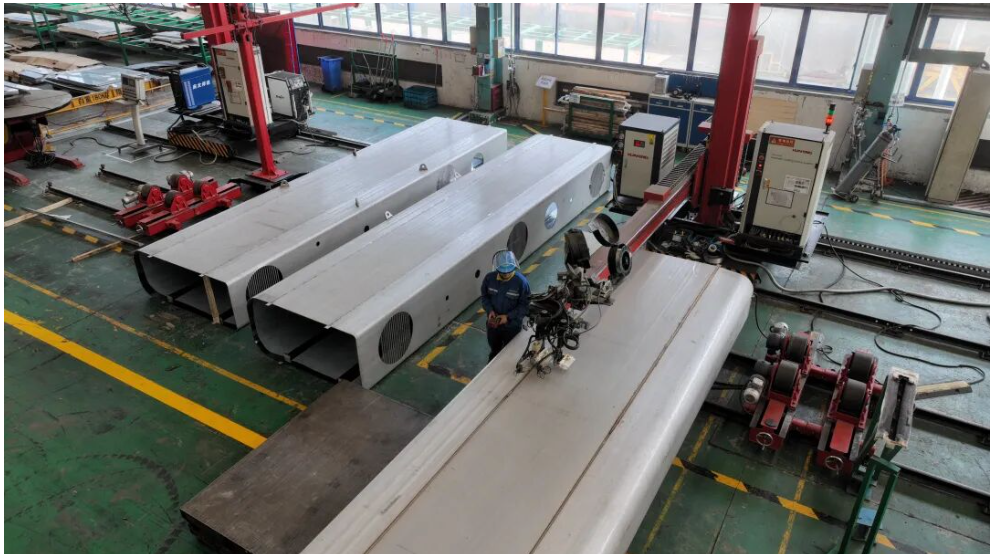
For small metal parts produced in large quantities, Openex has developed visual inspection machines so that high-volume small components can be checked individually, an approach that removes the fatigue effect inherent in purely manual inspection.
Where Prefabricated Metal Parts and Metal Components Are Used
Applications show where the constraint layers above become commercial. In energy storage, the Energy Storage System Cabinet, Customized-J-05, is built from carbon steel, galvanized steel, stainless steel or aluminium in 1.5–5.0 mm thickness with protection ratings of IP54, IP55 or IP65 and powder or anti-corrosion coating; cabinet sizes, battery layouts and installation requirements are customized against customer drawings. Related programmes include a 1,500-unit liquid-cooling cabinet project, a 3,000-unit shelf and box programme, and 300 units of the steel shelf and box assembly XHC-009, which measures 1.1 m × 1.1 m × 2.2 m at roughly 1,000 kg per unit with powder coating.
In logistics and heavy handling, custom steel chassis work demonstrates the load side of the same discipline. The JFE-1 steel chassis for carrying steel coils in a steel mill measures approximately 15 m × 2.5 m × 2.1 m, weighs 10 tonnes and carries a maximum load of 35 tonnes. The AGV steel chassis PSA-1 measures 15 m × 2.7 m × 3 m, weighs 10.5 tonnes and carries 30 tonnes, fabricated in 25 mm S355JR (or A572 Grade 50) plate with 20 mm NM400 abrasion-resistant plate; 345 units were supplied for container-yard AGV applications.
Energy applications include the Flywheel Energy Storage Shell AKI-1 — 1.5 m diameter, 0.8 m height, 2 tonnes, with a vacuum specification above 1.0 × 10⁻⁹ Torr·L/s within 30 seconds — supplied in a 400-unit programme, alongside solar panel supports and wind turbine structures.
Mining and machinery applications include the circular vibrating screen Customized-J-02 for mining and quarrying, hydraulic cone crusher frames and components, and frame work for machinery manufacturers, including a milling machine centre frame and a purpose-built steel frame held to 0.01 mm per metre. Modular construction is another route: prefabricated beam assemblies that weld cast hinges onto rolled I-beams, secured with high-strength pins, allow foldable housing structures to be assembled on site by crane. Mirror-finish stainless steel housings and enclosures for process equipment, semiconductor lines and research facilities complete the picture on the precision end of the stainless steel sheet fabrication spectrum.
Across these applications the pattern is consistent: the fabricator's value is not only in making the part, but in holding the constraint that makes the part acceptable at the point of installation.
Comparing Contract Fabrication With Traditional In-House Routes
Buyers comparing a workshop-based contract fabricator against traditional in-house or on-site fabrication should weigh the trade-off honestly rather than on price alone.
| Consideration | On-site / in-house fabrication | Controlled-workshop prefabrication |
|---|---|---|
| Schedule exposure | Weather and site sequencing directly delay the work | Weather delays are removed; site labour requirements fall |
| Trade interference | Fabrication competes with other site trades | Cross-trade interference is largely avoided |
| Consistency | Depends on the individual welder and the day | Fixtures, robotic cells and procedures hold consistency across a batch |
| Waste and cost | Higher site waste and rework risk | Recorded pipeline prefabrication practice reduces construction waste by roughly 50% and supports welding acceptance rates of up to 99.2%, with automated welding reported as 3 to 5 times more efficient than manual welding |
| Verification | Inspection is often retrospective | Certificate, procedure and dimensional evidence can be reviewed before shipment |
The limits are equally worth stating. Openex produces the majority of the metal parts, components and assemblies it exports — in practical terms 80–90% — while casting, forging, hot dip galvanizing and powder coating, along with other anti-rust finishes, are carried out by partner operations. A project that consists mainly of casting, forging or anti-rust finishing alone is therefore not a good fit for this supplier type. Very small components in very small quantities are also a weak fit, because communication, setup and freight effort do not shrink with order size, and small volumes moving as less-than-container loads carry a higher freight penalty than full-container loads. Finally, buyers who need deep drawing, progressive-die stamping or dedicated die tooling should place that scope with a specialist and keep the general fabrication scope separate, rather than assuming a single general fabricator covers every forming route.
What Is Changing in Sheet Metal Fabrication Sourcing
Two shifts are visible in how buyers approach sheet metal fabrication sourcing, and neither depends on a single market statistic.
The first is documentation-first evaluation. Buyers increasingly ask for factory photographs, workshop videos and certificate copies as a condition of shortlisting, before technical discussion begins. That request pattern is why suppliers now publish certificate numbers, issuing bodies, applicable standards and scope sentences, rather than simply stating that they are certified.
The second is the movement of fabrication work off project sites and into controlled workshops. Prefabricating pipe spools and structural assemblies in a workshop removes weather delays, reduces on-site labour and limits cross-trade interference; recorded practice in pipeline prefabrication places construction-waste reduction at roughly 50% and welding acceptance rates at up to 99.2%. Energy storage, solar and wind programmes have also become a visible share of custom metal fabrication demand, with projects such as the 1,500-unit liquid-cooling cabinet programme, the 3,000-unit shelf and box programme and the 400-unit flywheel shell programme reflecting that direction. For buyers, the practical consequence is that programmatic, repeatable orders with documented inspection are becoming easier to source than one-off, under-specified jobs.
A Pre-Award Verification Checklist
| Item to confirm | What to check | Why it matters |
|---|---|---|
| Certificate scope | Material group and welding process on the ISO 3834-2 certificate against your drawing | A certificate outside your material group or process does not qualify your joint |
| Grade equivalence | Whether Q355B, A572 Grade 50 and S355JR are acceptable substitutes in your specification | Substitution changes weld procedure and inspection, not only price |
| Drawing completeness | Tolerance, welding, roughness, rolling direction, bend radius, material, heat treatment, finish | Missing data is the main cause of quotation delay and rework |
| Tolerance feasibility | Which feature carries the tight tolerance and how it will be measured | A datum-pad or straightness call-out must be inspectable |
| Subcontracted steps | Which processes are performed in-house and which by partners | Lead time and quality ownership change at that boundary |
| Inspection plan | NDT methods, dimensional reporting and whether testing is 100% or sampled | Defines what evidence arrives with the shipment |
| Order profile | Volume against container-load logic | Freight and setup economics decide whether the order is viable |
FAQ
What metal materials can be processed for a sheet metal fabrication project?
Metals including carbon steel, stainless steel, aluminium, brass and bronze can all be fabricated, although carbon steel and stainless steel dominate custom fabrication work. In carbon steel, the two most commonly specified grade families are Q235B and its equivalents (A36, SS400, S235JR), and Q355B and its equivalents (A572 Grade 50, SS490/SPCC, S355JR); higher grades such as Q690 and abrasion-resistant NM450 and NM500 are also used. In stainless steel, SUS 304 and SUS 316L are the most frequently requested grades. Where a project requires special grades of castings or forgings, these are produced through long-term partner foundries and forges. Typical fabrication procedures applied to these materials include cutting, machining, welding, drilling, sand blasting and painting.
What drawing formats should be supplied to obtain an accurate quotation?
STEP, IGES, DWG, DXF and PDF are accepted, along with other 2D and 3D formats. For simple parts, a 2D drawing alone is usually sufficient. A 3D model alone is rarely enough, because it does not carry the information that determines manufacturability and cost: tolerance requirements, welding requirements, surface roughness and chamfer details, the cutting direction relative to the hot-rolling direction, the bend radius of the plate, the required metal material, the heat-treatment and stress-relief requirement, and finish requirements such as hot dip galvanizing, sand blasting or painting, and powder coating. Supplying 2D and 3D drawings together produces the fastest quotation; in some cases a physical sample also assists.
Is the supplier a manufacturer or a trading company, and what evidence can be requested?
Openex fabrication operates as a metal fabricator with two manufacturing premises, one near Xiamen Port in Fujian and one near Shanghai Port in Jiangsu. It produces 80–90% of the metal parts, components and assemblies it exports, and sources the remainder from partners. In-house procedures include laser cutting, bending, machining, welding, drilling, punching, stamping, assembling and packaging; casting, forging, hot dip galvanizing and powder coating are performed by partner operations. Buyers can request factory photographs, workshop video and certificate copies. The published certificate set includes ISO 9001 (11426Q01049R001), ISO 14001 (11426E00739R001) and ISO 45001 (11426S00656R001), issued by Beijing East Allreach Certification Center Co., Ltd. for the manufacture of machined parts, metal structures and sheet metal components, and ISO 3834-2 (23/999-3834) issued by SGS for fusion welding under process 135.
Can small quantities or samples be ordered before mass production?
There is no single minimum order quantity that applies to every project; the deciding factor is order profile. Very small components in very small quantities are generally not economical, because communication, setup and freight effort do not scale down with the order. Full-container-load quantities reduce freight cost compared with less-than-container loads, spread fixed overhead across more units, and support better material purchasing, so larger and repeat programmes are the preferred profile. Recorded capability minimums are 25 tonnes for welding scope, 15 tonnes for machining scope and 15 tonnes for surface finishing scope, with typical lead times of 30–45 days for welding and machining and 45 days for surface finishing. Production runs on an OEM/ODM and customizable make-to-order basis, with quality control applied as 100% inspection or random testing according to the requirements agreed at order stage.
Future Outlook
Constraint-driven evaluation is likely to keep tightening. As buyers request more evidence before shortlisting — certificate scope, procedure qualifications, inspection plans and dimensional reports — the suppliers that remain competitive are those whose documentation already matches their workshop reality. For projects in the energy storage, logistics, heavy machinery and modular construction segments, the practical next step is straightforward: fix the drawing set, confirm the material group against the supplier's welding certification scope, and agree which processes are performed in-house. Openex publishes a downloadable company and capability brochure at the Openex brochure PDF, and further company information is available at www.cncmetalworking.com.