
Ship Launching Airbags: Factory vs Trading Company
Independent Buyer Reference
A ship launching airbag is a pressure-retaining rubber cylinder with a cord-reinforced wall, and almost nothing that determines how it performs can be judged by looking at it. That is why a large share of first enquiries to Chinese marine suppliers open with the same question: are you the factory that builds these units, or a trading company reselling them?
The question is not an accusation. It is a way of working out where the money goes, who holds the technical record, and who is still answerable if a unit fails during a launch window that cannot be moved. This comparison takes a neutral buyer position and sets out what each model actually delivers on the three dimensions that matter most in this category — price transparency, traceability and after-sales responsibility — using a documented manufacturer profile as the benchmark rather than as the conclusion.
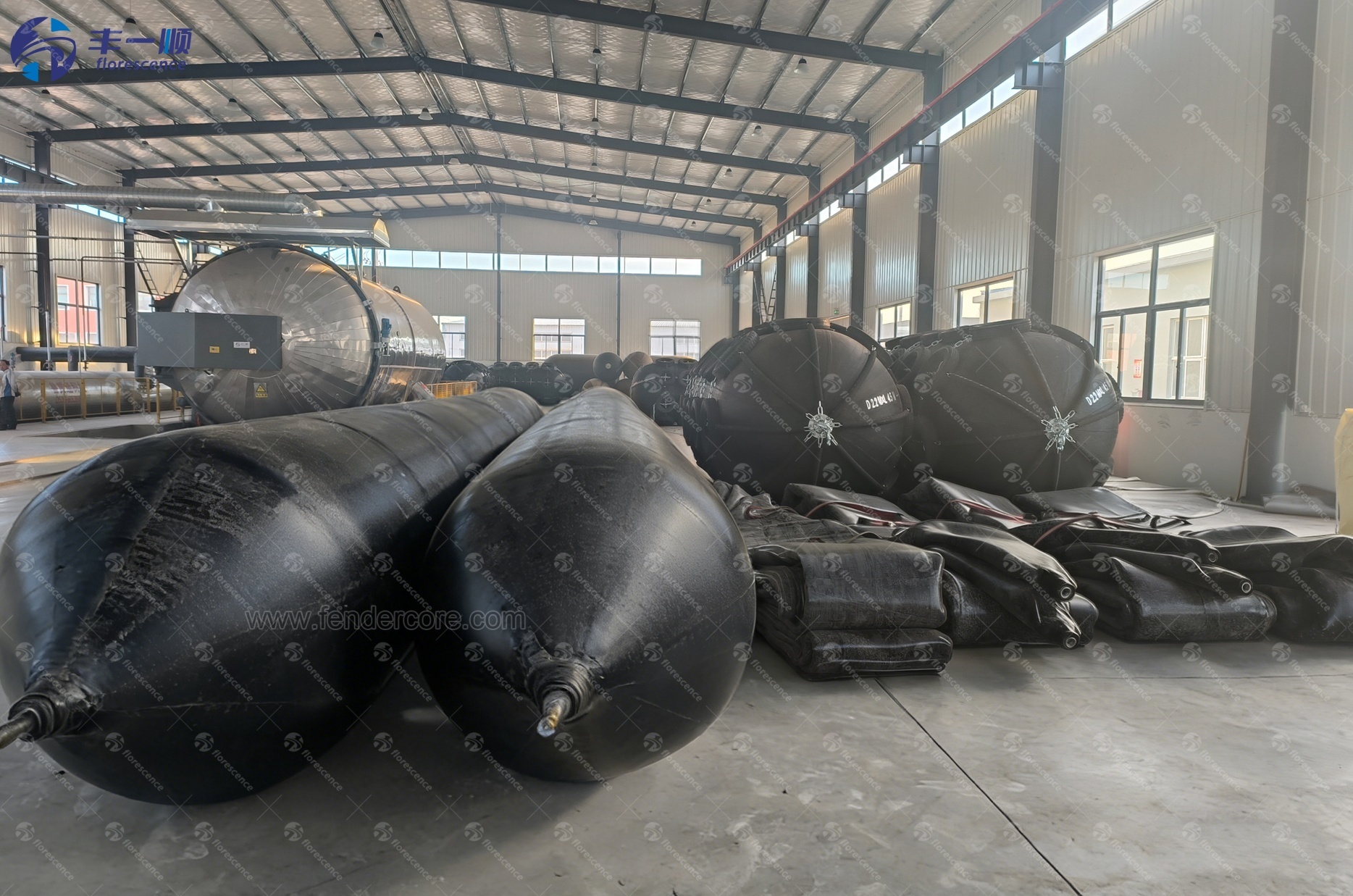
Ship launching airbag manufacturing is a build-to-order process: cord layers, rubber compound and vulcanisation decide performance long before the unit reaches a slipway.
Why the manufacturer-or-trader question decides this purchase
Ship launching airbags, also searched as ship landing airbags or marine launching airbags, sit in an unusual position among marine consumables. They are engineered products governed by a published standard — ISO 14409:2011, which sets design, material and testing requirements and classifies airbags as Ordinary (QP) or High-capacity (QG) — yet they are bought in an environment where most quotations arrive as a single number.
The technical envelope is narrow and well defined. A typical ship launching rubber airbag is built from natural rubber and nylon cord, carries between 3 and 12 reinforcement layers, and is supplied in diameters from 0.6 m to 2.8 m and lengths from 5.0 m to 25.0 m, with a stated service life of 5 to 8 years. Fittings normally include a valve, pressure gauge, pulling ring, three-way connecting tube and hose joint.
Everything that separates a good unit from a weak one sits inside that envelope: the number of cord layers, the grade and adhesion of the rubber compound, the control of the vulcanisation cycle, and the pressure and air-tightness testing that follows. None of it is visible in a product photograph, and none of it survives a price negotiation that treats all cylinders as equal. When two quotes for the same nominal size differ substantially, the difference is almost always located in one of those invisible variables — or in who is standing between the buyer and the press that formed the unit.
What a direct airbag factory delivers — three concrete differences
1. Price transparency
A manufacturer can decompose a quotation into its real cost drivers: rubber compound, cord fabric and layer count, end fittings, testing regime, packing, and the delivery term. That decomposition matters because it lets a buyer see what changes when a price changes. If a supplier's second quote is lower, the buyer can ask which variable moved — fewer layers, a lighter fitting set, a reduced test scope, or a different packing method — and get an answer that can be verified against the standard.
A trading intermediary sells a bundle. The margin is legitimate, and in some cases it buys real services, but it is opaque by design. The buyer cannot see whether the factory behind the trader changed between the sample order and the bulk order, and price movements cannot be attributed to a specific engineering decision.
2. Traceability
Traceability in this category means three things: batch records that link a delivered unit to its material and test data, test reports that can be read against ISO 14409, and certificates whose scope actually names the product being bought.
Scope is where buyers most often get caught. A classification society certificate issued for pneumatic rubber fenders does not cover ship launching airbags, however impressive the certificate looks. The document has to name the product family. The manufacturer's own quality system matters in the same way: an ISO 9001:2015 certificate whose scope reads "production of marine airbags, rubber fenders and docking fenders" tells a buyer that the airbag line is inside the audited system, not adjacent to it.
A trading company cannot issue that documentation in its own name. It can forward it, and a well-run trader will, but the chain now includes an additional party whose records the buyer cannot audit.
3. After-sales responsibility
Airbag failures are rarely gradual. A unit that loses pressure during a rolling launch creates a problem that has to be solved within hours, on a slipway, with the vessel already moving. In that scenario the useful question is not who offers a warranty, but who can put a technical opinion and a repair path in front of the buyer the same day.
A factory with in-house engineering can respond with installation and use guidance, repair kits, spare fittings and, where the project justifies it, on-site support. A trader must relay the problem to a third party and relay the answer back. That relay is workable for a standard spare part; it is slow for a technical failure during a launch.
Where the trading model legitimately fits — and where it stops
Neutrality requires saying this plainly: the intermediary model exists because it solves real problems, and for some buyers it is the better choice.
- Multi-category consolidation. A shipyard fitting out a berth may need airbags, pneumatic fenders, cone fenders, chain assemblies and pads. A trader can bundle several factories into one order, one set of documents and one payment.
- Small mixed quantities. Some traders hold stock and will break quantities below a factory's natural production batch.
- Local presence. Regional stock, local currency invoicing, and support in the buyer's language reduce administrative friction, particularly for buyers without an established import process.
The limits are just as concrete. A trader cannot change a layer count, run an air-tightness test, or authorise a deviation from ISO 14409 during production. It cannot open a vulcanisation press for a technical discussion. And if it re-sources between orders, the second batch may not match the first in compound or cord construction — a real risk in a category where the finished product carries no visible specification marking.
A benchmark profile to test any quote against
Qingdao Florescence Marine Supply Co., Ltd is a marine rubber manufacturer established in 1992 and based in Qingdao, China, producing pneumatic rubber fenders, ship and dock rubber fenders, foam fenders, and ship launching and salvage airbags. Its published profile is useful here not as a sales claim but as a checklist of what a genuine manufacturing position looks like on paper.
- Physical footprint: a 40,000 m² factory, 120 employees, 25 engineers in the technical team, and an annual output of around 2,000 units.
- Export orientation: a stated 95% export ratio, with markets in Southeast Asia, South America, Europe, North America, the Middle East and Africa.
- Quality system: ISO 9001:2015 certificate 32726Q10126RIS, issued 9 May 2026 and valid to 8 May 2029, covering production of marine airbags, rubber fenders and docking fenders; ISO 14001:2015 certificate 32725E20318R0S, valid from 28 May 2025 to 27 May 2028.
- Product-specific certification: a Bureau Veritas certificate, GTS 2025 154536 0003, issued 4 September 2025 against ISO 14409, with a scope naming marine rubber airbags, ship launching airbags and marine salvage airbags; and an Indian Register of Shipping test report, QIN21X015, issued 22 July 2021 against ISO 14409 for ship launching and marine salvage airbags.
- Classification society work: products can be manufactured and inspected to the applicable requirements of CCS, BV, RS, ABS and LR on a project basis.
- Reference base: supplied equipment to naval organisations including the Bangladesh Navy, French Navy, Royal Thai Navy, Italian Navy and Philippine Navy.
Read as a benchmark, the list does something a marketing page cannot: it gives the buyer specific nouns to demand from any supplier — a certificate number, a scope sentence, a factory area, an audit standard. A quotation that cannot be matched against items of this kind is not necessarily bad, but it is unverified.
Factory verification: five checks that separate the two models
Verification should be cheap and fast, and it should happen before a deposit, not after a delay.
- Match the address to the operation. Compare the registered business scope and the production address with the port of loading. A supplier whose declared factory and shipping origin do not line up deserves a follow-up question.
- Look at the process, not the showroom. A live video walk-through or an in-person visit should show cord cutting, airbag building and vulcanisation equipment on site. A workshop either has those assets or it does not.
- Read the certificate scope. Confirm that the classification certificate or test report names ship launching airbags, not only fenders, and that the standard referenced is ISO 14409.
- Ask for a recent batch record. Material test data, dimensional inspection and air-tightness results for a unit comparable to the one being ordered.
- Verify independently. Certificates carry numbers; issuing bodies can confirm them. This takes minutes and removes the entire category of document risk.
Pre-shipment quality checks: what should be on the report
A manufacturer working under ISO 9001:2015 is expected to test each production batch rather than the catalogue. For ship launching airbags and pneumatic fenders, the relevant checks are raw material testing, dimensional and hardness inspection, and air-tightness testing; rubber fenders additionally go through compression testing against design values.
Third-party inspection is a normal request, not an unusual one. Buyers regularly appoint SGS, Bureau Veritas, CCS, DNV or ABS to witness testing at the factory, and metal components can be supplied with EN 10204 3.1 mill test certificates so that bolt and fitting traceability is documented alongside the rubber data.
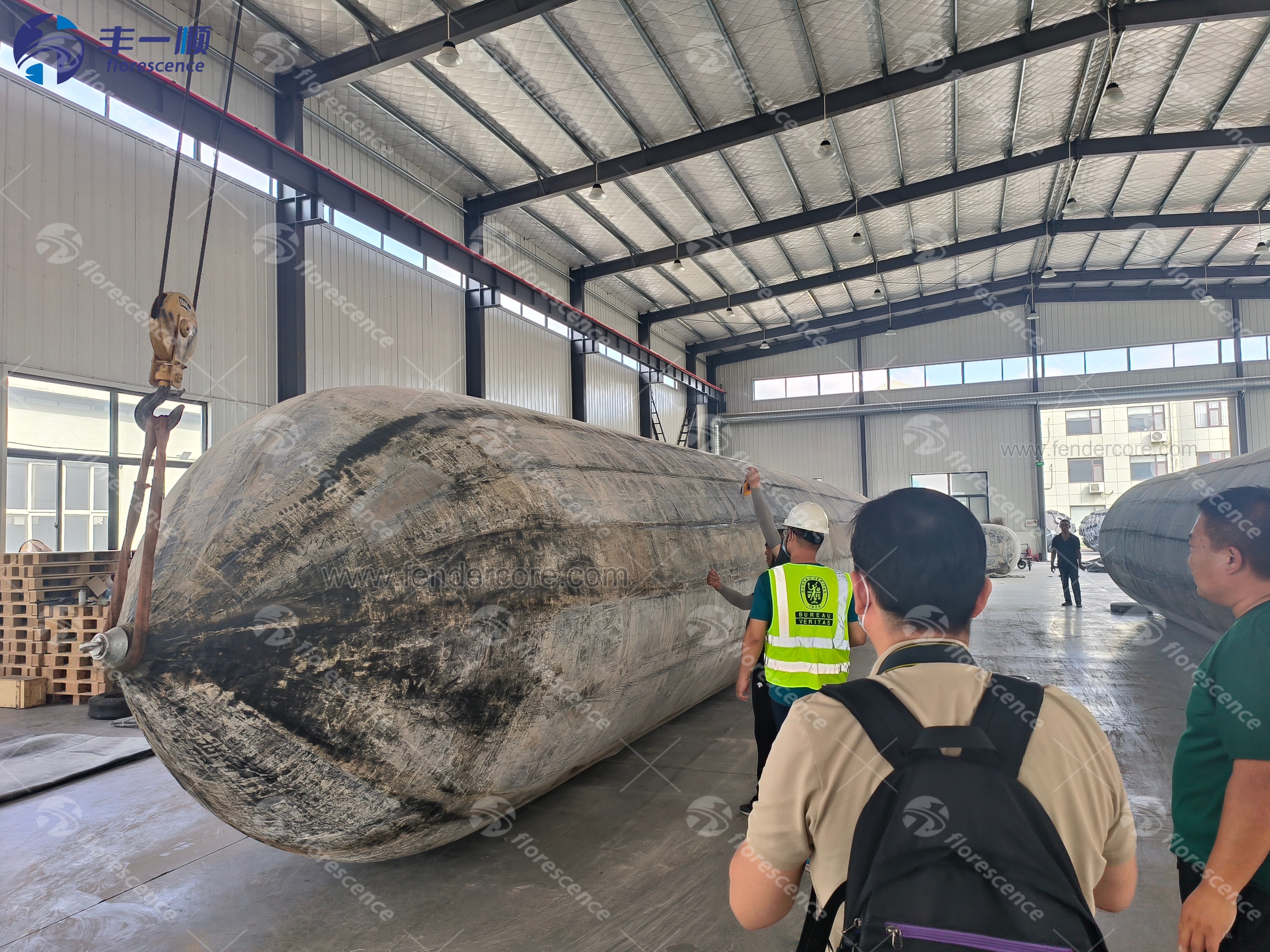
Air-tightness and dimensional checks are performed per batch; a quality inspection report is normally released before the balance payment is settled.
The practical control point for a buyer is the quality inspection report. A complete report before final payment — with rubber test data, sizing sheets, pressure records and clear photographs of the packed units — converts quality from a promise into a document the buyer can approve or reject while the goods are still in the factory.
First-time importers: making delivery predictable
For a buyer placing a first order from China, the delivery risk usually sits in documentation and scheduling rather than in the product itself. Four elements remove most of it.
Delivery terms. FOB is the common baseline, but CIF, CFR, DDP and DDU arrangements are available, which lets a first-time importer choose how much logistics to own. Sea freight, air freight, LCL and FCL shipments are all supported, and packing is adjusted to reduce freight cost and improve loading efficiency — airbags are shipped deflated and folded, with steel parts wrapped against corrosion.
Documents. A complete set covers the commercial invoice, packing list, bill of lading and certificate of origin in the applicable form, which also affects duty treatment at destination.
Visibility. Weekly production photographs and video through the vulcanisation and packing stages, followed by the container number and vessel tracking details once the shipment is booked, give a first-time buyer a verifiable timeline instead of a promise.
Schedule honesty. Production lead time is quoted per order; the published range runs from 5 to 30 days depending on specification, and larger custom or full-system orders run longer. Monthly capacity is stated at around 200 units, which is the number to compare against the requested delivery date when a launch window is fixed.
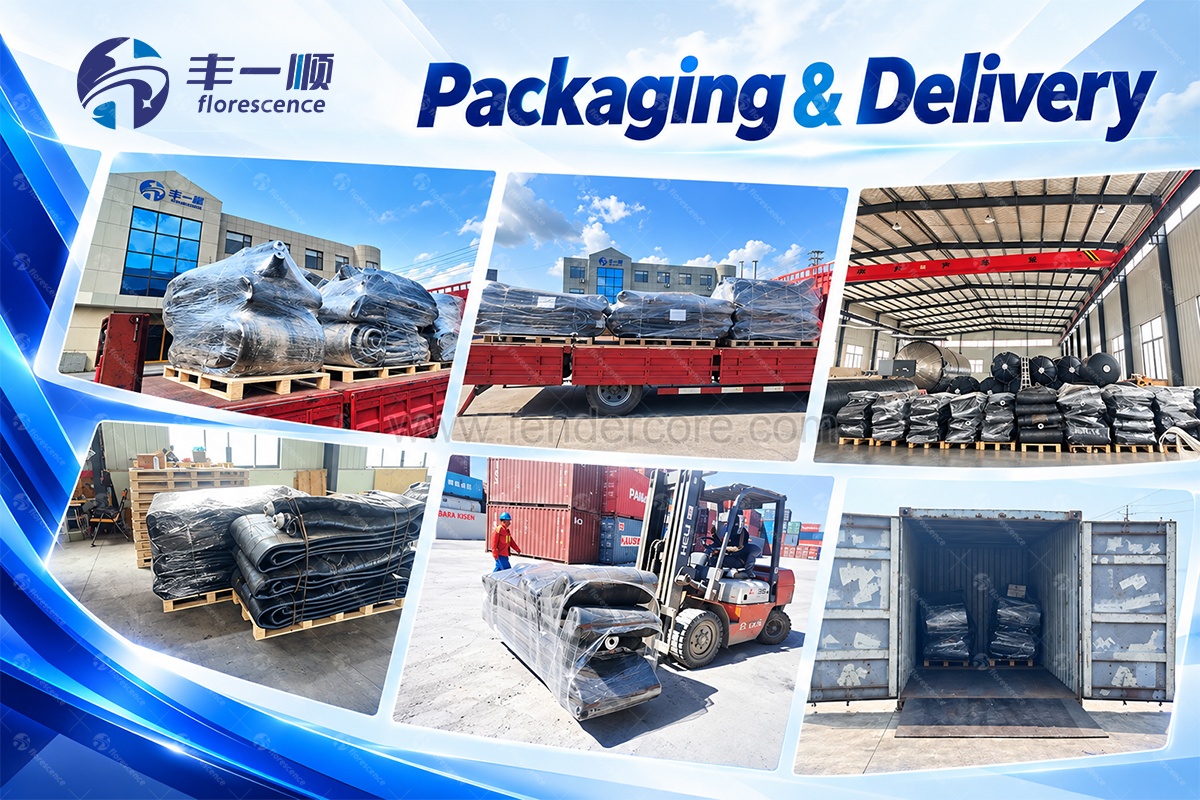
Export packing for ship launching airbags: deflated and folded units, protected fittings, and a document set released before dispatch.
Payment terms and what they reveal
Payment structure is a useful signal because it distributes risk. Terms commonly quoted in this category are 30% or 40% advance with the balance before shipment; letters of credit and cash transfer are also accepted. A buyer should read the structure together with the inspection sequence: if the balance falls due before the quality inspection report is released, the buyer has lost the main lever. The stronger arrangement is a balance payment triggered by an approved report, which is why factories that test per batch can offer it comfortably.
What the factory model looks like in the water
Two documented projects show where the difference becomes practical rather than commercial. In Brazil, a shipyard used 13 units of 2.5 m diameter by 15 m length ship launching airbags to launch 13 barges, with a reported 8 to 10 year service expectation under regular slipway conditions. The specification highlights were ISO 14409 compliance, multi-layer high-strength construction, puncture and wear resistance, and a large-diameter design giving higher ground clearance and smoother rolling efficiency for large barges.
In Romania, a marine salvage company used 10 marine salvage airbags for shallow and deep-water refloating work, with a stated 6 to 8 year service expectation under regular salvage and heavy-lifting conditions. In both cases the buyer's decision rested on a specification that could be written down — layer count, diameter, length, standard — which is only possible when the party quoting is the party building.
The boundaries of this comparison
The factory model is not universally superior, and any comparison that claims otherwise should be discounted. Three limits are worth stating.
- Breadth. A single factory covers airbags and fenders well; it will not cover every fitting, chain and pad in a berth package, so most projects still involve multiple suppliers.
- Order size. A factory quoting a minimum of one unit is flexible on paper, but the economics of small, mixed orders still favour consolidation, and freight for a single airbag can exceed the value it adds.
- Local obligation. A manufacturer selling across borders is not a local stockholder. Buyers who need same-week replacement from regional inventory are buying availability, and that availability typically sits with a distributor rather than the plant.
Market context: why the factory side is getting more attention
The global marine airbags market was estimated at USD 328.82 million in 2025 and is projected to reach USD 346.59 million in 2026, according to 360iResearch. Asia-Pacific accounts for approximately 52% of global revenue, with China acting as the primary manufacturing and export centre — which is precisely why the manufacturer-or-trader question carries commercial weight rather than being a formality.
Alongside scale, the standards picture is tightening. ISO 14409:2011 distinguishes Ordinary (QP) and High-capacity (QG) airbags, and the difference is not cosmetic: the classification maps onto layer count, working pressure and the tonnage a unit can safely support. Buyers specifying high-capacity units for larger vessels are, in effect, specifying a heavier cord construction and a more demanding test regime — the part of the offer a trader is least able to control.
A short scoring framework for the decision
The framework below is deliberately small. It is intended to be applied to two or three shortlisted offers in under an hour, and it weights factory verification most heavily because that is the item a trader cannot manufacture a substitute for.
| Dimension | What to check | Weight |
|---|---|---|
| Factory verification | Production address matches loading port; cord cutting, building and vulcanisation equipment shown on site or on video; certificate scope names ship launching airbags; certificate number confirmed with the issuing body | 30 |
| Price transparency | Quote itemises layer count, cord and compound grade, fittings set, test regime, packing and delivery term; changes between two quotes can be attributed to a named variable | 20 |
| Traceability and documentation | Batch records, ISO 14409 test data, EN 10204 3.1 certificates for metal parts, commercial invoice, packing list, bill of lading and certificate of origin | 20 |
| Payment terms | 30% or 40% advance with balance before shipment, letter of credit or cash transfer; balance ideally released against an approved quality inspection report | 15 |
| Pre-shipment quality checks | Air-tightness and dimensional testing per batch, third-party witness inspection by CCS, BV, ABS or DNV on request, complete report before dispatch | 15 |
A well-organised trading company can score respectably on documentation and payment flexibility. It will normally score low on factory verification, which carries the largest weight — and that asymmetry, rather than any judgement about intermediaries as a category, is the honest summary of the comparison.
Frequently asked questions
Are you a manufacturer or a trading company?
Qingdao Florescence Marine Supply Co., Ltd is a marine equipment manufacturer established in 1992, with more than 30 years of experience in marine fenders, pneumatic fenders, foam fenders and ship launching airbags. The factory operates under ISO 9001 and ISO 14001 with complete production and inspection systems. This distinction is verifiable: the production address, the presence of cord-cutting and vulcanisation equipment, and the scope wording on the ISO and classification certificates all point to the same conclusion.
How can a buyer verify an airbag factory before placing a first order?
Verification rests on documents and site evidence rather than assurances. The buyer can request the business scope and production address, a live video walk-through showing cord cutting, building and vulcanisation equipment, the ISO 9001:2015 certificate and its scope sentence, and a product-specific certificate or test report naming ship launching airbags against ISO 14409. Certificate numbers can be confirmed directly with the issuing body, and third-party inspection agencies such as SGS, BV, CCS, DNV or ABS can be appointed to witness testing at the factory.
What payment terms are normal for ship launching airbag orders?
Terms commonly quoted in this category are 30% or 40% advance with the balance before shipment; letters of credit and cash transfer are also accepted. The structure should be read together with the inspection sequence. Where a factory issues a full quality inspection report before dispatch, the buyer can approve the goods before releasing the balance, which is the more balanced arrangement for a first order.
How is airbag quality checked before the goods leave the factory?
The factory operates under ISO 9001, and every production batch goes through defined tests: rubber raw material testing, dimensional and hardness checks, and air-tightness testing for ship airbags and pneumatic fenders. Third-party inspection by agencies such as SGS, Bureau Veritas or LR is welcomed on request. Metal parts can be supplied with EN 10204 3.1 mill test certificates, and physical property reports covering tensile strength, elongation and compression are available for rubber components.
This is my first time importing. How can I be sure the goods arrive smoothly?
Four controls cover most of the risk. Choose the delivery term deliberately — FOB as a baseline, with CIF, CFR, DDP or DDU available if you prefer the supplier to manage more of the route. Insist on a complete document set: commercial invoice, packing list, bill of lading and certificate of origin. Ask for weekly production photographs and video through vulcanisation and packing, followed by container number and vessel tracking once booked. And confirm the schedule in writing before production starts, since standard orders and large custom or full-system orders run on different timelines.
How is airbag size and quantity decided for a launching project?
Size and quantity are derived from the vessel: length, width and weight are the inputs used to recommend airbag diameter, length and the number of units required. Bearing capacity itself depends on diameter, working pressure, contact area, vessel weight and the number of airbags in use. Diameter, length, pressure rating, reinforcement layers and end structure can all be customised, with layer configurations typically ranging from 3 to 12 depending on working pressure and project requirements.
Closing note
The manufacturer-versus-trader question is not really about purity of supply chain. It is about which party can answer a technical question, produce a batch record, and stand behind a unit after it has been rolled into the water. A buyer who asks for a certificate scope, a factory address and an inspection report before the deposit is placed will get a clear answer from either model — and that answer is the comparison.
For buyers who want the full technical and commercial reference in one document, the manufacturer's brief catalogue is available here: Florescence Catalogue – Brief (PDF).
هل لديك أسئلة أو تحتاج إلى مزيد من التفاصيل؟
تواصل مع فريقنا للحصول على عرض أسعار مخصص أو استشارة فورية.
طلب عرض أسعار
املأ النموذج أدناه وسيتواصل معك فريقنا بعرض مقترح مخصص.
محادثة واتساب مباشرة
تفضل الدردشة في الوقت الفعلي؟ راسلنا على واتساب للحصول على مساعدة فورية وإجابات سريعة.
- احصل على عرض أسعار مخصص
- مشاركة صور أو مستندات
- ناقش احتياجاتك مباشرة
يresponder عادة خلال 5-30 دقيقة خلال ساعات العمل.