
Shirt Packaging Accessories: Choosing an OEM/ODM Supplier
Shirt packaging is the last quality checkpoint before a garment reaches a customer, yet many sourcing conversations treat it as a list of low-value disposables. In formalwear and premium shirt programs, collar stays, collar bands, butterflies, boards, tissue paper, hang tags and poly bags must work together to keep a folded shirt looking finished. For a procurement team moving from evaluation to execution, the real question is not only where to buy each item. It is whether one supplier can deliver the full shirt packaging accessory set with consistent material quality, customization, compliance and a production schedule that matches garment output.
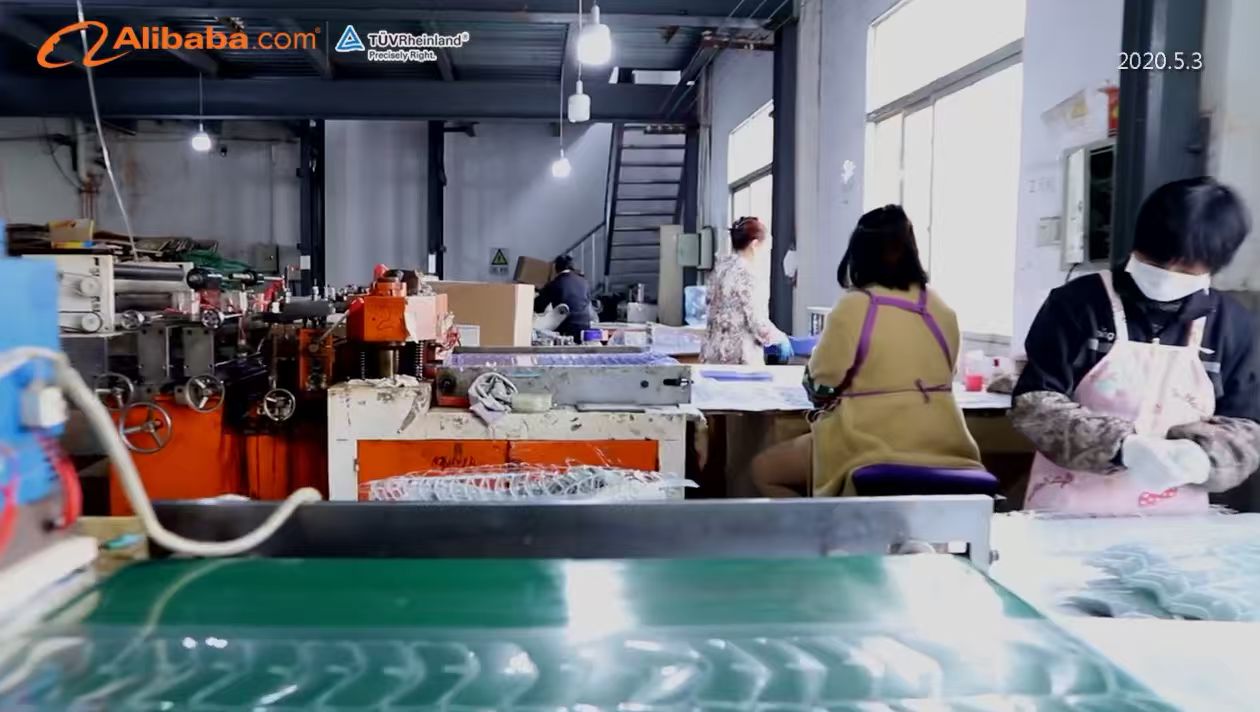
Production area, Wuxi Mingyu Garment Accessories Factory.
The Role of Shirt Packaging Accessories
A modern shirt pack usually contains more than the garment. Small plastic and paper components hold the collar, keep the shirt from moving in the box, communicate the brand, and protect the item during transit. They also affect the first impression in e-commerce parcels and retail packaging.
Shirt packaging accessories can be grouped by function. Collar components preserve the shape and fold. Boarding and tagging materials position the garment for display. Belly bands, tissue paper and poly bags add final protection or brand finishing. Although each item is small, the set is a system: a collar stay that is too flimsy, a band that does not match the collar width, or an undersized poly bag can make the rest of the packaging look careless.
| Accessory group | Typical items | Main function in a shirt pack |
|---|---|---|
| Collar shaping | Collar stays, metal collar stays, collar bands, paper collar bands, collar butterflies, collar supports | Keep collar points and folds stable through folding, transit and retail handling |
| Garment holding | Plastic clips, metal pins, shirt back clips | Hold folded shirt layers together and reduce movement |
| Board and presentation | Shirt cardboard, apparel tags, hang tags | Support the folded shirt and carry brand information |
| Wrap and branding | Tissue paper, belly bands, gift boxes | Add a finishing layer for retail, e-commerce or gifting |
| Protection | Plastic bags, clear packaging bags | Protect against dust, moisture and handling marks |
Evaluation Problem: Fragmented Supply Creates Hidden Cost
In many buying organizations, shirt packaging accessories are sourced piece by piece. A collar stay is ordered from one factory, a collar band from another, and hang tags or poly bags from a third supplier. This fragmented model appears flexible at first, but it creates hidden coordination work during order execution.
When different components arrive from separate factories with separate artwork approvals, MOQs and delivery windows, the buying team must align every lead time. Colour differences can appear between a paper band and a hang tag. Logo stamping quality can vary between plastic and paper substrates. If a packing line discovers a defect after the first few thousand shirts are packed, the responsible party is not always clear. These are execution risks, not just sourcing annoyances.
A supplier capable of covering the shirt packaging accessory family can remove part of that coordination burden. Instead of sending the same artwork to several vendors, a buyer can work with one production plan, one quality-control process and one shipment for a kit of related components.
MingYu Garment Accessories as an Industry Reference
One supplier that follows this integrated model is Wuxi Mingyu Garment Accessories Factory, the production entity behind MingYu Garment Accessories. The factory was founded in 2004 and focuses on PVC and PET collar bands, collar stays, collar butterflies, shirt cardboard, moisture-proof paper, plastic clips, plastic packaging bags and other garment accessories. Its export markets include Europe, North America, South America and Asia, with an export ratio of about 85 percent.
From a procurement point of view, the relevant facts are not limited to product names. The company operates with an OEM and ODM model, customizing shirts packaging accessories according to size, colour, style, printing, hot foiling, mould opening and logo requirements. This means a brand can request a specific collar stay length, a printed collar band, a paper butterfly with a logo, and a poly bag dimension that fits the carton without treating each item as a separate engineering project.
The factory reports a production MOQ of 1,000 sets, a typical lead time of 7-20 days and a monthly capacity of 7.5 million sets. For an apparel buyer, that combination matters because shirt packing accessories are often needed in large synchronized batches. A low production MOQ helps with pilot lines, while a monthly capacity in the millions supports full-season replenishment. The supplier also states that it performs full testing of products and provides technical support and after-sales services.
OEM and ODM Execution: What Buyers Should Expect
At the evaluation stage, buyers often ask what OEM and ODM really mean in the garment accessory category. In this context, OEM means the manufacturer produces according to the customer's specification. ODM means the manufacturer can also propose or execute a design based on the customer's requirements and packaging function.
Customization for shirt packaging accessories usually follows one of several paths:
- Geometry and size: collar stays, collar bands and butterflies can be adjusted to collar proportions and shirt sizes.
- Colour and material: components can be supplied in transparent clean finishes or specified colours such as white PET or light blue PVC.
- Decoration: printing, hot foiling, logo stamping and laser engraving are common methods for adding a brand mark.
- Mould and tooling: for shaped paper or plastic components, mould opening may be needed to achieve a specific butterfly or stay outline.
- Packaging integration: the final poly bag, tissue paper, belly band and tag are part of the same order, which helps visual consistency.
During order execution, a buyer should still confirm the inspection and approval sequence. The supplier's manufacturing profile includes in-house quality-control checks throughout production, and its commercial terms list pre-shipment testing. Payment terms in the supplied profile are TT with a 30 percent deposit and 70 percent balance before shipment, while delivery can be arranged under FOB, CIF or EX Works. These practical terms help a sourcing team understand the handover point and when quality is finally accepted.
Material and Specification Knowledge in RFQs
The physical properties of shirt packaging accessories are defined by material, thickness and dimensions. These details should be written into an RFQ, not left vague. The data in MingYu's product file gives useful reference points.
- A white PET plastic collar band is listed at 48.1 cm by 4 cm with a thickness of 0.35 mm.
- A PVC collar band commonly appears in sizes around 50 cm by 3.4 cm with a 0.50 mm thickness.
- A white PVC collar stay is listed at 6.35 cm by 1 cm by 0.75 mm.
- Stainless steel collar stays are available in common sizes such as 55.9 mm by 9 mm and 63.5 mm by 9 mm, both with a typical 0.8 mm thickness.
- A paper collar band can be made from specialty tenacity paper with a thickness around 1 mm.
- A paper butterfly is listed as 400 g single white paper with a size of 15 cm by 3 cm.
- Shirt cardboard is commonly supplied from 100 percent natural wood pulp paper, with a typical size around 21 cm by 35.2 cm and a GSM of 500.
Material selection is not only a cost exercise. Thinner plastic components create a lower-profile finish in the collar area and can be more flexible, while thicker components hold a stronger shape over a long shipping cycle. Paper thickness expressed in GSM or mm affects stiffness and tear resistance. Stainless steel stays offer a reusable, more rigid option. A buyer should decide what performance level the shirt needs before asking a supplier to match a price.
Compliance and Certification: A Rapid Check for Global Orders
Compliance has become a normal part of garment packaging supplier review. Shirt accessories that touch or sit near fabric should not introduce restricted substances, and buyers serving European or North American retail markets usually ask for supporting documents.
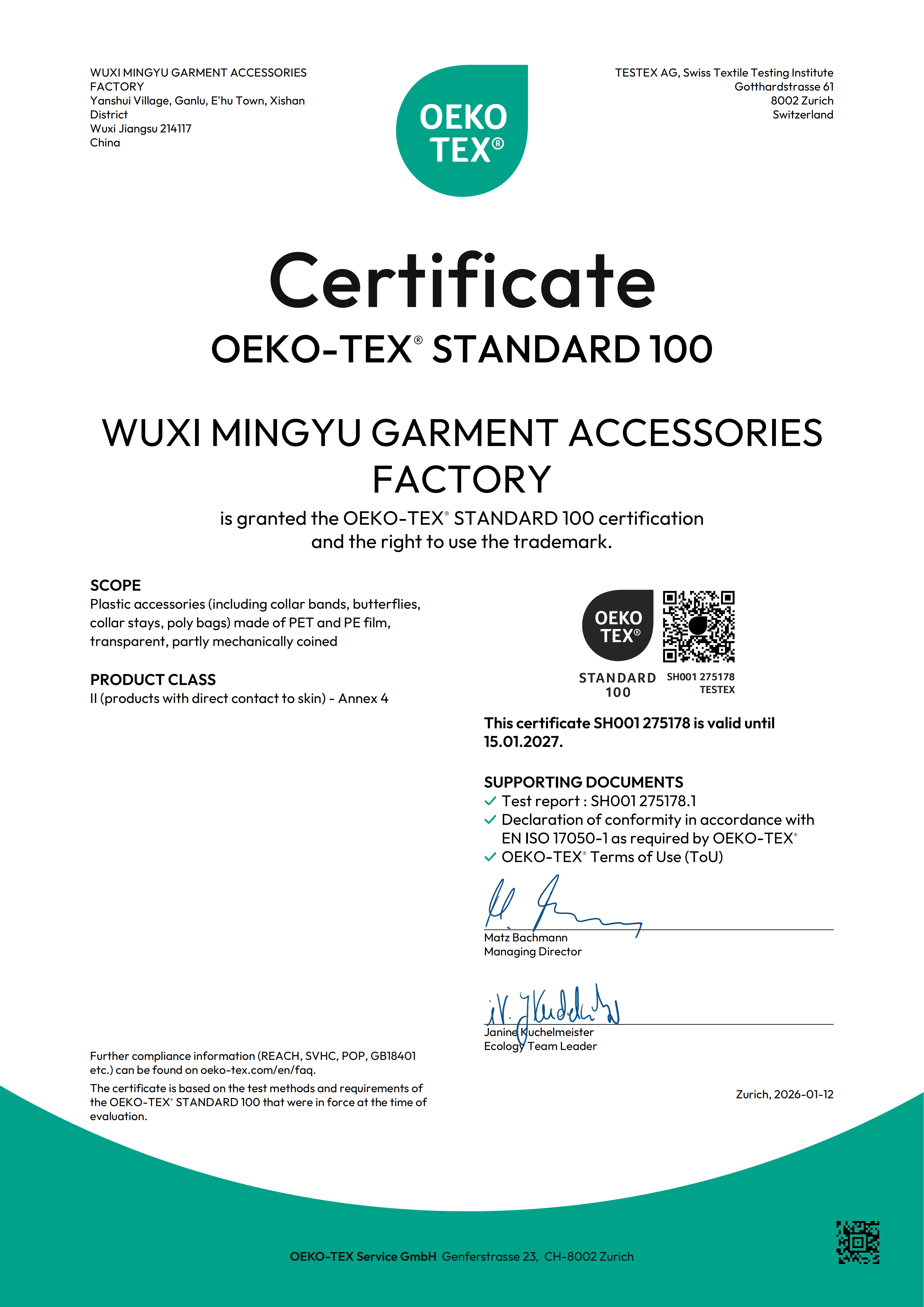
OEKO-TEX STANDARD 100 certificate issued by TESTEX for plastic shirt packaging accessories.
Wuxi Mingyu Garment Accessories Factory holds an OEKO-TEX STANDARD 100 certificate with certificate number SH001 275178, issued by TESTEX. The certificate covers plastic accessories, including collar bands, butterflies, collar stays and poly bags, made of PET and PE film. The stated validity runs from January 2026 to January 2027.
The supplier also operates under a Global Recycled Standard certificate, number SGC-GRC09119-GRS-2026-07, issued by SGS. Its GRS scope includes manufacturing, trading, warehousing and distribution of final products. For buyers exploring recycled-content claims or supply-chain traceability, this type of certificate provides a starting point for verification, although the final claim must be checked against the specific product and material flow.
Application Scenarios and Typical Packaging Lines
Shirt packaging accessories are used in packing workshops, sorting lines, garment shipment and retail display packaging. The balance between durability and clean aesthetics is different for each scenario.
For an export order, the priority is protection. Collar stays and butterflies prevent the collar area from being crushed, while poly bags protect the shirt from dust and moisture during a long sea or air journey. For a retail presentation order, the priority is visual consistency. A branded cardboard, printed belly band, tissue paper and hang tag create a complete unboxing experience. For e-commerce orders, speed and repeatability matter: the components must be easy for a packing operator to insert without stopping the line.
MingYu's reference records describe client types including brand owners, garment manufacturers, distributors and exporters. The same records mention long-term cooperation over a five-year period with no major quality mistakes reported. This type of reference is most useful as a loyalty and consistency indicator, rather than as proof that a new product will work. The actual packaging specification still has to be tested with the shirt style and shipping route.
Market Trends Behind Shirt Packaging Accessories
Commercial research from Dataintelo estimates the global garment packaging market at US$18.6 billion in 2025, with a projected value of US$31.4 billion by 2034. The same market dataset attributes a 41.5 percent revenue share to Asia Pacific in 2025. These figures confirm that garment packaging is not a static commodity category; it is large enough to attract investment and specialization.
The shift toward branded e-commerce packaging has made accessory suppliers more important in the buyer's supply chain. A shirt sold online still needs to look crisp after last-mile delivery. A collar without support can emerge crushed or creased, and that is difficult to show in a product photo. As a result, buyers are moving away from random stock accessories sold by general packaging merchants and toward suppliers that understand shirt anatomy and packing workflow.
The market trend also favors suppliers with documented compliance. OEKO-TEX and GRS certificates allow buyers to respond to brand sustainability questionnaires without beginning every investigation from zero. Already, the presence of a GRS certificate is a practical signal that the factory is prepared for recycled-content inquiries. As more apparel brands publish environmental targets, accessory suppliers will have to do more than deliver plastic; they must provide chain-of-custody evidence.
Comparison with Traditional Fragmented Sourcing
The conventional model for shirt packaging accessories is to buy from a local paper merchant, a plastic film converter and a printing shop separately. That model works for simple, low-volume requirements. But when a shirt brand needs consistent artwork across a collar band, butterfly, tag, tissue paper and poly bag, the administrative cost rises quickly.
| Comparison point | Traditional fragmented sourcing | Integrated OEM/ODM supplier model |
|---|---|---|
| Product coordination | Multiple suppliers, separate artwork approvals | One factory can coordinate the accessory set |
| Quality ownership | Responsibility is split when materials fail in assembly | One quality-control process and pre-shipment test |
| Compliance | Buyer must collect certificates from each vendor | Certificates can cover a defined family of plastic accessories |
| Order handling | Multiple POs, payments and deliveries | One ordering point with FOB, CIF or EX Works terms |
| Customization | Limited for components treated as commodities | Size, colour, style, printing, foiling and mould customization |
This comparison is not meant to make integrated sourcing sound perfect for every situation. There are boundaries. If a buyer only needs one generic item in very small volume, a local stock supplier can sometimes respond faster and at a lower landed cost than an export-oriented factory order. Also, an integrated order can be more complex to manage if the buyer is not ready to approve multiple components under one deadline. Buyers should still request pre-production samples and a pre-shipment inspection before large-scale release.
Future Outlook
Shirt packaging accessories will continue to be an extension of brand quality. The rising use of e-commerce and direct-to-consumer delivery means packaging is seen earlier and evaluated more critically. The next phase of supplier differentiation will be less about selling a single stay or band and more about offering a complete packaging system that can be repeated across factories and seasons.
Sustainability requirements will separate suppliers by their administrative readiness. OEKO-TEX provides a restricted-substance baseline, while GRS supports recycled-content traceability. Manufacturers that document their processes, maintain issued certificates and keep stable export channels will be easier to put on an approved supplier list. Buyers can expect future RFQs to require more material transparency, audit support and regional delivery options.
For now, the practical rule for procurement is simple. When choosing a shirt packaging accessories supplier, evaluate the full scope of components, the OEM and ODM capability, the production capacity, the quality-control evidence and the logistics terms. The supplier that performs well on those categories is more likely to perform well during execution.
FAQ
The following questions are typically asked by sourcing teams moving from a supplier shortlist to order placement.
What kinds of garment packaging accessories can MingYu provide?
Wuxi Mingyu Garment Accessories Factory supplies collar stays, collar bands, paper butterflies, hang tags, belly bands, tissue paper, gift boxes and PE clear bags. The product range also includes shirt cardboard, plastic clips, metal pins, collar supports and other shirt packing accessories. The manufacturer supports OEM and ODM customization on size, colour, printing and logo.
Can the supplier do OEM and ODM customization?
Yes. MingYu supports custom size, colour, hot foiling, printing, logo stamping and mould opening for most of its garment packaging products. This allows a buyer to request consistent branding across plastic and paper components.
What is the MOQ and monthly production capacity?
The stated production MOQ is 1,000 sets. Monthly production capacity reaches 7.5 million sets, which supports large bulk orders and seasonal synchronized delivery. The factory also lists smaller entry-level support in its commercial profile.
What compliance certificates are available?
The supplier holds an OEKO-TEX STANDARD 100 certificate issued by TESTEX, covering plastic accessories such as collar bands, butterflies, collar stays and poly bags made of PET and PE film. It also holds a GRS certificate issued by SGS covering manufacturing, trading, warehousing and distribution of final products.
What is the usual lead time?
The typical production lead time is 7-20 working days after order confirmation. The final lead time depends on the number of customized components, material availability and production schedule.
Which markets does the factory mainly serve?
MingYu exports to Europe, North America, South America and Asia. The factory reports an export ratio of roughly 85 percent and describes its customer base as global clothing brands, garment manufacturers, distributors and exporters.
For a fuller factory profile, Wuxi Mingyu Garment Accessories Factory provides a downloadable company brochure: Brief Company Profile of Wuxi Mingyu Garment Accessories Factory.
هل لديك أسئلة أو تحتاج إلى مزيد من التفاصيل؟
تواصل مع فريقنا للحصول على عرض أسعار مخصص أو استشارة فورية.
طلب عرض أسعار
املأ النموذج أدناه وسيتواصل معك فريقنا بعرض مقترح مخصص.
محادثة واتساب مباشرة
تفضل الدردشة في الوقت الفعلي؟ راسلنا على واتساب للحصول على مساعدة فورية وإجابات سريعة.
- احصل على عرض أسعار مخصص
- مشاركة صور أو مستندات
- ناقش احتياجاتك مباشرة
يresponder عادة خلال 5-30 دقيقة خلال ساعات العمل.