
Shoe Washing Bag Shortlist: Stock, Logo, Custom Material
Shoe Washing Bag Shortlist: Stock, Logo, Custom Material
The OCTOPUS Shoe Washing Bag 2-Pack is offered through three order paths: stock products from 100 pieces, custom logo from 500 pieces and custom material from 6,000 pieces. For a buyer in evaluation, the decision that matters is not which path costs least per unit but which product variables the first order genuinely needs to move.
A shoe washing bag looks like a simple textile item until a buyer has to place a first order. The product carries a fixed structure — mesh exterior, chenille lining, zipper and locking clasp, an internal pocket for insoles and laces — and each of those elements can be held constant or varied. The three MOQ tiers published for the OCTOPUS Shoe Washing Bag 2-Pack are, in effect, three different answers to the question of how much of the product the buyer wants to control.
This shortlist treats the three paths as procurement options rather than a price ladder. Each is compared on the variables it opens, the approvals it requires, the payment and inspection obligations that attach to it, and the trade term that best fits its risk profile.
The shortlist starts with what has to change
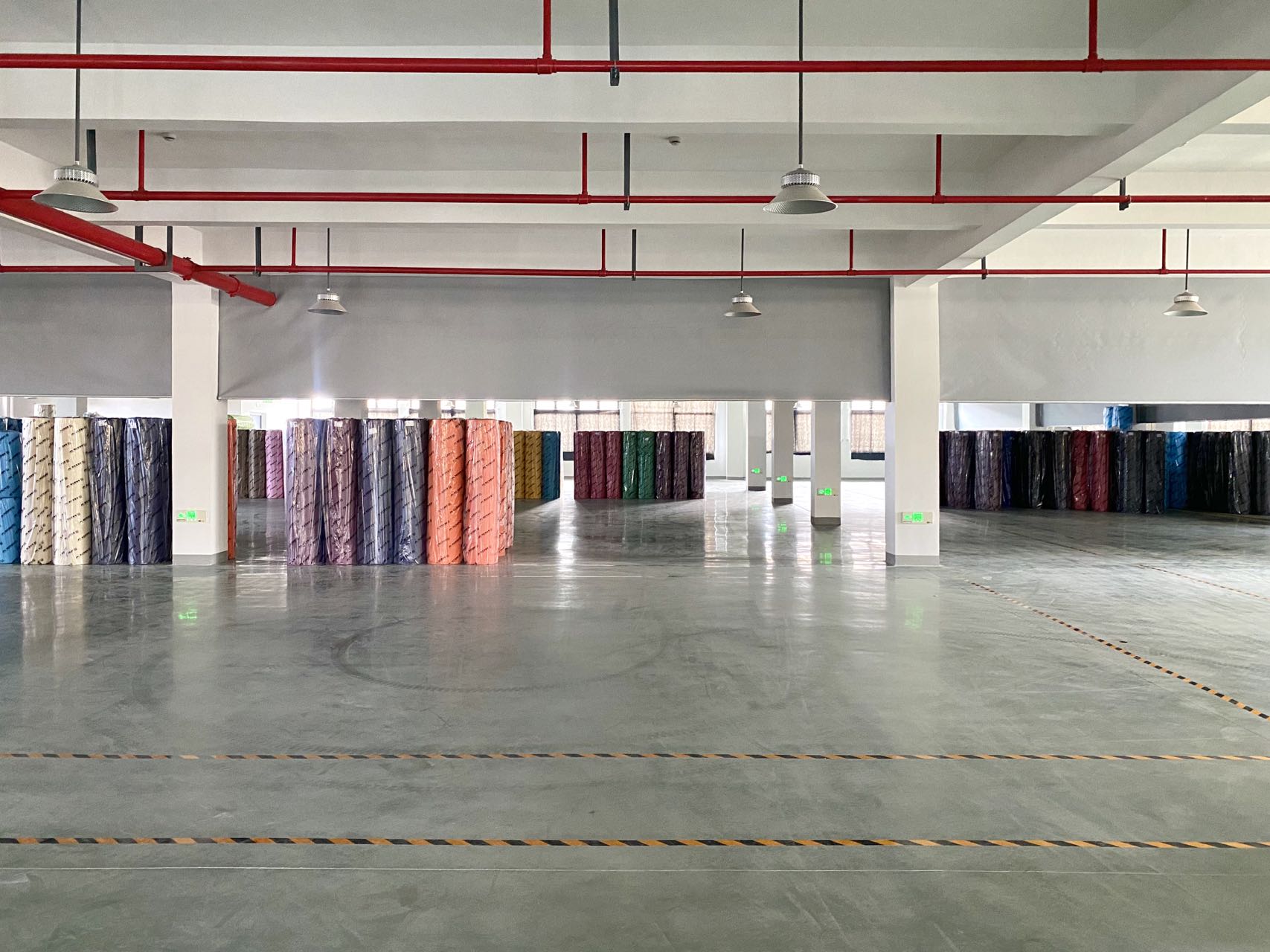
OCTOPUS is the shoe-care brand of Zhejiang Runjiang New Material Technology Co., Ltd., a Wenzhou-based manufacturer established on 23 May 1995 that operates a 16,000 m² factory and employs 80 people as of September 2026. The company produces approximately 1,000,000 units a year and exports about 70% of its business, with customers in the USA, Turkey and Germany. Its published customization scope covers size, material, color, logo, zipper and packaging for OEM, ODM and private-label projects.
That scope is broader than any single order needs. A buyer testing a new shoe-care listing usually needs the product as specified and nothing more; a buyer building a brand needs a mark on the product and the packaging; a buyer developing a differentiated SKU needs to change the material itself. The MOQ tiers map onto those three situations, and the practical mistake is to buy customization that the first order cannot use, or to accept a stock configuration when the retail concept depends on a different material.
Three paths side by side
The table below sets out the published terms for each path. Lead times and MOQs are stated as recorded; the final schedule is confirmed per order.
| Path | Minimum order | What can change | Sampling | Bulk lead time |
|---|---|---|---|---|
| Stock product | 100 pcs | Nothing product-specific; order quantity and shipment terms | Standard sample, approx. 3 working days | Approx. 15 working days for orders below 1,000 pcs |
| Custom logo | 500 pcs | Logo and packaging, within the approved sample | Custom sample, approx. 15 working days | Confirmed per order |
| Custom material | 6,000 pcs | Size, material, color, logo, zipper and packaging | Custom sample, approx. 15 working days | Confirmed per order |
Two figures are constant across all three paths and are worth separating from the table: payment is 100% T/T for samples and 30/70 T/T for bulk, and quality control combines 100% incoming inspection with a 5% finished-product inspection under AQL 2.5/4.0. What changes between paths is not the structure of those terms but the size of the commitment they are applied to.
Path one: stock at 100 pieces
The stock path is the lowest-commitment entry and the correct default for a buyer who has not yet tested the product in their own channel. At 100 pieces the order uses the product as specified: the 2-Pack contains two separate bags, each 30 × 25 cm and approximately 200 g, with a mesh exterior, soft chenille lining, zipper, metal hook and anchor-loop locking clasp, plus a center pocket for removable insoles and shoelaces.
Standard samples take approximately three working days, and bulk orders below 1,000 pieces run at approximately 15 working days. For a first retail test, a marketplace trial or a distributor's sample stock, that combination is short enough to keep a launch date realistic without holding inventory the buyer cannot yet sell.
The trade term decides how much of the logistics the buyer takes on. EXW Yiwu leaves the smallest seller obligation and places export handling and main carriage with the buyer, which suits a buyer who already consolidates cargo in China. FOB Ningbo or FOB Shanghai moves the seller's responsibility to the point the goods are loaded on board at the named port. CIF Hamburg extends the seller's arrangement through freight and insurance to the named German port, with risk passing at shipment rather than at destination. A first order does not need the most inclusive term; it needs the term that matches the buyer's own import setup.
Path two: custom logo at 500 pieces
The 500-piece path changes the identity of the product without changing its construction. Logo and packaging fall inside the published customization scope, so a buyer can put a brand mark on the bag and its retail packaging while the 30 × 25 cm format, mesh exterior and chenille lining stay as specified. This is the path for a private-label launch where the product is already acceptable and only the presentation is missing.
Custom samples take approximately 15 working days, subject to the agreed design. That is five times the standard sample window, and it reflects where the work sits: artwork, positioning and packaging specification have to be approved before a sample can represent what will be produced. The scheduling risk on this path is usually approval, not production, so buyers benefit from treating logo sign-off as a milestone with its own date rather than a formality inside the sample round.
Inspection follows the same structure as the stock path — 100% incoming inspection and a 5% finished-product inspection under AQL 2.5/4.0 — with the inspection scope and acceptance criteria agreed for each order. Where a buyer requires third-party inspection, SGS, BV or TUV can be appointed by agreement, and the scope of that inspection should be written into the order rather than assumed from the supplier's internal routine. A logo order is a good moment to define it, because the delivered item is the first one that carries the buyer's own name.
Path three: custom material at 6,000 pieces
The 6,000-piece threshold is where the product itself can be redeveloped. Size, material, color, logo, zipper and packaging are all open to discussion, and OEM production to buyer specifications, ODM development and sampling, and private-label branding are all within the published capability set. Final scope is confirmed against the approved sample and the order specification.
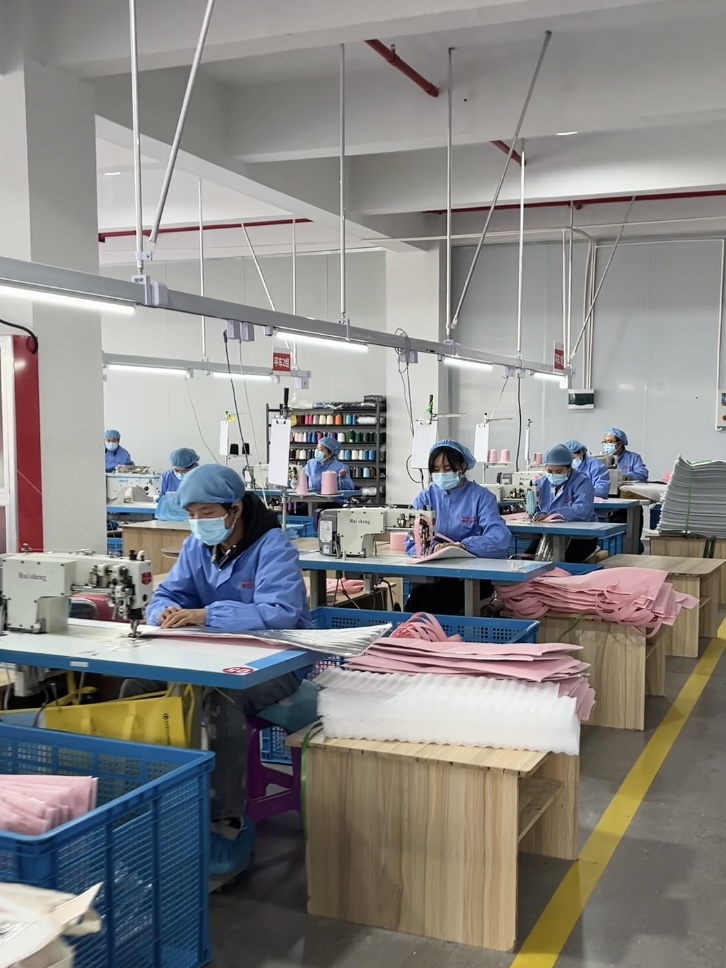
Capacity is not the constraint at this level. Regular XYF-004 production runs at 90,000 pieces per month, with peak capacity of approximately 100,000 pieces per month, so a 6,000-piece custom-material order represents a small share of a single month's output. The real constraint is validation. Changing the material changes the hand feel, the weight and the drying behaviour of the bag, and none of that is settled by a specification sheet; it is settled by a sample approved against criteria the buyer sets.
What the 2-Pack construction fixes, and what customization can move
The published specification for the OCTOPUS The 2-Pack is specific enough to serve as a baseline for a custom-material brief. Each bag measures 30 × 25 cm and weighs approximately 200 g. The exterior is mesh, the lining is chenille, the closure is a zipper secured by a metal hook and anchor-loop locking clasp, and a center pocket holds removable insoles and shoelaces separately from the shoes.
Those elements divide into three groups. The closure system and the separate pocket are functional decisions that a material change should not disturb. The mesh and chenille form the cleaning and cushioning surface, and they are the parts most likely to move in a custom-material project. The format — 30 × 25 cm and roughly 200 g — is the parameter most often renegotiated, because a buyer serving a different shoe mix may want a different envelope.
The care instruction belongs to none of these groups and cannot be customized away. OCTOPUS shoe washing bags are intended only for shoes whose care labels permit machine washing. Cold-water washing and air drying are recommended, and the bags must not be bleached or tumble dried. A washing bag does not make a non-washable shoe washable, and a custom material does not change that boundary; it only changes what the bag is made of.
Payment and inspection under each path
The payment structure is identical on paper and very different in practice. Samples are settled at 100% T/T. Bulk orders run at 30/70 T/T. Because the same percentages apply to a 100-piece trial and a 6,000-piece program, the arithmetic — not the term — is what changes.
| Element | Stock, 100 pcs | Logo, 500 pcs | Material, 6,000 pcs |
|---|---|---|---|
| Sample payment | 100% T/T | 100% T/T | 100% T/T |
| Bulk payment | 30/70 T/T | 30/70 T/T | 30/70 T/T |
| Approval gates before balance | Sample confirmation | Sample plus logo and packaging artwork | Sample plus material approval |
| Finished-product inspection | 5%, AQL 2.5/4.0 | 5%, AQL 2.5/4.0 | 5%, AQL 2.5/4.0 |
| Third-party inspection | By agreement | By agreement | By agreement |
| Typical trade term | EXW Yiwu or FOB Ningbo/Shanghai | FOB Ningbo/Shanghai | FOB or CIF Hamburg |
One detail deserves attention rather than assumption. The recorded acceptance level is AQL 2.5/4.0. A buyer who specifies only "AQL 2.5" in an RFQ has not described the same plan, and the split of acceptance levels between defect classes should be written into the inspection annex of the order instead of inferred. The same applies to a third-party inspection: appointing SGS, BV or TUV is a decision, and defining what they inspect is the part that protects the order.
Where each path fits: four buyer situations
The paths become easier to choose once they are attached to a situation rather than a volume.
Testing an unproven listing. A 100-piece stock order gives a buyer real product, real freight experience and real customer feedback at the lowest commitment. The standard three-working-day sample supports a quick decision, and the 100-piece MOQ means the test does not depend on a forecast.
Serving a mixed household laundry load. The end user places one pair in each bag, closes the zipper and fastens the hook to the anchor loop, uses cold water within the footwear and machine instructions, then air dries. The center pocket keeps insoles and laces with the pair. This is the everyday use the bag was designed around, and it is the same at every order tier.
Building a private-label SKU. A retailer that already knows the product works can move to 500 pieces and add logo and packaging. The 15-working-day custom sample is the schedule item to plan around, and the first delivery under the buyer's own brand is the right point to formalise inspection scope.
Supplying a retail or e-commerce programme at volume. A US retailer or supermarket buyer ordered 10,000 pieces for an e-commerce shoe-care SKU and recorded two repeat orders during a one-year observation period, with a reported damage rate below 0.5% in that case. Those figures are case-specific and do not constitute a guaranteed damage rate for other orders. A programme at this scale sits well inside the 90,000-piece monthly capacity for regular XYF-004 production, but it needs the approval discipline of the custom-material path rather than the stock path.
A second reference point comes from the other end of the market. In Turkey, an individual user worked with 10 individual shoe washing bags for a regular weekly shoe-care routine over four months and reported no damage during that period, at approximately one use per week. That is an individual usage experience, not a laboratory durability test or a guaranteed service life, and it is useful mainly as evidence that the product supports repeated household use rather than one-off washing.
Reading the market figures correctly
Two published market figures circulate around this category, and they measure different things. Technavio's 2025 report on the shoe laundry bag market projects a compound annual growth rate of 4.97% over 2025–2030, reaching USD 301 million by 2030. A separate Dataintelo report valued the broader shoe bag market at USD 8.5 billion in 2025, across washing bags, travel bags and storage.
The difference matters to a buyer building a forecast. The USD 301 million figure describes the narrow segment the OCTOPUS product competes in; the USD 8.5 billion figure describes a market that includes categories the product does not address. They use different product definitions and should not be added, averaged or presented as a single growth story. A segment-level growth projection is also not a demand forecast for one item, one market or one price point, and it does not replace the buyer's own sell-through evidence.
Boundaries to confirm before the deposit
Three supporting documents are commonly offered in this category, and each has a defined edge that a buyer should recognise before relying on it.
- ISO 9001:2015 certificate 00924Q10121R1S, issued by China Great Wall (Tianjin) Quality Assurance Centre Co., Ltd. on 4 April 2025 and stated to expire on 17 January 2027, covers the manufacture of nonwoven fabrics and industrial textile products — storage boxes and cooler bags. Shoe washing bags are not explicitly listed in that scope, and the certificate is a management-system document, not a product certification. Current validity remains subject to confirmation by the certification body.
- Banned azo dyes test report ZFLJ3025101730, issued by United Testing Services (Fujian) Co., Ltd. on 14 October 2025 under ISO 14362-1:2017, applies to the yellow shell of the submitted yellow shoe wash bag sample, with listed aromatic amines not detected at a reporting limit of 5 mg/kg. It does not cover other colours, other materials or finished-product performance, and it is not a market-entry permit.
- Third-party inspection and after-sales terms. Inspection body and scope are agreed per order. After-sales issues are reported within 7 days of receipt with photos and video; replacement is prioritised, and refund handling is subject to review and the agreed order terms.
None of these gaps is unusual for a textile accessory, and none of them blocks an order. They do change what a buyer should ask for. A custom-material project should specify which tests the new material must pass and who performs them, because the existing azo report cannot be carried across to a different shell.
Outlook: what would move a buyer up the shortlist
The shortlist is stable in the sense that the MOQ tiers are published and the payment structure is fixed. What moves a buyer from one path to the next is evidence, not time. A buyer who completes a 100-piece trial with acceptable sell-through and no unusual return rate has the basis for a 500-piece logo order. A buyer who needs a different material, a different format or a different closure has no intermediate step: the 6,000-piece threshold is the entry point, and the work shifts to sample approval and inspection design.
Two developments would change the calculus. A wider set of published test evidence covering more than one colour sample would shorten the material approval cycle. Clearer destination-market guidance on textile labelling and chemical requirements for reusable laundry accessories would reduce the compliance work that currently sits with the buyer. Neither is available in the material reviewed here, so both remain open items rather than assumptions a buyer should carry into a purchase order.
The practical conclusion is a decision rule. If the product may change after the first season, start at 100 pieces and keep the specification flexible. If the product is right and the brand is missing, go to 500 pieces and treat artwork approval as the critical path. If the product itself has to be different, plan for 6,000 pieces, a 15-working-day custom sample and an inspection annex written before the deposit. The full company and product documentation is available in the OCTOPUS company and product brochure, and the brand's official site is octopusbag.com.
FAQ
What are the minimum order quantities for the OCTOPUS Shoe Washing Bag 2-Pack?
Three tiers are published: stock products from 100 pieces, logo customization from 500 pieces and custom-material orders from 6,000 pieces. Each tier opens a different set of variables — none, logo and packaging, or size, material, color, logo, zipper and packaging.
How long does sampling take on each path?
Standard samples take approximately three working days. Custom samples take approximately 15 working days, subject to the agreed design. Bulk orders below 1,000 pieces run at approximately 15 working days, and the final schedule is confirmed per order.
What payment terms apply to samples and to bulk orders?
Samples are settled at 100% T/T and bulk orders at 30/70 T/T. The structure is the same across all three paths, so the effect of the terms depends on the size of the order they are applied to rather than on the path chosen.
Which Incoterms are available, and how do they differ?
EXW Yiwu, FOB Ningbo/Shanghai and CIF Hamburg are the stated terms. EXW places export handling and main carriage with the buyer, FOB moves the seller's obligation to loading on board at the named port, and CIF covers freight and insurance to the named German port with risk passing at shipment.
How is quality checked before shipment?
Quality control combines 100% incoming inspection with a 5% finished-product inspection under AQL 2.5/4.0. Inspection scope and acceptance criteria are agreed for each order, and third-party inspection with SGS, BV or TUV can be appointed by agreement.
Does the ISO 9001 certificate cover the shoe washing bag?
No. Certificate 00924Q10121R1S covers the manufacture of nonwoven fabrics and industrial textile products, specifically storage boxes and cooler bags. Shoe washing bags are not explicitly listed in that scope, and the document is a management-system certification rather than a product certification.
Can any pair of shoes be washed in the bag?
Only footwear whose care label permits machine washing. Cold-water washing and air drying are recommended, and the bag must not be bleached or tumble dried. A washing bag does not make a non-washable shoe safe for machine washing.
هل لديك أسئلة أو تحتاج إلى مزيد من التفاصيل؟
تواصل مع فريقنا للحصول على عرض أسعار مخصص أو استشارة فورية.
طلب عرض أسعار
املأ النموذج أدناه وسيتواصل معك فريقنا بعرض مقترح مخصص.
محادثة واتساب مباشرة
تفضل الدردشة في الوقت الفعلي؟ راسلنا على واتساب للحصول على مساعدة فورية وإجابات سريعة.
- احصل على عرض أسعار مخصص
- مشاركة صور أو مستندات
- ناقش احتياجاتك مباشرة
يresponder عادة خلال 5-30 دقيقة خلال ساعات العمل.