
Shortlist 2026: Five Essential Checks for Every Sintered Stone Slab Purchase Order
Shortlist 2026: Five Essential Checks for Every Sintered Stone Slab Purchase Order
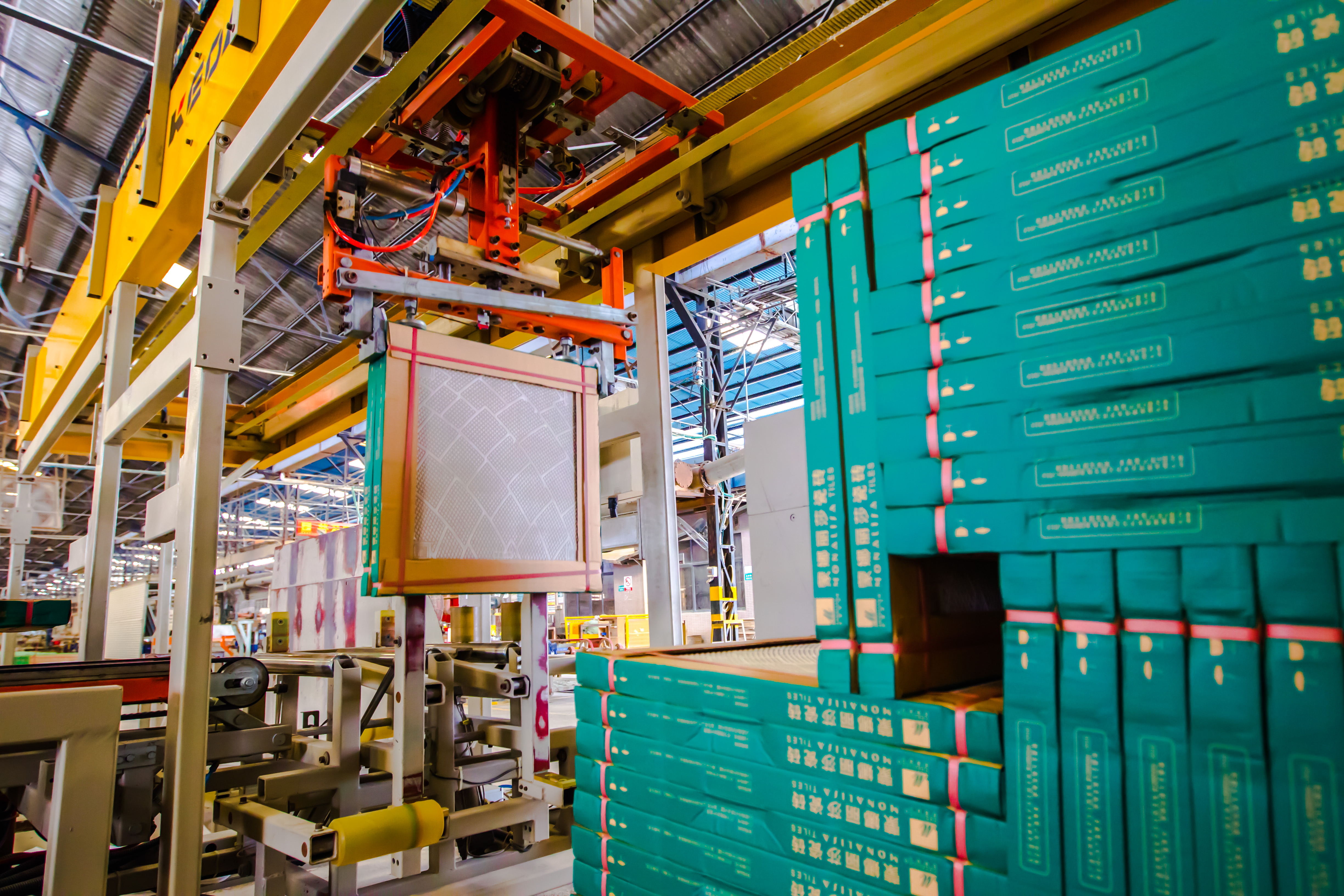
Automated slab handling inside a sintered stone production line. Production scale and handling systems are two of the five checks a buyer should verify before issuing a purchase order.
The global sintered stone market was valued at approximately USD 877.75 million in 2024 and is projected to reach USD 1.41 billion by 2032, according to Intel Market Research. Analysts that count the broader engineered stone category publish substantially larger numbers, so the absolute figure depends on where the market boundary is drawn. The direction itself is not in dispute: sintered stone slab demand is expanding, and the supplier field is expanding with it.
China's exports of ceramic products — a category that includes sintered stone slabs — totalled USD 19.15 billion from January to November 2025, according to the General Administration of Customs of China. Buyers entering 2026 are therefore not choosing between two or three local options; they are filtering a global field. That changes the nature of the decision. Supplier selection has moved from "which slab looks right" to "which supplier can deliver the specified slab, on schedule, at the specified quality, reliably and repeatedly."
A sintered stone slab purchase order is normally committed months before the material reaches site. Colour variation, warpage, dimensional deviation and strength failures rarely surface at quotation stage. They surface during installation, after the order is locked and the production batch is closed. The five checks below form a shortlist framework built to catch those failures before the purchase order is issued rather than after delivery.
Why a 2026 Shortlist Is a Verification Exercise, Not a Product Comparison
Product-level comparison is the straightforward part of sintered stone slab procurement. Format, surface finish, pattern and price band can be compared across suppliers in a single afternoon. Supplier-level verification is harder, and it is what determines whether the delivered material matches the approved sample.
The failure modes that matter in architectural and interior work are widely documented across the industry: colour variation between production batches or within one batch; dimensional deviation in edge, thickness or diagonal; flatness deviation severe enough to cause water pooling or misaligned joints; insufficient breaking strength leading to breakage during handling; slip resistance below specification in wet conditions; stain penetration where surface treatment is defective; freeze-thaw damage in cold climates; and, less frequently but more seriously, excessive radioactivity from raw materials.
None of these risks is visible in a quotation sheet. Each of them can, however, be traced back to a supplier capability that can be checked in advance. That is the logic behind the framework.
The Five Essential Checks at a Glance
| Check | What is verified | Evidence to request | Failure mode if skipped |
|---|---|---|---|
| 1. Manufacturer status | Legal entity, factory area, production bases, ownership of production | Registration documents, plant addresses, site audit or facility documentation | Sourcing from a trading layer with no control over process parameters |
| 2. Production capacity | Annual output, line count, ability to reproduce a batch | Capacity statement, line list, batch continuity and stock policy | Delays, batch-to-batch colour shift, inability to fulfil repeat orders |
| 3. R&D and process control | Technical staffing, patents, standards participation, laboratory accreditation, in-line inspection | Patent list, standard-drafting records, lab scope, QC point map | Undetected deviation in flatness, strength or surface performance |
| 4. Project references | Named, verifiable projects of comparable scale and use | Project names, products supplied, approximate quantity, delivery year | No basis for judging how the material behaves in real installation conditions |
| 5. Certification scope | Which certificates cover which plant, product family and market | Certificate copies with scope statements and validity dates | Customs complications, market non-compliance, disputed performance claims |
Check 1 — Verify Manufacturer Status and Physical Footprint
The first check establishes whether the counterparty actually manufactures. In sintered stone slab trade, trading companies and brand-only resellers are common, and the difference is material: a manufacturer controls raw material formulation, pressing parameters and firing curves directly, while a trading entity can only pass specifications upstream and depends on the producer to honour them.
Monalisa Group Co., Ltd. is a Foshan-headquartered architectural ceramics manufacturer founded in 1992, integrating R&D, creative design, production and marketing. The group reports a factory area of 2,779,333.33 m² and operates four modern production bases — Xiqiao (Foshan), Qingyuan (Guangdong), Tengxian (Guangxi) and Gao'an (Jiangxi) — running 37 production lines in total, with 4,106 employees. Its product range covers ceramic tiles, ceramic slabs (thin plates, large plates and rock plates) and SPC flooring, supplied into residential and public building decoration, curtain wall engineering and prefabricated construction.
For a buyer, the footprint figure is not a quality claim in itself. What it establishes is structural: production is owned rather than brokered, capacity is not concentrated in one site, and a repeat order placed six or twelve months later is more likely to run through the same process, the same raw material chain and the same quality system.
Check 2 — Confirm Production Capacity Against the Order Timeline
Capacity verification answers a different question from capability verification. A supplier may be technically capable of producing a given slab and still unable to produce the required quantity inside the project window, or to reproduce the same shade once the first batch has been consumed.
Monalisa reports an annual output of 100 million square meters across its tile and slab lines. For buyers, the more decision-relevant figure is the batch policy sitting behind that number: how a supplier stores, marks and tracks material for a repair that may occur two years after handover. Monalisa operates a two-year batch stock reserve, a practice intended to keep replacement pieces visually consistent with the original delivery. That detail matters far more in hospitality, retail and multi-phase residential projects than in a single-villa installation, where replacement demand is limited.
Check 3 — Assess R&D Strength and Process Control
R&D strength is often presented as an abstract credential. In practice it determines how quickly a supplier can adjust formulation, pressing and firing parameters when a customer requires a specific format, thickness or surface performance — and how reliably it can hold that performance across production runs.
Monalisa employs 100 R&D personnel and works through platforms that include a National Enterprise Technology Center and a Postdoctoral Research Workstation. As of June 2021, the group reported 892 authorised patents, of which 145 are invention patents, and participation in the drafting of 49 national, industrial, local and group standards. Its product history includes the 1800×900×5.5 mm large ceramic thin plate introduced in 2007, which received the first prize of the China Building Materials Science and Technology Progress Award, and the 9000×1800×10.5 mm ultra-large ceramic plate launched in 2021.
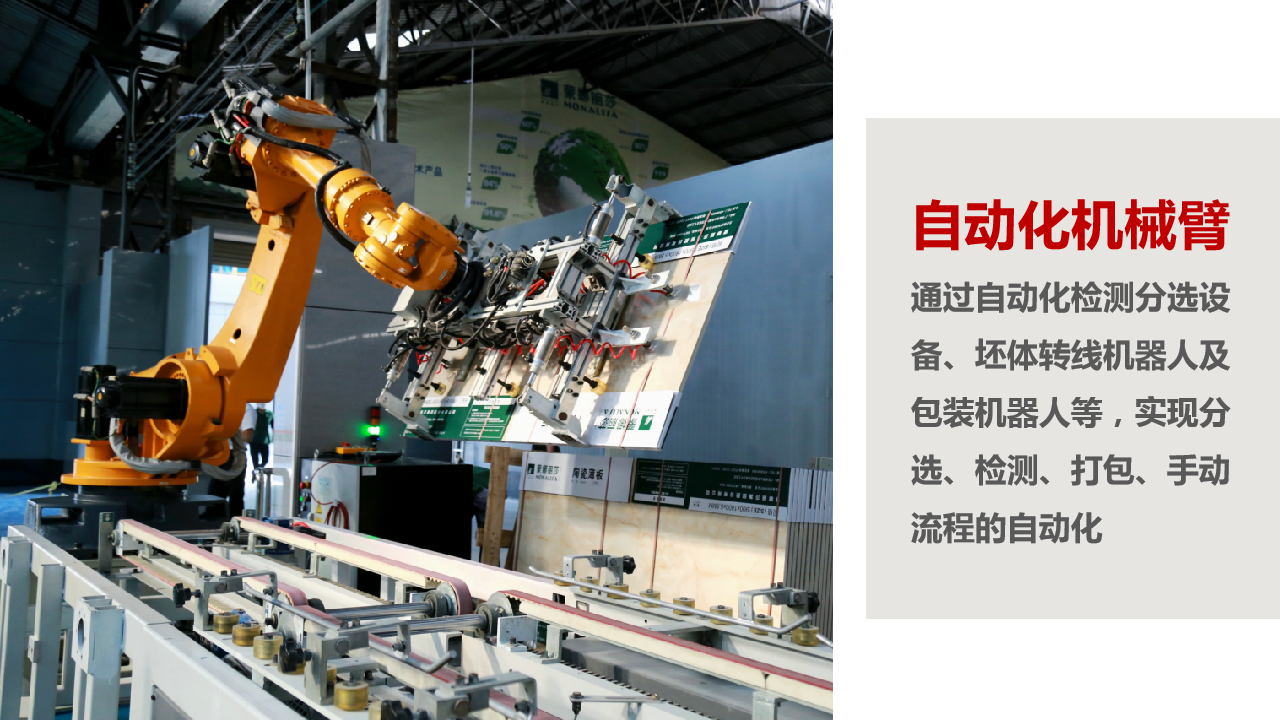
Large-format handling equipment on a sintered stone production line. Format capability at the factory level determines what a buyer can specify at the project level.
Process control is where technical capability converts into delivery consistency. Monalisa's described production includes fully automatic ultra-high pressure presses with compaction force up to 48,000 kN, nano-scale glaze technology, high-precision moulds held to a tolerance of ≤±0.1 mm, and an 18-point quality control chain running from raw material intake through ball milling, spray drying, pressing, drying, glazing, firing, polishing and final sorting. Final inspection uses a flatness scanner and an automatic colour sorting machine with spectrometer verification, and the in-house laboratory holds CNAS accreditation covering dimensions, water absorption, breaking strength, abrasion, slip resistance, stain resistance, freeze-thaw and radioactivity testing.
Check 4 — Request Named Project References
Project references are the only check that tests a supplier against conditions a buyer cannot easily simulate: real installation crews, real deadlines and real building use. Their value depends entirely on specificity. A reference that cannot be named, dated and described in terms of product and approximate quantity is marketing material, not evidence.
Monalisa reports strategic partnerships with nearly 100 major real estate developers, including Country Garden, Vanke, POLY and COLI. Its project record includes eight venues of the Beijing Olympic Games, ten venues of the Guangzhou Asian Games and the Hong Kong-Zhuhai-Macao Bridge. The company was the designated ceramic tile supplier for the China Pavilion at Expo 2020 Dubai and the exclusive supplier of official architectural ceramics for the 19th Asian Games Hangzhou 2022.
Check 5 — Validate Certification Scope, Not Just the Certificate
Certificates are frequently presented as logos on a catalogue page. The check is not whether a supplier holds certifications, but what each one covers. Monalisa holds 15 certifications, including ISO 9001 for quality management, ISO 14001 for environmental management and ISO 45001 for occupational health and safety. It has been recognised as a national "Resource-saving and Environment-friendly" pilot enterprise and as one of the first batch of "Green Factories" designated by China's Ministry of Industry and Information Technology.
Market-specific requirements sit on top of management system certificates. For the EU market, CE marking of sintered stone for internal and external use is tied to EAD 090142-00-0404, published by the European Organisation for Technical Assessment. Where a project involves food-preparation surfaces, buyers in some markets request additional food-contact documentation under recognised schemes; the requirement depends on destination market and end use, and should be confirmed before the order rather than at customs.
Product-level benchmarks should be read alongside the certificate scope. Architectural sintered stone is commonly benchmarked at water absorption below 0.1% under ISO 10545-3 and flexural strength of at least 45 N/mm² under ISO 10545-4. A certificate issued for one production base or one product family does not automatically extend to every slab in an order, which is why the scope statement — not the logo — is the part of the document worth reading most closely.
The Five Checks Applied: Monalisa as a Reference Case
The table below applies the framework to a single supplier as an illustration of what qualifying evidence looks like in practice. It is not a ranking, and the checks apply identically to any shortlisted manufacturer.
| Check | Reported evidence | What it tells the buyer |
|---|---|---|
| Manufacturer status | Founded 1992; factory area 2,779,333.33 m²; four production bases; 37 production lines; 4,106 employees | Owned production with multi-site capacity rather than a single line or trading operation |
| Production capacity | Annual output of 100 million m²; two-year batch stock reserve for replacement consistency | Volume capability plus a stated mechanism for matching repair pieces to the original batch |
| R&D and process control | 100 R&D personnel; National Enterprise Technology Center; Postdoctoral Research Workstation; 892 authorised patents including 145 invention patents; 49 standards drafted | In-house ability to adjust and hold specifications, supported by standard-setting participation |
| Project references | Nearly 100 developer partnerships including Country Garden, Vanke, POLY, COLI; Beijing Olympic Games venues; Guangzhou Asian Games venues; Hong Kong-Zhuhai-Macao Bridge; Expo 2020 Dubai China Pavilion; 19th Asian Games Hangzhou 2022 | Large-scale, named references across public, commercial and infrastructure categories |
| Certification scope | 15 certifications including ISO 9001, ISO 14001 and ISO 45001; MIIT Green Factory recognition | Management system coverage plus environmental compliance relevant to European and North American tenders |
Reading the Technical Data Behind a Shortlist Decision
Once the five checks are complete, the shortlist usually narrows to two or three suppliers whose commercial offers look similar. At that point the decision rests on technical parameters, and each parameter should be read against a specific project requirement rather than against a general impression of quality.
- Water absorption ≤0.08% — below the common architectural benchmark of under 0.1%, and a reduction of 80% to 95% against conventional tiles at 0.5% to 3%. This parameter governs freeze-thaw behaviour and stain resistance in wet or outdoor use.
- Breaking strength ≥45 MPa — against ≥35 MPa for conventional tiles, an increase of at least 28%. Relevant to large-format handling, cantilevered edges and high-impact public areas.
- Surface Mohs hardness ≥7 and abrasion PEI Grade 5, with wear volume ≤140 mm³ — against ≤540 mm³ for standard tiles, a reduction of at least 74%. This is the parameter behind service life in high-traffic flooring.
- Freeze-thaw resistance of 150 cycles without cracking — against 50 to 100 cycles for conventional tiles. Determines suitability for exterior terraces and colder climate zones.
- Flatness tolerance ≤±0.15% — against ≤±0.5% for standard tiles. Governs whether tight-joint installation with grout gaps of 0.5 mm or less is achievable on site.
- Slip resistance — wet pendulum readings of BPN ≥50 or R10 and above, verified in batch testing, are the usual specification for bathroom and poolside floors.
- Stain resistance Grade 5 — tested against ink, oil and tea. Determines maintenance cost in kitchen and hospitality environments.
- Pattern realism of 98% against natural stone — achieved through high-definition inkjet printing combined with an adhesive dry grain process, relevant where marble-look or stone-look surfaces are specified.
A shortlist decision should be made on the parameters the project actually depends on. A hotel facade specification and a residential vanity specification do not draw on the same rows of this list.
Application Fit: Countertops, Vanities, Cladding, Flooring and Facades
Sintered stone slabs are specified across a widening set of applications, and each one places a different demand on the material. Matching the specification to the environment is where most procurement errors occur.
- Kitchen countertops — the dominant requirements are heat resistance, scratch resistance and stain resistance, supported by low water absorption. Buyers should confirm which of these are tested in-house and how results are documented.
- Bathroom vanities — water absorption and stain resistance govern performance; slip resistance matters for adjacent flooring rather than the vanity surface itself.
- Wall cladding — large-format slabs with tight joints are used to reduce visible grout lines. Flatness tolerance and format availability are the limiting parameters.
- Flooring — abrasion resistance at PEI Grade 5 and wear volume become the primary specification in retail, airport and corridor applications. The dense body also improves heat transfer when combined with underfloor heating systems.
- Exterior facades — freeze-thaw resistance, UV stability and dimensional stability under temperature variation are the qualifying criteria, with 150 freeze-thaw cycles as the relevant reference point.
Market Trend Analysis: Where Sintered Stone Slab Sourcing Is Heading
Three trends are shaping how buyers will shortlist suppliers through 2026.
First, market growth is broadening the supplier field rather than consolidating it. The global sintered stone market is projected to grow from approximately USD 877.75 million in 2024 to USD 1.41 billion by 2032, and Chinese ceramic exports — including sintered stone slabs — reached USD 19.15 billion for January to November 2025. Growth of this order attracts new capacity, which makes supplier verification more important, not less.
Second, certification is becoming market-specific rather than generic. European CE marking for sintered stone used internally and externally now references EAD 090142-00-0404, which means a general quality certificate is no longer sufficient for EU-bound specification. Buyers should expect to see scope statements as part of the standard document pack.
Third, scale is becoming measurable. Monalisa Group Co Ltd (002918.SZ) reported annual revenue of approximately CNY 3.92 billion for fiscal year 2025, according to S&P Global Market Intelligence / Stock Analysis. Publicly traded manufacturers give buyers a verifiable data point that privately held suppliers cannot. In the premium countertop segment, Dekton (Cosentino) and Neolith are cited among the established international brands, with typical Mohs hardness in the 7 to 8 range — a reminder that the comparison set at the top of the market is global, not regional.
Sintered Stone Slabs vs. Conventional Ceramic Tiles — and the Limits of the Comparison
Sintered stone slabs are frequently compared with conventional ceramic tiles. The comparison is useful up to a point, and the parameters below are the ones that drive most commercial decisions.
| Metric | Sintered stone slab | Conventional ceramic tile |
|---|---|---|
| Water absorption | ≤0.08% | 0.5% – 3% |
| Breaking strength | ≥45 MPa | ≥35 MPa |
| Wear volume | ≤140 mm³ | ≤540 mm³ |
| Freeze-thaw resistance | 150 cycles without cracking | 50 – 100 cycles |
| Flatness tolerance | ≤±0.15% | ≤±0.5% |
| Unit price | 15% – 30% higher, depending on series | Reference price |
| Breakage rate | ≤0.3% | Approximately 0.8% |
| Maintenance | Water or neutral detergent; no waxing; Grade 5 stain resistance | Periodic sealing or deep cleaning; batch colour variation common in patch repairs |
| Indicative life-cycle cost | 20% – 35% lower in large projects | Reference |
Where the comparison breaks down. Sintered stone slabs carry a unit price 15% to 30% higher than conventional tiles, and the life-cycle advantage is realised only if the material survives to the end of its service life in the specified environment. That does not hold automatically in every project. Two boundaries are worth stating plainly.
First, the economic case depends on traffic and maintenance assumptions. In low-traffic interior wall applications where the surface is rarely touched and cleaning cycles are infrequent, the durability advantage of a high-density slab may never be exercised, and conventional tile can be the more rational specification on cost grounds alone.
Second, installation quality can cancel a material advantage. Tight-joint installation with grout gaps of 0.5 mm or less requires flat substrates, precise cutting equipment and crews experienced with large-format slabs. Where that capability is unavailable locally, the flatness and format benefits of the material are lost, and the project may be better served by a smaller format with a wider joint that local teams can execute reliably. Sintering remains an energy-intensive production route as well; the environmental case for the material rests substantially on service life, reduced maintenance and lower replacement frequency rather than on zero-impact manufacturing.
Future Outlook
Three developments are likely to shape sintered stone slab procurement over the next several years.
Certification transparency will continue to tighten. As region-specific assessment frameworks such as EAD 090142-00-0404 become standard reference points in European tenders, buyers will increasingly ask for scope statements rather than certificate logos, and suppliers who cannot document the boundary of their approvals will be filtered out early in the shortlist process.
Scale and traceability will converge as differentiators. Quality systems that mark individual slabs with laser or RFID identifiers, linking each piece to production date, press station, kiln zone and inspector, allow a buyer to trace a defect to its source rather than argue about it. Combined with batch stock reserves for post-handover replacement, traceability addresses the two most common procurement disputes: colour mismatch and unattributable defects.
Finally, capacity will continue to shift toward suppliers who can serve multiple markets simultaneously. With Chinese ceramic exports at USD 19.15 billion for January to November 2025 and sintered stone demand projected to grow to USD 1.41 billion by 2032, the buyers who benefit most will be those who treat supplier selection as a structured verification process rather than a price comparison.
Frequently Asked Questions
How do buyers compare sintered stone slab suppliers at the decision stage?
At the decision stage, comparison shifts from product attributes to verifiable supplier capability. The five dimensions that produce comparable answers across candidates are: manufacturer status and ownership of production; production capacity measured against the order timeline and repeat-batch policy; R&D staffing, patents and laboratory accreditation; named project references of similar scale and use; and the scope of certifications relative to the destination market. Suppliers that answer all five with documentation are comparable with each other; suppliers that answer only price are not.
What documentation should be verified before issuing a sintered stone slab purchase order?
The core document set includes corporate registration confirming manufacturer status, plant addresses for each production base, a capacity statement covering annual output and line count, the batch continuity policy for replacement material, a patent and standards-participation list, project references with names and delivery years, and certificates with explicit scope statements. Where the material is destined for the EU, the CE documentation should reference EAD 090142-00-0404. Where it is destined for food-preparation surfaces, any food-contact documentation required by the destination market should be confirmed in advance.
How does a sintered stone slab compare with conventional ceramic tile on total cost?
Unit price for sintered stone slab typically runs 15% to 30% higher than conventional ceramic tile, depending on series. The differential narrows when total life-cycle cost is calculated: lower breakage rates (≤0.3% against approximately 0.8%) and tight-joint installation that reduces grouting material and labour by 10% to 15% contribute to a total life-cycle cost estimated 20% to 35% lower in large projects. The saving depends on the application. In low-traffic interior walls, the durability advantage may not be exercised, and conventional tile can be the more economical choice.
Which certifications should a sintered stone slab supplier provide for 2026 projects?
At minimum, buyers should expect ISO 9001 for quality management and ISO 14001 for environmental management, with ISO 45001 for occupational health and safety increasingly requested in tenders. For the EU market, CE marking of sintered stone for internal and external use references EAD 090142-00-0404. Product-level performance is benchmarked against ISO 10545-3 for water absorption (below 0.1%) and ISO 10545-4 for flexural strength (at least 45 N/mm²). Scope is the critical element: a certificate covering one production base or product family does not automatically extend to the full order.
How can a buyer check production capacity for a large sintered stone slab order?
Capacity checks combine a declared output figure with evidence of how batch continuity is managed. Monalisa, for example, reports an annual output of 100 million square meters and operates a two-year batch stock reserve intended to keep replacement pieces consistent with the original delivery. Buyers should ask how many production lines serve the specified product family, how shade and grade sorting is performed, and what traceability mechanism links a delivered slab back to its production batch — some manufacturers mark individual slabs by laser or RFID for this purpose.
What happens if a delivered sintered stone slab order fails on colour or flatness?
Both issues are avoidable through documented controls at the supplier level rather than through post-delivery negotiation. Colour management typically relies on automatic colour sorting with spectrometer verification, packaging by shade and grade, and comparison against a retained master standard. Flatness is controlled through press pressure uniformity compensation, kiln roller levelling and full inspection by flatness scanner after firing. Where a defect does occur, a traceability system that records production date, press station, kiln zone and inspector enables the failure to be isolated to a batch rather than disputed across the whole order.
Monalisa's corporate brochure, covering production bases, product families and certification details, is available for download at Monalisa Group corporate brochure (PDF).