
Shortlist Builder: X20, Q1, Q2, Q3, Q7 Action Cameras for OEM Buyers
An OEM buyer rarely needs another catalogue. What a sourcing programme needs is a defensible shortlist — five models placed on the same page, described with the same parameters, so the first round of comparison is factual rather than promotional. This is that page for the X20, Q1, Q2, Q3 and Q7.
All five models are manufactured by Dongguan YuAoHeng Electronic Technology Co., Ltd., a manufacturer established in 2016 that specialises in the research, development, manufacturing and sales of action cameras, smart vehicle electronics and smart security products. The action camera range is marketed under the YUAOHENG brand, and the same production base also builds video doorbells and dash cameras. That context matters at the research stage: the five models below are variations inside one manufacturing platform, not five unrelated imports sourced from five different factories with five different quality systems.
What every model in this set shares is a starting point, not a conclusion. Each is built on an ABS body, and each carries a full-range built-in capacitor microphone. Everything else — resolution class, display size, battery format, stabilisation and handling method — is a deliberate difference, and those differences are what a shortlist has to expose.
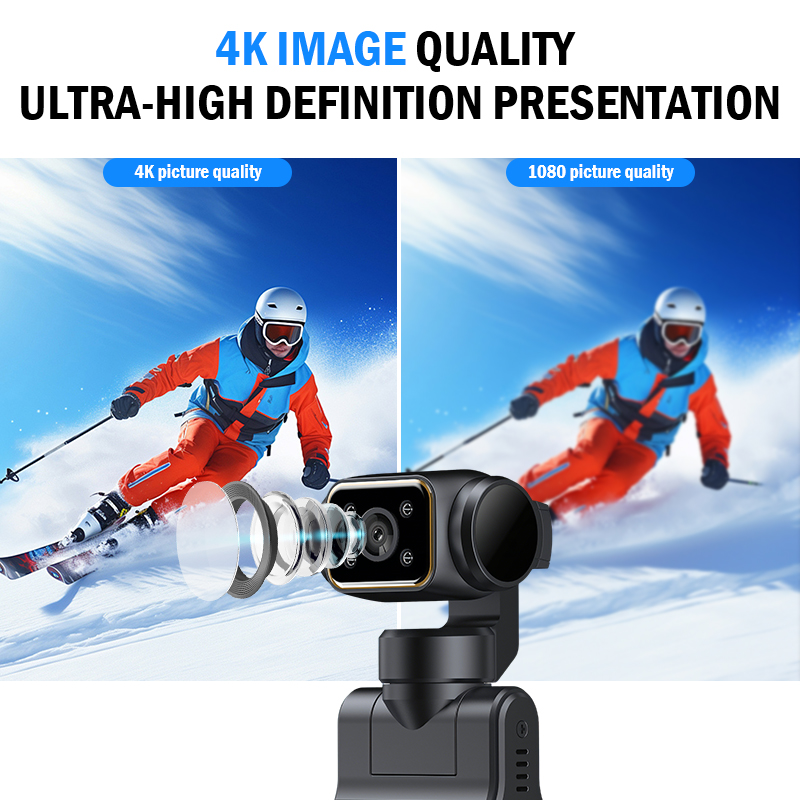
A five-model shortlist compresses the first comparison round into a single parameter set. Image: 4K Action Camera for Sports.
Why the Shortlist Comes Before the Spec Deep-Dive
The action camera category is wide enough that a buyer can spend weeks simply deciding what to compare. SkyQuest Technology valued the global action camera market at USD 6.57 billion in 2024, while Market Research Future estimated China's domestic action camera market at USD 502.25 million in the same year. Published global estimates diverge — Grand View Research and Mordor Intelligence both place the 2025 global figure above USD 7 billion using different scope definitions — which is itself a useful signal: category-level numbers vary by what is counted, so they cannot substitute for model-level parameters.
Trade flow tells a similar story from the supply side. According to the Observatory of Economic Complexity, China exported USD 166 million in video cameras in 2024, with the United States as the single largest destination at USD 31.8 million. In other words, a large share of global demand is served by export-oriented Chinese manufacturing, and procurement teams are routinely comparing several models from the same supplier family before they ever request a sample.
A shortlist does three things at this stage. It removes models that cannot meet a hard requirement. It identifies which differences are worth paying for. And it produces the questions that belong in a sample request — resolution, runtime, stabilisation behaviour, mounting and compliance documentation. The five models below are organised for exactly that purpose.
The Shared Platform: ABS Bodies and Capacitor Microphones
Before the differences, the constants. Across the X20, Q1, Q2, Q3 and Q7, the body material is ABS across the board, and the audio path is a full-range built-in capacitor microphone on every model. Those two facts are more consequential for sourcing than they first appear.
An ABS housing is a mouldable, impact-tolerant plastic that suits the accessory-heavy way action cameras are actually used — mounted on brackets, clamped to handlebars, pushed into housings. It also has a direct procurement consequence: ABS bodies are compatible with established mould tooling and finishing processes, which is relevant when a buyer is evaluating OEM and ODM customisation rather than buying a fixed catalogue item.
The capacitor microphone is the second shared element, and it is the one buyers overlook most often. A capacitor microphone delivers a wider, flatter frequency response than a simple electret capsule, which matters for Vlog-style spoken audio and for footage that will be edited rather than archived. Because all five models carry the same microphone type, audio capability is not a differentiator inside this shortlist — the differentiator is everything around it.
Side-by-Side Spec Foundation
The table below is the working shortlist. It uses only parameters stated in the models' own specification sheets, so it can be read as a like-for-like foundation rather than a marketing summary. A dash means the parameter is not declared for that model in its specification record — it is not a negative claim.
| Parameter | X20 | Q1 | Q2 | Q3 | Q7 |
|---|---|---|---|---|---|
| Declared class | 2K+WiFi action camera | 4K+WiFi action camera | 4K WiFi touch screen anti-shake action camera | 4K WiFi action camera | 4K WiFi anti-shake action camera |
| Display | 1.54-inch IPS | 1.5-inch IPS | 1.8-inch IPS | 1.5-inch IPS | 1.47-inch IPS |
| Screen resolution | 320 × 240 | 320 × 240 | 800 × 480 | 320 × 240 | 320 × 240 |
| Lens | HD 130° | HD 130° wide angle, rotating direction | 25 mm, 130° wide angle | HD 130° wide angle, rotating direction | HD 130° wide angle, rotating direction |
| Recording resolution | 1920 × 1080, AVI | Front 4K (3840 × 2160), rear 4K (3840 × 2160) | Front 4K (3840 × 2160), rear 4K (3840 × 2160) | Front 4K (3840 × 2160), rear 4K (3840 × 2160) | 4K (3840 × 2160) at 30 fps |
| Simultaneous dual recording | — | Front 2K + rear 2K | 2K + 2K, three modes optional | Front 2K + rear 2K | — |
| Image stabilisation | — | — | 6-level electronic image stabilisation | — | Supported |
| Battery | 1000 mAh / 3.8 V polymer | 2000 mAh / 3.8 V polymer | 18650, 2000 mA | 2000 mAh / 3.8 V polymer | 1000 mAh / 3.8 V polymer |
| Video working time | Approx. 6–7 hours | Approx. 4–5 hours | Approx. 4–5 hours | — | — |
| Recording working time | Approx. 9 hours | Approx. 9 hours | — | — | — |
| Microphone | Full-range built-in capacitor MIC | Full-range built-in capacitor MIC | Full-range built-in capacitor MIC | Full-range built-in capacitor MIC | Full-range built-in capacitor MIC |
| Infrared night vision | Supported | Supported | Supported | Supported | Supported |
| Handling | Rotating direction | Rotating direction | Standard touch & physical dual buttons | Rotating direction | Rotating direction |
| Power input | Micro Type-C, DC 5V 1A–2A | — | — | — | — |
| Storage options | 16 GB / 32 GB / 64 GB / 128 GB | — | — | — | — |
| Body material | ABS | ABS | ABS | ABS | ABS |
Read horizontally, the table answers the first procurement question — which models are even eligible for a given programme. Read vertically, it shows where each model concentrates its design effort.
Model-by-Model at a Glance
X20 — the 2K+WiFi class model with a 1.54-inch IPS display
The X20 is classified as a 2K+WiFi action camera and carries a 1.54-inch IPS display at 320 × 240 resolution. Its declared video resolution is 1920 × 1080 in AVI format, and it uses a 1000 mAh / 3.8 V polymer battery rated for approximately 6–7 hours of video working time and approximately 9 hours of recording working time. Rounded out by a rotating-direction lens, infrared night vision with four built-in infrared lights and manual switching, and Micro Type-C DC 5V 1A–2A input, the X20 is the entry point into this shortlist — and the only model here that documents selectable storage of 16 GB, 32 GB, 64 GB or 128 GB.
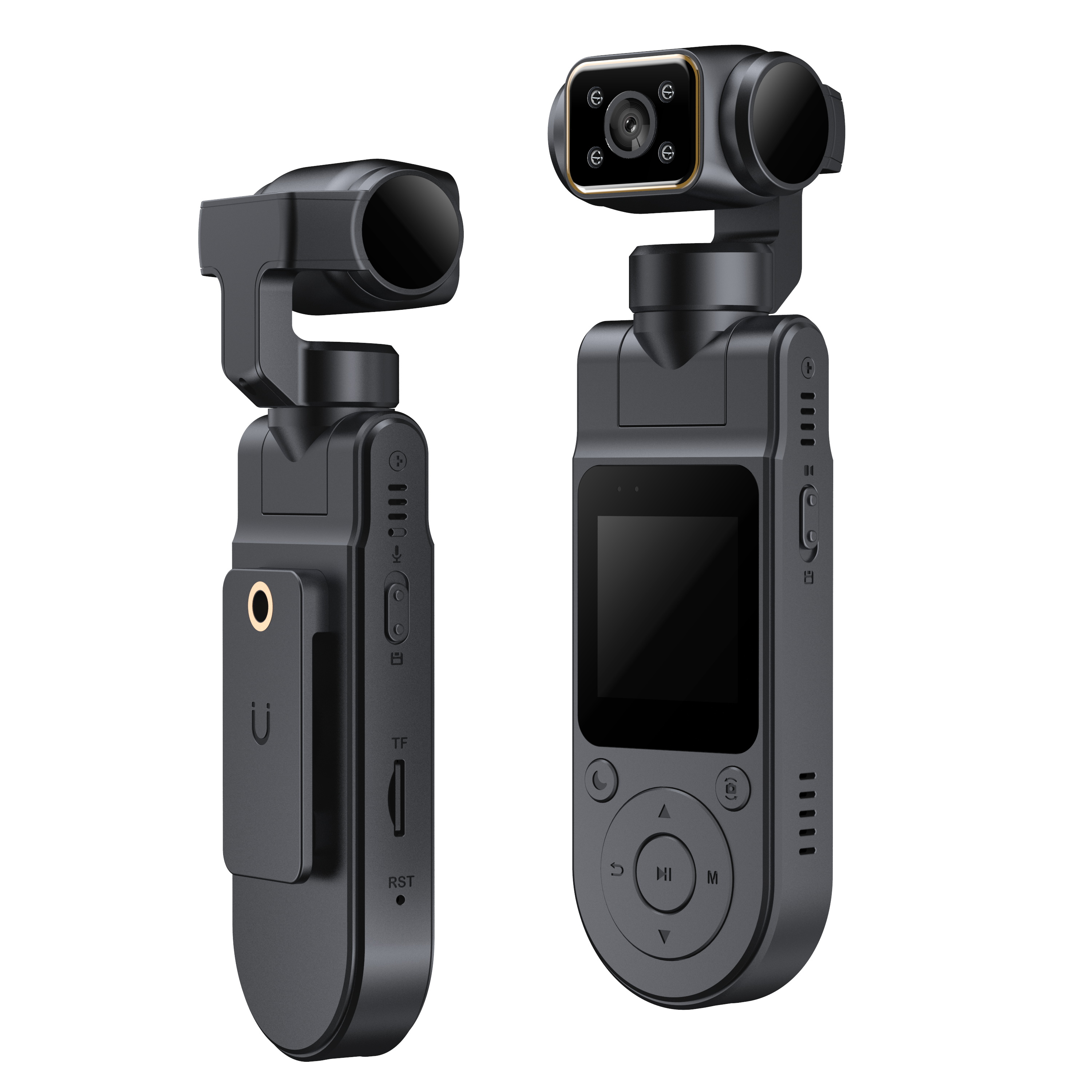
The X20 pairs a 1.54-inch IPS display with a 130-degree HD lens and a full-range built-in capacitor microphone.
Q1 — 4K+WiFi with dual 4K front and rear recording
The Q1 belongs to the 4K+WiFi category and records 4K (3840 × 2160) on both the front and the rear camera, with simultaneous dual recording at front 2K plus rear 2K. It carries a 2000 mAh / 3.8 V polymer battery, a maximum photo duration of approximately 10 hours at 720p 30 fps, a recording working time of approximately 9 hours and a video working time of approximately 4 to 5 hours. Its 1.5-inch IPS screen runs at 320 × 240, the lens is a 130-degree wide-angle design with rotating direction, and the model is compatible with a waterproof case for underwater shooting.
Q2 — the touchscreen and anti-shake model
The Q2 is the most feature-differentiated model in the set. It is a 4K WiFi touch screen anti-shake action camera with a 1.8-inch IPS display at 800 × 480 — the highest screen resolution in this shortlist — and it supports touch-screen operation alongside standard touch and physical dual buttons. Stabilisation is 6-level electronic image stabilisation. Its 25 mm lens offers a 130-degree wide angle, it supports front and rear dual recording simultaneously with 2K + 2K and three selectable modes, and it is powered by an 18650 cell rated at 2000 mA with approximately 4 to 5 hours of video working time. Like the Q1, it is compatible with a waterproof case.
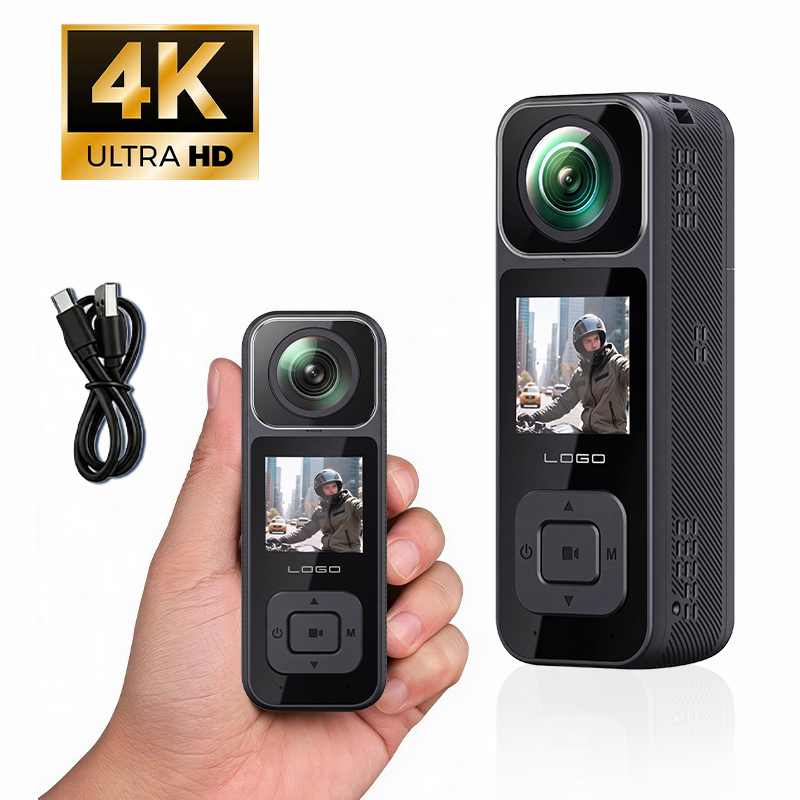
The Q2 combines a 1.8-inch 800 × 480 IPS touchscreen with 6-level electronic image stabilisation.
Q3 — the 130-degree lens with a 2000 mAh battery
The Q3 is classified as a 4K WiFi action camera. Its defining combination for most buyers is the 130-degree wide-angle HD lens with rotating direction paired with a 2000 mAh / 3.8 V polymer battery. It records 4K (3840 × 2160) on both front and rear cameras, supports simultaneous dual recording at front 2K plus rear 2K, and adds infrared night vision with manual switching. The display is a 1.5-inch IPS panel at 320 × 240, the interface is high-speed Mini USB 2.0, and the body is ABS.
Q7 — 4K anti-shake in the most compact display footprint
The Q7 is a 4K WiFi anti-shake action camera recording 4K (3840 × 2160) at 30 fps, with image stabilisation supported and a 130-degree wide-angle lens with rotating direction. It carries the smallest display in the group at 1.47-inch IPS (320 × 240) and is powered by a 1000 mAh / 3.8 V polymer battery. It supports infrared night vision and is compatible with a waterproof case for underwater shooting. Its selling-point set — wide angle, 4K, stabilisation and waterproof-case compatibility — positions it as the compact stabilised option rather than the dual-recording option.
Technical Explanation: What These Parameters Actually Decide
Three parameters in the table do most of the work in a real sourcing decision, and each behaves differently from how it reads on a spec sheet.
Resolution class versus battery format. The Q1, Q2, Q3 and Q7 all declare 4K (3840 × 2160) recording, while the X20 declares 1920 × 1080. Higher resolution consumes more power per minute of footage, which is why the numbers in this table need to be read together rather than separately: the Q1 and Q3 pair 4K recording with 2000 mAh batteries, the Q2 pairs 4K recording with an 18650 2000 mA cell, and the Q7 pairs 4K recording with a 1000 mAh polymer battery. A programme that needs long single-take runtime and 4K output is therefore working from a narrower set than a programme that only needs one of the two.
Electronic stabilisation. The Q2 declares 6-level electronic image stabilisation and the Q7 declares stabilisation support. Electronic image stabilisation works by software: the algorithm corrects motion in the recorded image, and industry guidance describes EIS as a standard feature across budget to mid-range action cameras. The practical implication for buyers is that EIS reduces shake but is not a mechanical gimbal — it belongs to the same conversation as mounting quality and lens field of view, not instead of them.
Wide-angle field of view. A 130-degree lens is the common specification across the set. A wide field of view reduces how much footage is lost when a camera is bumped off-axis, which matters most in bicycle-mounted, climbing and ski configurations where the camera cannot be re-aimed mid-run. It also interacts with stabilisation: a wider frame gives the correction algorithm more image to work with.
Audio and power interfaces. Every model uses the same microphone type and the same high-speed Mini USB 2.0 interface, which simplifies accessory planning — a single cable and mount family can serve the whole shortlist during sample evaluation.
Application Fit: Matching Models to Programme Types
None of these models is scenario-locked, but the parameter differences point toward natural fits.
- Underwater diving and surfing waterproof programmes. The Q1, Q2 and Q7 are documented as compatible with a waterproof case for underwater shooting. Buyers planning diving or surfing accessories should budget the housing and sealing accessories as part of the programme, not as an afterthought.
- Bicycle-mounted and motorcycle programmes. High-vibration use is where stabilisation earns its cost. The Q2's 6-level EIS and the Q7's stabilisation support are the relevant options here, and both rely on the 130-degree field of view to keep the frame stable.
- Ski, climbing and mountaineering programmes. Cold-weather and high-speed use puts runtime and mounting flexibility first. The Q1's 2000 mAh battery and approximately 9-hour recording working time, and the Q3's 2000 mAh battery, are the most accommodating options in the set for extended sessions.
- Vlog handheld and travel photography. Spoken audio and framing control dominate here. All five models use the same capacitor microphone, so the tie-breaker is handling: the Q2's 1.8-inch 800 × 480 touchscreen and dual touch and physical buttons suit handheld review and framing adjustments better than the smaller 320 × 240 panels.
- Night recording and low-light transit. Infrared night vision is supported across all five models, which keeps low-light capability off the differentiator list and shifts the decision back to battery and stabilisation.
- Driving and transportation programmes. Where a camera is used as an on-board recorder, the X20's approximately 9-hour recording working time and approximately 12-hour maximum photo duration at 720p 30 fps, and the Q1's approximately 9-hour recording working time, are the relevant endurance figures.
Market Trend Analysis
Two documented shifts are reshaping how this shortlist should be read.
The first is the migration toward higher resolution. Mordor Intelligence reported that the Ultra-HD segment — 4K and above — accounted for approximately 46.25% of action camera market share in 2025. That figure sits behind an obvious structural fact: four of the five models in this shortlist already declare 4K (3840 × 2160) recording, and the 2K+WiFi X20 occupies the lower tier of the same platform. For OEM buyers, the implication is that resolution-tier selection is increasingly a portfolio decision — a 2K-class model and a 4K-class model may both belong in the same range rather than one replacing the other.
The second is regional demand concentration. Grand View Research placed North America at a 34% revenue share of the global action camera market in 2025. Separately, BCN+R data reported by PetaPixel indicated that DJI and Insta360 together held nearly 90% of the action camera market share in Japan as of late 2025. Concentrated brand share in specific markets is a sourcing signal rather than a barrier: it shows where accessory ecosystems, retail expectations and price bands are already established, and it tells an OEM buyer which compliance and packaging requirements are likely to be tested first.
Compliance belongs in the same trend discussion. Action cameras fall under the IEC 62368-1 safety standard for audio/video and information technology equipment, whose fourth edition was published in 2023. Individually, the IP68 rating is defined by IEC 60529 as protection against dust and against immersion in water. Buyers comparing waterproof claims should treat the standard as the reference definition and the individual product's declared protection level as the claim to verify.
Comparison with Traditional Sourcing Approaches — and Where This Shortlist Stops
Traditional action camera sourcing often works in one of two ways: a buyer imports a single best-selling model and scales from there, or a buyer collects samples from several unrelated factories and compares them loosely, using different spec formats.
The first approach concentrates risk. If the single model's battery format, display size or stabilisation turns out to be wrong for the target market, the buyer has no adjacent model inside the same quality system to switch to. The second approach produces comparison noise, because parameters are not declared the same way across suppliers.
A single-platform shortlist addresses both problems, and the five models here come from a manufacturer with a standardised production facility, professional production lines and quality control, an annual production capacity of 2,000,000 units, a 1,500-square-metre manufacturing facility, approximately 300 employees and a 30-engineer R&D team. The same manufacturer holds FCC, CE and RoHS certification and exports approximately 80% of its products to more than 15 countries and regions, with major markets in Europe, North America, Asia and South America. It also provides OEM and ODM one-stop customisation services covering product design, engineering development, testing and mass production.
That said, this shortlist has clear boundaries, and buyers should treat them as decision inputs rather than objections.
- Housing-dependent waterproofing. The parameter sheets for the X20, Q1, Q2, Q3 and Q7 do not declare an individual IP rating. For the Q1, Q2 and Q7, underwater use is documented as achievable through a compatible waterproof case. A programme that requires factory-sealed waterproof capability without a housing is outside what this set documents, and the IP68 definition in IEC 60529 should be used as the reference when a specific ingress protection level is a hard requirement.
- Runtime asymmetry. The X20 and Q7 use 1000 mAh / 3.8 V polymer batteries, while the Q1, Q2 and Q3 carry 2000 mAh-class cells. Programmes built on continuous long-take recording should either select from the higher-capacity models or plan multi-battery kits.
- Resolution floor on the X20. The X20's declared recording resolution is 1920 × 1080 in AVI format. It is the lowest in this group, and a buyer whose retail channel expects 4K output should shortlist from the other four.
- Electrical stabilisation only. Both stabilised models in the set rely on electronic correction. Buyers who require mechanical stabilisation are looking at a different product category.
Future Outlook
The direction of travel for this tier of the market is fairly legible. Electronic image stabilisation has already moved from premium feature to expected baseline in budget to mid-range cameras, and the Q2's 6-level EIS and the Q7's stabilisation support sit inside that expectation rather than ahead of it. If 4K class recording continues to take share — and the approximately 46.25% Ultra-HD share recorded in 2025 points that way — the practical pressure on suppliers will be less about adding resolution and more about power density: sustaining 4K output on compact battery formats without shortening working time.
Compliance will move in parallel. With IEC 62368-1:2023 as the current safety standard edition and CE, FCC and RoHS already established as the baseline documentation set for export-oriented manufacturers, the differentiator for OEM buyers in the coming cycle is likely to be documentation readiness — how quickly a supplier can supply the certificate set and test evidence that a specific market requires — rather than the existence of certification itself.
For a buyer at the research stage today, the useful conclusion is modest: build the shortlist from declared parameters, not from class labels; decide early whether runtime or resolution is the binding constraint; and treat waterproofing, stabilisation and battery format as the three variables that actually eliminate models.
FAQ
What do the X20, Q1, Q2, Q3 and Q7 have in common?
All five use an ABS body material and a full-range built-in capacitor microphone. They share a 130-degree wide-angle lens specification, a high-speed Mini USB 2.0 interface, WAV 512 kbps recording bit speed where declared, infrared night vision support, and target use in the outdoor sports, photography and video shooting, and driving and transportation industries. They are all manufactured by Dongguan YuAoHeng Electronic Technology Co., Ltd.
Which models in the shortlist record 4K?
The Q1, Q2, Q3 and Q7 declare 4K (3840 × 2160) recording. The X20 declares 1920 × 1080 in AVI format. The Q1, Q2 and Q3 additionally support simultaneous dual recording at front 2K plus rear 2K, with the Q2 offering three selectable dual-recording modes.
Which models include image stabilisation?
Two of the five. The Q2 specifies 6-level electronic image stabilisation, and the Q7 lists image stabilisation as supported. Stabilisation on both is electronic rather than mechanical, meaning motion correction is handled by software algorithms.
What are the battery differences between the five models?
The X20 and Q7 use a 1000 mAh / 3.8 V polymer battery. The Q1 and Q3 use a 2000 mAh / 3.8 V polymer battery. The Q2 uses an 18650 cell rated at 2000 mA. Declared video working time is approximately 6–7 hours for the X20 and approximately 4–5 hours for the Q1 and Q2; recording working time is approximately 9 hours for the X20 and Q1.
Are these cameras waterproof without an additional housing?
The specification records for the X20, Q1, Q2, Q3 and Q7 do not declare an individual ingress protection rating. For the Q1, Q2 and Q7, underwater shooting is documented as supported through compatibility with a waterproof case. Where a specific protection level is required, IP68 is defined by IEC 60529 as protection against dust and against immersion in water, and should be used as the reference definition when verifying a supplier's claim.
Can these models be customised for OEM or ODM programmes?
Dongguan YuAoHeng Electronic Technology Co., Ltd. provides OEM and ODM one-stop customisation services covering product design, engineering development, testing and mass production. The manufacturer operates a 1,500-square-metre standardised production facility with professional production lines and quality control, has an annual production capacity of 2,000,000 units, employs approximately 300 staff and maintains a 30-engineer R&D team. Its products hold FCC, CE and RoHS certification.
For the complete model range, specifications and certification details, the manufacturer's product catalogue is available for public download: YUAOHENG product catalogue (PDF).