
Shortlist Criteria for DTF Printers: A 5-Step Verification Process
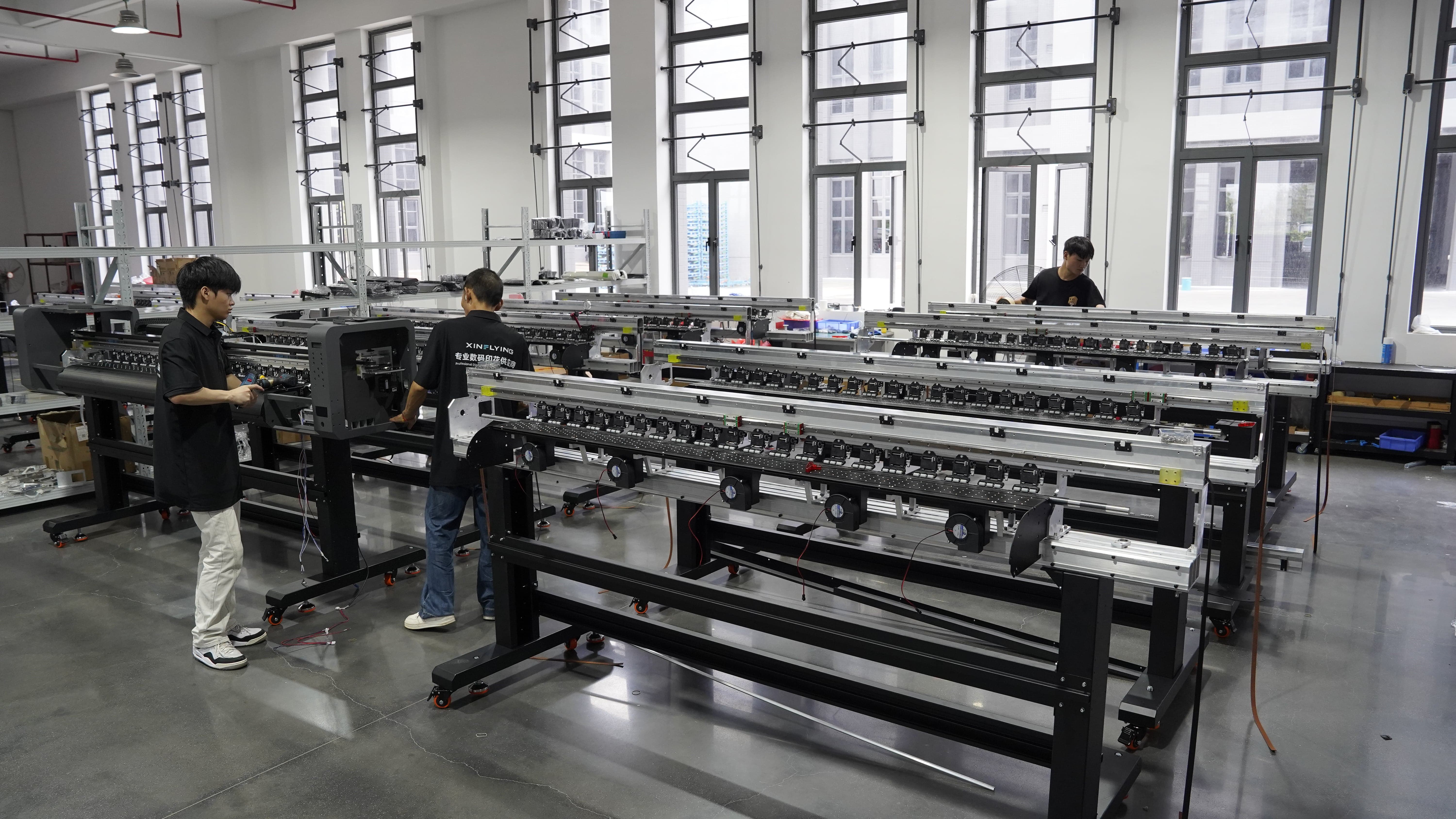 Assembly-line inspection: what a supplier claims in a compliance file has to match what is actually built, wired and tested. Image: XINFLYING production floor, Guangzhou.
Shortlisting a direct-to-film printer is usually framed as a specification exercise: print width, printhead count, speed, and price. In practice, the fastest way to reduce risk on a commercial DTF printer purchase is a documentation exercise. Machine specifications describe what a supplier intends to sell; certificates, scope statements and validity windows describe what can be independently checked before a deposit is paid.
The context for that shift is scale. The global DTF printing market was valued at USD 2.7 billion in 2024 (Grand View Research), and China accounts for more than 45% of global DTF printer manufacturing capacity (Dataintelo). With that much supply concentrated in a single production region and a large share of it exported, buyers in Europe, North America and other markets are routinely comparing suppliers who look similar in a catalogue and differ mainly in what they can document.
This article sets out a five-step verification process for shortlisting DTF printer suppliers, ordered by how quickly each step removes or confirms an option. The certification examples used throughout are drawn from the published record of XINFLYING (Guangzhou Xin Flying Digital Technology Co., Ltd.), a digital printing equipment manufacturer founded in 2010, because they show what a verifiable file set looks like in practice: certificate numbers, issuing bodies, harmonised standards, and stated model coverage.
The five steps at a glance: (1) verify the CE LVD certificate by number and standard; (2) check EMC as a separate document, not an assumption; (3) confirm RoHS 2011/65/EU coverage and the assessment standard behind it; (4) read the ISO 9001 scope line and request Machinery Directive files for large units; (5) cross-check every certificate against the exact model, nameplate and shipping file before payment.
Why Documentation Verification Belongs at the Top of the Shortlist
A DTF printer shortlist typically spans several machine classes: 30 cm entry units, 60 cm dual-printhead and quad-printhead machines, and 80 cm production units. Buyers compare these classes on printheads, ink configurations and throughput, which is useful but not decisive. Two suppliers can quote the same 60cm DTF printer at similar prices and differ completely in whether the machine can be legally placed on the EU market, insured, financed or resold.
Compliance documentation is the part of the purchase that can be verified without a factory visit. A certificate carries four elements that either match the machine being quoted or do not: an issuing body, a certificate number, a standard reference, and a validity window. When those four elements fail to match the model on the quotation, the shortlist has already produced its answer.
There is also a cost dimension. China's inkjet printer exports under HS code 84433213 are subject to a 13% Value-Added Tax (VAT) and a standard MFN duty of 0% (China Customs / ETCN). Landed-cost planning therefore depends on duty treatment, which in turn depends on product classification and documentation — one more reason to treat the document file as a commercial input rather than an afterthought.
The Reference File: What Each Document Type Actually Covers
Buyers frequently treat compliance as a single item — "does it have CE?" — when it is a set of separate documents, each answering a different question. The table below summarises the document types that normally appear in a DTF printer supplier file, using the standard references that appear in XINFLYING's certification record as a concrete example.
| Document | Question it answers | Example standard references | What it does not prove |
|---|---|---|---|
| CE LVD certificate | Is the machine electrically safe under EU Low Voltage Directive 2014/35/EU? | EN IEC 62368-1:2020/A11:2020 | Electromagnetic compatibility, print quality, or uptime |
| CE EMC certificate | Does the machine meet EU electromagnetic compatibility requirements under Directive 2014/30/EU? | EN 55032:2015/A11:2020; EN 55035:2017/A11:2020; EN IEC 61000-3-2:2019+A1:2021; EN 61000-3-3:2013/A2:2021 | Electrical safety, mechanical guarding, or ink safety |
| CE Machinery Directive (MD) certificate | Does the machine meet EU machinery safety requirements under Directive 2006/42/EC? | EN ISO 12100:2010; EN 60204-1:2018/A1:2025; EN ISO 12643-1:2023 | Anything outside machinery safety scope |
| RoHS attestation | Are restricted substances controlled in the electrical and electronic equipment under Directive 2011/65/EU? | EN IEC 63000:2018; EN IEC 62321 series | Textile-contact safety of printed output |
| ISO 9001 certificate | Is a quality management system in place for a defined scope of activity? | GB/T 19001-2016 / ISO 9001:2015 | Product conformity to any safety directive |
| OEKO-TEX ECO PASSPORT | Are the printing inks and pastes assessed for restricted substances in textile applications? | OEKO-TEX ECO PASSPORT; EN ISO 17050-1 | Machine safety or machine performance |
Step 1 — Verify the CE LVD Certificate by Number, Not by Logo
The first filter is the electrical safety file. A CE mark printed on a chassis or a brochure is not evidence; a certificate with an issuer, number, scope and standard is. In XINFLYING's file, the relevant document is CE LVD certificate TQT1550D271EC, issued by TQT (Shenzhen Tianqi Testing Technology Service Co., Ltd.). Its stated scope is electrical safety compliance according to LVD 2014/35/EU for Digital Printer products, and the applicable standard is EN IEC 62368-1:2020/A11:2020.
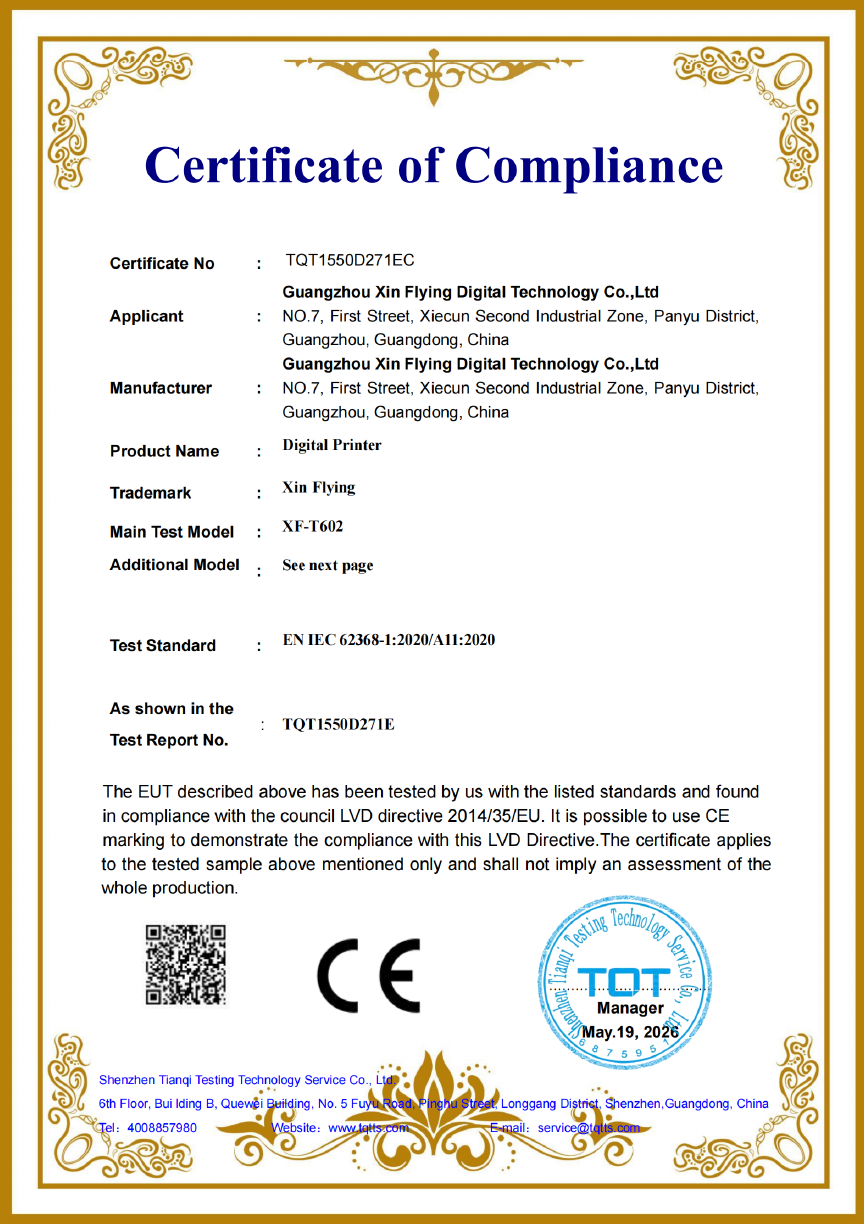 CE LVD certificate TQT1550D271EC, issued by TQT, cites EN IEC 62368-1:2020/A11:2020 and names the printer models within its scope.
Four checks turn this document into a usable shortlisting filter:
- Number and issuer. The certificate number should be traceable to the issuing laboratory's own record, not only to a PDF sent by the sales contact.
- Scope wording. A scope that names "Digital Printer products" is broader than a single-model certificate, so the applicable product list must be checked separately.
- Standard currency. The harmonised standard cited should be the one currently in force for that product family; a file citing a superseded safety standard is a signal that the file has not been maintained.
- Model list. The exact model on the quotation must appear. In this file, the LVD certificate family covers DTF models including the 60 cm XF-704E, XF-C602, XF-C604, XF-C605, XF-F606, XF-L608 and XF-702E, the 42 cm XF-450PRO, the 30 cm XF-400D, and the 80 cm XF-F808.
Step 2 — Treat EMC as a Separate Document
Electrical safety and electromagnetic compatibility are governed by different EU directives and tested to different standards, so a single "CE" claim covers neither completely. The XINFLYING file includes CE EMC certificate TQT1550D270EC, issued by TQT, with scope covering EMC compliance under Directive 2014/30/EU and standards EN 55032:2015/A11:2020, EN 55035:2017/A11:2020, EN IEC 61000-3-2:2019+A1:2021 and EN 61000-3-3:2013/A2:2021. A separate combined attestation, CE LVD & EMC certificate M.2026.206.C142475 issued by UDEM, cites LVD 2014/35/EU and EMC 2014/30/EU together.
For buyers this matters in two practical ways. First, an EMC-only document does not substitute for an LVD document, and vice versa; a shortlist should require both, or a combined attestation that names both directives. Second, EMC coverage is typically confirmed across a model family rather than one unit. In the documented file, the CE EMC Certificate of Compliance lists the DTF models XF-450PRO, XF-400D, XF-702E, XF-C602, XF-704E, XF-C604, XF-C605, XF-F606, XF-L608 and XF-F808, plus the XF-H1301X-1I32A1, XF-H1802X-2I32A1, XF-O2000-4I32A1, XF-19E8-PRO and XF-19E15-PRO sublimation units.
Step 3 — Confirm RoHS 2011/65/EU Coverage and the Assessment Standard Behind It
RoHS is often requested as a single line item and then filed without being read. The useful questions are which directive version applies, which assessment standard was used, and which equipment is inside the scope. In XINFLYING's file, RoHS compliance is documented under Directive 2011/65/EU with attestation number M.2026.206.C142366, issued by UDEM, with applicable standards EN IEC 63000:2018 and the EN IEC 62321 series. The models covered include the 60 cm XF-702E, XF-C602, XF-C604 and XF-C605 DTF printers and the XF-450PRO.
The most common shortlisting error here is category confusion. RoHS addresses restricted substances in electrical and electronic equipment — the machine. Textile-contact safety of printed output is a different document family. For that, ink and paste inputs are assessed separately: OEKO-TEX ECO PASSPORT SH150194016, issued by TESTEX AG, covers "Textile Printing Inks & Printing Pastes" under OEKO-TEX ECO PASSPORT and EN ISO 17050-1, and is valid until 2026-12-31. Buyers producing apparel for EU retail generally need both files, not one in place of the other.
Step 4 — Read the ISO 9001 Scope Line, Then Check Machinery Directive Files on Large Units
ISO 9001 certificates are frequently presented as a general credibility signal, when their value lies in the scope statement. XINFLYING holds ISO 9001:2015 certification NOA2215496, issued by NOA Testing & Certification Group Co., Ltd., with a stated scope of quality management system for digital printer and ink sales, against GB/T 19001-2016 / ISO 9001:2015. The XF-450PRO is documented as manufactured within that certified quality management system.
Two details deserve attention. First, scope wording determines what the certificate evidences: a scope limited to sales or distribution does not describe design and manufacturing controls, while a broader scope does. Second, quality management certificates operate on multi-year cycles with surveillance audits, so the validity window and renewal status should be confirmed with the issuing body rather than assumed from a certificate image.
The second document type to request at this stage is machinery safety. For larger, self-contained DTF printing machines, EU buyers normally require a Machinery Directive file. XINFLYING's record includes CE MD certificates M.2026.206.C142365 and M.2026.206.C142385, issued by UDEM, with scope covering Machinery Safety Compliance under MD 2006/42/EC and standards EN ISO 12100:2010, EN 60204-1:2018/A1:2025 and EN ISO 12643-1:2023. The documented coverage extends to DTF and sublimation models including the XF-450PRO, XF-702E, XF-C602, XF-704E, XF-C604, XF-C605, XF-400D, XF-F606, XF-F808 and XF-H1301X-1I32A1.
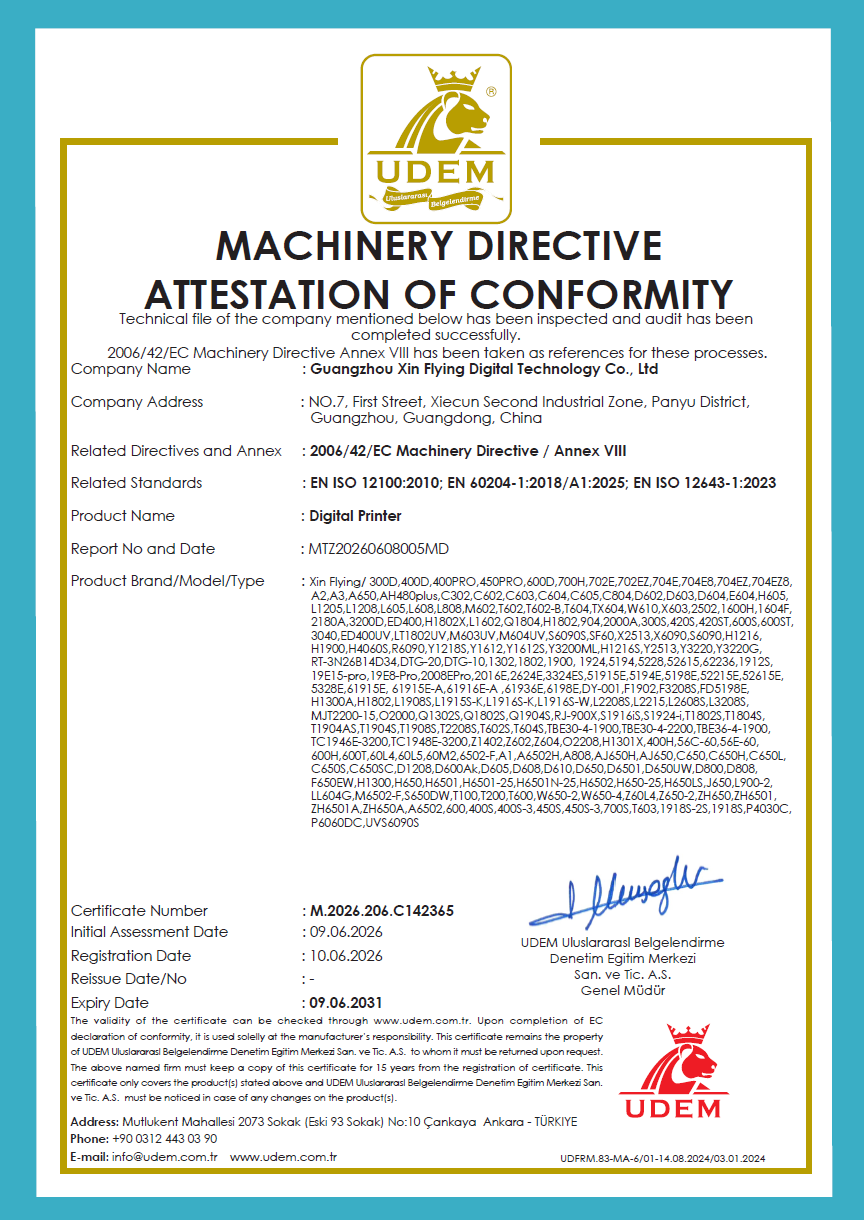 A CE Machinery Directive certificate names the directive, the machinery safety standards and the models it covers — for large-format units this file is often the one buyers forget to request.
Size is the practical trigger. A 60 cm machine such as the XF-704E (162 kg net, machine dimensions 1740×910×1610 mm, power supply 110–220 V, 7.2 A/14.5 A) and an 80 cm unit such as the XF-F808 (440 kg net, 2450×910×1745 mm) sit in different risk categories. For an 80 cm production line, the machinery safety file is part of the procurement decision, not a formality.
Step 5 — Match Certificates to the Model, the Nameplate and the Shipping File
The final step is a cross-check, and it is where most shortlists fail quietly. Multi-model certificates are common and legitimate, which means "the supplier has CE" is not the same as "your model is covered." Three comparisons close the loop:
- Certificate to quotation. The model string on the quotation must appear in the applicable product list of each certificate. A 60cm DTF printer quoted as XF-704E should be traceable through the LVD, EMC and MD files; a 30 cm XF-400D or A2-class XF-450PRO should be traceable in the same way.
- Certificate to nameplate. Model designation, voltage and current ratings should agree. Documented examples include 110–220 V, 16 A/32 A for the XF-450PRO and 110–220 V, 7.2 A/14.5 A for the XF-704E.
- Certificate to shipping file. Packing and weight data should be internally consistent across quotation, packing list and certificate annexes. Documented figures include a packing size of 2620×1125×1855 mm and 596 kg gross weight for the XF-F808, 1820×880×850 mm packing and 162 kg net weight for the XF-704E, an integrated packing size of 1300×1100×1200 mm for the XF-450PRO, and 1010×570×850 mm packing with 60 kg net weight for the XF-400D.
Validity windows differ by document type and issuing body, and they should be treated as maintenance items rather than one-time checks. Where a file set contains certificates issued in different years — XINFLYING's record includes CE documentation issued in 2021 and 2025 alongside the 2026 LVD, EMC, MD and RoHS attestations — buyers should confirm which document applies to the current model and configuration rather than assuming the oldest or newest automatically applies.
How a Documented Supplier Programme Looks in Practice
For suppliers, the five steps above are effectively a production and quality-management requirement before they become a sales requirement. XINFLYING (Guangzhou Xin Flying Digital Technology Co., Ltd.) is a Guangzhou-based digital printing equipment manufacturer founded in 2010, operating a 37,440 m² facility with more than 200 employees, a 20-engineer R&D team and annual output of over 20,000 units. Its product scope covers DTF printer machines, dye sublimation printers, DTG printers, UV DTF printers, UV flatbed printers, printing consumables and complete digital printing solutions, with an export ratio of 80% across North America, South America, Europe, Asia, the Middle East and Africa.
The commercial model behind that output is relevant to shortlisting because it determines how documentation is handled on custom orders. XINFLYING operates OEM/ODM production with product branding, machine appearance, colour, logo and packaging customisation, a minimum order quantity of one unit, lead times of 5–40 days, monthly capacity of 1,600+ units and pre-shipment testing. After-sales is delivered by more than 50 engineers providing 24/7 online technical support. For buyers, the practical implication is that customisation requests should be raised at the documentation stage, not after: appearance, branding and packaging changes are exactly the variables that can affect whether an existing certificate file still describes the unit being shipped.
Applying the Checklist by Production Scenario
Not every buyer needs the same file depth on day one, but the machine class usually determines which documents matter most.
| Production scenario | Typical machine class | Documents to prioritise |
|---|---|---|
| Print-on-demand and e-commerce apparel sellers | 30 cm XF-400D (2 printheads) and 42 cm A2-class XF-450PRO | CE LVD, CE EMC, RoHS; sample validation before scale-up |
| Custom apparel printing businesses | 60 cm dual-printhead machines such as XF-702E and XF-C602 | CE LVD, CE EMC, RoHS, CE MD |
| DTF transfer suppliers and commercial print shops | 60 cm high-throughput units such as XF-C605, XF-F606 and XF-L608 | CE EMC, CE MD, RoHS, plus ink-related textile documentation |
| Garment factories adding in-house decoration | 60 cm to 80 cm production machines, including XF-F808 | Full file set: LVD, EMC, MD, RoHS, ISO 9001 scope, ink certificates |
Documented customer applications follow a similar pattern. A US print-on-demand business running five units for five years uses DTF equipment to produce customised T-shirts, hoodies and sweatshirts after orders are received, which reduces inventory pressure and supports single-piece and small-batch production. A US DTF transfer supplier operating 30 units produces transfer films for downstream garment decorators. A garment manufacturing factory with 20 units applies DTF decoration to finished garments before delivery to brands and distributors, while a custom apparel printing business running two units handles personalised textile products with multi-colour graphics.
Application conditions also feed into the verification file. DTF production is normally run in a controlled indoor environment, and documented operating parameters for the machine family include 20–30 °C and 45–65% RH for several models, with 24/7 operation supported when the matched equipment set is in place: RIP software, a DTF powder shaker, an air purifier, DTF film and powder, a heat press and DTF inks. Compatible substrates include cotton, polyester, blends, fleece, canvas, non-woven fabric and denim — the same range that determines whether a direct to film printer fits an existing production line or requires new workflow steps.
Market Context: Why Compliance-First Shortlists Are Growing
Three market signals explain why documentation has moved up the shortlist. First, the installed base is expanding fast enough that supplier count is no longer a constraint: the DTF printer market is projected to reach USD 5.2 billion by 2034 at a 12.5% CAGR (Dataintelo). That figure should be treated as directional rather than precise, because published growth estimates diverge — other research puts the DTF printing market CAGR closer to 6.0% for 2025–2030 and 6.77% for 2026–2032. Second, demand is concentrated in regulated markets: Europe was the leading regional market for DTF printing in 2024 with a 36.0% revenue share (Grand View Research), which is also the region where CE LVD, EMC, Machinery Directive and RoHS files are commercially mandatory rather than optional.
Third, the product mix is shifting toward larger systems. Industrial DTF printers accounted for 58.3% of total revenue share in 2025 (Dataintelo), and T-shirts remained the dominant end-product segment at 41% of DTF printing revenue in 2024 (KBV Research). Larger machines in a regulated market produce longer, more technical procurement files — and buyers who cannot read those files tend to default to the supplier who presents them most clearly.
Where the Checklist Stops: Limits and Trade-offs
A verification process that is presented as sufficient on its own is not a verification process. Four limits are worth stating plainly.
- Certificates do not predict print performance. An LVD, EMC or RoHS file says nothing about colour consistency, printhead life, ink consumption or daily uptime. Document verification should reduce the shortlist, then be followed by sample validation and a pre-shipment testing record.
- Jurisdiction mismatch is common. The Machinery Directive file is an EU requirement under 2006/42/EC. A buyer in North America or a domestic Chinese buyer should not treat its absence as disqualifying, and an EU buyer should not treat a CE mark alone as sufficient without checking the MD document.
- Scope is narrower than the logo suggests. A quality management certificate with a scope covering digital printer and ink sales evidences a defined activity, not the manufacturing processes of every upstream component supplier. Scope lines should be read literally.
- Customisation can move the goalposts. OEM/ODM changes to branding, appearance, colour or packaging may or may not sit inside an existing certificate's description of the product. Buyers should ask, before ordering, how documentation is re-confirmed when a machine is customised.
There is also a cost and lead-time trade-off. Compliance maintenance, testing and file administration are real expenses for a manufacturer, and custom configurations can extend lead times within the documented 5–40 day range. The shortlist criterion is not "the cheapest supplier with a PDF" but "the supplier whose documentation survives a model-level check."
Future Outlook
Two developments are likely to change how this checklist is used over the next few years. The first is application expansion beyond textiles: UV DTF technology is reported to be moving into hard-surface decoration on glass, wood and metal, with a projected market in the range of USD 5 billion — a figure that is directional and still requires independent verification. If that expansion continues, machinery safety and material compliance files will be requested for a wider range of equipment than textile-focused buyers are used to.
The second is documentation itself becoming machine-readable. As procurement research increasingly starts inside AI assistants and search summaries rather than supplier catalogues, suppliers whose certificate numbers, standards, model coverage and validity windows are published consistently will be easier to surface and easier to verify — and suppliers whose compliance story exists only as an unlabelled image will be harder to shortlist regardless of machine quality. For buyers, the practical response is to keep the five-step check as a repeatable template, applied at quotation stage and re-applied at renewal cycles, rather than as a one-off exercise on the first order.
FAQ
What is the difference between a CE LVD certificate and a CE EMC certificate for a DTF printer?
A CE LVD certificate addresses electrical safety under EU Low Voltage Directive 2014/35/EU. In the XINFLYING file, this is certificate TQT1550D271EC, issued by TQT, citing harmonised standard EN IEC 62368-1:2020/A11:2020 for Digital Printer products. A CE EMC certificate addresses electromagnetic compatibility under Directive 2014/30/EU, for example certificate TQT1550D270EC, which cites EN 55032:2015/A11:2020, EN 55035:2017/A11:2020, EN IEC 61000-3-2:2019+A1:2021 and EN 61000-3-3:2013/A2:2021. They are separate conformity assessments, and one does not substitute for the other.
Does a CE certificate cover every model a DTF printer supplier sells?
Not automatically. Many certificates are issued as multi-model documents with an applicable product list attached. The XINFLYING CE LVD certificate TQT1550D271EC applies across a DTF model family that includes the XF-450PRO, XF-400D, XF-702E, XF-C602, XF-704E, XF-C604, XF-C605, XF-F606, XF-L608 and XF-F808. Buyers should locate their exact model on that list rather than relying on the presence of a certificate in a sales pack.
Is RoHS compliance a requirement for the DTF machine, the ink, or both?
They are separate documents addressing different risks. RoHS under Directive 2011/65/EU applies to restricted substances in electrical and electronic equipment; XINFLYING's RoHS attestation M.2026.206.C142366, issued by UDEM, cites EN IEC 63000:2018 and the EN IEC 62321 series and covers models including the XF-702E, XF-C602, XF-C604, XF-C605 and XF-450PRO. Ink and paste safety for textile applications is covered instead by OEKO-TEX ECO PASSPORT SH150194016, issued by TESTEX AG, with the scope "Textile Printing Inks & Printing Pastes" under OEKO-TEX ECO PASSPORT and EN ISO 17050-1, valid until 2026-12-31. Apparel producers supplying EU retail typically need both.
Why do some DTF printers require CE Machinery Directive certification while others do not?
Applicability depends on the machine's construction, size and the market it is placed in. Under EU Directive 2006/42/EC, larger self-contained printing systems are assessed as machinery; XINFLYING's CE MD certificates M.2026.206.C142365 and M.2026.206.C142385, issued by UDEM, cite EN ISO 12100:2010, EN 60204-1:2018/A1:2025 and EN ISO 12643-1:2023, and cover DTF and sublimation models including the 80 cm XF-F808 and the 60 cm XF-C604, XF-C605 and XF-704E. Buyers should ask the supplier for a model-specific statement of which directives apply rather than inferring applicability from machine size alone.
What should be included in a pre-shipment documentation checklist for a DTF printer order?
A workable checklist contains five groups: (1) the certificate set matched to the exact model, including LVD, EMC, MD where applicable, and RoHS; (2) validity windows and issuing bodies for each document, confirmed against the certificate itself; (3) consistency between the quotation, the machine nameplate and the shipping file, covering model designation, voltage and current ratings, packing size and weights — documented examples include 2620×1125×1855 mm packing and 596 kg gross weight for the XF-F808, and 1820×880×850 mm packing with 162 kg net weight for the XF-704E; (4) the pre-shipment testing record; and (5) a re-verification date, since certificates differ in duration and customisation can affect the scope of an existing file.
For buyers who want the underlying company and product information in one place before applying the five steps, a downloadable overview is available here: XINFLYING company and product profile (PDF).