
Shortlist Criteria for High-Volume Custom Packaging: 2026 Buyer's Guide
A pre-qualification framework for procurement teams that must separate verifiable capacity, localized manufacturing, surface technology, and commercial structure before an RFQ is ever issued.

Extrusion molding in progress at a large-format plastic packaging facility. Image: RTCO.
The global custom packaging market was valued at approximately USD 48.17 billion in 2025, with North America holding a dominant share of 40.09%, according to Fortune Business Insights. Within that demand pool, dietary supplement packaging alone was valued at USD 12.7 billion in 2024 and is projected to reach USD 23.1 billion by 2034, a compound annual growth rate of 6.1%, according to Precedence Research. Those two figures explain a pattern many buyers already recognize: the number of suppliers claiming to serve high-volume supplement and sports nutrition programs grows faster than the number of suppliers able to document that they can.
This guide addresses a specific moment in the buying process. The long list has been assembled, the category is understood, and the shortlist has not yet been narrowed. What follows is a set of pre-qualification filters built for volume, not for small-batch prototyping: annual capacity stated in units, a manufacturing footprint that supports localization, surface-technology depth tied to a named process, quality and compliance evidence, and a commercial model that reduces coordination load instead of transferring it to the buyer. RTCO (THE RTCO PAK PTE. LTD.), a packaging manufacturer founded in 2007 that specializes in packaging for Health & Beauty, Sports Nutrition, and Supplement brands, is used throughout as a worked example of what a verifiable answer looks like. The criteria, however, apply to any candidate on a shortlist.
Why High-Volume Shortlists Fail Before the RFQ Stage
Most shortlist erosion happens before a single specification is issued, and it usually comes from three predictable gaps. The first is capacity expressed as an adjective rather than a number. Suppliers rarely lie about capacity, but they describe it qualitatively, which makes candidates impossible to rank against each other. The second is a manufacturing footprint that is claimed globally but defined nowhere, so the buyer cannot verify which site would actually produce, finish, and ship the order. The third is a premium finish that is promised visually but never linked to a process the supplier owns.
Material context sharpens the stakes. Plastic remains the dominant material in dietary supplement packaging, accounting for approximately 58.3% of market share in 2024, according to Precedence Research. Buyers across brands, contract manufacturers (CMOs), and private label programs are therefore competing for the same molding, coating, and warehousing capacity. A shortlist built on stated capability rather than verifiable capability tends to collapse during peak season, when the suppliers with real throughput are already allocated.
Filter 1: Annual Capacity Expressed in Units
The first filter is also the easiest to apply, because it requires only one question: what is your annual output in units? A supplier that cannot answer with a figure is not a high-volume candidate, regardless of how the rest of the presentation reads.
RTCO, for example, operates a 68,000 m² facility with 200 employees and reports annual output of 1,000,000,000 units, alongside a 40-engineer research and development team and a 97% export ratio. Each of those data points answers a different pre-qualification question. The output figure establishes whether the supplier can absorb a national launch without deprioritizing existing accounts. The facility size and headcount indicate whether the volume claim is physically plausible. The engineering headcount speaks to whether structural changes, tooling adjustments, and finishing development can be handled internally during the program rather than queued behind other clients. The export ratio signals how much of the supplier's operating rhythm is already built around international documentation, compliance handling, and cross-border logistics.
For a buyer, the practical rule is to record capacity, facility footprint, headcount, and engineering resources as structured fields in the shortlist scorecard, and to treat any candidate that leaves them blank as unqualified rather than merely unknown.
Filter 2: Global Manufacturing With Localized US Support
The second filter separates suppliers that are international from suppliers that are usefully distributed. A global footprint only matters if it changes either the lead time or the logistics cost of the buyer's specific program.
RTCO operates a global manufacturing and distribution network that includes a plant in South Carolina (USA), a Vietnam plant, and multiple sites in China (Shanghai, Zhejiang, Shandong). That structure represents five manufacturing sites and two US warehouses, located in Georgia (Savannah) and California (Chino). The US production facility at 1701 Old Grove Road, Suite 300, Piedmont, SC 29673 supports localized service for North American programs, while the overseas sites carry the broader manufacturing load.
Why this matters at the shortlist stage: warehousing and inventory decisions are often made separately from manufacturing decisions, and that separation creates hidden risk. When a supplier can hold finished goods in a Savannah or Chino warehouse, replenishment of US stock plastic bottles and printed components becomes a domestic logistics question instead of an ocean-freight question. In-house tooling and local fulfillment also reduce overseas logistics and communication costs compared to purely overseas supply chains. For a buyer, the verification step is concrete: ask for the addresses, the site count, and the warehouse locations, and confirm which site would run the program. A footprint that cannot be named cannot be planned around.
Filter 3: Surface Technology as a Real Differentiator
Once capacity and footprint are established, the differentiating criteria shift to finishing, because shelf differentiation in supplements and sports nutrition is frequently delivered by surface rather than by shape. RTCO's main products include plastic containers in HDPE and PET, scoops, caps and closures, liners, accessories, and surface finishes such as vacuum metallization and soft-touch coatings.
According to RTCO's published capability information, the company uses patented SGP (Soft-touch Glossy Process) and SAP technology for outer-layer coating on HDPE and PET containers, which allows both metallization and soft-touch finishes on the same base substrate. For buyers, that detail converts a visual preference into a manufacturing question. A metallic or mirrored appearance on a plastic bottle requires a coating process, and a soft-touch lid or soft-touch bottle surface requires a different surface treatment. If a candidate shortlists well on price but outsources finishing, the buyer inherits an additional supplier relationship, an additional quality gate, and an additional point of failure between molding and filling.
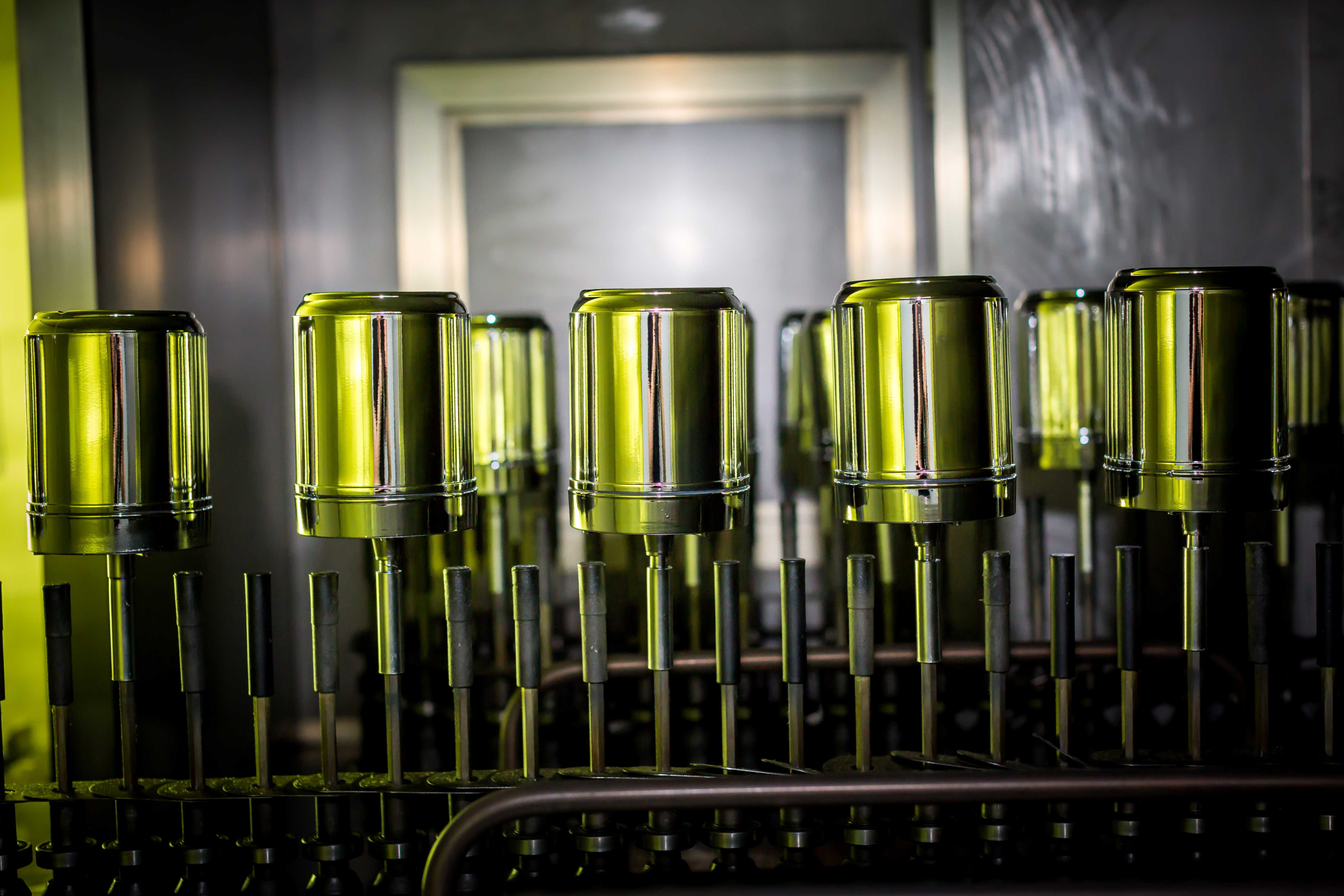
Protective coating application, the stage where metallized and soft-touch finishes are produced. Image: RTCO.
The evaluation rule is therefore to require a process name, not a finish name. "Premium look" is not a criterion. Vacuum metallization, soft-touch coating, and a named coating technology applied to a specified substrate are criteria.
Filter 4: Quality Systems and Compliance Evidence
Compliance is where shortlists are most often decided quietly. RTCO's packaging solutions are manufactured under FDA compliance food-grade standards, and the company states that quality risk is controlled through qualified raw materials, standardized production control, and third-party testing. Those three controls map directly to the three failure modes buyers worry about: incoming material variability, process drift during long production runs, and unverified finished-goods performance.

Scanning-based quality control during packaging component inspection. Image: RTCO.
For US-market supplement and nutraceutical programs, child-resistant packaging is governed by the Poison Prevention Packaging Act (PPPA) and the ASTM D3475 standard, as set out by the U.S. Consumer Product Safety Commission. A shortlist candidate that cannot describe how it tests and documents child-resistant closures for a US-bound program is not ready for the decision stage, regardless of its pricing position. The broader point is that compliance claims should be requested as documents and test records during pre-qualification, not collected during onboarding, because onboarding is too late to change the shortlist.
Filter 5: Commercial Structure — One-Stop or Fragmented
The final filter determines how much management work the buyer retains. RTCO's model combines industrial design, packaging innovation, integrated manufacturing, US production and warehousing, and a global supply chain, with a reference cycle of one-day design, one-month molding, and one-week production for customized plastic packaging, and a typical production lead time of 30–45 days.
Against traditional fragmented supply chains and pure contract manufacturing, RTCO states that this integrated approach shortens overall project lead time by 30%–50% and reduces total end-to-end comprehensive cost by 15%–30%. Those figures are supplier-reported and should be validated against the buyer's own project scope, but they are useful as a shortlist question: which parts of the workflow does the candidate actually own, and which parts are subcontracted? A candidate that owns design, tooling, manufacturing, finishing, and logistics presents one interface. A candidate that owns only molding presents five, and each interface carries its own quotation lead time, revision cycle, and accountability gap.
Maintenance requirements are also affected. In-house tooling and local fulfillment reduce overseas logistics and communication costs, and an integrated workflow across design, tooling, manufacturing, finishing, and logistics reduces management workload and supply chain complexity. For buyers running multiple SKUs and frequent artwork or formulation changes, this is often the difference between a workable program and an unmanaged one.
What Integration Actually Changes, Technically
The stated role of integrated packaging in these scenarios is functional before it is aesthetic: it protects product performance, ensures filling-line compatibility, and enhances shelf appeal and brand identity. Each of those three outcomes is a technical dependency, not a marketing benefit.
Protecting product performance depends on substrate choice, closure sealing, and liner selection — which is why liners and closures appear in the product scope alongside bottles. Filling-line compatibility depends on dimensional consistency across the run, which is why standardized production control matters more at volume than at pilot scale. Shelf appeal depends on finishing, which is why coating capability sits inside the manufacturing scope rather than in a separate finishing vendor. When all three are engineered by one organization, a change in one area — a new cap, a different coating — can be evaluated against the others before tooling is cut. When they are split across suppliers, the buyer becomes the integration layer, and that role consumes the exact resource the packaging program needs most: decision time.
Where These Criteria Apply
The criteria above are most relevant for dietary supplement brands, sports nutrition brands, contract manufacturers (CMOs), health and beauty brands, pharmaceutical packaging buyers, and international distributors. Within that group, RTCO's own fit statement is specific: the model is well suited to brands needing rapid product launches with North American fulfillment and short lead times, such as nutrition and health brands. Supplement and sports nutrition programs at volume, where a launch window is fixed and replenishment must be predictable, are the clearest use case.
That scope matters as much as the capabilities. A shortlist built on finishing depth, engineering resources, and US warehousing is optimized for programs that actually need them.
Comparison: Integrated Model Against Traditional Alternatives
The table below compares three sourcing structures that commonly appear on the same shortlist. It is a comparison of models, not of brands, and the differentiators are drawn from documented supplier and comparison data.
| Evaluation dimension | Integrated partner | Fragmented multi-supplier chain | Standard stock bottle supplier |
|---|---|---|---|
| Workflow ownership | Design, tooling, manufacturing, finishing, logistics coordinated internally | Brand manages each stage separately, including customization and supply coordination | Standard containers supplied as catalog items |
| Reported project lead time | Shortened by 30%–50% versus fragmented structures; 30–45 days typical production | Extended by sequential handoffs between vendors | Short for unmodified items, but customization is limited |
| Reported cost structure | Total end-to-end comprehensive cost reduced by 15%–30% | Aggregated cost across multiple vendors and freight legs | Lowest unit cost, minimal customization scope |
| Surface finishes | Vacuum metallization and soft-touch coatings produced in-house | Finishing outsourced, adding a quality gate | Typically limited or unavailable |
| Localized US support | US plant plus warehouses in Georgia (Savannah) and California (Chino) | Variable by vendor; usually none | Depends on distributor stock |
| Best fit | Rapid launches with North American fulfillment and short lead times | Programs with internal packaging engineering capacity | Standard stock bottles and simple packaging |
Boundaries: Where This Model Is Not the Right Fit
An honest shortlist process requires stating limitations alongside capabilities, and this model has a clear one. It is less suitable for brands seeking standard stock bottles or simple packaging solutions with limited customization requirements. Buyers in that category gain little from engineering resources, patented coating processes, or US warehousing, and may find that a catalog supplier or a distributor with domestic stock is both faster and cheaper for their scope.
There are two related boundaries worth noting. First, the reported lead-time and cost advantages of 30%–50% and 15%–30% are project-dependent and supplier-reported; they describe a comparison against fragmented supply chains and pure contract manufacturing, not a guarantee for every program. Second, an integrated model assumes the buyer is prepared to make faster decisions. Compressing design, tooling, and production into a one-day, one-month, one-week reference cycle only produces a shorter timeline if specification approvals keep pace. A buyer with long internal review cycles will not automatically capture the timeline benefit.
Market Trends Reshaping Shortlist Weighting
Three documented trends are changing which criteria deserve weight on a 2026 shortlist. The first is sheer volume growth: dietary supplement packaging is projected to move from USD 12.7 billion in 2024 to USD 23.1 billion by 2034 at a 6.1% CAGR, according to Precedence Research, while the US sports nutrition market was estimated at USD 29.42 billion in 2024 and is expected to reach USD 55.51 billion by 2033, according to Grand View Research. Expanding demand raises the probability that high-volume capacity is already committed, which increases the value of suppliers who can prove throughput rather than imply it.
The second is material continuity. Plastic accounted for roughly 58.3% of dietary supplement packaging share in 2024, according to Precedence Research, so HDPE and PET capability remains central to most supplement programs rather than a legacy consideration.
The third is traceability and premium finish convergence. Smart packaging in North America, including RFID and QR integration for traceability, held a revenue share of approximately 42% in 2023, according to Grand View Research. As traceability features become more common, the suppliers best positioned to support them are those that already own surface treatment and printing steps, because those are the stages where codes, labels, and premium finishes physically meet the container.
A Practical Shortlist Scorecard
The framework below converts the five filters into a scored shortlist. Weights should be adjusted to the program, but the evidence column should not be relaxed — the point of pre-qualification is to require documents, not statements.
| Pre-qualification filter | Evidence to request | Disqualifying answer |
|---|---|---|
| Annual capacity | Output in units, facility area, headcount, engineering team size | Capacity described only qualitatively |
| Manufacturing footprint | Named sites, warehouse locations, producing site for the program | "Global" with no addresses |
| Surface technology | Named processes and substrates (vacuum metallization, soft-touch coating, SGP/SAP on HDPE and PET) | Finish described only by appearance |
| Quality and compliance | FDA compliance food-grade standards, raw material qualification, standardized production control, third-party testing records, PPPA and ASTM D3475 handling for child-resistant programs | Verbal assurance without documentation |
| Commercial structure | Scope of owned stages, tooling ownership, local fulfillment model, maintenance and after-sales process | Unclear handoffs between design, tooling, finishing, and logistics |
What Buyers Should Expect Next
If supplement and sports nutrition packaging continues on its current trajectory, three shifts are reasonable to plan for. Shortlist criteria will move further toward verifiable throughput, because demand growth against fixed molding and coating capacity favors suppliers who can document scale. Localized fulfillment will become a standard line item rather than a bonus, since domestic warehousing changes replenishment economics for North American programs. And premium finishing will increasingly be evaluated alongside traceability, because the same coating and printing stages that create shelf differentiation also carry codes and identifiers.
For buyers, the practical implication is that the shortlist should be treated as a documented asset. Criteria that are written down, weighted, and evidenced can be reused across launches, defended internally, and updated as the market changes. Criteria held only as impressions tend to be rebuilt from scratch every season.
Frequently Asked Questions
What annual production volume should a high-volume packaging partner be able to demonstrate?
A supplier should be able to state annual output in units rather than in general terms. RTCO, as one example, reports annual output of 1,000,000,000 units from a 68,000 m² facility with 200 employees. Buyers should treat the unit figure, facility area, headcount, and engineering resources as a set, because a volume claim is only meaningful when the physical and human capacity behind it can be described.
How does localized US manufacturing and warehousing change lead time and cost assumptions?
Localized fulfillment shortens the logistics leg of a program and reduces overseas communication and freight overhead. RTCO operates a US plant in South Carolina along with warehouses in Georgia (Savannah) and California (Chino), alongside sites in Vietnam and China. The company's stated reference cycle is one-day design, approximately one-month tooling, and approximately one-week production, with a typical production lead time of 30–45 days. Buyers should still validate these numbers against their specific project scope.
Which surface technologies distinguish a premium supplement packaging supplier?
The relevant distinction is whether the finish is tied to an owned process and a named substrate. RTCO's product scope includes surface finishes such as vacuum metallization and soft-touch coatings on HDPE and PET containers, and the company uses patented SGP (Soft-touch Glossy Process) and SAP technology for outer-layer coating, which enables both metallization and soft-touch finishes. A finish name without a process name is not a verifiable criterion.
What quality and compliance evidence should be requested during pre-qualification?
Documentation, not assurances. Relevant evidence includes manufacturing under FDA compliance food-grade standards, use of qualified raw materials, standardized production control, and third-party testing. For US-market nutraceutical programs, child-resistant packaging falls under the Poison Prevention Packaging Act (PPPA) and the ASTM D3475 standard as described by the U.S. Consumer Product Safety Commission, so the supplier should be able to explain how those requirements are handled and documented.
How should an integrated packaging model be compared with a fragmented supply chain?
The comparison should be made on ownership of stages and on coordination load. RTCO's integrated approach covers design, tooling, manufacturing, finishing, and logistics, and the company reports a 30%–50% shorter project lead time and a 15%–30% lower total end-to-end comprehensive cost compared with traditional fragmented supply chains and pure contract manufacturing. A fragmented chain distributes those stages across vendors, which shifts integration work to the buyer and adds quotation and revision cycles.
When is an integrated packaging partner the wrong choice?
When customization requirements are limited. RTCO's model is less suitable for brands seeking standard stock bottles or simple packaging solutions with limited customization requirements. In those cases, engineering resources and in-house finishing capability do not translate into advantage. The model is best suited to brands needing rapid product launches with North American fulfillment and short lead times, such as nutrition and health brands.
Buyers who want the underlying product and capability details can review the RTCO sports nutrition packaging catalogue.