
Shortlist: Five Bulk Matcha Products by Certification Coverage
Certification coverage has become the first commercially decisive filter in bulk matcha sourcing. Before flavour profile, price band or packaging format are discussed, global buyers check whether a supplier can document the standards their destination market requires. TangMist Matcha, the matcha brand of Shanghai Kelrosa Health Technology Co., Ltd., is a Chinese matcha manufacturer and B2B supplier serving cafés, food and beverage brands, distributors, wholesalers and private label businesses worldwide. Its published certificate set lists product codes KM1 through KM10 as applicable products.
This shortlist narrows that range to five codes and maps each one against documented certification coverage, so buyers can filter by compliance need rather than by catalogue position. Every statement below is drawn from the certificate record and the published product specifications.
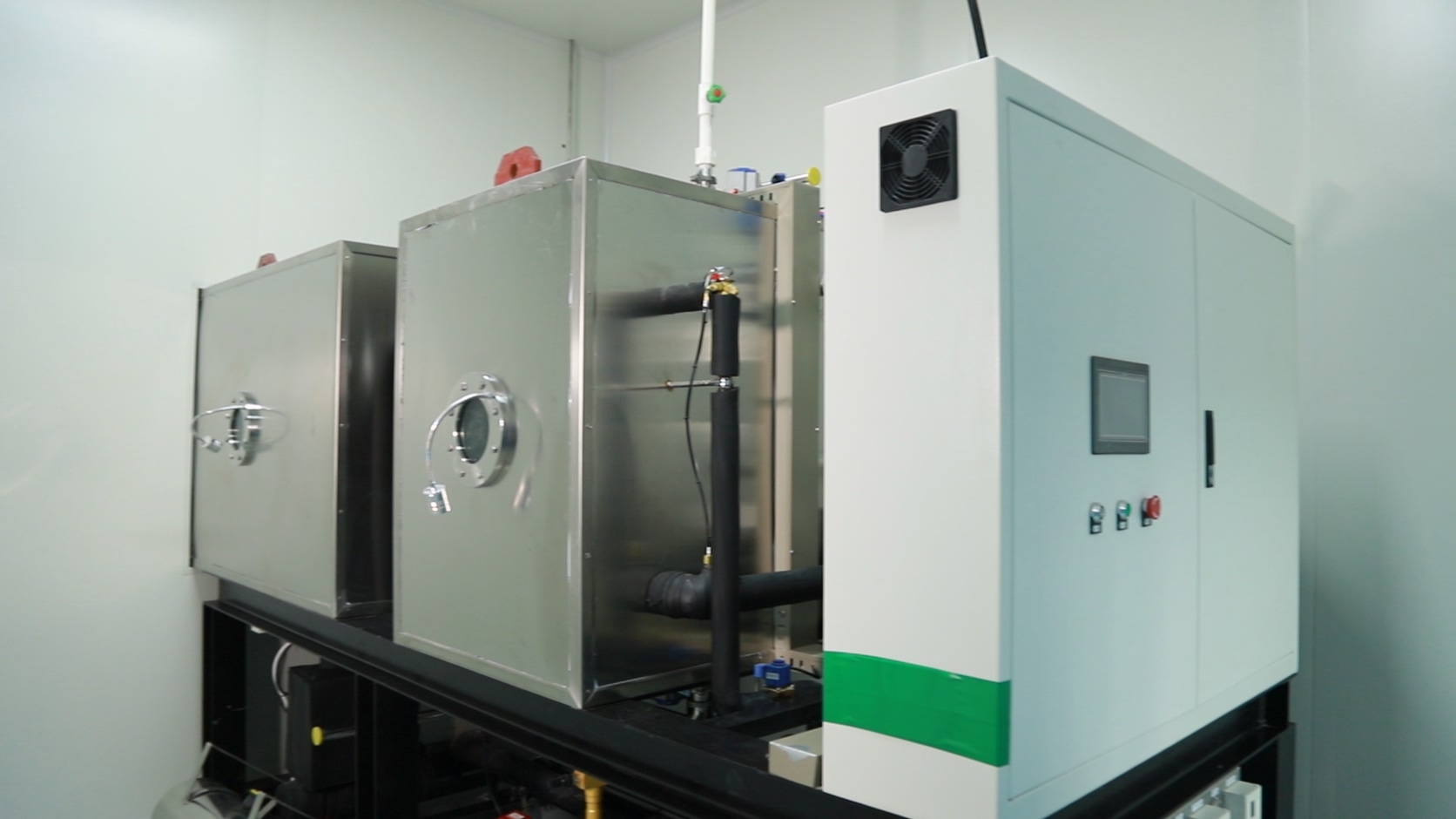 Bulk matcha production capacity and documentation are evaluated together during supplier qualification.
Why Certification Coverage Became the First Filter
Two of the largest destination markets tightened documentation expectations in 2026. The European Union applies stricter maximum residue limits for clothianidin and thiamethoxam at 0.01 mg/kg, effective March 2026, under Regulation (EC) No 396/2005. In the United States, the FDA requires Food Facility Registration and Foreign Supplier Verification Program (FSVP) documentation for imported matcha powder. Both requirements sit upstream of product evaluation: a supplier that cannot produce the documentation cannot complete the transaction, whatever the quality of the powder.
Demand-side data points in the same direction. Organic certified matcha accounted for approximately 41% of total global market demand in 2025, and organic matcha is the fastest-growing segment with an expected CAGR of 12.68% through 2033, according to SNS Insider. Certification is therefore not a secondary attribute in a bulk matcha enquiry. It is usually the first attribute that determines which suppliers remain in the process at all.
The consequence for buyers is a change in the order of evaluation. Certificates are reviewed before samples, because a sample that cannot be supported by documentation is not a usable sample. For suppliers, the same shift means that certification coverage functions as supply infrastructure rather than as a marketing line.
How This Shortlist Was Built
The five codes below were selected using three rule-based criteria, applied to the published certification and product data. No sensory ranking, price claim or popularity claim was used.
- Applicable-product listing. The code must appear in the applicable-product list of the manufacturer's certificate set, covering EU Organic, ISO 22000, GMP, HACCP, Kosher and HALAL documentation.
- Defined application fit. The grade and particle fineness must map to a defined commercial application, such as beverage formulation, bakery and food manufacturing, functional blends, or premium retail.
- Destination-market relevance. The certificate must carry a market field that matches a major buying region, or a global market field, so that it can be used in a real import decision.
The result is a shortlist that covers the full commercial range of the KM family, from functional grade through ultra ceremonial grade, rather than a shortlist that ranks codes against each other.
The Five Shortlisted Codes
Each of the five codes is made from 100% Matcha Green Tea Powder and is differentiated by grade, particle fineness and intended application.
| Product code | Grade | Particle fineness | Primary application fit |
|---|---|---|---|
| KM1 | Functional Grade | 800–1000 mesh | Supplements, functional food blends, powdered formulations |
| KM4 | Culinary Plus | 800–1200 mesh | Chocolate, beverages, desserts, premium food products |
| KM5 | Beverage Grade | 1000–1200 mesh | Milk tea, matcha latte, café drinks, beverage formulations |
| KM7 | Ceremonial Grade | 1300–1800 mesh | Matcha latte, premium cafés, specialty tea beverages, retail matcha |
| KM10 | Ultra Ceremonial Plus | 1500–1800 mesh | Traditional matcha preparation, tea ceremony, luxury matcha brands, high-end retail |
On the certification dimension, all five codes appear in the applicable-product list of every certificate in the published set. In other words, certificate coverage is consistent across the KM1–KM10 range, and it works as a qualification gate rather than as a differentiator between these five codes. The differences that matter for selection are the application tier and the particle fineness range shown above.
Certificate-by-Certificate Coverage Across the KM Range
What varies between certificates is the issuing authority, the market field, the standard referenced and the validity window. These are the fields a buyer should read line by line.
| Certificate | Type | Authority | Certificate number | Market | Referenced standard | Validity |
|---|---|---|---|---|---|---|
| EU Organic | Product Certificate | ECOCERT SAS (CN-BIO-154) | CN-BIO-154-0003930.2025.001 | European Union | Regulation (EU) 2018/848 | Issued 15 Aug 2025, expires 31 Mar 2027 |
| ISO 22000 | Management System Certificate | CQC | 001FSMS2300111 | Global | ISO 22000:2018 Food Safety Management Systems, based on HACCP | 22 Feb 2026 – 21 Feb 2029 |
| GMP | Management System Certificate | Intertek | SZ2511G3 | USA | cGMP based on 21 CFR Part 111 (2020), published by the U.S. Food and Drug Administration | 13 Nov 2025 – 30 Nov 2028 |
| HACCP | Management System Certificate | CQC | 001HACCP2300121 | Global | Hazard Analysis and Critical Control Point System Certification requirements (V1.0) | 22 Feb 2026 – 21 Feb 2029 |
| Kosher | Product Certificate | STAR-K KOSHER CERTIFICATION | WXF44CWI | Global | Star-K Kosher | 15 Apr 2026 – 31 Jan 2027 |
| HALAL | Halal Product Certificate | AHF | HP 6785 CH | Global | AHF 5600:2020; MUI LPPOM HAS 23000; OIC/SMIIC 1:2019; GSO 2055-1:2015; MS 1500:2019 | 11 Apr 2026 – 10 Apr 2029 |
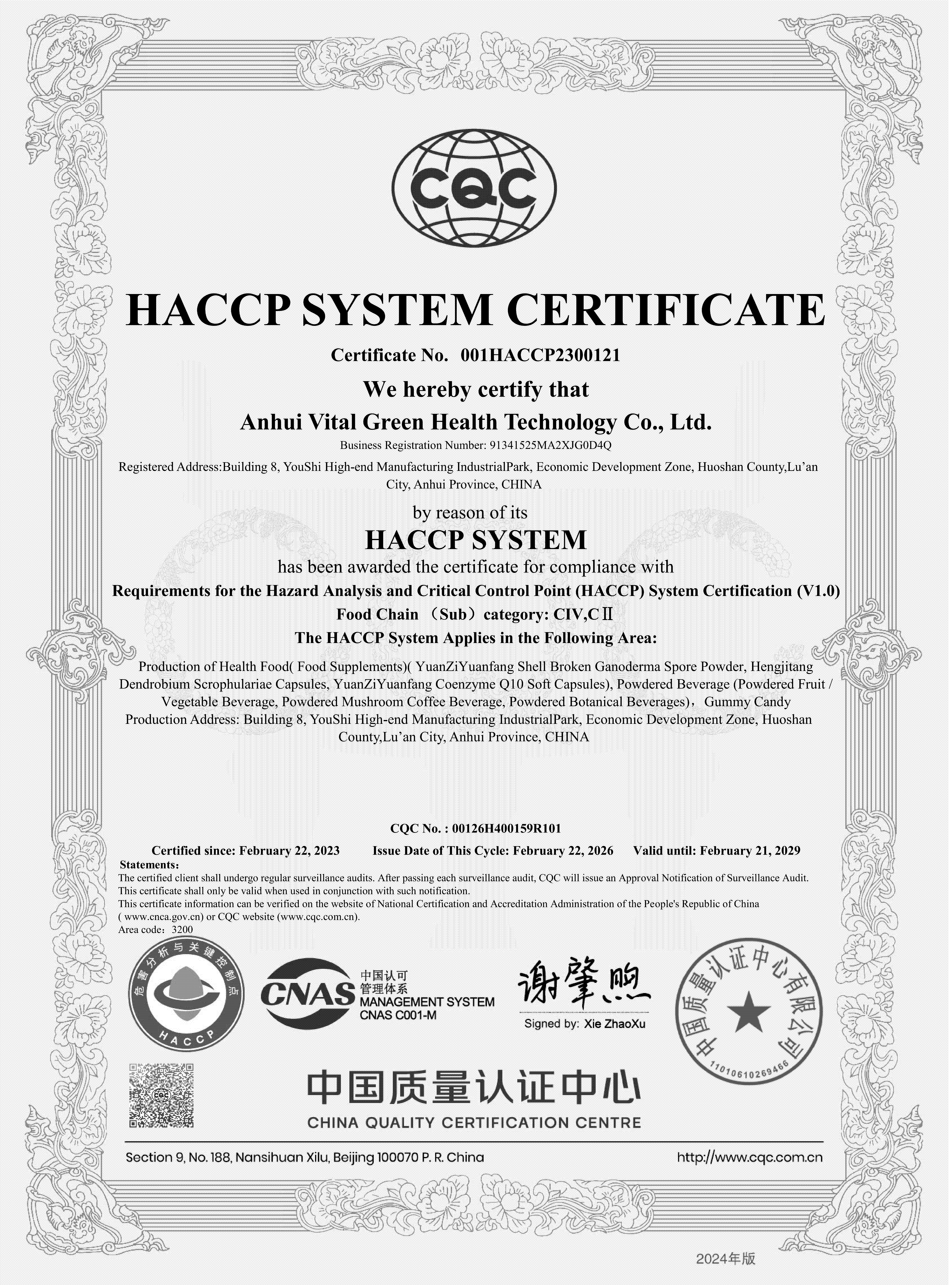 The HACCP certificate is issued by CQC for the global market and lists matcha codes KM1 through KM10 as applicable products.
Three observations follow directly from the table. First, the GMP certificate is the only entry with a single-country market field (USA), which makes it the reference document for U.S.-bound programmes. Second, the EU Organic product certificate is the only entry tied to a specific regional regulation, Regulation (EU) 2018/848. Third, validity windows differ materially: the Kosher certificate runs to 31 January 2027, while the HALAL and ISO 22000 certificates run into 2029. A three-year supply contract that begins in 2027 will cross at least one renewal point.
What the Certificate Record Does Not Establish
Certification data is precise about systems, standards and validity, and silent about several things buyers often assume it covers. The boundaries below are the ones that most often cause friction during execution.
- Scope wording is specific, not general. Each certificate is written around a defined scope. The ISO 22000 certificate, for example, is scoped to the production of health food (food supplements) and powdered beverage. Buyers should confirm that the intended product code and end use fall inside the applicable scope before treating a certificate as transferable to their project.
- A certificate is not a batch release. System and product certificates document capability and conformity at the level of the organisation and the listed product. Batch-based quality control and order-specific documentation remain the mechanism that supports an individual shipment.
- Certification does not by itself resolve residue limits. Pesticide residue and heavy metal testing is conducted according to product specifications and destination-market requirements, with supporting documentation available where applicable. A certificate and a residue test report are different instruments.
- Validity is a moving target. Certificates renew. A buying decision that assumes the current expiry date will still be valid three years later is built on an assumption rather than on documentation.
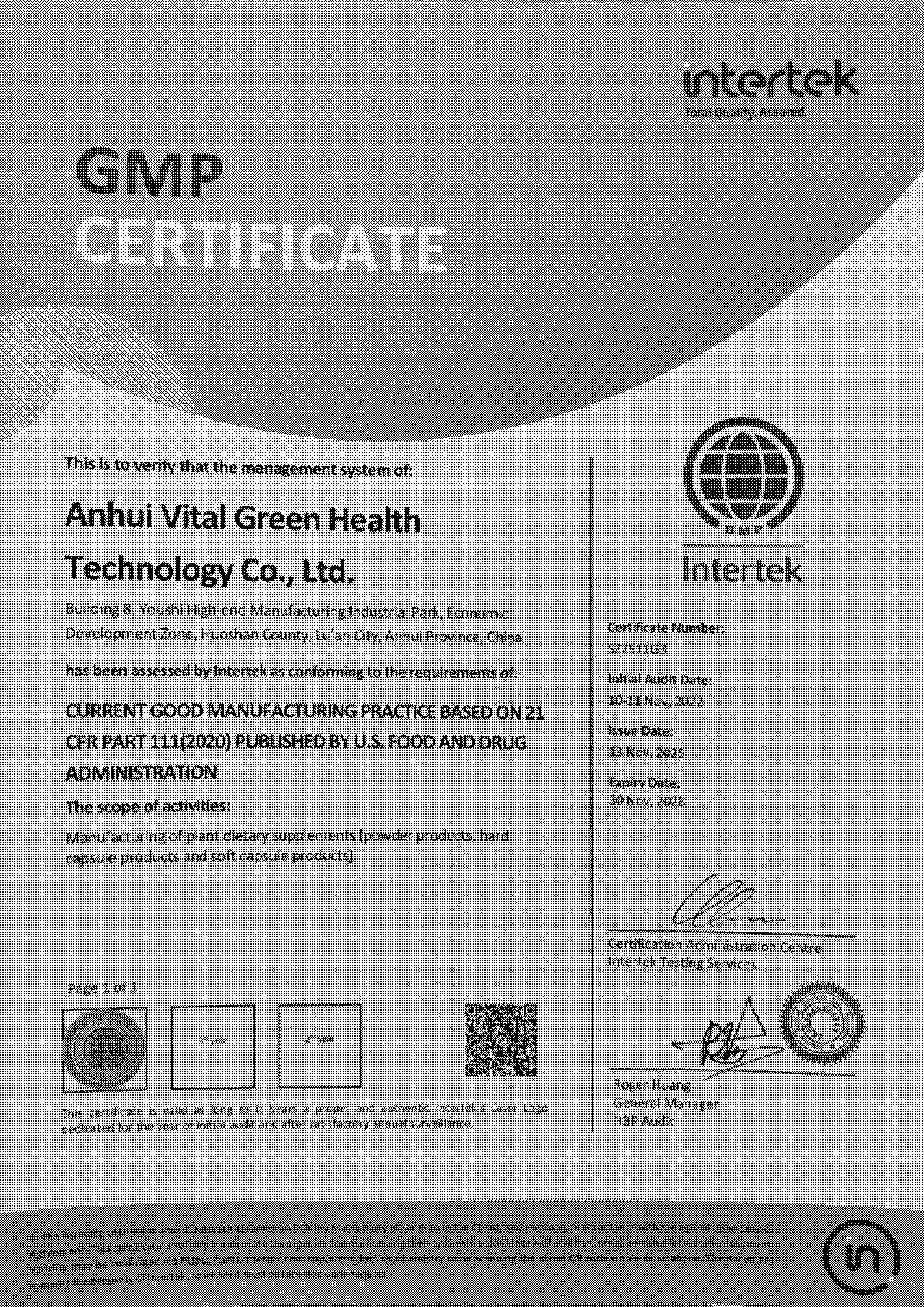 The GMP certificate carries a USA market field and references 21 CFR Part 111, making it the primary compliance document for U.S. import programmes.
Certificate-First Shortlisting Compared With Sample-First Evaluation
The traditional entry point into bulk matcha sourcing is the sample. A buyer requests a sensory sample, evaluates colour, aroma and mouthfeel, and then checks documentation for the shortlisted candidates. The certificate-first approach reverses that sequence.
| Dimension | Sample-first evaluation | Certificate-first shortlisting |
|---|---|---|
| Starting point | Sensory sample request | Documentation review (authority, standard, market, validity) |
| What it filters | Flavour, colour, texture, price perception | Market eligibility, system conformity, applicable-product listing |
| Speed of exclusion | Slower, because results are subjective | Faster, because fields are binary |
| Where it fits | Final selection between qualified options | Qualification gate before any sample is requested |
The limitation is straightforward and worth stating plainly: certificate coverage says nothing about flavour profile, colour intensity, price level or batch-to-batch sensory consistency. A shortlist built purely from certification data narrows the field; it does not choose the product. Sample evaluation and application testing remain necessary before a commercial commitment, and for beverage programmes the sample must be tested in the actual beverage matrix rather than in water alone.
Matching the Five Codes to Buyer Scenarios
Once the certification gate is cleared, the selection question becomes an application question. The five shortlisted codes split cleanly along application lines.
- Supplements and functional nutrition. KM1, at 800–1000 mesh, is specified for supplements, functional food blends and powdered formulations, where cost efficiency, batch consistency and fine particle size typically drive the decision.
- Bakery, confectionery and food manufacturing. KM4, at 800–1200 mesh, is specified for chocolate, beverages, desserts and premium food products, where flavour retention and colour performance in processed formulations matter.
- Cafés, milk tea and beverage production. KM5, at 1000–1200 mesh, is specified for milk tea, matcha latte, café drinks and beverage formulations, where milk compatibility and smooth dispersion are the practical requirements.
- Premium café chains and specialty beverages. KM7, at 1300–1800 mesh, is specified for matcha latte, premium cafés, specialty tea beverages and retail matcha, where a finer texture and a more refined presentation are expected across multiple locations.
- Luxury retail and traditional preparation. KM10, at 1500–1800 mesh, is specified for traditional matcha preparation, tea ceremony, luxury matcha brands and high-end retail, where the finest texture and the highest positioning tier are central to the brand.
Documented case records align with this split. The manufacturer's case material covers a café and beverage brand using a grade selected for milk compatibility, flavour strength and café preparation requirements; a bakery and food manufacturer using application-specific culinary grades selected by processing method rather than a single grade for all products; a private label matcha brand developing branded retail products with packaging and labelling support; and a premium matcha and specialty tea brand comparing ceremonial and ultra-ceremonial options before selecting a final product. Each of these records is described with a 10 t quantity over a three-year duration.
Documented Terms That Sit Alongside Certification
For buyers in the execution stage, certification coverage is only useful if it can be translated into an order. The published commercial terms that accompany the certificate set are as follows.
- Minimum order quantity. From 10 kg, with larger documented tiers for higher-volume programmes.
- Lead time. Typically 15–21 days.
- Monthly capacity. 10 metric tons.
- Production mode. OEM, ODM and fully customizable production, including matcha grade, formulation, flavour profile, product positioning, packaging format, labelling and branding.
- Packaging formats. Pouch, tin, jar and sachet options, with brand logo, package size, label and retail positioning support.
- Delivery terms. EXW, FOB, CIF, DDP and other agreed Incoterms.
- Payment terms. 30/70.
- Export markets. North America, Europe and other global markets, with export documentation, shipping coordination and destination-specific order coordination.
Market Trend Analysis
Three trends explain why certification-led shortlisting is spreading rather than receding.
- Market growth. The global matcha market was valued at USD 5.1 billion in 2025 and is projected to reach USD 8.9 billion by 2033, according to Grand View Research.
- Culinary dominance. Culinary grade matcha accounted for 56.4% of global market share in 2026, driven by demand in industrial food and beverage manufacturing, according to Market Data Forecast. Matcha powder featured in 68% of new green tea product launches in 2024, using culinary grade, according to the International Food Information Council.
- Organic premium. Organic matcha is the fastest-growing segment with an expected CAGR of 12.68% through 2033 against a base of approximately 41% of 2025 global demand, based on SNS Insider and Matcha Tea Powder Market Industry Analysis figures.
Buyers should also apply a caution rule to headline numbers. Published market size estimates for matcha range from roughly USD 2.2 billion to USD 5.1 billion depending on whether bulk ingredients or finished retail products are counted, and China's share of global production is reported at 70% by some sources and closer to 33% by others. A single figure is not a settled fact. For procurement purposes, direction and regulation matter more than a specific valuation, because the MRL and FSVP requirements described earlier apply regardless of which market size estimate is used.
Future Outlook
The shortlist model used here is likely to become standard practice rather than an exception. As destination-market rules tighten, documentation becomes part of the supply contract rather than a pre-contract formality, and buyers increasingly expect a certificate package to be assembled per market rather than presented as a single generic folder. That means the market field, the referenced standard and the validity date carry as much commercial weight as the certificate name.
The second shift is lifecycle management. Certificates expire on different dates, and multi-year supply agreements will need renewal calendars built into the contract, in the same way that delivery schedules are. The third shift is scope literacy: buyers who read the scope wording will be able to distinguish between a certificate that covers their specific product and application and one that merely carries a familiar name.
For the KM1–KM10 range, coverage is already documented across EU Organic, ISO 22000, GMP, HACCP, Kosher and HALAL certificates. The next differentiation between suppliers is unlikely to be the number of certificates held, but the precision with which each certificate is matched to a product code, a destination market and an end use.
FAQ
Which product codes are listed on the HALAL certificate?
The HALAL product certificate HP 6785 CH, issued by AHF for the global market, lists matcha product codes KM1 through KM10 as applicable products. It references AHF 5600:2020, MUI LPPOM HAS 23000, OIC/SMIIC 1:2019, GSO 2055-1:2015 and MS 1500:2019, and is valid from 11 April 2026 to 10 April 2029.
Which codes are covered by GMP for the United States market?
The GMP management system certificate SZ2511G3, issued by Intertek with a USA market field, lists matcha codes KM1 through KM10 as applicable products. The referenced standard is current Good Manufacturing Practice based on 21 CFR Part 111 (2020), published by the U.S. Food and Drug Administration. The certificate is valid from 13 November 2025 to 30 November 2028.
Which codes does the HACCP certificate cover?
The HACCP management system certificate 001HACCP2300121, issued by CQC for the global market, lists KM1 through KM10 as applicable products and is valid from 22 February 2026 to 21 February 2029. The same product range is listed on the ISO 22000:2018 certificate 001FSMS2300111, also issued by CQC, which is based on HACCP principles and carries the same validity dates.
Is organic matcha available, and under which standard?
An EU Organic product certificate is held under number CN-BIO-154-0003930.2025.001, issued by ECOCERT SAS (CN-BIO-154) for the European Union market, referencing Regulation (EU) 2018/848, with validity from 15 August 2025 to 31 March 2027. Organic matcha options and market-specific compliance documentation are available according to product and destination market, and the applicable product listing covers KM1 through KM10.
What are the documented order terms for these codes?
Documented terms include a minimum order quantity starting at 10 kg, a typical production lead time of 15–21 days, and a monthly production capacity of 10 metric tons. Delivery terms include EXW, FOB, CIF and DDP or other agreed Incoterms, and payment terms are stated as 30/70. OEM, ODM and customizable production are available, covering grade, formulation, flavour profile, packaging format, labelling and branding.
How should a buyer verify certification coverage for a specific order?
Verification involves four checks: confirming that the specific product code appears in the applicable-product list; confirming that the certificate's market field matches the destination market; confirming that the referenced standard satisfies local import requirements; and confirming that the validity dates cover the intended shipment window. The scope wording should then be read against the intended product and end use, because certificates are issued around defined scopes. Batch-level quality control and order-specific documentation are handled separately from the certificate itself.